The short answer
Great Pyrenees are livestock guardian dogs (LGDs), a working category distinct from herding dogs and personal-protection dogs. The breed was developed over 3,000 years in the Pyrenees mountains between France and Spain to guard sheep and goat flocks from wolves and bears, autonomously, through the night. That temperament shapes every behaviour the modern pet Pyrenees shows: night barking (the working role), roaming (territory patrol), independent thinking (autonomous decision-making), and stranger suspicion. The Calgary fit is acreage and rural-fringe Foothills, not apartment or tight infill suburb. Night barking is the breed, not a problem to solve.
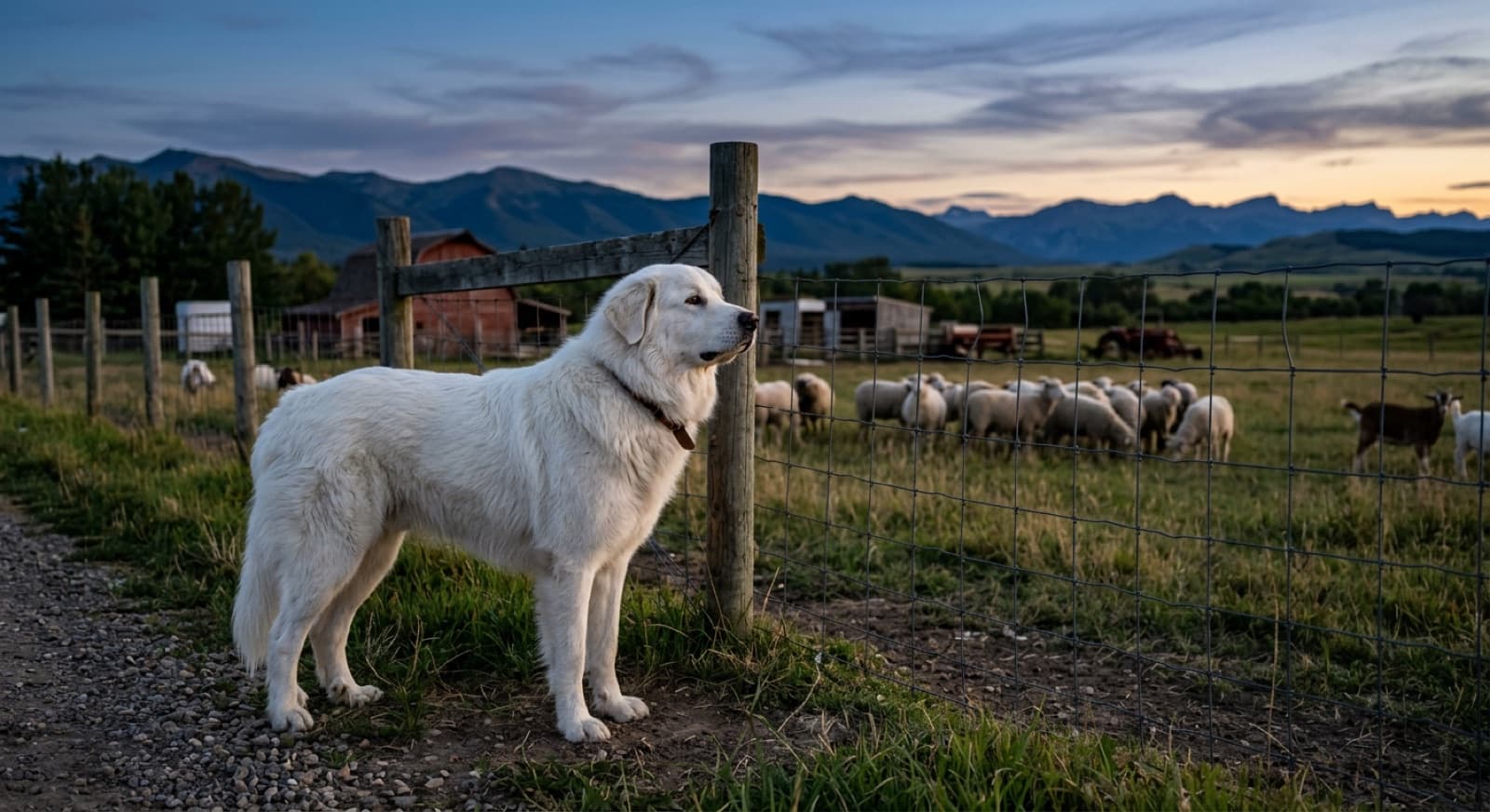
What a livestock guardian dog actually is
Livestock guardian dogs are a distinct working category. They are not herding dogs (which move livestock), and they are not personal-protection or guard dogs (which protect property and people). LGDs live with the livestock, bond to the flock as their family, and protect that flock autonomously, often through the night, often without any direct human supervision. Their job is to evaluate threats and decide what to do about them by themselves.
The category includes the Great Pyrenees (the most common LGD in North America), the Anatolian Shepherd, the Maremma Sheepdog, the Kuvasz, the Komondor, the Pyrenean Mastiff, the Akbash, the Caucasian Shepherd, and several regional breeds. All share a core temperament profile: calm and patient with their flock, alert and suspicious of strangers, vocal at perceived threat, willing to roam to patrol territory, and capable of independent decision-making without a handler's direction. The Livestock Guardian Dog Association publishes working-standards material across the category.
The LGD working role is older than most modern breeds. Pyrenees-type dogs were guarding flocks in the mountains between France and Spain for thousands of years before the breed was formally standardised. The temperament traits were selected by working shepherds, not show breeders, and they have been remarkably stable across the breed's history because the working role rewarded those exact traits for that long.
The relevance for a Calgary adopter is simple. When you bring a Pyrenees home, you are bringing a working dog with a temperament shaped by thousands of years of selection for night patrol, autonomous decisions, and vocal threat deterrence. The temperament does not switch off because there are no sheep in the yard.
The Pyrenees working life in historical context
The Great Pyrenees (called the Pyrenean Mountain Dog in Europe) was developed in the Pyrenees mountain range that forms the border between France and Spain. The working role was guarding sheep and goat flocks from wolves and bears in remote, rugged terrain.
Several features of the historical working life are worth understanding because they explain modern temperament.
The dog lived with the livestock. Pyrenees puppies were placed with sheep or goats from a young age and bonded to the flock as their family. The dog slept with the livestock, ate near them, and treated the flock as the unit to defend. The shepherd was a familiar figure but not the primary social bond. This is the source of the breed's deep loyalty to its bonded family unit in modern pet homes.
The dog worked at night without supervision. Predators (wolves, bears, lynx) approached at night. The shepherd slept; the Pyrenees patrolled. The dog evaluated sounds, smells, and movement, and responded with a deep alert bark to warn the flock and signal the predator to leave. If the warning was not enough, the dog engaged. This required full autonomous judgment. The modern breed inherits the night-patrol instinct and the alert-bark response.
The dog roamed a wide territory. A working Pyrenees did not stay in a small enclosed pen. The dog patrolled the perimeter of the grazing area, often a substantial distance, and pushed against the territory edge. Recall was not part of the job. The dog returned when the patrol was finished, not because the shepherd called. The modern breed inherits the roaming drive.
The dog evaluated strangers carefully. A wandering person near the flock might be a fellow shepherd, might be a thief, might be a curious traveller. The Pyrenees was bred to alert, hold position between the flock and the stranger, and let the situation develop before deciding. Slow warming to strangers is breed-typical.
Reading the breed temperament without this historical context is the most common Calgary adopter mistake. Every behaviour that surprises an unprepared adopter (the 2 AM bark at a distant siren, the refusal to come when called in an open field, the deep stare at a delivery person at the door) is the breed doing its 3,000-year-old job.
How LGD temperament shapes Pyrenees behaviour in a Calgary home
The working traits do not stay in the mountains. They surface in every pet Pyrenees household, and they shape what daily life with the breed actually looks like.
Night barking. A Pyrenees patrols. At night, that means standing alert at the window or in the yard, listening, scanning, and barking at anything that registers as a possible threat. Coyotes howling near Fish Creek Park. A neighbour's late-night door slam. Distant sirens. Wildlife moving along the river path. The breed's alert bark is deep, loud, and carries. Calgary urban neighbours hear it. This is the most common surrender reason for adolescent Pyrenees in the city. Mitigation includes bringing the dog indoors at night (which reduces but does not eliminate barking), reducing visible and audible triggers, and scheduling structured daytime exercise. The honest answer is that night barking is the breed, and the lifestyle fit needs to absorb it.
Roaming. Territory patrol is hardwired. A Pyrenees in a Calgary yard pushes against the fence, tests gates, digs at the perimeter, and leaves if there is any weakness in containment. A 6-foot fence with the bottom buried or anchored is the practical Calgary standard. Invisible fences (buried wire correction-collar systems) do not work; the breed accepts the correction to follow the patrol instinct. Off-leash recall in unfenced spaces is rarely reliable for the same reason: the dog's patrol drive overrides the call to return.
Independent thinking. Working LGDs evaluate commands. The Pyrenees does not refuse out of stubbornness so much as out of judgment: the dog considers whether the command makes sense in the moment and acts accordingly. This is not a training failure. It is the temperament that made the breed valuable to shepherds for thousands of years. Force-free training installs basic obedience and good house manners (Raising Canine and Pup City Pup Academy run group classes in Calgary that work for the breed), but the trainer who expects retriever-style recall and snappy sit-stay performance is reading the breed wrong.
Suspicion of strangers. Slow warming is standard. A Pyrenees at the door barks deep alerts, holds position between the stranger and the family, and watches. Most Pyrenees warm to family friends over a few visits. Visitors who behave calmly and let the dog observe are accepted. Visitors who rush, lean over the dog, or approach quickly trigger the breed's protective alert response. This is not aggression; it is the working temperament. Children visiting an unfamiliar Pyrenees home should always be supervised.
Pack and family bond. Once trust is earned, Pyrenees are deeply bonded to their family unit. They follow family members around the house, position themselves where they can see everyone, and treat the household as the flock to protect. This is one of the breed's most appealing traits and is part of why owners who match the breed lifestyle love the dog so deeply.
Calm patience with children. Working LGDs are calm with their bonded flock. That same temperament translates beautifully to gentle behaviour with family children. Pyrenees position quietly near kids, absorb interaction without becoming overstimulated, and tolerate the chaos of family life. The size caveat applies: an adult Pyrenees at 120 lbs can knock a toddler over without intending harm, so supervision around small children is sensible.
Same-sex dynamics. Some Pyrenees lines show same-sex selectivity with other dogs, particularly female-female. This is breed-typical for several LGDs and matters for multi-dog Calgary households. Foster-based rescues like AARCS evaluate dog-dog dynamics during the foster period and give honest feedback before placement.
The Alberta livestock guardian context
Pyrenees and Pyrenees mixes are common across rural Alberta because the breed has a real working purpose in the province's agricultural community. Hobby farms in the Foothills, working sheep and goat operations, alpaca farms, and free-range poultry operations all use LGDs as predator deterrents against coyotes, wolves, bears, cougars, and lynx. Alberta Lamb Producers and other livestock organisations publish guidance recognising LGDs as a working component of predator management. Alberta Lamb Producers has worked with provincial researchers on LGD effectiveness for sheep operations.
Calgary's rural fringe (Bragg Creek, Springbank, Bearspaw, Cochrane outskirts, the Foothills Municipal District, and properties west and north of the city) hosts a substantial population of working Pyrenees on hobby farms and acreage homesteads. Coyote pressure is real in these areas; chicken coops, sheep paddocks, and goat barns benefit from the breed's night patrol.
This context matters for two reasons. First, Calgary rescue intake of Pyrenees is partly driven by acreage households whose situation changed (retirement, downsizing, livestock sold) and the dog needs a new working or pet home. Second, the Foothills acreage lifestyle is the closest match to the breed's natural fit, and adopters in that area generally find Pyrenees an easier breed to live with than urban Calgary households do.
Working versus pet placement also matters at adoption. AARCS and Calgary Humane Society foster networks generally evaluate whether an incoming Pyrenees has a working background (livestock-bonded, comfortable outdoors year-round) or a pet background (house-living, family-bonded), and place accordingly. A working-line Pyrenees with no livestock experience in an apartment is the worst-case mismatch; a pet-line Pyrenees on a hobby farm is the easiest fit.
Working Pyrenees versus pet Pyrenees in the modern breed
The modern Great Pyrenees lives in three broad household types in Alberta. The temperament expression differs across them, but the underlying breed traits do not.
Working Pyrenees with livestock. The dog lives outdoors with sheep, goats, poultry, or other livestock. Working role is fully expressed: bonded to the flock, patrols territory, barks at night, refuses to leave the flock area, slow warming to strangers approaching the property. The dog is deeply satisfied and the temperament is doing its job. The Alberta agricultural community values these dogs as a meaningful predator-management tool.
Pet Pyrenees in a rural or acreage home. The dog lives with the family (often house-living with yard access), no livestock on the property, but the rural setting absorbs the breed's working traits naturally. Night barking lands without complaint because neighbours are distant. Roaming is contained by acreage fencing or extensive property. Stranger suspicion is appropriate to the rural setting where unannounced visitors are unusual. This is one of the most common Calgary-area Pyrenees lifestyles and a generally happy fit.
Pet Pyrenees in an urban or suburban home. The dog lives indoors with a family in a Calgary detached home, townhouse, or rare apartment. The working traits still surface, but now they collide with urban realities: close neighbours hear the night barking, smaller yards do not satisfy the patrol drive, frequent visitors trigger stranger suspicion, and bylaw complaint risk is real. This is where most Calgary rescue surrenders come from. The breed is not failing; the lifestyle match is.
Calgary adopters considering the breed should be honest about which household type they actually offer. A detached home in a quiet older neighbourhood with tolerant neighbours and an active outdoor lifestyle can work. An apartment, a townhouse with shared walls, or a tight infill suburb usually cannot.
The four make-or-break LGD traits Calgary adopters refuse to believe (until they see)
Every Calgary surrender of a young adult Pyrenees lines up against one of these four traits. The adopter knew the trait existed and assumed their dog would be the exception. Most dogs are not the exception. Plan for the trait; treat any individual variation as a bonus.
1. Night barking IS the breed. Not anxiety. Not boredom. Not separation distress. Not a training gap. The Pyrenees was bred to bark at night for thousands of years, and the instinct is intact in the modern pet dog. You can reduce frequency by managing triggers and bringing the dog indoors at night, but you cannot remove the behaviour. Adopters who plan for it adapt. Adopters who fight it usually surrender within 6 to 18 months.
2. Recall WILL fail off-leash in open Calgary spaces. The combination of independent decision-making and territory-patrol drive means that an off-leash Pyrenees in an unfenced area will pursue a perceived task (a smell, a sound, a sighted animal, a wandering edge of territory) and not return when called. Long lines of 10 to 15 metres in safely contained spaces are the practical Calgary compromise. Off-leash freedom at Nose Hill, Tom Campbell's Hill, or any unfenced river path is not a realistic goal for the breed.
3. Adolescence (12 to 24 months) IS when guarding fully comes online. A floppy friendly Pyrenees puppy at 8 months is not the same dog at 18 months. The working temperament matures during adolescence, and the alert barking, territory patrolling, and stranger suspicion all intensify. Many Calgary surrenders happen exactly here. Adopters who understand the developmental timeline ride through it. Adopters who do not understand it interpret the change as a behaviour problem and give up.
4. Stranger suspicion IS appropriate guardian behaviour. A Pyrenees who alert-barks at the front door, holds position between visitors and the family, and warms slowly to new people is doing the job. This is not aggression. It is not a confidence problem. It is not a socialisation gap (though early calm exposure helps moderate intensity). The breed is reading the situation and responding the way it was bred to. The handling approach is calm consistent introductions and acceptance that visitors take a few meetings before the dog relaxes.
Browse adoptable Great Pyrenees in Calgary
Once the LGD temperament is the planning framework, the rescue conversation gets clearer. Foster networks evaluate the individual dog's working background, drive level, and family fit before placement, which beats the breed label for predicting the real lifestyle match.
See Available Pyrenees →Training the Pyrenees: what works and what does not
Force-free training installs basic obedience and house manners. It will not override the LGD instincts. Setting realistic expectations matters more than choosing a clever training method.
Calgary force-free trainers experienced with guardian breeds (Raising Canine and Pup City Pup Academy run continuous group classes that suit Pyrenees adolescents) work well for the breed because their methods rely on high-value rewards and patient repetition rather than dominance or correction-based handling. Aversive methods (prong collars, e-collars, leash corrections) damage the bond with independent-minded breeds and tend to escalate the underlying behaviours rather than resolve them. The American Veterinary Society of Animal Behavior position statement on punishment-based training applies in full to guardian breeds.
Realistic training goals for a pet Pyrenees in Calgary:
- Polite leash walking. Achievable with consistent positive-reinforcement work. The dog will not be a snappy heeler, but a relaxed loose-leash walk on a wide flat collar or front-clip harness is realistic.
- Settle on a mat. Pyrenees take to mat work well because the calm baseline supports settling indoors. A reliable settle is one of the most useful behaviours to install for visitor management.
- Basic come-when-called in fenced safe zones. The dog will come for high-value rewards in a fenced yard. The same recall in an open space with a moving stimulus will fail.
- Visitor management. A consistent visitor-entry routine (calm visitor enters, dog goes to mat, treats reinforce settle) makes everyday life easier and reduces the intensity of the alert response over time.
- Crate or quiet-space comfort. A Pyrenees who has a comfortable indoor settle zone (a crate, a mat, a corner of the living room) is easier to live with than one expected to be constantly engaged.
Unrealistic goals for the breed:
- Off-leash freedom in unfenced spaces. Long lines are the safe alternative.
- Quiet at night. Mitigation is possible; elimination is not.
- Eager-to-please obedience. Pyrenees comply when the command makes sense to the dog.
- Fast warming to strangers. Slow consistent introductions work over weeks and months, not minutes.
Adopters who set the right expectations are happy with the training outcomes. Adopters who expect retriever-style obedience are disappointed.
Calgary lifestyle compatibility framework
The Pyrenees fit question is geographic and lifestyle-shaped more than it is about square footage. Use this framework honestly before adopting.
Strong fits
- Foothills acreage: Bragg Creek, Springbank, Bearspaw, Cochrane outskirts, Priddis, Millarville, the wider Foothills Municipal District. Distance from neighbours, space to patrol, rural night soundscape, often livestock already on the property.
- Rural Alberta hobby farms: the breed's native fit, with sheep, goats, poultry, or other small livestock to bond with and protect. Working role fully expressed.
- Quiet detached Calgary homes with 6-foot fenced yards and tolerant neighbours: older single-family neighbourhoods with larger lots, side and back yard space, and neighbours willing to absorb occasional barking. This is a workable urban fit if the household commits to indoor-at-night management.
Poor fits
- Calgary apartments and condos: shared walls and ceilings carry the night barking. Bylaw barking complaints reach the landlord. Hallway and elevator stranger encounters trigger the alert response. Almost never a workable fit.
- Townhouses with shared walls: same fundamental problem at smaller scale. Most Calgary townhouse households cannot absorb a Pyrenees.
- Tight infill suburban neighbourhoods: 4-foot fences too close to neighbouring bedrooms, strict bylaw barking enforcement, multiple complaint pathways. High surrender risk.
- Off-leash recall-dependent lifestyles: households whose primary daily exercise is unfenced trail running with the dog off-leash. The breed will not deliver reliable recall in this setting. Long lines are the alternative but they change the lifestyle.
- Households with very frequent unfamiliar visitors: short-term rental properties, in-home daycares, frequent contractor traffic, or any setting where the dog cannot establish a stable visitor pattern. The constant stranger arrivals exhaust the breed's slow-warming protocol.
The “but my Pyrenees is different” trap
Every Pyrenees adopter believes their dog will be the exception. Most are not.
The trap usually shows up in one of two ways. The first is during the puppy phase, when a friendly social Pyrenees puppy at 6 months reassures the adopter that the breed temperament concerns are overblown. The adopter relaxes the planning around fencing, night management, and neighbour relations. Then at 14 months adolescence hits and the working traits come online, and the household is caught flat-footed.
The second is during the early adult phase, when an individual Pyrenees has a milder version of one trait (less barking, less roaming, faster stranger warming) and the adopter generalises that to assume the whole working temperament is mild. Then the missing traits surface in a different context (new neighbours move in, a renovation brings strange tradespeople, a change in night sounds) and the dog responds with full breed temperament.
The practical planning rule for Calgary Pyrenees adopters: plan for the full breed temperament expression, treat any individual variation as a bonus, and never relax the fencing, night management, or stranger-introduction protocols just because the dog seems quiet. The working instincts are present even when not visibly expressed in the moment.
Foster-based rescues like AARCS evaluate the individual dog during the foster period and give honest assessments before adoption. That information is more useful than the breed label for predicting the day-to-day reality, but even foster-evaluated Pyrenees can have working traits that surface later as the dog matures.
Frequently Asked Questions
Can Great Pyrenees night barking be trained out?
No, and any trainer who promises otherwise has not worked with the breed. Night barking is the documented working role of a livestock guardian dog. Pyrenees were bred for at least 3,000 years to patrol and bark through the night to deter wolves and bears from sheep and goat flocks. The instinct stays even in a Calgary pet Pyrenees with no livestock to guard. It can be mitigated (bring the dog indoors at night, reduce environmental triggers, structured daytime exercise) but it cannot be trained out. The honest answer for any urban or suburban Calgary household is to plan for the breed temperament and pick a different breed if neighbour barking complaints would be a problem. This is the single most common surrender reason for adolescent Pyrenees in Calgary rescue.
Is recall achievable with a Great Pyrenees?
Limited and conditional. Pyrenees were bred to make autonomous decisions without shepherd supervision; the breed evaluates whether a command makes sense before responding. Combined with the roaming instinct (the working dog patrols a wide territory and does not return on call), the result is that off-leash recall in open Calgary spaces is rarely reliable. Force-free trainers like Raising Canine and Pup City Pup Academy can install basic come-when-called in a fenced safe zone with high-value rewards. Off-leash recall in Nose Hill, Tom Campbell's Hill, or any unfenced trail is not a realistic goal for the breed. Long lines of 10 to 15 metres in safely contained spaces are the practical Calgary compromise.
Are Great Pyrenees a fit for apartments or condos in Calgary?
No, with rare exceptions. The breed is large (85 to 160 lbs adult), needs space, and the night barking carries through shared walls and ceilings. Calgary apartment and condo households with tight bylaw enforcement and close neighbours will hit barking complaints within weeks. The breed also benefits from yard access for territory patrol behaviour; an apartment Pyrenees has no outlet for that instinct. The rare exceptions are ground-floor end units with thick walls, tolerant neighbours, and an owner committed to indoor-at-night management. For most Calgary urban adopters considering the breed, the honest answer is that an acreage or detached-home rural-fringe lifestyle is the right fit, and an apartment is not.
What other livestock guardian breeds end up in Calgary rescue?
Several. The Great Pyrenees is the most common LGD in Alberta, but Calgary rescue intake also sees Anatolian Shepherds, Maremma Sheepdogs, Kuvasz, and occasional Komondor, Pyrenean Mastiff, and Akbash dogs. Crosses between any of these breeds and the Pyrenees (or with other large working breeds) are common in foster networks like AARCS and BARCS. The LGD temperament traits (night barking, roaming, independent thinking, stranger suspicion, calm baseline, late maturity) are shared across the working category. An adopter who has done the lifestyle work for a Pyrenees has done most of the work for any LGD; the breed-specific differences are size, coat, and the degree to which each trait dominates.
Is there a difference between a working Pyrenees on livestock and a pet Pyrenees?
Yes, in expression rather than in baseline temperament. A working Pyrenees living with sheep, goats, or poultry on an Alberta hobby farm has the LGD instincts directed at its intended job: bonding with livestock, patrolling territory, barking at perceived predator threat at night, refusing recall when on duty. The dog is deeply satisfied. A pet Pyrenees with no livestock has the same instincts but redirects them at family, property, and neighbourhood. Night barking still emerges. Stranger suspicion still emerges. The roaming drive still pushes against the fence. The pet adopter must accept that the LGD temperament will surface even without livestock, and plan housing, fencing, and neighbour relations accordingly.
Are Great Pyrenees good with children?
Generally yes, and often exceptionally so. The working LGD baseline is calm, patient, and protective with its bonded flock, and this translates well to gentle behaviour with children in the family. Pyrenees tend to tolerate the chaos of family life, position themselves quietly near kids, and absorb interaction without becoming overstimulated. Two practical caveats. First, the size: an adult Pyrenees weighing 100 to 140 lbs can knock a small child over without intending harm. Toddler households need supervision around the dog's normal movement. Second, supervision with visiting children: stranger suspicion is part of the breed, and an unsupervised Pyrenees may guard the home territory more assertively when visiting children behave unpredictably. With introductions handled calmly, most Pyrenees adjust to visitors well.
How do you handle Pyrenees stranger suspicion?
Slow, calm, and consistent introductions, not avoidance and not forced exposure. Pyrenees are bred to evaluate whether a stranger represents a threat to their territory or flock, and the dog's first response is often a deep alert bark and a body block between the stranger and the family. This is breed-typical, not aggression. The handling approach is to let visitors enter the home calmly, ignore the dog while the dog settles, offer no high-value attention until the dog has decided the visitor is safe, and never punish the alert bark (it suppresses the warning without changing the underlying assessment). Most Pyrenees warm to family friends over a few visits. Children visiting an unfamiliar Pyrenees home should always be supervised. Force-free trainers experienced with guardian breeds (the network includes Raising Canine and Pup City Pup Academy) can coach the introduction protocol.
When does Pyrenees guarding behaviour start?
Between 12 and 24 months. Pyrenees puppies are floppy, friendly, and apparently happy with everyone. The guarding instinct is not fully online until adolescence, and many Calgary surrenders happen exactly when it switches on. A 14-month-old Pyrenees that was sociable with every visitor at 8 months suddenly starts alert-barking at the door, refusing strangers, patrolling the yard at night, and pushing against the fence to investigate sounds. This is not a behaviour problem and not a training failure. It is the breed maturing into its working temperament. Adopters who understand this in advance can prepare housing, fencing, and neighbour relations for the transition. Adopters who do not understand it often surrender the dog in the second year. The Calgary rescue intake of 1 to 4 year old Pyrenees reflects this pattern.
Where in Calgary are Great Pyrenees actually appropriate?
Acreage and rural-fringe Foothills locations: Bragg Creek, Springbank, Bearspaw, Cochrane outskirts, and the wider Foothills Municipal District. Detached homes with 6-foot fenced yards in quieter Calgary suburbs (especially older single-family neighbourhoods with larger lots and tolerant neighbours) can work. Rural Alberta hobby farms with poultry, sheep, or goats are the breed's native fit. What does not work in Calgary: any apartment or condo, townhouses with shared walls, tight infill housing with close neighbours, and any setting where bylaw barking complaints are a real risk. The Calgary fit question is not about square footage; it is about how the night barking, roaming, and stranger suspicion will land with the surrounding neighbourhood.
Are there protective family breeds that fit Calgary urban life better?
Yes. If the appeal of the Pyrenees is the protective family-guardian profile but the lifestyle does not match acreage living, several breeds carry some of the guardian traits with a more urban-workable temperament. Bullmastiffs (calmer indoor baseline, less night barking, lower roaming drive) suit detached suburban homes well. Standard Schnauzers and Giant Schnauzers offer guardian alertness without LGD intensity. Doberman Pinschers and Rottweilers are working guard breeds rather than livestock guardians and have very different exercise and training needs. The honest first question is whether you actually want a guardian breed or whether you want the calm gentle Pyrenees presentation without the LGD demands. The two things often do not come in the same package.
How big are Calgary fences for containing a Great Pyrenees?
6 feet minimum, with the bottom anchored against digging. Pyrenees patrol their territory and will leave the yard if the fence is climbable, jumpable, or diggable. Many Calgary acreage Pyrenees households add a buried wire base (chicken wire or hardware cloth extending 12 to 18 inches below ground, bent inward toward the yard) to prevent digging out. Climbing escapes are less common than digging, but a determined adolescent Pyrenees can scale a 5-foot chain-link fence; 6 feet is the practical minimum. Invisible fences (buried wire shock collar systems) do not work for the breed because the Pyrenees will accept the correction to chase or roam. Physical containment is the only reliable option.
What is the most common reason Pyrenees end up in Calgary rescue?
Night barking that the household and neighbours cannot tolerate, typically combined with the size shock of a fully grown 120 lb dog. Most Calgary surrender intake is 1 to 4 year old young adult Pyrenees whose adolescent transition into full LGD temperament outpaced the household's ability to absorb it. Secondary surrender reasons include escape and roaming (especially in urban yards), shedding workload (the dense double coat sheds dramatically twice a year), and the calm misread: adopters who took a quiet puppy as evidence of a low-maintenance dog and were unprepared for the working temperament. AARCS, Calgary Humane Society, BARCS, Pawsitive Match, ARF Alberta, and Cochrane Humane all see Pyrenees regularly. The foster network gives honest temperament feedback before adoption.
Adoptable Great Pyrenees in Calgary
Live listings of Great Pyrenees and Pyrenees crosses from the Calgary rescue network, updated regularly.
Great Pyrenees Adoption Calgary
Rescue sources, real adoption costs, surrender patterns, and named-rescue verification for Calgary Pyrenees adopters.
Great Pyrenees Health Issues: Joints, Bloat
Great Pyrenees health issues to plan for: hip dysplasia and slipping kneecaps, bloat, bone cancer and giant-breed growth, plus what to ask your vet after adoption.
Alaskan Malamute Adoption Calgary
Another large working breed common in Calgary rescue with very different exercise and temperament demands from the Pyrenees.
New dog? Start with these care guides
Everything a new adopter needs to set up a safe, happy home.