The honest version
Retired racing greyhounds were never alone. They lived in kennels with 40 to 60 other greyhounds, surrounded by familiar dogs and handlers around the clock. Solo home life is genuinely foreign. The howling, pacing, and destructive behaviour many Calgary adopters see in the first 6 to 12 weeks is not a defect. It is a dog being asked to do something it has never practiced. Most retired racers learn alone-time over a few months of patient gradual training. A smaller group develops true separation anxiety that needs medication and a vet behaviourist. This guide separates the typical adjustment period from true SA, walks through the desensitization plan, covers the second-greyhound question honestly, and gives Calgary-specific costs and referrals.
Why retired racers struggle with alone-time
Alone-time is a learned skill. Retired racers never learned it. The first weeks home are a steep learning curve, not a behaviour problem.
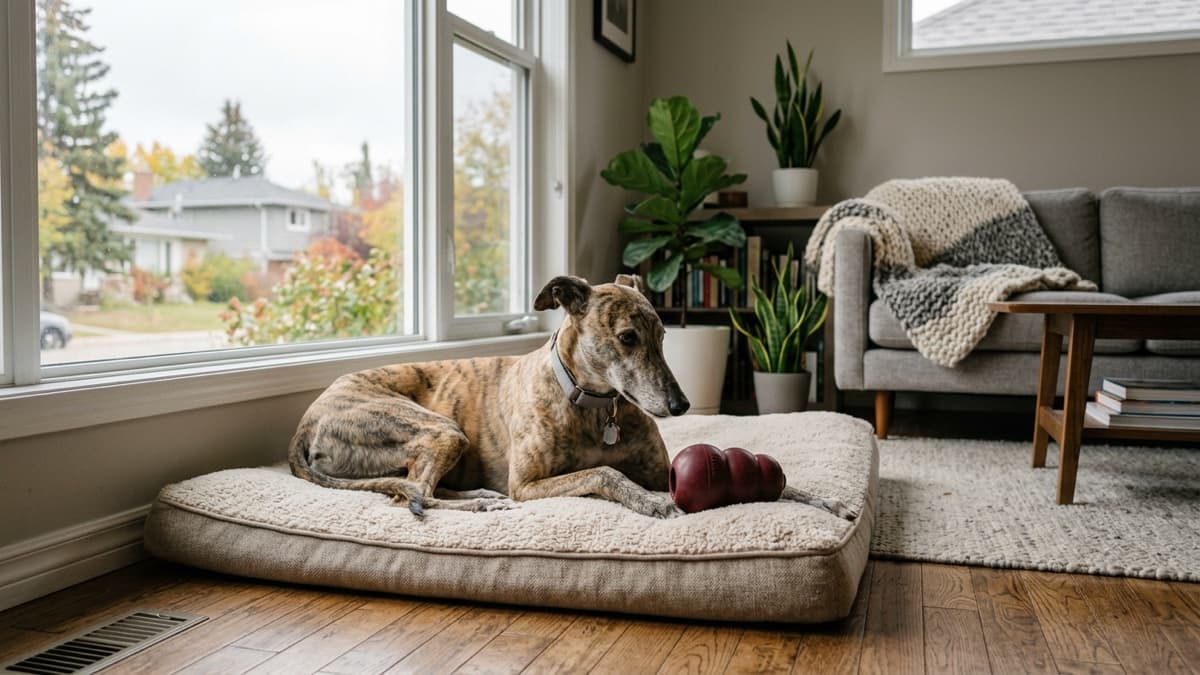
Kennel life is constant company. A racing greyhound lived in a kennel building with 40 to 60 other greyhounds. There were always other dogs sleeping, eating, moving, breathing nearby. Handlers came in and out throughout the day. The dog was never in a silent empty room. Solo life in a quiet Calgary condo at 9am on a Monday is the opposite of every prior experience.
House life is also new. Many retired racers have never seen stairs, glass doors, mirrors, hardwood floors, or rugs. They have never been in a car for a non-track reason. They have never been alone with the TV off. The first weeks home stack many novel experiences on top of the alone-time learning curve.
The bond forms fast and tight. Retired racers often imprint on their new family within days. That intensity feels lovely but can fuel SA. The dog who had 40 packmates yesterday now has one or two people, and losing them feels enormous.
Greyhound rescues already screen for this. NCGL and other greyhound rescues warn every adopter about the alone-time adjustment. Foster reports often include alone-time tolerance data. That intel matters; ask for it before you choose a candidate.
Normal adjustment vs true separation anxiety
Most retired racers go through a noisy adjustment in the first 6 to 12 weeks. A smaller number develop true SA. The two patterns look similar at first but call for different responses.
Normal adjustment (resolves)
- • Follows you to the bathroom and bedroom
- • Whining or single howl when you leave
- • Settles within 5 to 15 minutes of departure
- • Eats food and treats when alone
- • Some pacing on first few departures, then less
- • Mild house-soiling on first 1 to 2 departures
- • Greets you happily on return without panic
- • Improvement visible week over week
True SA (escalate)
- • Drooling visible on chest or floor on your arrival
- • Self-injury: bloody paws, torn nails, broken teeth
- • Urination or defecation despite being housetrained
- • Persistent howling heard by neighbours
- • Destruction focused on doors, window frames, blinds
- • Escape attempts (scratching, chewing through barriers)
- • Refuses food and high-value treats during alone time
- • No improvement after 8 to 12 weeks of consistent work
Set up a phone or camera recording the first 30 minutes after departure. Anxiety produces sustained visible distress; adjustment produces fussing that settles. Calgary force-free trainers can review the footage and tell you which pattern you are seeing.
Step-by-step desensitization plan
Teach alone-time in tiny increments. Move at the dog's pace, not yours. Most retired racers progress through these phases in 6 to 12 months. Some go faster, some slower.
5 to 60 second departures
Start absurdly small. Step out the front door for 5 seconds. Come back calmly. Repeat dozens of times per day. Build up to 60 seconds over 4 weeks. The dog learns that departures are routine and you always return. Pair every absence with a frozen Kong or lick mat. Calm exits. Calm returns.
2 to 15 minute departures
Run to the mailbox. Take a short walk. Sit on the patio with the door closed. Mix routine and non-routine departures so keys, shoes, and coats do not become anxiety cues. Pick up keys without leaving 50 times a day to break the cue. Record on camera. If the dog panics, shorten the next session.
30 minutes to 2 hours
Build to short outings. Coffee run, gym session, grocery trip. Confirm the dog settles within 10 to 15 minutes of departure on camera. If you see escalating signs, pause and repeat phase 2 for several more weeks. Setbacks are normal. Progress is non-linear.
4 to 6 hour tolerance
Reach functional working-day tolerance with daycare or walker support filling the gaps. Many greyhounds reach 4 to 6 hours of comfortable alone time. A few reach a full 8 hour workday. Some top out earlier. Build the schedule around the dog you have, not the dog you wished for.
Never punish distress. Punishment raises cortisol and worsens anxiety. If a session goes badly, the next one shrinks back down. This is not about willpower; it is about teaching a nervous system to feel safe.
Make leaving routines boring
Dramatic goodbyes feel kind, but they signal danger. A tearful five-minute farewell teaches a greyhound that departures are emotionally enormous. The dog rides that emotional spike straight into panic the moment the door closes.
The fix is dull. Drop your goodbyes entirely. Put on your coat in calm silence. Walk past the dog without a glance. Step out the door. On return, ignore the dog for 60 to 90 seconds, even if they are excited. Greet them after they settle.
This feels rude. It works. Departures become a non-event. The nervous system stops bracing for the door.
Pre-departure cue desensitization. Pick up your keys 50 times today without leaving. Put on your shoes and sit back down. Open and close the front door. Each cue, repeated outside of an actual departure, loses its anxiety charge over a few weeks.
Crate vs free-roaming: most greyhounds prefer free
Standard puppy and small-dog advice says crate-train for alone time. Greyhounds are different. They spent years in kennels, and many associate confined spaces with the racing life they just left. Crating a recently adopted retired racer can spike anxiety rather than reduce it.
The common pattern. Greyhound settles on a couch or dog bed in the living room within a week. Same dog panics in a crate even after weeks of conditioning. Many adopters discover this the hard way after buying an expensive XL crate.
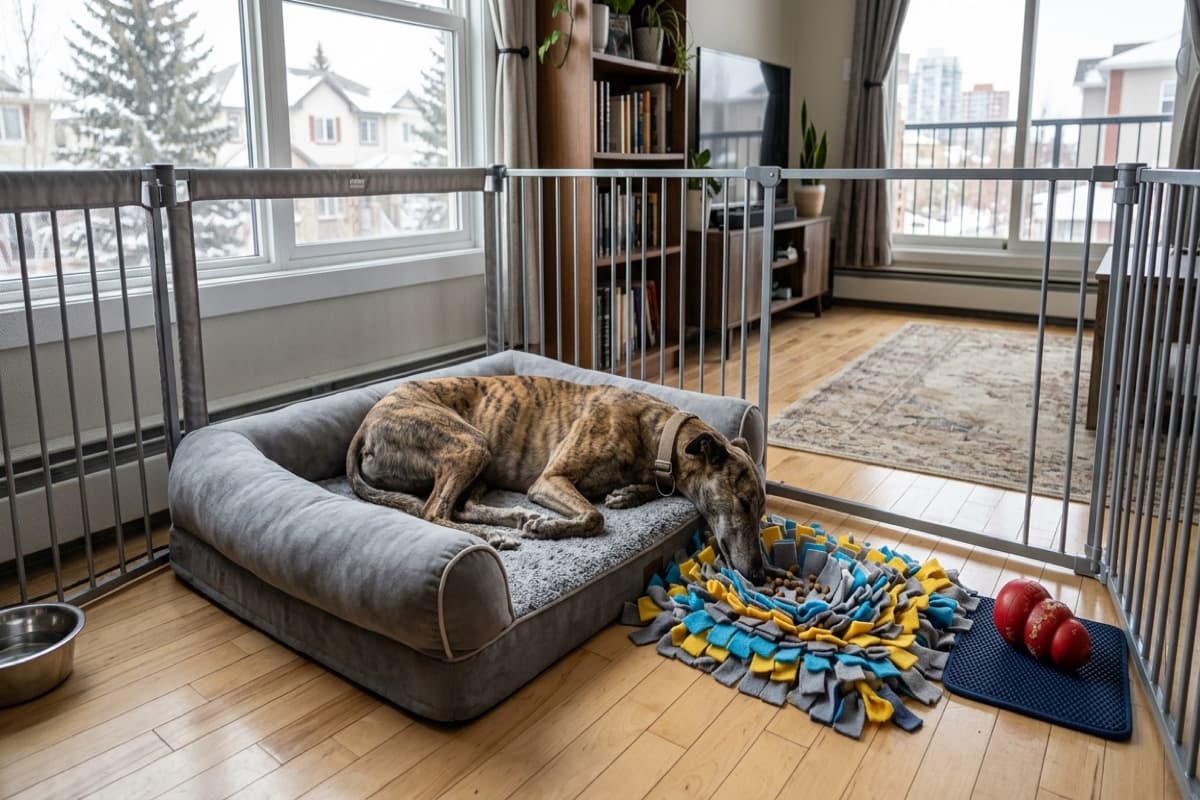
What usually works better. A dog-proofed living room with a couch or two comfortable beds. Soft surfaces matter; greyhounds are bony and dislike hardwood floors for resting. Baby gates can restrict access to bedrooms or stairs if needed. Most retired racers self-select a favourite resting spot within a few days and stay there during alone time.
If you do try a crate. Use an XL or giant size with a soft thick bed. Feed every meal inside with the door open for the first week. Toss chews and bully sticks inside throughout the day. Never close the door if the dog shows panic. If after 2 to 3 weeks the dog still refuses to enter voluntarily, stop and use a free-roaming setup instead.
Read your dog, not the rule book. Two retired racers can have opposite preferences. The kennel association cuts both ways.
The second greyhound question
This is the most-asked question in greyhound adoption groups. The honest answer is: it depends, and you should not decide alone.
When a second greyhound helps:
- Mild to moderate SA where company is the missing piece, not the only piece
- Resident dog is already social and confident with other greyhounds
- You genuinely have time, budget, and space for two dogs regardless of SA
- You can foster-to-adopt or trial a pairing before committing
- Rescue confirms both dogs are good fits for each other on temperament
When a second greyhound doubles the problem:
- Resident dog has severe SA and is dysregulating constantly
- You are stretched thin on time, budget, or space already
- The second dog has any anxious tendencies of its own (now two panicking dogs feed each other)
- Small condo or apartment where two greyhounds will not fit comfortably long-term
- You are using the second dog purely as a fix and would not otherwise want two
The decision step. Talk to NCGL or your adopting rescue. They have placed hundreds of greyhounds and can tell you whether a second dog is likely to help in your specific case. Many rescues offer trial pairings or foster-to-adopt arrangements that give you real data before committing. Do not buy a second dog as a fix without that input.
Browse adoptable greyhounds in Calgary
Foster reports often include alone-time tolerance and crate compatibility notes. Critical info if you are choosing between candidates.
Calming aids that actually help
None of these replace gradual desensitization. They reduce baseline anxiety enough that the dog can learn during sessions. Stack two or three for moderate cases.
- Adaptil (DAP) diffuser or collar. Synthetic copy of the calming pheromone mothers produce. Plug-in $40 to $60 per refill, collar $30 to $50. Takes 1 to 2 weeks to show effect.
- Thundershirt. Pressure wrap sized M or L for greyhounds. $45 to $60. Works for some dogs, neutral for others. Worth a try.
- Calming music or white noise. Through a Dog's Ear playlists and classical music have measurable calming effects in shelter studies. A TV or radio left at low volume mimics the constant background sound of kennel life. Free.
- Frozen Kongs sized L or XL. Kong stuffed with peanut butter, wet food, plain yogurt, or pumpkin and frozen. 20 to 40 minutes of focused work on every departure.
- Lick mats. Silicone mats with grooves, smeared with wet food. 10 to 20 minutes of soothing low-stress activity. The licking action itself is calming.
- Long-lasting chews. Bully sticks, yak cheese, antlers (vet check first). Greyhounds tend to chew gently; choose sized for medium-to-large dogs.
- Snuffle mats and food-dispensing toys. Greyhounds are smart and motivated foragers. Rotate two or three to keep novelty.
Some of the product links in this section are Amazon affiliate links — we may earn a small commission at no extra cost to you. It never changes which products we recommend.
Greyhounds have thin skin and delicate teeth. Skip rawhide, hard plastic toys, and anything with small swallowable parts.
Calgary force-free trainers experienced with SA
Reward-based trainers fit the sensitive greyhound temperament. Harsh handling makes anxiety worse, not better. Calgary options with separation anxiety experience:
- Dogma Training. Multiple Calgary locations, force-free group and private sessions, behaviour consults.
- ImPAWSible Possible (Linda Skoreyko). Strong separation anxiety focus, Karen Overall relaxation protocol experience.
- Calgary K-9. Force-free private training, behaviour consults, in-home work.
A typical Calgary behaviour consult runs $150 to $300 for the initial session and $80 to $150 per follow-up. A full SA package usually runs $400 to $1,200 across 6 to 12 sessions. Cheaper and faster than a vet behaviourist for mild to moderate cases.
When to involve a veterinary behaviourist or medication
Escalate to a vet behaviourist if any of the following are present:
- Self-injury attempting to escape (bloody paws, torn nails, broken teeth)
- Persistent howling for 30+ minutes despite enrichment
- Urination or defecation during alone time despite being housetrained
- Refusing all food and high-value treats during alone time
- No improvement after 8 to 12 weeks of consistent protocol work
- Worsening signs over weeks rather than improvement
Calgary referral: Dr. Jennifer Pelster at Calgary Veterinary Behaviour Services. Referral from your regular vet is required. Initial consult $300 to $600, follow-ups $200 to $400. For after-hours emergencies, Western Veterinary Specialist & Emergency Centre.
Medications commonly used for moderate to severe greyhound SA:
- Fluoxetine (Prozac, Reconcile). Daily SSRI. 4 to 6 weeks to full effect. $40 to $80 per month at greyhound doses. Long-term medication, usually 6 to 18 months.
- Trazodone. Situational anti-anxiety. Useful for predictable triggers like departures or vet visits. $30 to $60 per month.
- Clomipramine (Clomicalm). TCA antidepressant labelled for separation anxiety. $35 to $80 per month.
Sighthounds can be sensitive to some sedatives and anesthetics. Always work with a vet who knows greyhound-specific pharmacology, and mention the breed at every appointment. Medication is not a moral failure. Paired with desensitization, it often reduces baseline anxiety enough for the dog to learn new patterns.
The cost reality
Honest first-year budget for a Calgary greyhound with moderate separation anxiety:
| Item | Calgary cost | Notes |
|---|---|---|
| Vet behaviour initial consult | $300 to $600 | Referral required from regular vet |
| Vet behaviour follow-ups (2 to 4 visits) | $400 to $1,600 | Most cases need 2 to 4 in year one |
| Medication (fluoxetine, trazodone) | $360 to $960/yr | Greyhound dose higher than tiny breeds |
| Force-free trainer SA package | $400 to $1,200 | 6 to 12 session program |
| Calming aids (Adaptil, Thundershirt, Kongs) | $150 to $300 | Mostly one-time spend |
| Daycare or midday walker support | $400 to $800/mo | While building tolerance, year one |
Total first-year investment for a moderate case: roughly $2,800 to $5,500. Severe cases run higher. Mild cases (typical first-12-weeks howling that resolves with training) run much less, often $200 to $500 in total. Knowing the number before adoption protects both you and the dog from a mid-year crisis.
The honest timeline
Most retired racers learn alone-time in 6 to 12 months of consistent work. True SA cases take 12 to 18 months. Anyone selling a 4-week fix is overselling.
Mild adjustment (the typical case): 6 to 12 weeks of consistent training resolves first-month howling and restlessness. The dog learns the leave-and-return pattern and settles within 10 to 15 minutes of departure. Most Calgary greyhound adoptions land here.
Moderate cases: 6 to 12 months. Vocalizing, panting, and refusing food during alone time take longer to resolve. Most owners add medication, calming aids, and a force-free trainer in this range.
Severe cases: 12 to 18 months or longer. Self-injury, urination, and escape attempts almost always need a vet behaviourist, medication, and a long patient program. Some greyhounds in this range never reach more than 4 to 6 hours of comfortable alone time. That is still a successful outcome.
Progress is non-linear. Expect plateaus and setbacks. A bad week does not erase three good months. The owners who succeed measure progress in months and zoom out when discouraged.
“I work full time. Can I adopt a greyhound?”
Short answer: yes, if you set up gradual alone-time conditioning before crisis hits. Long answer: most failed greyhound adoptions in Calgary look like this. Family adopts on a Saturday. Owner takes 2 days off. By the following Friday, the dog is alone for 9 hours and howling. SA crystallizes. Neighbours complain. The dog gets returned at week 6.
The avoidable version looks like this. Family adopts on a Saturday. Owner takes 2 to 3 weeks off, partial WFH, or arranges family help for the first 3 weeks. The 5 to 60 second departure phase starts on day 1 even though the dog seems fine. A midday dog walker is booked starting week 2. Daycare 2 to 3 days a week starts week 4. By month 3, the dog tolerates a partial workday with walker support filling the gap.
The infrastructure has to exist before the dog needs it. That is the difference between a successful working-household greyhound adoption and a return at week 6.
Frequently asked questions
Why do retired racers struggle with alone-time?
They lived in kennels with 40 to 60 other greyhounds, surrounded by familiar dogs and handlers around the clock. Alone-time was simply not part of their previous existence. Solo home life is foreign and has to be learned.
What is the difference between true SA and normal velcro?
Normal adjustment: brief whining, settles in 5 to 15 minutes, eats food alone, improves week over week. True SA: drooling on arrival, self-injury, urination despite training, persistent howling, escape attempts, refuses food. Use a camera to confirm.
Will it go away on its own?
Typical first-month howling resolves in 6 to 12 weeks with gradual training. True SA does not resolve without an active plan, often including medication. Some greyhounds never reach full working-day tolerance, and that is still a successful outcome.
Should I get a second greyhound?
Sometimes helps, sometimes doubles the problem. Depends on severity, your time and budget, and the resident dog. Talk to NCGL or your rescue before deciding. Do not adopt a second purely as a fix if you would not otherwise want two dogs.
Should I crate my greyhound?
Most retired racers prefer free-roaming. They associate confined spaces with the kennel life they just left. A dog-proofed living room with a comfortable bed usually beats a crate. If you try a crate, stop immediately at any sign of panic.
What calming aids work?
Adaptil diffuser or collar, Thundershirt, calming music or low-volume TV, frozen Kongs, lick mats, long-lasting chews sized for medium-to-large dogs. Stack two or three for moderate cases. Skip rawhide and hard plastic.
When should I see a vet behaviourist?
Self-injury, 30+ minute persistent howling, urination despite training, refusing food, no improvement after 8 to 12 weeks. Calgary referral: Dr. Jennifer Pelster, Calgary Veterinary Behaviour Services. Medications: fluoxetine, trazodone, clomipramine.
How much does treatment cost?
Moderate case first year: roughly $2,800 to $5,500. Vet behaviour consult $300 to $600, follow-ups $200 to $400, medication $30 to $80/mo, trainer package $400 to $1,200, daycare/walker support $400 to $800/mo. Mild cases run $200 to $500 total.
More greyhound guides
Greyhound Adoption Calgary →
The full Calgary greyhound playbook covering rescues, fees, what to expect, and red flags.
Is a Greyhound Right for You? →
Honest self-assessment built from Calgary surrender patterns. Time, budget, lifestyle fit.
Greyhound Temperament and Quirks →
What greyhound personality is really like. Couch potato calm, sighthound prey drive, sensitivity, common quirks.
Greyhound Training Calgary →
Force-free training for retired racers. Why standard puppy methods need adjusting and what works instead.
Greyhound Off-Leash and Recall →
Why most greyhounds should never be off-leash, the rare candidates who can be, and recall training reality.
Retired Racer First Weeks Home →
The 3-3-3 rule applied to retired racers. Decompression, kennel-to-couch transition, first-month roadmap.
Greyhound Health and Vet Guide →
Anesthesia sensitivity, dental disease, osteosarcoma, thin skin. Calgary vet costs and what to watch for.
Greyhounds with Kids and Cats →
Honest compatibility guide. Cat-tested greyhounds, prey drive reality, kid-safe screening, what foster reports tell you.
New dog? Start with these care guides
Everything a new adopter needs to set up a safe, happy home.