The short answer
Shibas are notorious escape artists because Japanese breeders selected for independence, agility, and prey drive, not handler compliance. The Calgary action plan: a 3-strap escape-proof harness (Ruffwear Web Master or Hurtta Trail) clipped to both the harness and a martingale collar, a double-gated airlock at the front door, a 6-foot fence with dig prevention and climb prevention, a Tractive or Fi GPS tracker as a backup layer, and force-free emergency-recall training that tops out around 70 to 80 percent reliability. Off-leash time happens in fenced spaces only. Recovery rule: never chase, sit still, and lure with food.
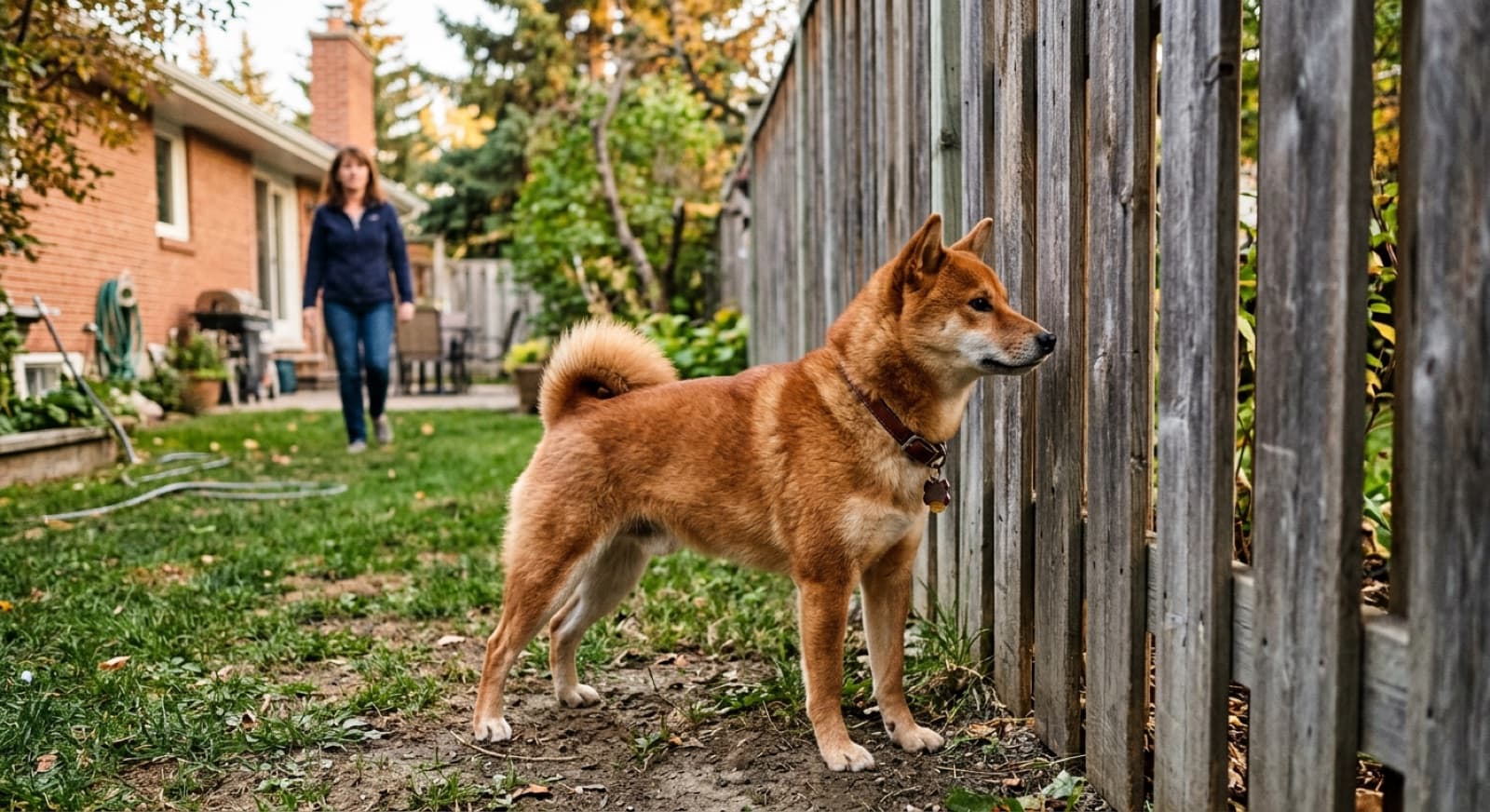
Why Shibas escape: the genetic reality
Shibas have a reputation for escape-artistry that other small breeds simply don't carry. The Calgary rescues we work with see Shiba surrenders specifically tied to escape incidents more than any other small breed. Reddit's r/shiba is full of the same stories: dog out the front door, dog over the fence, dog out of the harness, dog gone for hours or days. It's not a training failure. It's breed history.
The Shiba Inu was developed in Japan for independent small-game hunting in mountainous terrain. The breed standard from the American Kennel Club and the Japanese preservation society Nippon Inu Hozonkai both describe a dog selected for the same combination of traits:
- Independent hunting heritage. Shibas worked away from handlers, making decisions about routes and prey without checking in
- Low compliance threshold. The breed was not selected for handler cooperation the way Labradors and Goldens were. A Shiba doesn't default to “what does my owner want?”
- High prey drive. Rabbits, squirrels, magpies, cats, and small dogs all trigger pursuit. The drive activates instantly and overrides recall
- Physical athleticism. Shibas climb chain-link, jump 4 to 5 feet from a standstill, dig under fences, and squeeze through narrow gaps
- Wedge-shaped head narrower than the neck. Flat collars slip off backward when the dog reverses
- Flexible lean body. Shibas drop their shoulders and reverse out of standard Y-front harnesses
Combine those traits and you get the breed Reddit calls the most escape-prone small dog. The behaviour is doing exactly what 700 years of Japanese hunters bred it to do. Your job as a Calgary owner isn't to train it out. Your job is to manage around it.
The off-leash reality
Shibas should never be off-leash in unfenced areas, regardless of how good their recall is in the backyard. The prey-drive override is uncontrollable in the moment.
The Reddit consensus from years of r/shiba escape threads is consistent: even Shibas with extensive force-free recall training fail when scent or movement triggers fire. Owners describe the moment as a switch flipping. The dog goes from attentive and engaged to a single-track pursuit machine in under a second. Calling, treats, leash pressure all stop registering.
Calgary's unfenced off-leash parks are the highest-risk environments for Shibas in the city:
- Nose Hill Park. 11 square kilometres of unfenced prairie with abundant rabbit, hare, deer, and coyote scent. A Shiba on a trail here is a Shiba bolting on the next squirrel
- Fish Creek Park. Off-leash zones run along the creek through Bow Valley. Wildlife-rich and bordered by Bow Bottom Trail and Macleod Trail
- Bowmont Park. Bow River escarpment, unfenced off-leash sections, and Crowchild Trail proximity
- Edworthy Park. Off-leash river-flat area, bordered by Bow Trail and the railway
- Sue Higgins Park. Has a smaller fenced off-leash section that is acceptable for Shibas. The larger unfenced area is not
None of these unfenced spaces are appropriate for off-leash Shibas. The fenced section at Sue Higgins, a SniffSpot private rental ($5 to $25 per hour), a friend's fully fenced backyard, or a Calgary daycare single-dog off-hours session are the realistic off-leash venues. Everything else is on-leash or long-line only.
The City of Calgary's Responsible Pet Ownership Bylaw 23M2006, Section 14, requires owners to have voice control over recall-responsive dogs in off-leash areas. A Shiba off-leash without reliable recall is a bylaw violation, with fines starting at $250 and rising to $1,500 for first offences.
The escape modes Shibas actually use
Knowing the failure modes lets you build defences against each one. Owners we talk to in the Calgary rescue network describe the same patterns over and over:
- The front-door bolt. Guest arrives, door opens, Shiba shoots between legs and is gone. This is the single most common escape mode. Fix: a baby-gate airlock inside the front door
- The fence jump or climb. Standing jump over 4-foot fences, running jump over 5-foot, climbing chain-link hand-over-paw. Fix: 6-foot solid fence plus coyote rollers on any wire sections
- The dig-under. Shibas excavate under fence lines, especially after frost-heave loosens soil. Fix: concrete footing, buried hardware cloth, or an L-footer wire mesh
- The harness slip. Backward reverse out of a Y-front harness. Fix: 3-strap harness with a strap behind the armpits
- The collar slip. Flat collar pops over the head when the dog pulls backward. Fix: a martingale (limited-slip) collar
- The gate dash. Owner takes out the garbage, gate left ajar for 10 seconds, Shiba gone. Fix: self-closing self-latching gates with a carabiner backup
- The latch unlock. Shibas paw at simple latches and open gates. Fix: two-sided latches plus a padlock or coded keypad
- The window-screen push. Shibas push through standard window screens following scent. Fix: pet-resistant heavy-duty steel mesh screens
Some of the product links in this section are Amazon affiliate links — we may earn a small commission at no extra cost to you. It never changes which products we recommend.
Each failure mode is preventable. None can be trained away. You build infrastructure once, then maintain it.
Escape-proofing the home: the entry routine
The front-door bolt is preventable with one piece of infrastructure: a double-gated airlock inside the entry.
Setup:
- Install a sturdy baby gate (or two stacked for height) about 4 feet inside the front door, creating a small enclosed buffer between door and gate
- When you open the front door, the Shiba is contained by the gate, not facing an open exit
- When a guest enters, they step into the airlock first, then close the door behind them, then open the gate. The dog is never in an open-door environment
- When you leave with the dog, clip the leash inside the airlock first, then open the gate, then open the door. Leash-on-before-door-open is a habit, not an option
- Train every household member on the routine. Train every guest verbally as they arrive (“please close the door behind you before opening the gate”)
- Post visible signage on the inside of the front door for delivery people: “Dog in home, please knock, do not open the door”
Train the “wait” cue at every threshold. Dog sits at the door, owner opens the door, dog waits, owner releases with “okay”, dog moves through on cue. Reward heavily with high-value food. Practise daily for the first month, then weekly forever.
Calgary hardware: baby gates run $40 to $120 at Calgary retailers. Pet-resistant heavy-duty steel-mesh window screens run $30 to $80 per window if you decide screens are also a risk in your home. Door alarms ($20 to $40) provide an audible cue when a door opens. All available at Home Depot, Rona, and Lee Valley Tools.
Escape-proofing the yard: fence, dig, climb, latches
A Shiba-safe Calgary backyard takes more setup than most owners expect. The full perimeter needs three layers of containment.
Layer 1: Fence height and material.
- 6 feet minimum. Solid wood, vinyl, or composite preferred over chain-link or wire
- Chain-link is a Shiba climbing surface unless you add a coyote roller along the top rail (free-spinning aluminium tube the dog cannot grip)
- Wire fences require visual barriers (slats, panels) or the Shiba will fixate on every passing dog, squirrel, or jogger
- Inspect monthly for loose pickets, rotted boards, gaps under decks or sheds, gate damage
Layer 2: Dig prevention at the base.
- Pour concrete or paver footing along the fence base, OR
- Bury hardware cloth (welded wire mesh) 12 to 18 inches deep along the entire perimeter, OR
- Install an “L-footer”: hardware cloth laid horizontally inside the yard along the fence base, extending 2 feet into the lawn. The Shiba hits wire when digging
- Patio stones along the fence base work as a budget option but inspect for shifting after frost heave
Layer 3: Climb prevention at the top.
- Coyote rollers on the top rail of any chain-link or wire fence ($25 to $40 per 4-foot section)
- Shovel down snowbanks against the fence in winter. A 3-foot snowbank against a 6-foot fence is now a 9-foot launch ramp
- Inspect after every chinook. Winds at 80 to 120 km/h damage Calgary fences seasonally. Walk the perimeter and repair within 24 to 48 hours
Gate management:
- Self-closing, self-latching hardware ($40 to $80 installed) on every gate
- Two-sided latch (must operate from both sides)
- Carabiner or padlock as a secondary backup. Latches fail, carabiners don't
- Coded keypad gates for high-traffic households ($150 to $300)
- Inspect latches after every Calgary cold snap. De-icer compromises latch springs and freezes hardware
Realistic Calgary Shiba-proofing budget for the first year: $400 to $1,200 covering fence upgrades, dig-prevention installation, coyote rollers if needed, and gate hardware. Less than the cost of losing the dog once.
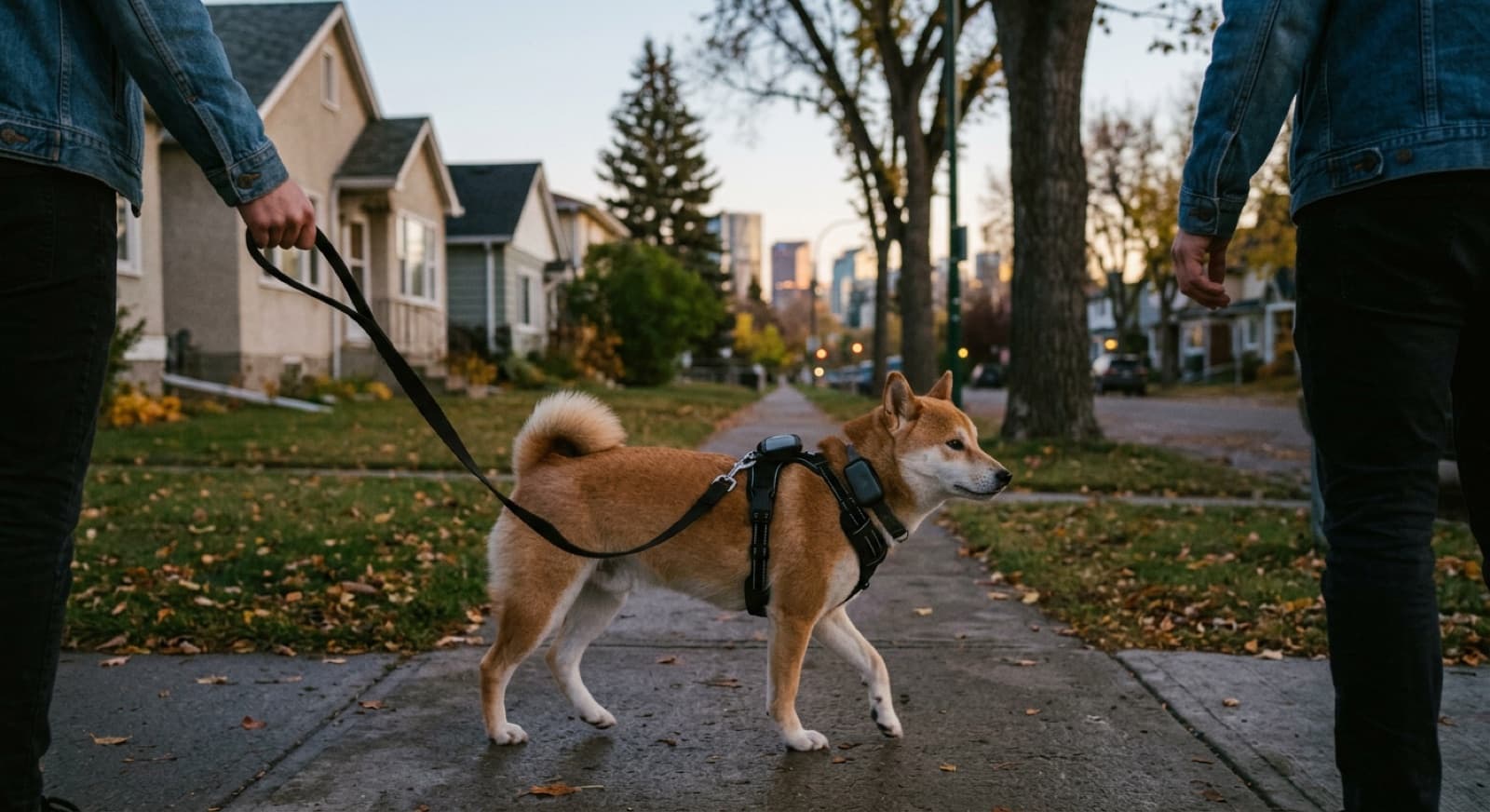
Harness selection: the 3-strap escape-proof reality
Regular Y-front harnesses fail on Shibas. The dog drops the shoulders, reverses, and is out in one motion.
The standard Y-front harnesses most Calgary pet stores stock first (Ruffwear Front Range, Easy Walk, Blue-9 Balance) are great harnesses for most breeds. They are not Shiba-safe. A panicked Shiba pulls backward, the chest panel shifts forward over the head, and the dog steps out.
The escape-proof harness profile every Shiba owner should be looking for:
- 3 points of contact: neck, chest, and a third strap that sits BEHIND the armpits (not just in front of them)
- Wide, padded straps that distribute pressure without pressing into the throat or armpits
- Reinforced stitching at every junction. Cheap harnesses fail at the seams under Shiba reverse-pull pressure
- Heavy-duty buckles (steel preferred over plastic on a Shiba)
Brands Calgary Shiba owners commonly settle on:
- Ruffwear Web Master. The 3-point standard. Around $90 to $120 at Calgary outdoor retailers
- Hurtta Trail Harness. Has a third behind-armpit strap variant. Around $70 to $100
- Other Houdini-style 3-strap harnesses are available; the key is the BEHIND-armpit strap, not the brand
Redundancy with a martingale collar: a martingale (limited-slip) collar tightens slightly when the dog pulls backward and prevents the slip-off that flat buckle collars allow. Clip the leash to BOTH the harness and the martingale via a safety coupler ($10 to $20). If the harness fails, the collar catches. If the collar fails, the harness catches.
Fit check weekly. Two fingers under every strap, no looser. Replace immediately at any sign of fraying, buckle wear, or stretched material. Cheap is expensive when the dog is the cost.
GPS tracker setup
Most experienced Calgary Shiba owners treat a GPS tracker as standard equipment, not optional. When every other layer of containment fails, the tracker is what turns a permanent loss into a 4-hour scare.
The realistic options:
- Tractive. Live GPS tracking over LTE, waterproof, around $50 device cost plus $5 to $13 monthly subscription. The most popular tracker for escape-prone breeds. App shows live location on a map and saves a track of where the dog went
- Fi Collar. Live GPS, similar feature set to Tractive, often longer battery life (some models 2 to 3 weeks per charge). Higher device cost (around $150 to $200) but lower or no subscription depending on plan
- Apple AirTag. Bluetooth-only tracking via nearby Apple devices. $40 one-time, no subscription. Works as a finder if your dog passes near an iPhone but no live GPS. Backup only, not primary for an escape-prone breed
Calgary winter considerations:
- Cold reduces lithium battery life noticeably. Charge nightly in winter even if the device shows charge remaining
- Test the tracker before every outing. Check the location updates correctly on your phone
- Secure the tracker to the collar (not the harness, which gets removed at home). Use the supplied clip plus a backup zip-tie
- Cell coverage is variable on the edges of Calgary off-leash spaces. The tracker won't help if it can't reach LTE
- Have a backup plan if the tracker fails: microchip (Calgary licence requires it), visible ID tag with phone number, and the recovery protocol below
Budget the device plus first year of subscription at roughly $150 to $250. Then $60 to $156 per year ongoing for the subscription.
Recall training: the force-free protocol
Shiba recall is an emergency tool, not a lifestyle tool. The realistic ceiling is roughly 70 to 80 percent reliability in moderate distractions, and that drops toward zero when prey-drive triggers fire. Build the cue carefully and use it like the safety layer it is.
The American Veterinary Society of Animal Behavior's position statement on humane dog training covers why aversive methods (e-collars, prong collars, leash pops) backfire on independent breeds. Force-free is the only method that builds recall in Shibas without producing handler-avoidance.
Protocol:
- Pick a unique cue. Not the dog's name, not “come” (those are over-used). A whistle blast, the word “now”, or a unique sound the dog has never heard before. This cue will only ever mean emergency recall
- Pair the cue exclusively with the highest-value food the dog will ever see. Real chicken, cheese, freeze-dried liver. Never give that food in any other context. The food has to feel like winning the lottery
- Start at zero distraction. In the house. Cue, treat, repeat 5 to 10 times per session, twice a day, for two weeks. The dog should hear the cue and bolt toward you
- Move to the fenced backyard. Very low distractions. Same protocol. Always reward, always treat as the lottery
- Move to a long-line (15 to 30 foot biothane) on a fenced field. Wait until the dog is engaged in something else (sniffing, looking away). Cue. Jackpot when they come
- Never call to punish. If you call and then crate, vet, bath, or scold the dog, you have poisoned the cue. Always reward, always celebrate
- Never test in unfenced spaces. A failed recall in an unfenced park trains the dog that the cue is optional. Practice in fenced spaces only
- Never use the emergency cue in casual play. If you use it to call the dog in from the yard for dinner, the cue's value erodes. Use a different word for routine calls
Accept the realistic ceiling. Even with 6+ months of consistent training, Shibas hit 70 to 80 percent reliability in moderate distractions. That's a useful safety layer alongside leash, harness, fence, and GPS. It is not a substitute for any of them.
“Why won't my Shiba come when called?” The prey-drive override
The most common owner frustration on r/shiba threads, and the answer is the same every time: the prey-drive override is uncontrollable in the moment.
When a Shiba sees a rabbit, squirrel, magpie, or another dog moving fast, the brain enters a state of arousal where the dopamine reward system prioritises pursuit over every other behaviour. Calling, food, leash pressure, even pain stimuli reduce in importance during pursuit. The dog isn't ignoring you. The dog literally cannot register your voice the way it does in calmer states.
Even well-trained Shibas fail recall when:
- Prey scent or sight triggers (rabbit, squirrel, magpie, cat)
- A fast-moving dog runs past
- The dog has been off-leash long enough that the world is more interesting than you
- The wind carries a new scent from a distance
- The dog is bored, under-exercised, or over-stimulated
The data from Calgary owners and the rescue network is clear: this is NOT a breed where off-leash freedom is achievable. Working with the breed means accepting the leash-life. Working against it means losing the dog.
The good news: a Shiba on a 30-foot biothane long-line has plenty of room to sniff, explore, and exercise. It feels off-leash to the dog. It feels safe to the owner. That's the working compromise.
Calgary winter escape-prevention
Winter in Calgary adds escape variables most owners don't anticipate until the first cold snap.
- Booties for ice. Shiba pads tear on packed ice and road salt. Booties also slow down a panicked bolt by maybe a second, which is sometimes enough to grab the leash. Around $25 to $50 per set
- Reflective gear for dawn and dusk visibility. Calgary winter daylight is short. Reflective harness panels and a clip-on LED light on the collar make a loose dog findable by car headlights
- Frozen latches need de-icing. Cold compromises gate latch springs. Carry a small bottle of de-icer for outdoor latches and inspect every latch after a chinook
- Snowbanks become fence-jumping launchpads. Shovel snowbanks down to ground level along the fence base. A 3-foot snowbank against a 6-foot fence is now a 9-foot launch ramp
- Salt and gravel on roads. A loose Shiba running on Calgary winter roads is at higher risk for paw injuries that compromise recovery later
- Frozen tracker batteries. Lithium tracker batteries lose capacity in extreme cold. Charge nightly through winter
- Visible breath = visible dog. If you can see your breath, your dog's breath is visible too. Useful for spotting at distance during recovery searches
Calgary winters run roughly mid-November through early April. Plan the winter system in October, not in February after the first incident.
The emergency action plan if your Shiba escapes
Rule one: do NOT chase. A Shiba interprets chase as a game and runs faster, further, and with more drive. Most lost-Shiba recoveries fail because the owner chased.
The protocol the Calgary rescue network teaches, in order:
- Stop. Sit or kneel on the ground, low and small, facing slightly away from the dog. Make yourself non-threatening and non-chase-able
- Open food loudly. A treat bag, a bag of dog food, a cheese package. Make the food sound interesting. Sometimes shake a bag of kibble
- Call calmly, once, in a happy voice. Do not call repeatedly. Do not raise your voice. The dog should hear you sound interested and relaxed, not panicked
- Wait. Most Shibas circle back within minutes if not chased. Curiosity and food bring them in. Stay still
- When the dog approaches, do NOT reach for the collar. Drop food on the ground. Let the dog settle into eating. Then calmly clip the leash. Reaching too early triggers a second escape
If the dog runs out of sight:
- Call Calgary Animal Services at 311 immediately. They log lost-dog reports and check impound for matches
- Post in Lost Dogs of Calgary on Facebook (active group with city-wide reach), Calgary Lost & Found Pets, and your neighbourhood community Facebook group. Include a clear photo, location of last sighting, your phone number
- Activate your GPS tracker app. Pull up the location map on Tractive, Fi, or AirTag
- Check known scent paths first: regular walking routes, favourite parks, the path of any squirrel or rabbit the dog was focused on at the moment of escape. Shibas often follow the same route the prey did
- Expand outward in concentric circles from the escape point. Most Shibas are found within 1 to 3 km of where they got out
- Within 24 hours: visit Calgary Animal Services at 2201 Portland St SE in person. Check the impound. They sometimes have dogs that haven't been logged yet
- Notify veterinary clinics within 5 km. Good Samaritans bring loose dogs to vet clinics for microchip scans
- Print posters with a clear photo and your phone number. Post at intersections, dog parks, and along the dog's likely path
- Recheck Calgary Animal Services daily for the first week
Most Shibas are recovered within 24 to 72 hours when owners follow this protocol. Some take a week. Some are never recovered. The single biggest predictor of recovery is whether the owner chased or didn't chase in the first minutes.
The lifelong leash-life acceptance
The owners we see thrive with their Shibas in Calgary have the same realisation in common: the leash isn't a training problem to solve, it's a permanent breed reality to accept.
Shibas are independent, opinionated, athletic, and prey-driven by 700 years of selection. That's why people love the breed. The same traits that make them brilliant companions also make them escape artists. You can't have one without the other.
What that looks like in practice:
- Leash, harness, and martingale on every outdoor walk, every time, no exceptions
- Long-line (15 to 30 feet) for trails and open spaces, never freehand off-leash
- Off-leash play in fenced spaces only: backyard, SniffSpot, fenced daycare, fenced park section
- GPS tracker on the collar as a backup layer
- Door-and-gate routine practised by every household member and reinforced with every guest
- Fence walk monthly, with chinook and frost-heave repair as needed
- Recall training maintained as a safety layer, not relied on as a primary
Owners who accept this build deep, trusting relationships with their Shibas. The dog gets all the exercise, sniffing, and exploration it needs. The owner gets the brilliant, weird, dignified companion the breed is famous for. Nobody loses the dog.
Owners who fight it lose dogs. The rescue network sees those Shibas come back into rescue after multiple escapes, after a hit-by-car incident, or after the family decides they can't manage. That's not a training failure on the family's part. It's a breed-expectations failure.
Browse adoptable Shiba Inus in Calgary
Foster-home assessment is the closest thing to a guarantee on a Shiba's recall reliability, escape patterns, and prey drive. Browse Calgary-area rescue Shibas whose foster homes have already evaluated those traits.
See Available Shiba Inus →Frequently Asked Questions
Can I ever let my Shiba off-leash?
Not in unfenced spaces, ever. Even Shibas with years of force-free recall training fail when a rabbit, squirrel, or off-leash dog crosses their path. The realistic ceiling for emergency recall is 70 to 80 percent in low distraction, near zero in scent or chase-trigger environments. Off-leash time happens only in fully fenced spaces: a 6-foot backyard, a SniffSpot rental, a fenced park section, a friend's secure yard. Calgary off-leash parks like Nose Hill, Bowmont, Edworthy are not appropriate for Shibas. Owners who accept this thrive. Owners who fight it lose dogs.
What harness won't my Shiba slip out of?
A 3-strap escape-proof harness with a strap that sits BEHIND the armpits, not just in front. Standard Y-front harnesses (Ruffwear Front Range, Easy Walk, Blue-9 Balance) fail on Shibas because a panicked Shiba pulls backward, drops the shoulders, and reverses out. The escape-proof setup: Ruffwear Web Master or Hurtta Trail Harness (3 points of contact: neck, chest, behind-ribcage), plus a martingale collar as a secondary attachment, plus the leash clipped to BOTH via a safety coupler. Pricing $60 to $130. Fit check weekly: two fingers under every strap, no looser. Replace immediately on any fraying or buckle wear.
How do I teach a Shiba recall?
Build an emergency recall cue using force-free protocol. Pick a unique cue word (whistle, “now”) never used for routine calls. Pair exclusively with the highest-value food the dog will ever see (chicken, cheese, liver). Start at zero distraction in the house. Move to fenced backyard. Move to a long-line on a fenced field. Never call to punish. Never test in unfenced spaces. Never use the cue in casual play (poisons it). Realistic ceiling with extensive training: 70 to 80 percent reliability in moderate distractions. Treat it as one safety layer alongside leash, harness, fence, and GPS. Do not bet your Shiba's life on it alone.
How tall does my fence need to be?
6 feet minimum, plus dig prevention, plus climb prevention, plus secure latches with carabiner backup. Shibas climb chain-link hand-over-paw, jump 4-foot fences from standstill and 5-foot with a running start, dig under loose soil, squeeze through 5 to 6 inch gaps. Solid wood, vinyl, or composite preferred over chain-link. Dig prevention: concrete or paver footing, buried hardware cloth 12 to 18 inches deep, or an L-footer wire mesh. Climb prevention: coyote rollers on any wire fence top rail. Gate latches: self-closing, self-latching, two-sided, with carabiner or padlock backup. Walk the fence after every chinook. Shovel down snowbanks against the fence. Budget $400 to $1,200 first year.
What do I do if my Shiba escapes?
Do NOT chase. A Shiba interprets chase as a game. Sit or kneel low, open food loudly, call calmly once in a happy voice, wait. Most Shibas circle back within minutes. Do NOT reach for the collar when they approach. Drop food, let them eat, then clip the leash. If out of sight: call Calgary Animal Services 311, post in Lost Dogs of Calgary on Facebook, activate the GPS tracker, check known scent paths first, expand outward, visit Calgary Animal Services at 2201 Portland St SE within 24 hours. Most Shibas recovered within 24 to 72 hours when owners follow this protocol.
Why is my Shiba an escape artist when other dogs aren't?
Genetics, not training failure. Shibas were bred in Japan for independent mountain hunting, working without handler input across rough terrain. The AKC and Nippon Inu Hozonkai breed standards both describe a dog selected for independent decision-making, agility, and physical athleticism. Combine that with low compliance threshold, high prey drive (rabbits, squirrels, cats, magpies trigger pursuit), and physical capability (climb, jump, dig, slip restraints), and the result is the most escape-prone small dog the rescue network sees. The fix is not more training. The fix is breed-appropriate management: redundant containment, escape-proof gear, GPS backup, and lifelong leash-life.
Are GPS trackers worth it for Calgary Shibas?
Yes, most experienced Calgary Shiba owners treat the tracker as standard equipment. Tractive (live GPS, LTE, $50 plus monthly subscription, the most popular) or Fi Collar (live GPS, longer battery life). Apple AirTag is backup only because it has no live GPS. Calgary winter: cold reduces battery life, charge nightly, check the device works before every outing. Secure to the collar with the supplied clip plus a backup zip-tie. The tracker is a backup layer alongside harness, leash, fence, and recall. When other layers fail, the GPS is what makes the difference between a 4-hour scare and a permanent loss. Budget $150 to $250 first year.
How do I stop my Shiba bolting out the front door?
Build a double-gated airlock and train every household member plus every guest. Install a baby gate (or two stacked) about 4 feet inside the front door, creating an enclosed buffer between door and gate. When the door opens, the dog is contained by the gate. Train a “wait” cue at every threshold: sit, owner opens door, dog waits, owner says “okay”, dog moves through. Reward heavily. Post signage on the inside of the front door for delivery people. The bolt-out is the most common escape mode for Shibas and the easiest to prevent with infrastructure. Skip this step and the rest of the safety system is undermined.
Should I use an e-collar to recall my Shiba?
No. The AVSAB's humane training position is clear: aversive methods (e-collars, prong collars, leash pops) increase fear and aggression and reduce trust without producing more reliable recall than reward-based methods. On a Shiba specifically, an e-collar during prey pursuit either does nothing (arousal masks the shock) or creates handler-avoidance (dog associates shock with the owner). Calgary force-free trainers we point Shiba adopters to include Raising Canine and Pup City Pup Academy. $150 to $300 for a 6 to 8 week class. Avoid any Calgary trainer recommending prong, e-collar, or dominance methods for Shibas.
My Shiba slipped out of the collar. What do I do?
Recover the dog using the don't-chase, lure-with-food protocol. Then change gear. Flat buckle collars don't hold Shibas because the head is narrower than the neck behind the ears, so backward pressure pops the collar off. Switch to a martingale collar (limited-slip, tightens slightly under backward pull, doesn't choke). $20 to $40. Treat the collar as backup only. Use a 3-strap escape-proof harness as the primary, with the leash clipped to BOTH the harness and the martingale via a safety coupler. If the harness fails, the martingale catches. If the martingale fails, the harness catches. Replace gear immediately on any fraying, buckle wear, or stretched material.
Adoptable Shiba Inus in Calgary
Live listings of Shibas and Shiba mixes from Calgary-area rescues with foster-home assessments.
Shiba Inu Adoption Calgary
Where to find Shibas in Calgary, rescue verification, breeder vs adoption math, adoption costs, surrender patterns.
Is a Shiba Right for You?
Honest breed-fit decision guide: living situation, lifestyle, experience level, first-time-owner reality.
Shiba Training + Temperament
Force-free training approach for an independent breed, the “Shiba scream”, resource guarding, socialisation.
New dog? Start with these care guides
Everything a new adopter needs to set up a safe, happy home.