The short answer
Shiba Inu training is unlike training most other breeds. The breed was developed to hunt independently in the mountains of Japan, which selected for intelligent, opinionated, self-directed dogs that do not look to humans for constant direction. Calgary owners who expect a Labrador-style eager-to-please dog often label the Shiba stubborn. The dog is not stubborn. The dog is evaluating. What works: very high-value rewards, short sessions, force-free handling, consistency from every household member, patience through adolescence, and the long view that most Shibas settle into a much easier adult around 18 months.
The Shiba temperament reality
The Shiba Inu was developed in mountainous regions of Japan as an independent small-game hunter. The breed standard explicitly prioritises spirited boldness, good nature, and an unaffected forthright disposition. None of those traits read as eager-to-please. They read as confident, self-directed, and dignified.
The Reddit consensus across thousands of Shiba owner threads is remarkably consistent. The breed is independent, intelligent, opinionated, cat-like in many ways, deeply bonded to their household but reserved with strangers, and emphatically not eager to please. The American Kennel Club Shiba Inu breed profile describes the temperament as “alert, active, attentive” with notable bold spirit, and the Canadian Kennel Club breed entry reads similarly. The breed is not described as eager-to-please anywhere in either standard.
This matters because most popular dog training advice is built on the assumption that the dog wants to work for the human. Retrievers, Poodles, German Shepherds, and Border Collies all share an underlying drive to engage with their handler, and most training methods tap into that drive. The Shiba does not have that drive. The Shiba is happy to engage when there is a clear benefit and equally happy to disengage when there is not. This is not a training failure. This is the breed working as designed.
The cat-like comparison appears constantly in Shiba owner communities for good reason. The breed grooms themselves meticulously, dislikes being wet or dirty, has strong opinions about touch and handling, will accept affection on their terms, and chooses their attachment carefully. Calgary owners with prior cat experience often find Shibas much easier to understand than owners coming from Labrador or Golden experience. The mental model that matches the dog is a confident, dignified small animal that has chosen to live with you, not a hardwired companion that exists to please you.
The stubborn but intelligent framework
The phrase “stubborn but intelligent” circulates constantly in the Shiba community, but it is slightly misleading. A more accurate read is that Shibas are not stubborn in the obedience-failure sense. They are highly intelligent and operate on cost-benefit analysis.
A Shiba learns a new cue often within one or two repetitions. The behaviour exists. The dog understands what the human wants. The dog then evaluates whether complying with that cue produces something worth more than whatever they are currently doing or planning to do. If the answer is yes, the dog complies. If the answer is no, the dog declines. The cue itself is not the issue. The reward value relative to alternatives is the issue.
Practical example. A Calgary Shiba sits perfectly on cue in the kitchen for a piece of kibble. The same dog ignores the same cue at the edge of Nose Hill Park where a squirrel is running. The dog has not forgotten the cue. The squirrel is currently worth more than the kibble. This is the breed thinking exactly the way it was bred to think. Hunting dogs that defer to handlers in pursuit of small fast game make poor hunting dogs.
The implication for training. Increasing pressure does not change the math. Adding a leash correction, a stern voice, or any aversive does not make the kibble worth more than the squirrel. It just teaches the dog that the handler is unpleasant in this context. The fix is changing the reward side of the equation: higher-value food the dog cannot get anywhere else, variable reward schedules that keep the dog uncertain about what the next reward will be, and choosing situations where the dog can succeed and earn the reward rather than situations where the reward cannot compete.
The Shiba is one of the most intelligent breeds in any honest measurement. They are not on the popular “most trainable” lists because trainability is measured as how readily the dog complies with human direction. By that measure, the Shiba scores low. By any measure of independent problem-solving, environmental awareness, or self-preservation, the Shiba scores high.
Why standard obedience methods fail with Shibas
The eager-to-please retriever model is the foundation of most pet-dog training curricula. Applied to a Shiba, that model produces frustrated owners and unmotivated dogs. The model assumes a drive that the breed does not have.
Three common failure patterns Calgary Shiba owners run into when they apply standard obedience methods:
- Aversive correction causes shutdown. A Shiba on a prong collar, choke chain, or e-collar does not become more compliant. The dog becomes guarded, defensive, and emotionally withdrawn. They may stop performing the punished behaviour, but they also stop offering any behaviour. They evaluate the handler as unpredictable and dangerous, and trust collapses. The breed is sensitive in a specific way: not soft like a Cavalier or a Whippet that flinches at a raised voice, but proud, and once trust is damaged, rebuilding it is slow and uncertain. The American Veterinary Society of Animal Behavior position statement on humane training is unambiguous: force-free, reward-based methods are both more effective and lower-risk for aggression than aversive methods.
- Harsh handling damages trust permanently. Yelling at a Shiba, pinning them down, alpha-rolling, scruffing, or grabbing them by the collar in frustration produces a dog that no longer trusts the handler in that context. Unlike a Lab that often shrugs off rough handling, a Shiba files it permanently. Calgary owners who reach the “why won’t my Shiba listen” frustration point often have a Shiba that has lost trust in them, not a Shiba that is being defiant. Repairing that trust takes consistent force-free handling over months, not days.
- High-volume drilling bores them and they tune out. The puppy class model of 30 sit-stay repetitions in a row works on retrievers. A Shiba will do three repetitions, evaluate that the human is going to keep asking the same boring thing, and decide to disengage. Long sessions of repetitive drilling tell the Shiba that training is tedious. Once that association is built, getting the dog to engage in training becomes a project. Short and high-frequency beats long and high-volume every time with this breed.
If a Calgary trainer recommends prong collars, e-collars, leash pops, alpha rolls, or any tool whose mechanism is “the dog learns to stop the behaviour because the behaviour hurts,” that trainer is using the wrong protocol for a Shiba. Force-free options are widely available in Calgary, and there is no reason to compromise on a breed this sensitive to handler conduct.
What actually works
The protocol that consistently produces well-trained Shibas in Calgary households, drawn from force-free training principles and the AVSAB and IAABC consensus literature:
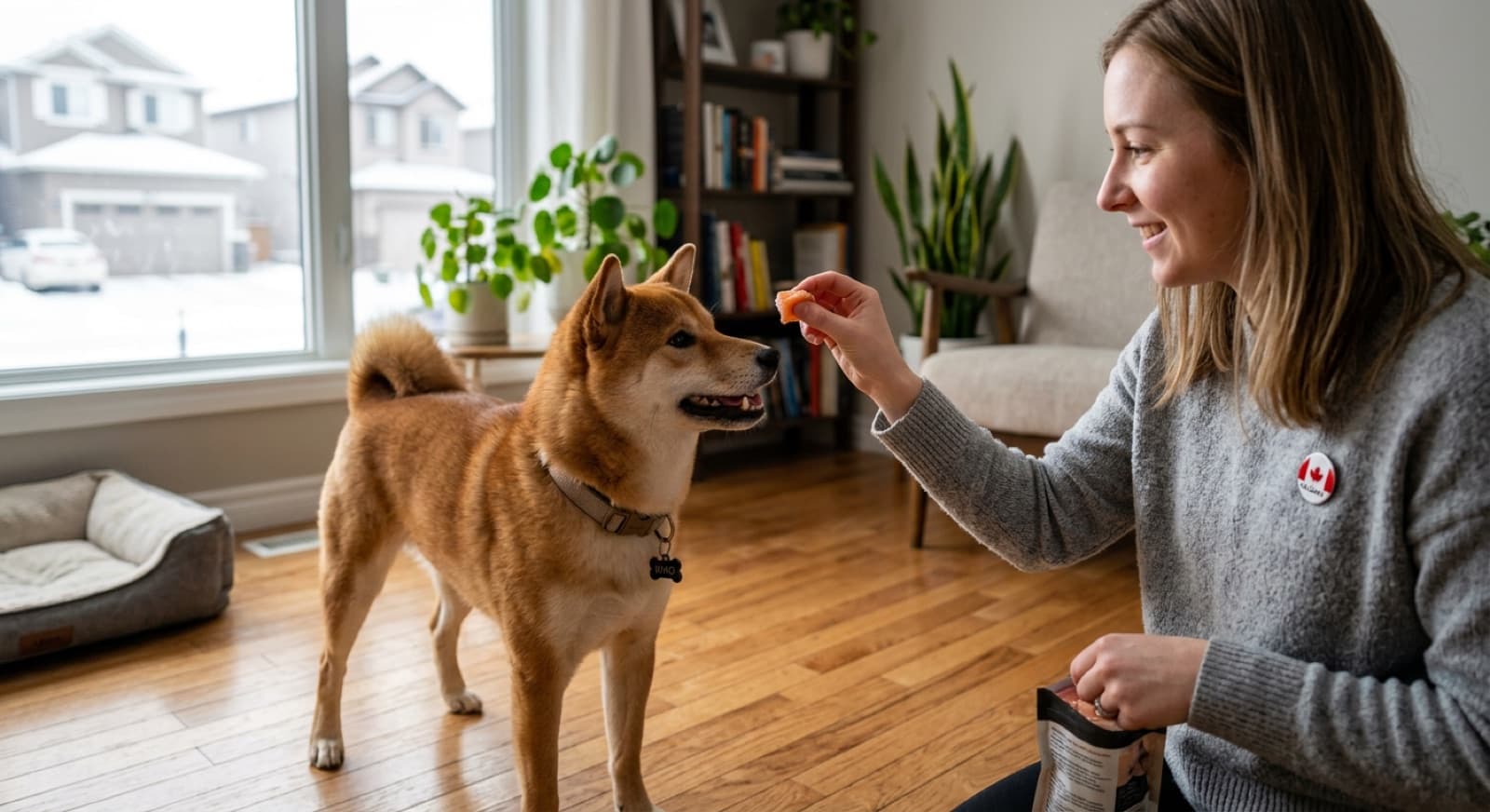
- Very high-value treats. The kibble that works for a Lab does not work for a Shiba. Calgary owners get reliable engagement with cooked chicken, cheese, small pieces of hot dog, freeze-dried liver, or commercial high-value training treats. The food must be something the dog cannot get anywhere else, in a small enough piece that the dog can swallow and re-engage quickly. A Shiba that gets cheese only during training works for cheese. A Shiba that gets cheese on dinner every night does not.
- Short three to five minute sessions. Two or three brief sessions throughout the day vastly outperform one 30-minute session. The dog stays interested, the handler does not run out of patience, and the dog ends each session wanting more rather than tuning out partway through.
- Variable reward schedules. Once a behaviour is established, do not reward every repetition. Sometimes reward, sometimes praise only, sometimes high-value reward, sometimes lower-value. The unpredictability keeps the dog engaged because the next try might pay off big. Variable schedules are how slot machines hold attention, and the same psychology applies to a Shiba.
- Trust-building as the foundation. A Shiba complies with handlers they trust. Trust is built through consistency, respect for body language, force-free handling, and never breaking the dog’s confidence in the handler. This is the slowest-building variable and the most important one. Owners who treat trust as a side effect of training rather than the foundation tend to plateau.
- Consistency from every family member. Shibas exploit inconsistency. If one household member enforces “wait at the door” and another lets the dog rush out, the dog learns the rule does not apply with one of you. Family alignment matters more for Shibas than for many breeds. A household meeting at adoption time on what the rules are and how cues will be reinforced pays back across the dog’s life.
- Never train when frustrated. The dog reads frustration immediately. A training session conducted in a tight, irritated handler-state teaches the dog that training is a high-pressure context, which reduces voluntary engagement. If you are frustrated, walk away and resume when you are calm. The dog has nothing scheduled; the session can wait an hour.
- Mark-and-reward precision. A clicker or verbal marker (“yes”) followed by food teaches the dog precisely which behaviour earned the reward. Precision matters with a breed this analytical. A vague “good dog” three seconds after the behaviour communicates almost nothing. A precise click at the moment of compliance communicates everything.
- Capture the behaviours you want. When the Shiba offers a calm sit at the door without being asked, mark and reward. When they choose to disengage from a trigger, mark and reward. Capturing voluntary good behaviour builds the dog you want faster than drilling cued behaviour.
None of this is exotic. It is the same force-free reward-based protocol that works on most breeds. The difference with Shibas is that the protocol stops working the moment you cheat on any of the variables. Switch to lower-value food and they tune out. Drill for too long and they disengage. Lose your temper once and trust takes weeks to rebuild. The protocol is unforgiving, which is why many owners reach for aversive shortcuts and make things worse.
The Shiba personality across life stages
The Shiba is a long-lived breed, often 12 to 16 years, and the personality progresses through distinct stages. Understanding what is normal at each stage helps Calgary owners avoid the most common surrender pattern, which is giving up during adolescence right before things get easier.
Puppy (0 to 6 months)
Biting and zoomies are intense. The needle-teeth phase is real, and Shiba puppies bite hard, often, and without much volume control. The socialisation window of 6 to 16 weeks is critical and load-bearing. A Shiba puppy whose socialisation window falls during a Calgary deep cold snap needs creative indoor exposure (pet store off-hours, friends’ homes, parking garages, force-free puppy class) because the window does not pause for Chinooks. Missing this window has lifelong consequences for environmental confidence and reactivity. Plan it carefully and do not skip it because of weather.
Adolescent (6 to 18 months)
The hardest period. Stubbornness peaks, recall fails, selective hearing arrives, and the dog tests every boundary they have. This is also when many first-time Shiba owners in Calgary post on Reddit asking whether they made a mistake. The honest answer is no, this is normal, and it gets better. The dog is not regressing. They are figuring out their place in the household and what the rules actually mean when no one is watching. Force-free consistency through this stage is what produces the settled adult. Aversive escalation during adolescence often produces a permanently mistrustful adult instead.
Young adult (1.5 to 3 years)
The turning point. Around 18 months Calgary owners report a noticeable shift. The dog becomes calmer, more predictable, and easier to live with. Recall improves. The exhausting puppy energy fades. By two to three years the dog you signed up for has arrived. This is the Reddit-validated turning point, and it is real. Owners who stayed consistent through adolescence reap the reward here.
Mature (3 to 9 years)
Settled. This is the dog described in the breed standard: spirited, bold, dignified, confident, deeply bonded to household. Daily life is manageable. Trust is established. Training maintenance is light. The Shiba you have at this stage is dramatically easier than the Shiba you had at 14 months.
Senior (10+ years)
Shibas are generally a healthy long-lived breed. Many remain active well into their teens. Senior care priorities shift toward joint comfort, dental hygiene, weight management, and twice-yearly vet visits to catch age-related issues early. The personality usually softens with age, and senior Shibas often become more openly affectionate than they were in their prime, though still on their terms. Calgary winters are harder on senior joints, so plan for warmer indoor surfaces, shorter cold-weather walks, and ramps or steps for couch or vehicle access if the dog is having trouble.
When do Shibas calm down?
This is the most-asked question in every Shiba owner community, and the answer is remarkably consistent across thousands of owners reporting their own dogs. The turning point is around 18 months. Owners describe it as a switch flipping. The dog who was relentless and oppositional at 15 months becomes settled and cooperative by 20 months. Full adult temperament typically arrives between two and three years.
The shift is not subtle. Calgary owners who keep journals describe noticing within a single week that the dog is asking for less stimulation, recovering faster from over-arousal, holding stays for longer, choosing to disengage from triggers they used to escalate on, and generally being easier to live with. The puppy is gone. The adult has arrived.
The implication for adopters considering a Shiba. If you adopt a six-month-old puppy, you have roughly a year of hard work ahead of you before things meaningfully ease. If you adopt a two-year-old, you are past the hardest stretch. Calgary rescues placing adult Shibas often emphasise this in matchmaking, because the difference between an adolescent and a settled adult is night and day for a first-time Shiba household.
What the turning point does not mean. It does not mean the dog becomes eager to please. It does not mean recall becomes reliable in unfenced spaces (see the dedicated escape and recall guide for that conversation). It does not mean affection style changes. The dog is still the dog. The dog is just easier to be the partner of.
Common training challenges and force-free solutions
Biting and mouthing
Shiba puppies bite hard and often. Force-free protocol: redirect to a frozen Kong, frozen carrot, or chew toy the dog can have. Teach a “gentle” cue by marking and rewarding soft mouth pressure. Use an exit-and-return protocol: if the bite is too hard, the human ends the play and walks away for 30 seconds. The dog learns that hard biting ends the fun. Do not yelp loudly (often increases arousal in Shibas), do not hold the muzzle shut, do not pin the dog down. Most Shibas resolve hard mouthing by four to five months when the protocol is consistent.
Barking and the Shiba scream
Identify the trigger first. Shibas bark or scream at restraint, frustration, fear, strangers approaching, or disagreement with a procedure. Once the trigger is identified, build threshold tolerance through sub-threshold exposure paired with food. For the scream specifically, build cooperative-care behaviours so the dog consents to procedures (nail trims, baths, vet handling) rather than being restrained against their will. Never reward screaming or barking with attention, but also do not punish it; the dog is communicating. Capture and reward the quiet moments between vocalisations.
Growling
Never punish growling. This is the single most important rule in Shiba behaviour management. A growl is communication. The dog is telling you they are uncomfortable, that they want space, that a resource is theirs, or that a handling event is unwelcome. Punishing the growl teaches the dog that growling produces consequences, so the dog skips the growl next time and goes straight to a snap or bite. The growl is your warning system. Address the underlying trigger (more space, trade-up for the resource, change the handling approach) and the growl resolves on its own.
Pulling on leash
Front-clip harness is the starting hardware (not a flat collar, not a harness with a back-clip only). For Shibas with strong pulling habits, a 3-strap escape-proof setup is often safer because Shibas are escape artists. The training: stop-when-pulls (the moment the leash tightens, the human stops moving) or change-direction (the moment the leash tightens, the human turns and walks the other way). Both teach the dog that pulling does not produce forward movement. Loose leash earns continued walking. This is slow work and takes months. The reward is a Shiba you can actually walk with.
Ignoring commands when distracted
Normal. Build distraction tolerance gradually. Start in low-distraction environments (kitchen, backyard) and progress to higher distraction (front yard on quiet days, then quiet pathway, then busier pathway, then a Calgary off-leash perimeter on a leash). Pay heavily for compliance in higher-distraction settings. Never punish for inattention; the dog is not being defiant, the reward at the current distraction level is not competitive enough.
Trust-building as the foundation
Trust is the load-bearing variable in every Shiba relationship. A Shiba that trusts their handler will work hard, accept handling, recover quickly from setbacks, and choose to engage even in tough conditions. A Shiba that does not trust their handler will withhold compliance regardless of how skilled the training plan is.
Trust with a Shiba is built through these specific things, in roughly descending importance:
- Consistency. The dog can predict what the handler will do. The rules are the same on Monday as on Friday. The cue means the same thing across every context. Inconsistency damages trust because the dog cannot predict the handler’s behaviour.
- Force-free handling, always. The dog never has to brace for unpleasant handling. Nail trims, baths, vet visits, ear cleanings, all built through cooperative-care training where the dog consents. The handler never grabs, pins, scruffs, or alpha-rolls.
- Respecting body language. When the Shiba turns away, the interaction ends. When they show signs of stress (lip lick, head turn, whale eye), the trigger is reduced. The handler treats body language as communication that matters, not as something to push through.
- Never forcing physical contact. Petting happens when the dog invites it. Hugs, picking the dog up, lap-sitting, all let the dog choose. A Shiba forced into physical contact they did not consent to learns that the handler ignores their boundaries, which damages trust permanently.
- Following through. Cues mean what they mean. If the recall cue is given, the recall is reinforced when it happens. The handler does not abandon cues mid-attempt, which would teach the dog that cues are negotiable.
- Predictable consequences for good behaviour. Voluntary good behaviour is reliably reinforced. The dog learns that engaging produces reward, which makes engagement more likely next time.
Trust is also lost through specific things. A single significant breach (a frustrated scruff, a forceful nail trim, an alpha-roll out of frustration) sets trust back weeks. Repeated minor breaches compound. Owners who think of trust as something they have rather than something they continuously earn tend to lose it without realising. The Shiba notices.
Are Shibas affectionate? Do they cuddle?
Sometimes. On their terms. Varies dramatically by individual. This is the honest answer.
Many Shibas are not cuddle-prone. A typical Shiba shows affection through proximity rather than physical contact. They will follow family members from room to room, lie nearby while you work, position themselves where they can see you, and clearly choose their household over alternatives. That is affection. It just does not look like the velcro-snuggler model many first-time owners expect.
Some Shibas do cuddle. Some sleep in their humans’ beds, lean into petting, climb into laps. This is not a defective Shiba; it is genuine individual variation. But it is not the breed default, and expecting it sets the relationship up for disappointment.
Reddit owner reports converge on a clear pattern. Setting the expectation at “loving but independent” rather than “velcro snuggler” produces a much happier owner-dog relationship. The Shiba is showing all the affection they have. The mismatch is the human’s expectation, not the dog’s capacity.
Practical implication for Calgary households considering adoption. If the household needs a dog that climbs into laps, accepts long hugs, sleeps cuddled up, and shows affection through constant physical contact, the Shiba is the wrong breed. Cavalier, Golden Retriever, and many Doodle mixes deliver that profile reliably. If the household wants a dog that loves their people fiercely while maintaining their dignity and choosing affection on their own terms, the Shiba is exactly right.
Aggression: what is normal vs concerning
Shibas are alert, self-confident, and opinionated. Some of what looks like aggression to a new Shiba owner is normal breed communication. Some is genuine behavioural concern. Reading the difference is the first job.
Normal Shiba behaviour that often gets mislabeled as aggression:
- Growling at unfamiliar handling, a stranger reaching over the head, or restraint they did not consent to. This is communication. Address the trigger; do not punish the growl.
- Resource guarding around high-value food or chews. Common in the breed and very common in rescue dogs from any background. Trade-up training resolves most cases.
- Stiffening or staring when another dog approaches in a way the Shiba reads as rude. The Shiba is communicating disagreement; the polite outcome is usually space.
- Snapping at the air during inappropriate handling. An air-snap is a warning, not a bite. The handling needs to change, not the dog.
Genuinely concerning behaviour that needs professional escalation:
- Snapping at strangers without any warning sequence (no growl, no stiff body, no warning). This indicates either learned suppression of warning behaviours (often from punishment of growling) or a more complex behavioural picture.
- Aggression toward primary household members, especially children.
- Bites that have made skin contact or caused punctures, not just air-snaps.
- Severe same-sex dog-on-dog aggression that has resulted in actual fights, not just posturing. Two-female Shiba pairings can be particularly high-risk; two-male less so but still meaningful. Mixed-sex pairs are generally safer.
- Generalised aggression that is not tied to a specific predictable trigger.
Same-sex dog-on-dog aggression in Shibas tends to escalate at social maturity, between 18 and 36 months. If you have two same-sex adult Shibas and tension is developing, work with a force-free Calgary trainer experienced with multi-dog homes before things escalate. If any real fight occurs, escalate immediately to a veterinary behaviourist. Repeat fighting after the first incident becomes substantially more likely.
Browse adoptable Shiba Inus in Calgary
Adult Shibas at Calgary rescues are often past the hardest adolescent stretch. The settled adult Shiba is dramatically easier to live with than the puppy or adolescent, and rescue matchmaking helps you find the right temperament fit.
See Available Shiba Inus →Calgary force-free trainer referrals
The Calgary trainers most commonly recommended within the Pawfinder rescue network for opinionated breeds like the Shiba use force-free, reward-based methods exclusively. Two practices most often cited:
- Raising Canine. Calgary force-free training practice with experience across independent and opinionated breeds. Offers private consultations, group classes, and behavioural programming. Confirm current intake and class schedule directly with them.
- Pup City Pup Academy. Calgary positive-reinforcement trainer working with rescue dogs and primitive-type breeds. Group classes plus private sessions. Same vetting questions apply: no prong, no choke, no e-collar.
Vetting any Calgary trainer for a Shiba. Ask three questions before booking. First, do you ever use prong, choke, or e-collars? The correct answer is no. Second, have you worked with primitive-type or independent breeds like Shibas, Akitas, Basenjis, or Huskies? The correct answer is yes, with specific examples. Third, what do you do when a dog growls at you during a session? The correct answer is that you add distance and reassess; you do not correct the growl. If the trainer fails any of these, find a different trainer. The IAABC clinical animal behaviour consultant directory also lists certified consultants serving Calgary by remote consultation, which can be useful for specialty cases.
When to involve a veterinary behaviourist
A force-free trainer is the right starting point for most Shiba behaviour work. A board-certified veterinary behaviourist (DACVB) or a qualified IAABC clinical animal behaviour consultant is the right escalation when the situation crosses specific lines.
Escalation criteria. Call a veterinary behaviourist if any of these apply:
- The dog has bitten with skin contact, punctures, or multiple bites in one incident (not just an air-snap)
- Aggression has appeared or worsened suddenly in an adult dog, after a thorough medical workup has ruled out (or identified) pain
- Aggression is generalised rather than tied to a single predictable trigger
- The dog is showing aggression toward primary household members, not just strangers
- Suspected medical-behavioural overlap (sudden behaviour change, neurological signs, pain indicators)
- Severe panic, fear, or separation distress that is not responding to early force-free intervention
- Two same-sex Shibas in the household with escalating tension
- Children are in the household and the situation feels unsafe for them
- Two or more force-free trainers have flagged the case as out of their scope
What a veterinary behaviourist does. A DACVB is a licensed veterinarian with post-graduate specialty training in behaviour medicine. They can rule out and treat medical contributors, co-manage cases with your force-free trainer, and where appropriate prescribe behaviour-supporting medications as part of an integrated plan. We do not recommend any specific medication in this article. Medication decisions belong with the prescribing clinician who has examined the dog.
How to get a referral in Calgary. Start with your regular vet, who can refer to a DACVB. In Alberta the nearest specialists are typically based in larger centres and some offer remote-consultation models for Calgary cases. Western Veterinary Specialist Centre and VCA Canada West are the Calgary specialty practices most commonly involved when a referral is needed. An IAABC certified consultant can also be approached directly without a vet referral, though for a true aggression case the integrated medical-and-behaviour model is preferable.
Do not wait for a serious incident. A Shiba that air-snapped once at a visiting child is the right time to escalate, not the time to dismiss. Early intervention has a much better prognosis than crisis intervention after a bite.
A note on off-leash and recall
This article covers training fundamentals and temperament. Off-leash work, recall reliability, escape prevention, gear (front-clip harness, 3-strap setup, long-line work), and the specific Calgary fenced spaces where a Shiba can earn safe off-leash time are covered in detail in the dedicated Shiba escape and recall safety guide. The short version: Shibas are escape artists with high prey drive and independent dispositions, and reliable off-leash work in unfenced Calgary spaces is rare. Default to on-leash or fully fenced, and refer to the dedicated guide for the full protocol.
Sources and further reading
- American Kennel Club: Shiba Inu breed profile and temperament standard
- Canadian Kennel Club: Shiba Inu breed standard
- American Veterinary Society of Animal Behavior (AVSAB): position statements on puppy socialisation and humane training
- International Association of Animal Behaviour Consultants (IAABC): clinical animal behaviour consultant directory
- club
This article is informational. It is not behavioural or veterinary advice for an individual dog. For specific aggression, fear, or pain concerns, work with your Calgary veterinarian, a force-free trainer experienced with independent breeds, and where appropriate a board-certified veterinary behaviourist.
Frequently Asked Questions
Are Shibas really that stubborn?
Not exactly. Shibas are independent and opinionated, not stubborn in the traditional sense. The breed was developed in mountainous Japan to hunt small game alongside humans without constant direction, which selected for dogs that think for themselves. A Shiba learns a new cue often in one or two repetitions. They simply choose whether to comply based on what they get out of it. Calgary owners coming from Labrador, Golden, or Poodle experience are used to dogs that work because the human asked. Shibas work because the deal is worth it. This is the same behavioural profile cat owners recognise, and it is by design, not a training failure.
When does a Shiba calm down?
Around 18 months is the consistent owner-reported turning point, with the full settled adult temperament usually arriving between two and three years. The puppy and adolescent stages are the hardest with Shibas. Biting, zoomies, recall failure, and selective hearing peak between six and 18 months. Owners who post on the Calgary rescue forums and on the broader Shiba community describe a noticeable shift around the dog’s second birthday, when the dog they signed up for finally arrives. The settled adult Shiba is dramatically easier than the adolescent. If you are in the hard middle, the work is to stay consistent, keep training force-free, and not give up before the turning point arrives.
Why does my Shiba ignore me?
They are not ignoring you in the obedience-failure sense. They have heard you and are evaluating the cost-benefit of compliance. If your recall pays off in praise but the squirrel pays off in a chase, the squirrel wins. The fix is changing the math, not increasing the pressure. Use very high-value treats (cheese, hot dog pieces, freeze-dried liver) that the dog cannot get anywhere else, keep training sessions short (three to five minutes), use variable reward schedules so the dog stays interested, and never punish inattention because punishment damages trust and makes the next compliance decision harder. If your Shiba sits perfectly at home and ignores the cue at the off-leash perimeter, the cue is not the issue. The reward value at the perimeter is.
Are Shibas affectionate? Do they cuddle?
Sometimes, on their terms, and it varies significantly by individual. Many Shibas are not cuddle-prone. Some are. The honest expectation is loving but independent, not velcro-snuggler. A typical Shiba bonds intensely to their household, follows family members around the house, and shows affection through proximity rather than physical contact. Many will accept brief petting and then move to their own spot. Forcing physical contact (hugs, holding, lap-sitting) on a Shiba that is not inviting it is the fastest way to damage trust. The Shibas that do cuddle generally choose when and on whose terms. If you want a dog that climbs into your lap on demand, the Shiba is the wrong breed. If you want a dog that loves their people fiercely while keeping their dignity, the Shiba is exactly right.
Are Shibas aggressive?
Not in the unprovoked sense. The breed is alert and self-confident, and individuals can show resource guarding, growling at handling they did not consent to, and same-sex aggression toward other dogs. None of this is unprovoked aggression. It is communication. A Shiba that growls when their food is approached is telling you they are uncomfortable, not warning of an unprovoked attack. The behaviour to be concerned about is snapping at strangers without warning, escalating aggression toward primary household members, or any aggression that has resulted in skin-puncture bites. Those cases need a board-certified veterinary behaviourist (DACVB) or a qualified IAABC consultant. Normal Shiba growling, opinionated body language, and same-sex dog-on-dog tension are managed with force-free training and management, not punishment.
Why does my Shiba scream?
The Shiba scream is breed-distinctive. It is a high-pitched vocalisation triggered by frustration, fear, restraint, or strong disagreement with what is being done to them. Common triggers: nail trims, baths, being picked up against their will, being held in place at the vet, or being prevented from doing something they want. The scream is not pain in most cases, though it sounds dramatic enough that Calgary owners often call the vet thinking the dog is injured. The fix is force-free handling, building cooperative-care behaviours so the dog consents to procedures, and avoiding situations that produce the scream. Forcing through a scream teaches the dog that the human ignores their communication, which makes everything harder later.
Can I train a Shiba off-leash?
Reliable off-leash work with a Shiba in unfenced Calgary spaces is rare. The breed has high prey drive and an independent disposition, and recall failure under distraction is the breed default rather than the exception. For the full off-leash safety protocol, fenced area options, and the gear that actually contains a Shiba (front-clip harness, 3-strap escape-proof setup, long-line work), see the dedicated guide on Shiba escape and recall safety. This temperament article covers training fundamentals; that one covers off-leash specifically. The short version: assume your Shiba should be on-leash or in fully fenced spaces by default, and earn off-leash freedom only in genuinely contained environments.
Do Shibas do well with other dogs?
Mixed picture. Many Shibas do well with one steady opposite-sex companion they were introduced to carefully. Same-sex dog-on-dog aggression is a documented risk in the breed, particularly between two adult females. Off-leash dog parks are usually not a good environment because the Shiba’s body language is often misread by other dogs and their humans, and high-arousal interactions go sideways fast. The pattern that tends to work in Calgary households: one Shiba plus one opposite-sex dog of a different breed, both spayed and neutered, careful introductions, supervised play, and management around resources. If you already have a same-sex Shiba and tension is developing, work with a force-free Calgary trainer experienced with multi-dog homes before things escalate.
How long does it take a rescue Shiba to settle in Calgary?
Six to twelve months is realistic, with the decompression period being the first three weeks. During decompression: minimal outings, no visitors, no busy environments, no training demands beyond house routine. Months one to three are foundation building (predictable schedule, force-free class, learning the household). Months three to six are work (structured socialisation, addressing reactivity, building trust). Months six to twelve are integration. The classic Shiba pattern is a dog who appears settled within the first month and then tests every boundary in month two as they figure out the new household. This is normal. Stay consistent on force-free handling, do not punish growls or body-language communication, and the work pays off as trust builds.
When should I call a veterinary behaviourist for my Shiba?
Escalate from a force-free trainer to a board-certified veterinary behaviourist (DACVB) or a qualified IAABC clinical animal behaviour consultant when: the dog has bitten with skin contact or punctures (not just an air-snap), aggression has appeared or worsened suddenly in an adult (medical workup first to rule out pain), the dog is showing aggression toward primary household members, panic disorders or severe fear are not responding to early intervention, or two force-free trainers have flagged the case as out of their scope. A DACVB is a licensed veterinarian with post-graduate specialty training in behaviour medicine. Calgary owners typically need a referral from their regular vet. Western Veterinary Specialist Centre and VCA Canada West are the Calgary specialty practices most often involved. Do not wait for a serious incident; early escalation has a much better prognosis.
Shiba Inu Adoption Calgary
Where to find Shiba Inus in Calgary, rescue vs breeder costs, breed-specific rescue verification, free-Shiba warning signs, and what to expect from the adoption process.
Shiba Inu Escapes and Recall
Why Shibas escape and ignore recall: fence-proofing, door-dashing, harness fit and reward-based training.
Is a Shiba Inu Right for You?
Honest fit assessment for first-time owners considering a Shiba in Calgary. Lifestyle questions, common surrender patterns, and who the breed genuinely suits.
Shiba Inus for Adoption in Calgary
Current Shiba Inu and Shiba-mix listings from Calgary Humane, AARCS, and the partner rescue network. Updated regularly.
New dog? Start with these care guides
Everything a new adopter needs to set up a safe, happy home.