The short answer
Vizslas are rare in Calgary rescue and most listings place within days. Apply broadly to Calgary Humane Society, AARCS, BARCS, Pawsitive Match, ARF Alberta, Cochrane Humane Society, and Heaven Can Wait, and set up notifications so you see new listings quickly. Rescue fees are typically $400 to $800 versus $2,000 to $3,500 for an ethical Canadian Kennel Club breeder puppy with a 6 to 18 month wait. Calgary winters require real coat and booties. The dealbreaker for most households is velcro and separation anxiety, not exercise.
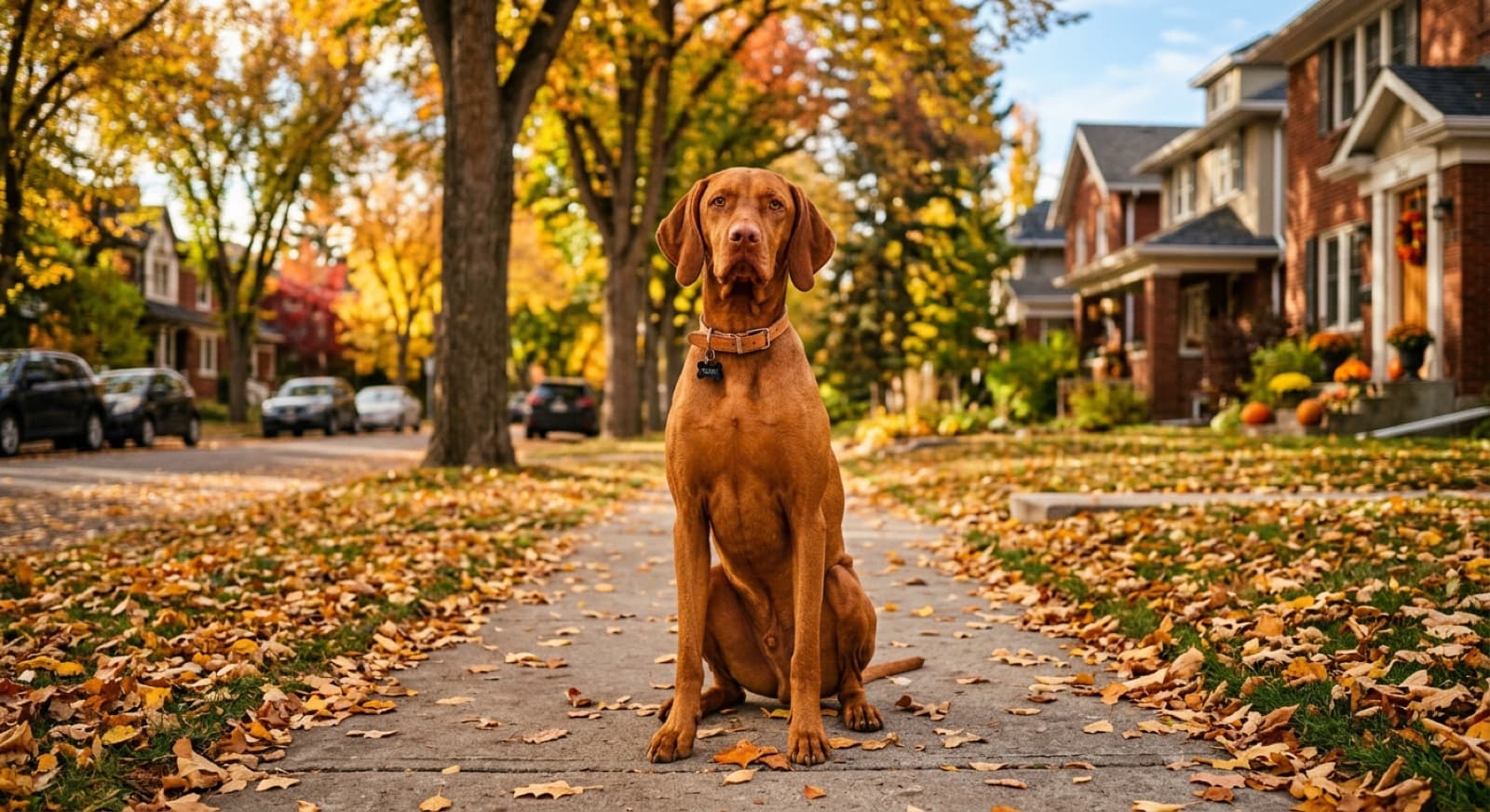
The Vizsla is one of the most family-bonded sporting breeds in the world. Developed in Hungary as an all-purpose hunting companion for pointing, retrieving, and tracking, the modern Vizsla still carries that working drive in a 45 to 65 pound athletic body. The breed is intelligent, eager to please, and so attached to its people that the nickname “Velcro Vizsla” is genuinely earned. In Calgary, Vizslas are uncommon in rescue, place within days when they appear, and almost never show up as puppies. This guide covers where to find one, what a realistic budget looks like, why so many young-adult Vizslas get surrendered to Canadian rescues, and how rescue and breeder paths actually compare for this breed.
The Vizsla at a glance
Vizslas are a medium-large sporting breed with a short rust-coloured single coat, lean athletic build, and floppy ears. According to the American Kennel Club and the Canadian Kennel Club, the breed standard is consistent across both registries. The Vizsla Club of Canada maintains the Canadian breed parent club standard and rescue referral network.
| Trait | Typical range |
|---|---|
| Adult weight | 45 to 65 lbs (20 to 29 kg) |
| Adult height (shoulder) | 21 to 24 inches (53 to 61 cm) |
| Lifespan | 12 to 14 years |
| Coat | Short single coat, rust or golden rust, minimal shedding |
| Energy level | High; sporting-dog drive built for full-day hunting |
| Exercise needs | 60 to 90 minutes daily plus mental enrichment |
| Temperament | Velcro-bonded, sensitive, intelligent, intensely affectionate |
Vizslas are physically apartment-compatible, but they are also notoriously dependent on human company. Verify your daily schedule and household availability before applying. A Vizsla left alone all workweek is the breed's most common surrender pattern.
Where to adopt a Vizsla in Calgary
Vizslas are uncommon in Calgary rescue. The strategy is the same as any low-inventory breed: apply broadly, set up alerts, and be ready to move within hours when a listing appears. In our experience working with Calgary adopters, the families who land a Vizsla are the ones who applied to multiple rescues before a dog was even listed.
Calgary-area rescues to monitor:
- Calgary Humane Society: the largest local shelter, occasional Vizsla or Vizsla-mix intakes from owner surrenders.
- AARCS: foster-based; structured “good with” evaluations are valuable for a sensitive, velcro-prone breed.
- BARCS Rescue: Calgary foster network; sporting and pointer-type mixes appear from time to time.
- Pawsitive Match: Calgary foster-based; sporting and bird-dog breeds appear occasionally.
- ARF Alberta: Calgary foster network; broad medium-to-large dog inventory.
- Cochrane Humane Society: Cochrane-based, serves the Calgary region.
- Heaven Can Wait: based in High River, Calgary placement common.
- Calgary Animal Services: the municipal facility, occasional stray or surrendered Vizslas.
The single best move is to set up notifications on the LocalPetFinder Vizsla breed page. Live listings from 15+ Calgary rescues land there as they appear, and you will catch a new arrival before most adopters do.
National-level breed rescues are also worth knowing. The Vizsla Club of Canada runs a national rescue referral network through its regional member clubs, and Magyar Vizsla Rescue coordinates breed-specific intake across North America with occasional Canadian placements. Expect a more thorough application process than a general rescue, including a home visit, vet reference checks, and detailed questions about your daily schedule, training philosophy, and time-alone tolerance. Breed-specific rescues are especially careful about velcro placements because most of their dogs were surrendered for that exact reason.
What does a Vizsla cost in Calgary?
Calgary fees vary by rescue and what is included. The realistic ranges below are directional, not quotes:
| Source | Fee range | Typically includes |
|---|---|---|
| Calgary Humane Society | $400 to $600 | Spay or neuter, vaccinations, microchip, vet exam |
| AARCS | $500 to $700 | Spay or neuter, vaccinations, microchip, foster history |
| BARCS / Pawsitive Match / ARF Alberta | $500 to $800 | Spay or neuter, vaccinations, microchip, foster notes |
| Breed-specific rescue transport | $600 to $800 | Transport, foster-based temperament evaluation |
| CKC-registered breeder puppy | $2,000 to $3,500 | Health screening, contract, breeder support, 6 to 18 month waitlist |
The adoption fee is only the entry cost. Annual care for a Vizsla in Calgary runs higher than the size suggests because of two real line items: winter clothing and daycare. Plan for:
- Winter clothing: a properly insulated winter coat is non-optional in Calgary, similar to a Doberman. Budget $80 to $200 for a good coat and $40 to $80 for booties. Plan to replace booties annually.
- Daycare or dog walker: almost every Calgary Vizsla owner with a full-time office job uses daycare two to five days a week to manage separation anxiety. Calgary daycare runs $35 to $50 per day, so plan $300 to $700 per month if you go daily.
- Food and treats: $70 to $120 per month depending on quality tier. Vizslas are athletic and burn through calories.
- Vet and preventive care: roughly $500 to $900 per year for routine wellness, vaccines, parasite prevention, and dental.
- Pet insurance: strongly recommended for this breed. Plan for $60 to $100 per month given Vizsla-specific cancer, epilepsy, and hip risks.
- Force-free training: group classes with Raising Canine or Pup City Pup Academy typically run $200 to $400 for a 6-week course. Vizsla temperament rewards positive reinforcement and breaks under harsh methods.
- Calgary dog licence: required for every dog three months and older under the Responsible Pet Ownership Bylaw. A small annual fee.
First-year totals typically land between $3,500 and $6,000 once you add gear, training, daycare, and licence on top of the adoption fee. The daycare line is the variable that swings the most. For a full breakdown of lifetime ownership cost in Calgary, see our Calgary adoption costs guide.
Why Vizslas end up in Calgary rescue
Understanding why this breed gets surrendered helps you build a household where it does not happen to your dog. The patterns we hear from Calgary rescues are consistent. Most Vizsla surrenders are 2 to 6 year old young adults, not puppies or seniors. The single biggest driver is velcro and separation anxiety.
- Velcro and separation anxiety. This is the number-one surrender driver for the breed in Calgary and across North America. Vizslas form intense one-household bonds and struggle hard when left alone. Owners with full-workday-alone schedules who skipped the research often hit a wall around month four: the dog scratches doors, howls through the workday, breaks crates, and rips drywall. The neighbour complaints follow. Read our companion guide on Vizsla velcro and separation anxiety for the full protocol.
- Sensitive-temperament mismatch. Vizslas cannot tolerate harsh training methods or chaotic households. Owners who use prong collars, e-collars, or aversive corrections often end up with a dog that shuts down, develops fear-based reactivity, or starts resource guarding. The breed needs force-free methods only.
- Lifestyle changes. Move, divorce, new baby, job change. Common across breeds, but a velcro dog is especially hard to rehome after years in one household.
- Full-workday-alone households. Calgary has a lot of office-return households post-2024, and Vizslas adopted during work-from-home years started getting surrendered when their owners returned to in-office schedules. This is a distinct surrender pattern from classic separation anxiety: the dog was fine until the schedule changed.
- Exercise mismatch. First-time owners who picked the breed for the rust-coloured photo aesthetic hit the wall around month six when the sporting drive shows up. Vizslas need 60 to 90 minutes of daily off-leash running plus mental enrichment.
- Owner medical or end-of-life. Rescues see a steady trickle of senior Vizslas whose owners moved into care or passed.
None of these are problems with the breed. They are problems with the match. Calgary rescues that run foster-based programs (AARCS, Pawsitive Match, ARF Alberta, BARCS) are the best resource for a Vizsla whose adult temperament and separation tolerance is already known, which avoids most of the patterns above.
Adult versus puppy: which Vizsla is right for you?
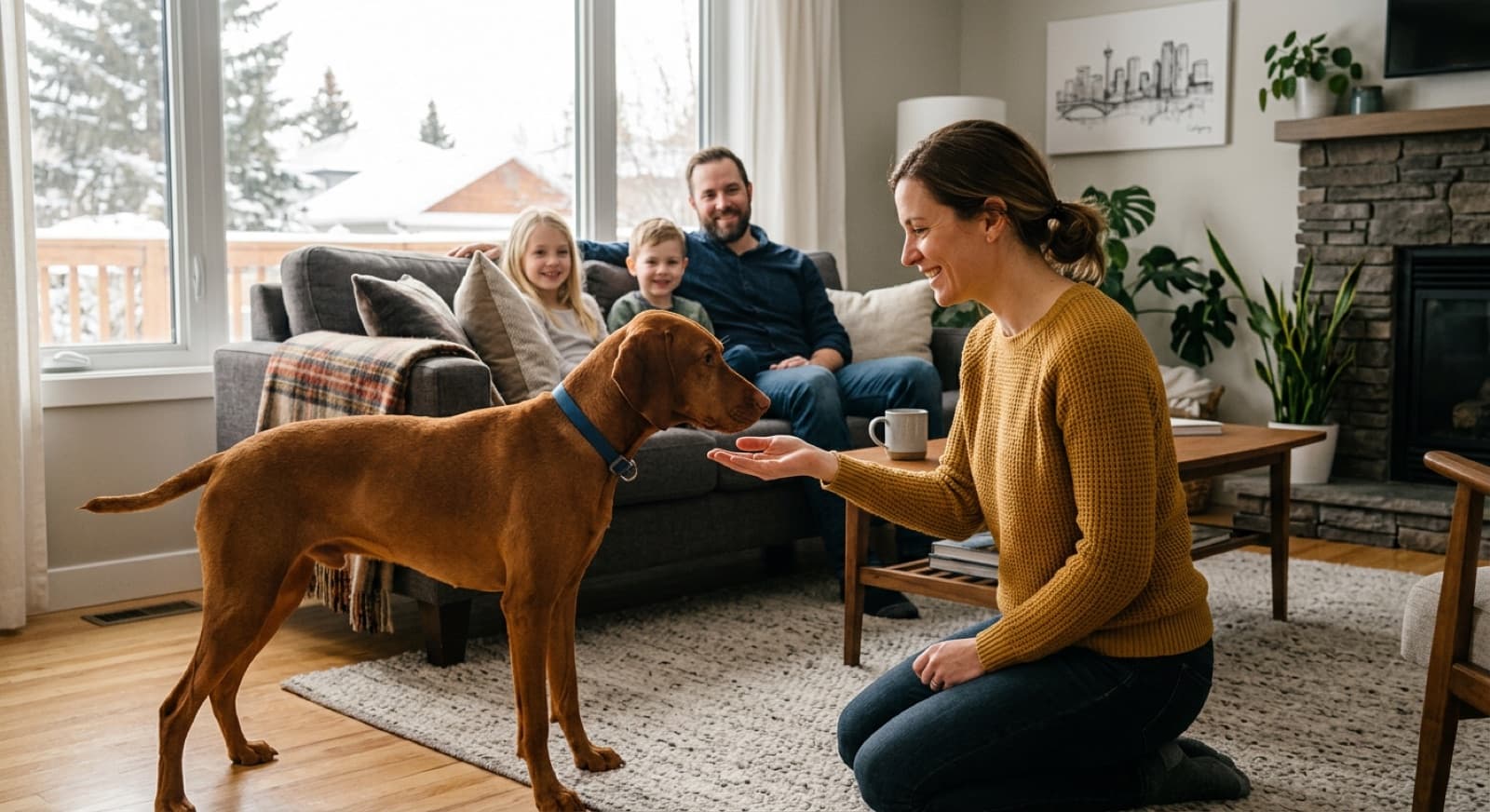
For most Calgary adopters, an adult Vizsla from a foster home is the better fit. Vizsla puppies are genuinely rare in Calgary rescue. Almost every Vizsla listing through Calgary rescues is a 2 to 6 year old young adult surrendered because of velcro, separation anxiety, or a schedule change. These dogs are typically well past the chewing phase, already house-trained, and have known temperament from their foster placement.
Why the adult-from-foster path tends to work best for this breed:
- Known separation tolerance. Some adult Vizslas have done the work and tolerate four to six hours alone; others cannot do an hour. A foster knows exactly which one you are bringing home before you sign.
- Known compatibility with kids, cats, and other dogs. Foster households evaluate this in real life, not a kennel.
- Known training history. An adult Vizsla that was force-free trained is a delight. An adult Vizsla that was harshly trained needs a careful trainer, and the foster will tell you up front.
- Past the chewing phase. Vizsla puppies chew baseboards, shoes, and remote controls. An adult skips that.
- Lifespan math still favours the adult. A 4-year-old Vizsla adopted today has 8 to 10 years ahead, which is most of a typical owner relationship.
Puppies make sense if you specifically want to shape socialisation from week 8, you have the flexibility for 12 to 18 months of structured training, and you have prior experience with velcro sporting breeds. Calgary Vizsla puppy waitlists with Canadian Kennel Club breeders run 6 to 18 months, so most adopters who insist on a puppy end up waiting that long or unintentionally buying from a backyard source. For first-week guidance once your dog arrives, see the first week with a rescue dog.
Common Vizsla mixes in Calgary rescues
Most Calgary “Vizsla” listings are mixes. Be honest about this when you set your expectations. Mixes are still excellent dogs, and several Vizsla crosses make easier first-time pets than the purebred, but daily life with each cross is genuinely different. All three of the common Vizsla mixes share the velcro tendency to some degree.
- Vizsla-Lab (Labrador cross): the most common Vizsla cross in Calgary rescue. Slightly heavier (55 to 75 lbs), often with a longer coat, and typically slightly more independent than a purebred Vizsla. Still velcro, but easier to leave alone for a workday. Best for active families wanting the Vizsla look with somewhat lower separation anxiety.
- Vizsla-Pointer (German Shorthaired Pointer or English Pointer cross): very high drive (50 to 70 lbs), strong prey drive, and even more athletic than a purebred Vizsla. Best for owners with prior bird-dog experience, secure fenced yards, and a real exercise budget. Shares the velcro tendency and the cold-sensitive single coat.
- Vizsla-Weimaraner cross: larger (55 to 80 lbs), often grey-rust mix coat, intense velcro behaviour (Weimaraners are also famously velcro). Both parent breeds struggle with separation anxiety, so this cross is the highest-risk for the surrender pattern. Best for households with someone home most of the day.
- Vizsla-mix of unknown origin: the most common label on Calgary rescue intake. Ask for the foster's temperament notes and read them carefully before applying. The notes matter more than the breed label.
The realistic message: if you want an athletic, family-bonded, rust-coloured sporting dog who loves training and can handle Calgary outdoor life, several mixes deliver almost exactly that experience. Holding out for a purebred can mean waiting many months on a breeder list or paying a premium for a dog whose lineage cannot be verified.
Vizsla and Wirehaired Vizsla: two different breeds
This trips up almost every first-time Vizsla adopter, so it is worth being explicit. The American Kennel Club recognised the Wirehaired Vizsla as its own separate breed in 2014, distinct from the smooth-coat Vizsla. The Canadian Kennel Club follows a similar separation. They look related, share Hungarian sporting-dog roots, and are often confused at a distance, but they are not the same dog.
- Vizsla (smooth-coat): developed in Hungary as an all-purpose pointing and retrieving breed. 45 to 65 lbs, 21 to 24 inches at the shoulder. Short rust-coloured single coat. The breed most people picture when they say “Vizsla.”
- Wirehaired Vizsla: developed in Hungary in the 1930s by crossing smooth Vizslas with German Wirehaired Pointers. 45 to 65 lbs, 21 to 25 inches at the shoulder. Coarse wire coat with a distinct beard and eyebrows. Slightly heavier-boned. Marginally better suited to cold weather than the smooth-coat thanks to the coarser coat.
Most Calgary Vizsla rescue intake is smooth-coat. Wirehaired Vizslas are even rarer in Canadian rescue than the smooth-coat variety. If you adopt a dog labelled “Vizsla” from a Calgary rescue and the foster suspects a wire coat, ask. Why the distinction matters in Calgary: insurance applications, registration for performance sports, and breed-specific rescue all key off the actual breed paperwork. Daily life is similar, but the wire-coat dog needs slightly less winter clothing and slightly more coat-line grooming.
Buying versus adopting: the ethical breeder framework
For most Calgary households, adoption is the right starting point. The math is straightforward: a $400 to $800 rescue fee with a vetted, spay-neutered, foster-evaluated dog versus $2,000 to $3,500 for a breeder puppy with a 6 to 18 month wait.
The case for rescue is strongest when:
- You want a known adult temperament and known separation tolerance rather than rolling the dice on a puppy.
- You can accept “Vizsla” or “Vizsla mix” rather than a verified purebred. Most rescue Vizslas in Calgary do not come with papers.
- You want to keep one more dog out of the velcro-surrender cycle that hits this breed's young adults.
- You do not want to wait 6 to 18 months on a breeder list.
The case for an ethical breeder is narrow but real. It applies when:
- You need a verifiable health-screened puppy (OFA hip clearance, eye CERF, thyroid panel, and where available a polymyositis screening).
- You are prepared to wait 6 to 18 months and budget $2,000 to $3,500.
- You want to shape socialisation from week 8 in a household with specific exposure goals (kids, other dogs, busy public spaces, performance sports, hunting work).
How to vet a Vizsla breeder in Canada:
- Verify Canadian Kennel Club registration on the breeder, not just the puppy.
- Ask for parent health clearances in writing: hip OFA, eye CERF or OFA, thyroid panel, and von Willebrand DNA test.
- Ask whether the breeder screens for polymyositis, the Vizsla-specific autoimmune condition. Awareness of the condition is itself a signal.
- Visit the home or request a live video tour of where puppies are raised.
- Expect the breeder to interview you. Breeders who do not ask questions are a red flag.
- Confirm a written take-back contract. Ethical breeders take their dogs back at any age, for any reason.
- Reference the breeder against the Vizsla Club of Canada code of ethics and the regional member club referral list.
The most common Calgary search for this breed is some version of “Vizsla puppy for sale Calgary cheap.” Almost every listing under $1,800 is a problem. The realistic picture:
- Free-to-good-home “Vizsla” on Kijiji: often a scam or an unverified rehome. Genuine Vizsla owners surrendering a dog go through a Calgary rescue or back to the breeder, not a free Kijiji post. Free listings frequently target dog-flipping networks.
- $800 to $1,500 “Vizsla” on Kijiji or Facebook Marketplace: usually a Vizsla-Lab cross, a Pointer mix, or an undocumented backyard litter. The dog may be lovely, but the breed identity is not verifiable.
- $1,500 to $2,000 “purebred” with no health clearances: typically a commercial breeder running parent dogs hard. The parents often surrender to rescue around age 4 to 6 once their breeding career ends.
- $2,000 to $3,500 from a CKC member breeder with documented testing: the realistic ethical Canadian range. Yes, the price feels high. The math reflects health testing, breeder vet costs, careful pairing, and a take-back lifetime obligation.
- “Miniature Vizsla” or “Toy Vizsla”: not a recognised variation. The marketing usually covers a runt, an unhealthy under-bred dog, or a Vizsla-mini-mix sold at a premium.
The rescues we work with see most of these “cheap Vizsla” dogs land in shelter intake within 18 months. The dog is the casualty. Skip Kijiji, Facebook Marketplace, and pet-store listings entirely. If a verifiable puppy is the only acceptable outcome, wait the 6 to 18 months on a Canadian Kennel Club Vizsla breeder list.
Calgary climate fit: winter clothing required, summers easy
Vizslas have a short single coat with no insulating undercoat. The breed is genuinely cold-sensitive in Calgary winters, following the same pattern as the Doberman. A Vizsla shivers in a t-shirt at minus 5 degrees Celsius and cannot safely run a 60-minute loop in deep cold without proper gear. This is a real ongoing cost and a real daily-life adjustment.
The realistic Calgary winter protocol for a Vizsla:
- Below minus 5 degrees Celsius: insulated winter coat for every outing longer than a bathroom break. A good Vizsla coat from a specialty Calgary dog outfitter runs $80 to $200.
- Below minus 15 degrees Celsius: add booties. Calgary sidewalks are salted in winter and the salt burns short-coated paws. Booties also protect against ice-ball formation between the toes.
- Below minus 25 degrees Celsius: limit outdoor time to bathroom breaks plus short walks. Replace the exercise loop with indoor mental work, fetch in a heated space, or a dog daycare run. Calgary regularly sees several weeks of minus 25 to minus 35 each winter, so plan for this in advance.
- Indoor enrichment matters more in winter. A Vizsla needs the full 60 to 90 minutes of activity year-round. If you cannot deliver it outside, you have to deliver it inside. Snuffle mats, scent work, recall games down a hallway, and trick training all count.
The runaround spaces still work. A Vizsla in proper winter clothing runs happily at Nose Hill Park, Fish Creek Park, Bowmont Park, Edworthy Park, or Tom Campbell's Hill through most of the Calgary winter. The pattern is similar to the Doberman protocol, and our companion guide on Doberman winter care in Calgary covers the cold-sensitive single-coat playbook in detail. Most of it applies to Vizslas one-for-one.
Summer is much easier than winter. Vizslas tolerate Calgary summers easily because the short coat regulates heat well. The breed is built for full-day hunting work in warm Hungarian climates, so a Calgary summer pathway run is no problem. Carry water on long outings and watch hot pavement after noon. Never leave any dog in a parked car.
For ongoing specialty veterinary care of breed-specific conditions, the Western Veterinary Specialist Centre in Calgary handles oncology, internal medicine, and orthopaedic referrals for cancer and hip cases that need more than a general practice.
Browse adoptable Vizslas in Calgary
See current Vizslas and Vizsla mixes across 15+ Calgary rescues in one place. Inventory updates regularly, so set up notifications and apply quickly when a listing appears. Most Vizsla listings place within days.
See Available Vizslas →Frequently Asked Questions
Where can I adopt a Vizsla in Calgary?↓
How much does it cost to adopt a Vizsla in Calgary?↓
Why are Vizslas rare in Calgary rescue?↓
Why do Vizslas end up in rescue?↓
Are Vizslas good first-time dogs in Calgary?↓
How long do Vizslas live?↓
What Vizsla mixes show up in Calgary rescues?↓
Is a Wirehaired Vizsla the same as a Vizsla?↓
Are Vizslas good in Calgary winters?↓
Should I adopt a puppy or adult Vizsla?↓
Can a Vizsla live in a Calgary apartment?↓
Continue reading
Vizsla velcro and separation anxiety
Why Vizslas form intense bonds, the force-free desensitisation protocol, the Calgary daycare playbook, and how to build alone-time tolerance from day one.
Adoptable Vizslas in Calgary
Current Vizslas and Vizsla mixes across 15+ Calgary rescues, updated regularly. Set up alerts to catch new arrivals first.
Doberman velcro and separation anxiety
Dobermans share the velcro pattern with Vizslas. Same behaviour playbook, useful comparison for owners weighing both breeds.
Doberman winter care in Calgary
The cold-sensitive single-coat winter playbook. Coat, booties, and minus-25 protocol that applies one-for-one to Vizslas.
New dog? Start with these care guides
Everything a new adopter needs to set up a safe, happy home.