The short answer
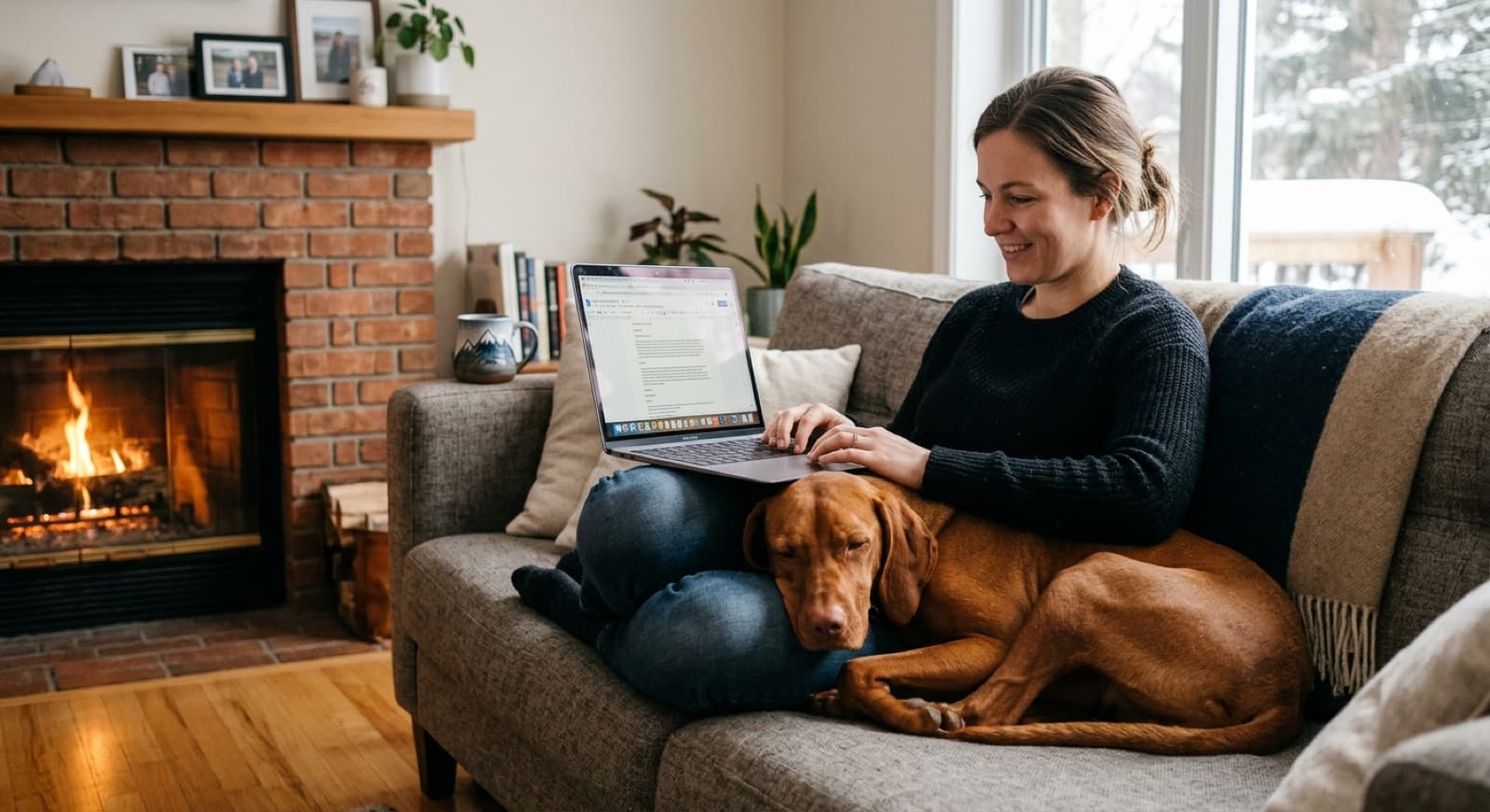
Vizslas are widely considered the most velcro breed of all dogs. A thousand-plus years of Hungarian selection produced a pointing dog that worked shoulder-to-shoulder with the hunter all day and slept inside the home at night. The breed-typical velcro pattern is healthy attachment, not separation anxiety. Clinical SA is a different condition: panic, destruction only when alone, refusal to eat alone, and sometimes self-injury. The puppy-cam test sorts the two. Calgary working-owner setups that succeed combine daycare three to four days a week ($35 to $55 per day), a midday walker on the rest ($20 to $35 per visit), and force-free desensitisation. Aversive tools (shock collars, scolding, isolation) make Vizsla SA worse, not better.
Why Vizslas are the most velcro breed
The Vizsla is one of the oldest documented sporting breeds. Hungarian Magyar tribes developed the dog for close-working bird hunting beside a single handler. Unlike some hunting breeds that ranged ahead and worked independently, the Vizsla was selected to stay close, read the hunter's body language, and adjust pace and direction with the handler. After the day's hunt, the dog returned to the family home and slept inside, not in a kennel. That dual selection (close-working in the field plus inside-the-home companionship) carved a genetic pattern that the modern breed still expresses.
According to the Vizsla Club of Canada, the breed's intense bond with humans is the trait owners cite most often, both as the reason they fell in love with the breed and as the source of the most management challenges. The American Kennel Club lists the Vizsla among its top breeds for owners seeking constant companionship and one of its most difficult breeds for owners who need a dog that handles long alone-time.
Adult Vizslas typically:
- Follow the primary handler room to room throughout the day
- Lean against legs or feet whenever the handler is seated
- Press against the body when sitting on the couch (sometimes called the “Vizsla lean”)
- Sleep touching the owner if allowed in the bed, or directly outside the bedroom door if not
- Block doorways to maintain a sightline to the handler
- Choose the handler over food, toys, or other dogs when given a choice
This is breed-typical healthy behaviour. It is not, on its own, separation anxiety.
What Vizsla velcro looks like in the Calgary home
The Calgary owners we hear from describe a consistent pattern. The Vizsla wakes when the owner wakes, follows them to the kitchen, sits on a foot while coffee brews, and watches the morning routine from a chair within sightline. The dog follows them to the bathroom. The dog presses against their leg on the couch. The dog sleeps at the foot of the bed or on the bed itself if permitted. The dog blocks the hallway when the owner moves between rooms.
In a Calgary condo this is amplified by tight square footage. The dog has nowhere to be that is not within four metres of the owner anyway, so the velcro pattern reads as gentle. In a Calgary suburban house the pattern is more visible: the dog actively works to stay close instead of resting wherever in the available space.
The healthy velcro Vizsla is calm. The dog is near you because that is where the dog wants to be, not because the dog is in distress. The body is relaxed, the breathing is normal, the dog can disengage to eat, drink, or briefly nap apart from you. The dog can settle when you ask. The dog accepts a brief closed door (bathroom, office) with mild whining that resolves within a minute or two.
If you would prefer a dog that finds its own corner and rests apart from you for hours, the Vizsla is the wrong breed. The Labrador, the Golden Retriever, and the Greyhound all rest more independently. The Doberman is also intensely velcro but bonds to one primary handler more singularly than the Vizsla, which bonds to the whole family. Knowing which breed your lifestyle fits is the most important step.
Velcro behaviour vs clinical separation anxiety
The distinction matters because the interventions differ. Treating velcro behaviour as a problem to be punished can create the clinical SA you were trying to avoid. Treating clinical SA as “just velcro” lets the panic deepen and lets the dog self-injure.
Two distinct conditions. Two distinct response protocols.
| Velcro (breed-typical, healthy) | Clinical separation anxiety (medical condition) |
|---|---|
| Follows owner room to room when home | Panics when owner picks up keys or coat |
| Mild whining for the first one to two minutes alone | Continuous vocalisation for thirty-plus minutes |
| Settles within five to fifteen minutes | Never settles, paces for hours |
| No destruction | Destruction targeted at exits (doors, windows, crate) |
| Eats and drinks normally when alone | Refuses food and water alone, sometimes for the whole day |
| Reliably housetrained, no accidents | Soils indoors despite reliable housetraining when owner is home |
| No self-injury | Self-injury: raw paws, broken teeth, mouth wounds, torn nails |
| Calm greeting on return | Frantic, hyperventilating, sometimes urinating in excitement |
The left column does not require medical intervention. It requires baseline alone-time conditioning so the dog learns short separations are routine. The right column requires a structured force-free desensitisation protocol, often a veterinary behaviourist consultation, and sometimes medication. Different problems, different tools.
The puppy-cam test (the cheap diagnostic)
Most Calgary Vizsla owners do not know which condition their dog is in. The dog is quiet when they return, the home is intact, and they assume the dog is fine. Thirty minutes of camera footage often tells a different story.
How to run the test:
- Set up a phone propped on a shelf, a Wyze indoor cam, a Ring indoor cam, or a Furbo ($30 to $150). Aim it at where the dog stays when you leave.
- Run your normal departure routine. Do not perform a long emotional goodbye: that itself creates anxiety. Be neutral.
- Leave for at least thirty minutes. Stay out of sight if you can.
- Review the full thirty minutes when you get back, not just the first five.
Some of the product links in this section are Amazon affiliate links — we may earn a small commission at no extra cost to you. It never changes which products we recommend.
Healthy velcro Vizsla footage: the dog follows you to the door, watches through a window, paces for one to three minutes, finds a resting spot, lies down with its head on its paws, and stays settled for the rest of the clip. The dog may briefly investigate a food puzzle. Breathing is normal. The body is relaxed.
Clinical SA footage: the dog paces continuously without settling, pants heavily, drools (you will see wet spots on the floor), vocalises (whines, howls, or barks for the majority of the clip), scratches at the door, jumps at windows, attempts to escape a crate, chews the crate bars or door frame, or shows trembling and hiding behaviour. If you see these signs, stop leaving the dog alone at that duration and start the desensitisation protocol below.
Force-free desensitisation protocol
The rule: never escalate past the threshold where the dog shows distress. The point of the protocol is to never let the dog rehearse panic. Each successful repetition writes a new association into the dog's brain.
This is the protocol Calgary force-free trainers run. It is consistent with the American Veterinary Society of Animal Behavior position on humane, evidence-based training and with the protocols taught through the International Association of Animal Behaviour Consultants.
- Departure-cue desensitisation. Pick up your keys, put them down, give a treat. Repeat fifty times over a few days until the keys mean nothing. Then put on your coat, take it off, treat. Repeat. Then walk to the door, touch the handle, walk back, treat. The goal is to break the anxious anticipation chain before you ever step outside.
- Two-second leave. Step outside, close the door, count to two, open the door, walk back in calmly. Do not fuss over the dog on return. Just calm reentry. Repeat five times in a session.
- Build duration. Two seconds becomes ten seconds. Ten seconds becomes thirty. Thirty becomes two minutes. Two minutes becomes five. Each step requires the dog to remain settled. If the dog shows distress at any step, drop back to the last successful duration.
- Vary the routine. Mix short and long departures. The dog should not learn that every departure means a long absence: that itself creates anxiety on cue.
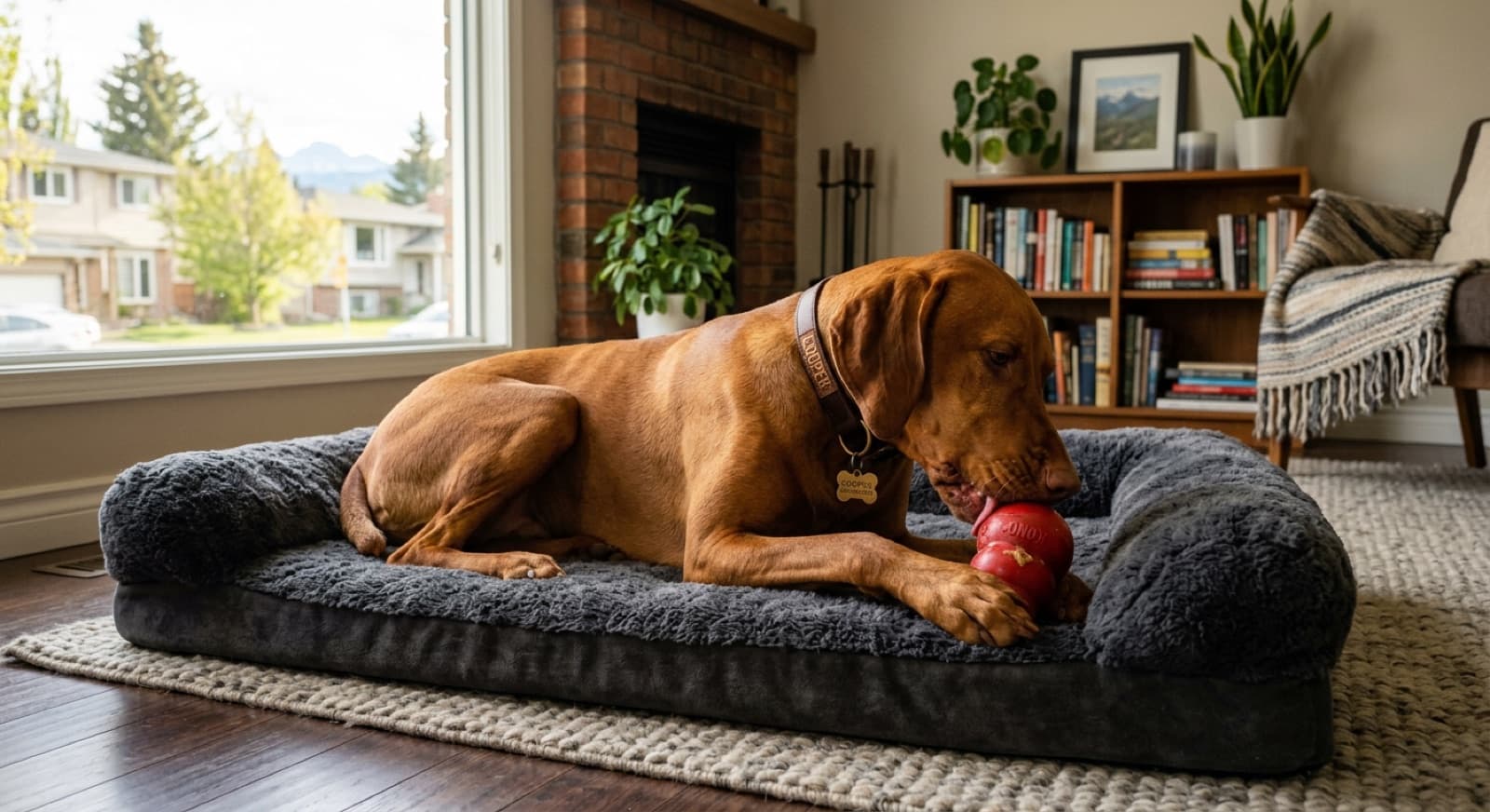
- Use high-value rewards for calm. Reward the calm settling behaviour, not the active behaviour. A frozen Kong stuffed with wet food and given right before departure is a powerful counter-conditioner: the dog associates your departure with a high-value reward.
- Camera every session. Without video you cannot tell whether the dog stayed below threshold. Watch for the first signs of distress and pull back the duration if you see them.
- Practice daily. Three or four short sessions a day work better than one long session. The full protocol takes six to twelve weeks of daily practice for a Vizsla without clinical SA. Dogs with clinical SA take longer and usually need medication and behaviourist support alongside the protocol.
Do not skip steps. The most common failure mode is impatience: the owner pushes from two minutes to thirty minutes too fast, the dog panics, and the protocol restarts from week one.
Daycare and dog-walker reality for working Calgary households
The Vizsla is genuinely a poor fit for the full-workday-alone household. We say this directly because the breed's surrender pattern in Calgary makes it clear. The Vizslas that end up with Alberta rescue networks are disproportionately from single-person, full-time-office households where the dog spent nine to eleven hours alone five days a week with no mitigation. The dog is not defective. The setup is.
Working households can succeed with a Vizsla, but only with structured infrastructure. The Calgary cost picture in 2026:
- Daycare: $35 to $55 per day at structured group daycares. Sport-style daycares with active play tend to fit Vizslas best. Three to four days a week is the realistic minimum for most working-owner Vizslas.
- Dog walker: $20 to $35 per visit (30 to 45 minute walk). One midday visit on non-daycare days breaks up the alone-time block.
- Hybrid schedule: three office days plus two work-from-home days is the most common successful pattern. The WFH days double as bonding and training days.
- Pet sitter for work travel: $50 to $100 per day, or a board-and-train daycare arrangement. Travel days without coverage are the single most common SA-trigger event.
The monthly cost runs roughly $500 to $1,200. The annual cost runs $6,000 to $14,000. This is the realistic financial bar for working-owner Vizsla ownership in Calgary. Owners who cannot or do not want to absorb it usually surrender the dog within twelve months. Vizslas surrendered to Calgary rescues almost always come from households that could not provide the infrastructure the breed needs.
The math sounds steep until you compare it to the cost of rehoming. The emotional toll on the dog and the household, the rescue fees, the application processes, and the months of stress for everyone involved usually exceed a year of daycare costs. The investment is the better deal.
Calgary force-free trainers and behaviourist referrals
The trainers we recommend in the cluster also handle Vizsla cases regularly. The breed is common enough in Calgary that any experienced force-free trainer has worked with one. The two we name throughout the breed cluster:
- Raising Canine: Calgary-based force-free trainer with experience in working and sporting breeds, including velcro-pattern dogs.
- Pup City Pup Academy: another Calgary force-free option in the cluster recommendation set. Group classes plus private consultations.
Both will run the desensitisation protocol above, troubleshoot specific home setups, and refer to a veterinary behaviourist when the case warrants medical intervention. A private consultation is typically $90 to $150 and is worth the spend before adding a second dog, moving residences, or returning to office work after a long WFH stretch.
When to involve a veterinary behaviourist (DACVB): the criteria are clear. Self-injury during alone time, sustained refusal to eat alone, panic vocalisation lasting more than thirty minutes, escape attempts, or behaviour that worsens despite six to twelve weeks of consistent force-free desensitisation. A veterinary behaviourist holds board certification through the American College of Veterinary Behaviorists or its Canadian equivalent, diagnoses the condition, prescribes medication when warranted, and writes a behaviour modification plan.
Calgary has limited local DACVB options. The standard path is a virtual DACVB consultation ($300 to $600 initial) or a referral to the Western College of Veterinary Medicine in Saskatoon. Western Veterinary Specialist Centre in Calgary handles referrals and can coordinate with the DACVB on medication management. We do not recommend specific medications in this article: medication is a veterinary decision based on the dog, the case, and any concurrent health considerations. The Fear Free Pets network maintains a directory of force-free, fear-free certified professionals across North America for owners looking to verify credentials.
Home setup for an anxious Vizsla
The right home setup reduces baseline arousal so the dog enters alone-time already calm. The elements that move the needle for most Calgary Vizslas:
- Predictable daily routine. Same wake time, walk time, meal time, departure time, and return time within reason. Vizslas read patterns. A predictable schedule lowers the anticipatory arousal that fuels SA.
- White noise or background TV. Calgary apartment buildings have hallway traffic, elevator chimes, and neighbour sounds that trigger reactive barking. A white-noise machine or a TV running at low volume masks these triggers. Vizslas in suburban houses benefit similarly: garbage trucks, school buses, and delivery drivers all trigger alert behaviour.
- Frozen Kongs and food puzzles. A Kong stuffed with wet food, plain yogurt, or wet kibble and frozen overnight gives the dog twenty to forty minutes of focused work right at departure. The dog associates departure with high-value reward, and the chewing activity is itself calming.
- Comfortable solo bedding. A bed in a low-traffic part of the home (not by the front door, not under a window with high outside activity). Some Vizslas settle better in a covered crate or a pen that feels den-like; others do better with full-room access. Camera footage tells you which.
- Gradual alone-time building from Day 1. From the moment a rescue Vizsla arrives in your home, structure short solo periods. Do not spend the first week glued to the dog. That builds an attachment baseline that the dog will then panic when you break. Build the “alone muscle” from arrival.
- Calgary winter accommodations. Five to six months a year, outdoor exercise is curtailed by cold and short daylight. An under-exercised Vizsla is harder to settle. Indoor enrichment (scent games, structured training sessions, a treadmill where space allows, food puzzles) becomes the substitute. The City of Calgary Responsible Pet Ownership Bylaw also covers minimum care standards that apply year-round.
None of these are gadget purchases. They are routine and environment changes that lower baseline arousal so the desensitisation protocol can work.
Browse adoptable Vizslas in Calgary
Vizslas reach Calgary rescues most often from working-owner households that could not provide the companionship the breed needs. With realistic mitigation in place, the same dog thrives.
See Available Vizslas →The lifelong reality
The velcro pattern does not disappear. A Vizsla puppy is velcro. A Vizsla senior is velcro. The dog that follows you to the bathroom at three years old will still follow you to the bathroom at twelve. What changes with training is the dog's ability to settle calmly during the unavoidable solo periods of normal life: the work shift, the trip to the grocery store, the hour-long shower-and-coffee morning routine.
Owners who frame the goal as eliminating velcro behaviour set themselves up for disappointment and tend to keep escalating interventions in search of a result that is not biologically available. The realistic frame is sustainable management: the dog gets the close companionship the breed was selected for, the household gets tolerable alone-time windows, and the dog lives a calm and connected life. The goal is “tolerable alone time,” not “independent dog.”
This frame matters for adopter expectations. The Vizsla owners we hear from who are happiest are the ones who came to the breed wanting an intensely bonded dog. The ones who came hoping the dog would “learn to be more independent over time” almost always struggle. Adopt the dog for what the dog is, not for what you hope the dog will become.
Why aversive methods backfire on Vizslas
The Vizsla is a soft, sensitive breed. Aversive correction shuts the dog down hard, suppresses the visible behaviour, and worsens the underlying panic. Force-free only. No exceptions for this breed.
A common mistake with separation anxiety, especially when the dog is barking and creating neighbour complaints, is reaching for a bark collar (citronella or shock), a scolding routine on return, or isolating the dog as “tough love.” These approaches fail with Vizslas for predictable reasons.
Bark collars suppress the symptom, not the cause. The dog learns that vocalising produces pain or an unpleasant spray, so the dog stops vocalising. The panic does not stop. The dog is now panicking silently, which means the owner cannot tell the dog is in distress and the alone-time exposure continues. The underlying cortisol cycle deepens. Self-injury and destruction often replace the vocalising.
Scolding on return is too late and too confusing. By the time you walk in and see the destruction or the soiled floor, the dog has no association between your scolding and the behaviour that happened hours ago. The dog learns instead that your return predicts scolding, which makes the entire departure-and-return cycle scarier.
Isolation as discipline deepens the anxiety. The dog is panicking because it cannot tolerate being alone. Forcing more alone-time as a corrective adds trauma to trauma. The dog does not “get over it.” The dog learns that alone-time has no exit, which makes future short separations harder, not easier.
The AVSAB position statement on humane dog training is direct on this: aversive methods carry significantly higher risk of fallout (fear, aggression, learned helplessness) and are not recommended for fear-based or anxiety-based behaviour. Force-free desensitisation, environmental management, and (when warranted) medication are the tools that work. Calgary force-free trainers do not use shock collars or other aversive tools. If a trainer recommends one, find a different trainer.
Frequently Asked Questions
Are all Vizslas this velcro?
Effectively yes. The Velcro Vizsla nickname did not come from one viral Reddit post: it is the breed identity recognised by the Vizsla Club of Canada, the breed parent clubs, and every Calgary rescue that has placed one. Vizslas were developed in Hungary over a thousand years as close-working pointing dogs that lived inside the hunter's home and worked shoulder-to-shoulder in the field. Selection pressure was for dogs that wanted to be near their person, watch their person, and read their person's body language. That trait did not turn off when the breed moved into Calgary living rooms. Adult Vizslas typically follow their primary handler room to room, lean against legs when seated, sleep touching the owner, and block doorways to maintain proximity. Individual variation exists. Some Vizslas tolerate being a few metres away. Some only relax in direct physical contact. But the breed-typical baseline is dramatically more attached than a Lab, a Border Collie, or even most Goldens. If you do not want a dog that follows you into the bathroom, the Vizsla is not the right breed.
Can I have a Vizsla if I work full-time?
Honestly, it depends entirely on the infrastructure around the dog. A Vizsla left alone in an empty house for nine to eleven hours a day, five days a week, is one of the most predictable separation anxiety setups in the breed world. The Calgary rescue surrender pattern bears this out: full-time-office single-person households are the dominant source of Vizsla rehoming applications. The breed can work for working owners, but only with structured mitigation. The realistic Calgary setup looks like daycare three to four days a week ($35 to $55 per day), a midday dog walker on non-daycare days ($20 to $35 per visit), a hybrid schedule where possible, and sometimes a second dog companion. The monthly cost runs roughly $500 to $1,200. If that budget does not work, a different breed is a kinder choice. Vizslas surrendered to Calgary rescues are usually wonderful dogs in households that could not provide the companionship the breed needs.
Will my Vizsla outgrow the velcro behaviour?
No. The velcro pattern is genetic, not a phase. A Vizsla puppy is velcro. A Vizsla adolescent is velcro. A Vizsla senior is velcro. What changes with age and training is the dog's ability to settle calmly when the handler is briefly out of sight. A well-trained adult Vizsla can lie quietly on a mat while you cook in the next room, take a shower, or work in the home office with the door closed for an hour. That is the realistic ceiling. The dog will still want to be in the same room as you ninety-five percent of the time it is awake. Owners who frame the goal as “eliminating velcro behaviour” set themselves up for disappointment. The right frame is sustainable management: the dog gets the companionship the breed needs, and the owner builds tolerable alone-time windows so the household runs.
How long can a Vizsla be left alone?
Two to four hours is the realistic ceiling for a well-conditioned adult Vizsla. Puppies under six months handle one to two hours at most. Adolescents (eight months to two years) are the hardest age and rarely tolerate more than two to three hours. Rescue Vizslas in the first month after placement should start at thirty minutes to an hour and build slowly. Senior Vizslas (eight or older) sometimes settle for slightly longer because their baseline arousal is lower, but most still prefer company. The Calgary downtown commute scenario (thirty to sixty minutes each way plus a nine-hour office day) pencils out to nine to eleven hours of isolation. Most Vizslas cannot handle that without mitigation: daycare on most workdays, a midday walker on the rest, a hybrid schedule, or a household member working from home are the workable options.
What does the puppy-cam test actually look like?
Set up a phone, a Wyze camera, a Ring indoor cam, or a Furbo (anything in the $30 to $150 range works) pointed at where your dog stays when you leave. Record at least the first thirty minutes after departure. A healthy velcro Vizsla follows you to the door, watches you leave through a window or the door, paces briefly, and then settles within five to fifteen minutes. The dog may sigh heavily, lie down with its head on its paws, sleep, or chew on an enrichment item. A Vizsla in clinical separation anxiety pants heavily, drools, vocalises continuously, paces without settling, scratches at exits, jumps at windows, or attempts to escape its crate or room. Many Calgary Vizsla owners assume their dog is fine because the dog is quiet when they return. Thirty minutes of camera footage tells the real story. If you see clinical signs, do not continue the current alone-time pattern. Continued exposure deepens the panic response and can lead to self-injury.
How do I start force-free desensitisation?
Start with departures so short the dog never crosses into distress. The protocol is roughly: pick up your keys, put them down, give a treat. Repeat fifty times across a few days until the keys are a neutral cue, not a trigger. Then put on your coat, take it off, treat. Repeat. Then walk to the door, touch the handle, walk back, treat. Then open the door, close it, treat. Then step outside for two seconds, return, treat. Build to ten seconds, thirty seconds, two minutes, five minutes, fifteen minutes. The rule is: never escalate past the point where the dog shows distress. If the dog whines, paces, or panics at the current threshold, drop back to the last successful duration and rebuild more slowly. High-value rewards (small pieces of cooked chicken, freeze-dried liver, real cheese) accelerate the work. The full protocol usually takes six to twelve weeks of daily practice. Skipping steps causes setbacks.
When should I call a veterinary behaviourist?
Call sooner rather than later if the dog is showing severe signs. The clear triggers are: self-injury during alone time (raw paws, broken teeth, mouth wounds from chewing exits or crates), panic vocalisation that lasts more than thirty minutes without settling, sustained refusal to eat alone, soiling in the house despite reliable housetraining, or escape attempts (jumping fences, breaking windows, ripping crates). A veterinary behaviourist is a veterinarian with board certification through the American College of Veterinary Behaviorists (DACVB) or its Canadian equivalent. They diagnose, prescribe medication when warranted, and write a behaviour modification plan. Calgary has limited local options, so most cases are handled through virtual DACVB consultations ($300 to $600 initial) or by referral to the Western College of Veterinary Medicine in Saskatoon. Working in parallel with a Calgary force-free trainer (Raising Canine, Pup City Pup Academy) is the standard model. Do not wait for the dog to injure itself before involving a specialist.
Will bark collars or shock collars fix it?
No, and they make Vizsla separation anxiety worse. The Vizsla is a soft, sensitive breed bred for cooperative work, not a thick-skinned guarding breed that shrugs off correction. Aversive tools (shock collars, citronella bark collars, scolding, isolation as punishment) trigger shutdown in a Vizsla, suppress the visible behaviour without resolving the underlying panic, and add a second layer of fear to the existing anxiety. The American Veterinary Society of Animal Behavior position on humane training is explicit: aversive methods carry a higher risk of fallout and are not recommended for fear-based or anxiety-based behaviour. Calgary force-free trainers will not use these tools. If a trainer suggests a shock collar for separation anxiety, find a different trainer. The path forward is desensitisation, enrichment, daycare and walker mitigation, and a vet behaviourist when warranted. Punishing a panicking dog is not training.
Is a second dog a good fix for Vizsla velcro?
Sometimes. Not reliably. A second dog can reduce isolation distress for a Vizsla whose alone-time anxiety is primarily about being without any company. It does not help when the anxiety is specifically handler-focused, which is common in Vizslas. A handler-focused dog will still pace, vocalise, and panic when the primary human leaves, regardless of whether another dog is present. Before adding a dog: confirm your Vizsla genuinely enjoys other dogs (daycare reports, playdates, friend's dogs), confirm financial capacity ($4,000 to $8,000 additional annual cost), confirm your training time can absorb two dogs, and ideally consult a force-free trainer or behaviourist first ($90 to $150 for a consultation). The realistic frame is that a second dog supplements solid alone-time training. It does not replace it.
What home setup helps the most?
Predictability and enrichment do the heavy lifting. The home setup that works for most Calgary Vizslas: a consistent daily routine the dog can anticipate (same wake, walk, meal, departure, and return times within reason), white noise or a TV running during alone time to muffle building or street triggers, a comfortable resting spot in a low-traffic part of the house, frozen Kongs or food puzzles given right before departure (the dog associates departure with a high-value reward), and gradual alone-time conditioning starting from day one. Do not make a fuss when you leave. Do not make a fuss when you return. Treat departures and returns as neutral events. Calgary winter adds a layer: cold and short daylight mean less outdoor exercise and a Vizsla with unspent energy is harder to settle. Indoor enrichment (food puzzles, scent games, training sessions, treadmill where available) becomes essential five to six months of the year.
Adoptable Vizslas in Calgary
Live listings of Vizslas and Vizsla mixes from Calgary rescues.
Vizsla Adoption in Calgary
Rescue sources, real costs, surrender patterns, free-pet scam warnings, and the breed-vs-buy reframe.
Doberman Velcro + Separation Anxiety
Sister velcro-breed companion guide. Dobermans bond more singularly to one handler than Vizslas: the management differs.
Samoyed Separation Anxiety + Barking
A different breed, same fundamental SA framework, with Samoyed-specific barking management for Calgary condos.
New dog? Start with these care guides
Everything a new adopter needs to set up a safe, happy home.