The short answer
Great Dane puppies need slow, controlled growth. Feed a large-breed puppy food with an AAFCO statement for large-breed growth, three measured meals a day, never free-feed, and target Body Condition Score 4 of 9 (slightly underweight is correct). Leash walks only until 12 months. No jumping, no stairs, no off-leash sprints until 18 months. Edmonton ice slips and slippery indoor floors amplify the joint risk. Growth plates close between 18 and 24 months and the wrong protocol causes osteochondrosis, hip dysplasia, panosteitis, and HOD. Cross-link the Great Dane health issues guide for the clinical pathology and surgical decision tree.
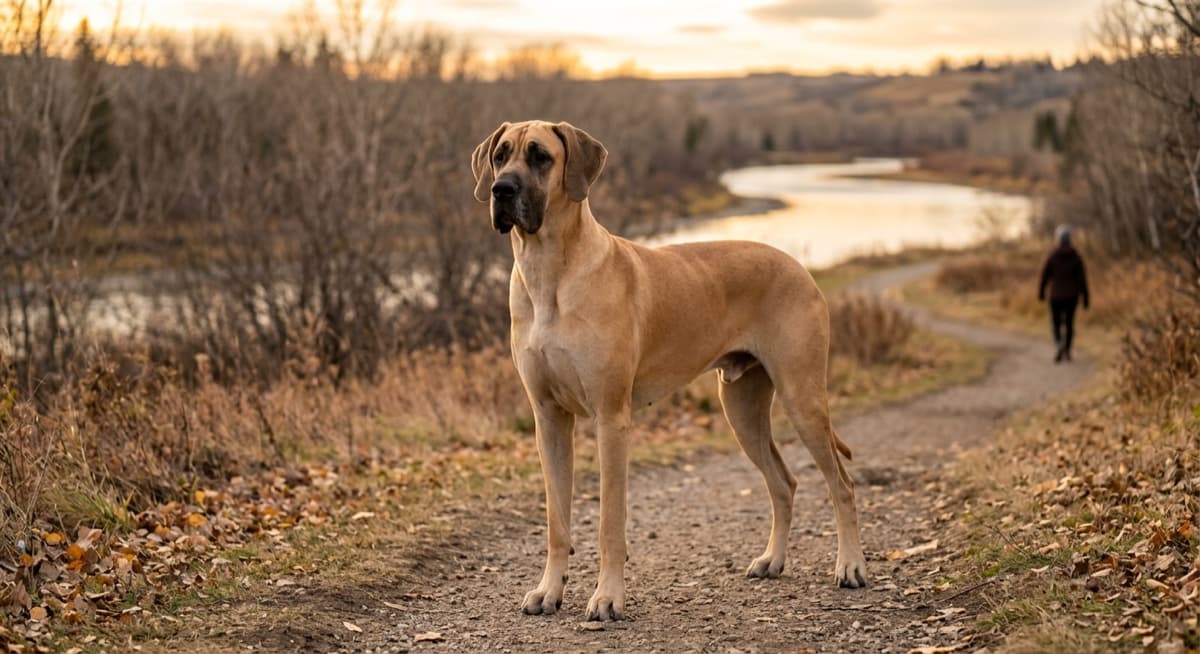
Why Great Dane puppy growth is different from every other breed
A Great Dane puppy grows from roughly 1 lb at birth to 100 lbs by 6 months. That is a hundred-fold body-weight increase in half a year, and the rate is the highest of any pure breed. The skeletal system has to keep up with that growth: bone elongation at the growth plates, joint cartilage formation, and the supporting tendons, ligaments, and muscles. When growth is forced too fast through high-calorie food, free-feeding, or high-calcium supplementation, the bones outrun the cartilage and joint structures. The result is developmental orthopaedic disease, which is a category of conditions that includes osteochondrosis, hip dysplasia, panosteitis, and hypertrophic osteodystrophy.
The American College of Veterinary Nutrition emphasizes that giant-breed puppy growth must be controlled, not maximized. The ACVN board-certified veterinary nutritionists are clear that giant-breed puppies do worse on standard puppy food, do worse on adult food, and need a formulation specifically balanced for the slow-growth profile of large and giant breeds.
The growth plates themselves are the structural reason for the exercise restrictions. A growth plate is a band of cartilage at the end of each long bone where new bone is added to lengthen the limb. It is the weakest point of the bone during the growth window because cartilage is softer than bone. Impact, repetitive loading, or sudden lateral force on an open growth plate can cause a Salter-Harris fracture, which is a fracture through the growth plate itself. The bone heals, but the growth plate often closes prematurely on the injured side, which means the limb stops growing on that side while the other side continues. The result is a permanently bent or shortened limb. Every Edmonton orthopaedic surgeon has seen these in giant-breed puppies that slipped on stairs or jumped from a height.
The compounding problem is that a 10-month-old Great Dane looks like an adult dog. They are tall, they have adult proportions, and they have adult energy. The skeleton underneath does not match. A 10-month-old Great Dane puppy is a structural toddler in an adult-sized body, and the protocol has to honour the structural age, not the visible age.
The Great Dane growth plate timeline
Three different developmental milestones run on different schedules in a Great Dane, and they matter because the protocol relaxes at each one.
Adult height: 12 to 14 months
Most Great Danes reach their adult height (28 to 34 inches at the shoulder) by 12 to 14 months. They look adult-sized to a visitor. They are not. The bones are still soft, the joints are still developing, and the growth plates are still open. The exercise and stair restrictions stay in place even though the dog looks fully grown.
Growth plate closure: 18 to 24 months
The growth plates fully close between 18 and 24 months in most Great Danes. Males tend toward the longer end. This is the structural inflection point. After plate closure, the joints handle impact and repetitive loading the way an adult dog does. Most of the restrictions on jumping, stairs, and off-leash sprints can relax through this window. Some specialty veterinary surgeons recommend radiographs at 18 months to confirm closure before clearing the dog for high-impact activities like agility or fast-recall fetch. The radiograph runs $200 to $400 at most Edmonton vet clinics.
Muscle and structural maturity: 24 to 36 months
Even after plate closure, the supporting musculature continues to develop until 24 to 36 months. The dog is structurally adult but the muscle mass is still filling in. Most Great Danes do not look fully mature in body condition until 2 to 3 years old. This is normal. Forcing muscle development through heavy exercise during the closing window does not speed maturation. It just stresses joints that have just finished closing.
The Canadian Kennel Club Great Dane breed profile covers the developmental timeline at a higher level. The key for Edmonton owners is to internalize that the protocol does not end at 12 months. It tapers gradually from 12 to 24 months.
Large-breed puppy food: the AAFCO statement that matters
The food choice is the highest-leverage growth decision an Edmonton Great Dane owner makes. Standard puppy food is wrong. Adult food is wrong. Generic large-breed food without the right AAFCO statement is wrong. The food has to be formulated specifically for large-breed growth.
On the bag, look for an AAFCO statement that includes the phrase “including growth of large-size dogs (70 lbs or more as an adult)” or wording equivalent. A standard AAFCO growth statement is not enough; it has to include the large-size qualifier. This is a regulatory test that the manufacturer has shown the food supports controlled growth in giant breeds. Foods without that statement may meet standard puppy growth needs but not the slower controlled growth profile a Great Dane puppy requires.
The nutrient ratios that matter for a Great Dane puppy food:
- Calcium 1.0 to 1.5 percent on a dry-matter basis. Standard puppy food often runs 1.5 to 2.0 percent, which is too high for a giant breed. Excess calcium forces bone elongation faster than the joints can keep up.
- Phosphorus 0.8 to 1.0 percent dry-matter basis. The calcium-to-phosphorus ratio should sit between 1.1 and 1.5.
- Lower fat density than standard puppy food. Look for 12 to 16 percent fat, not 18 to 22 percent. Lower energy density slows the growth rate without compromising nutrition.
- Protein 23 to 30 percent dry-matter basis. Adequate protein supports muscle development; the old guidance that high protein causes hip dysplasia in giant puppies has been disproven. What matters is calorie density and calcium, not protein.
- DHA and omega-3 fatty acids for joint and cognitive development.
- Avoid supplemental calcium on top of the food. Adding bone meal, calcium powder, or unbalanced raw diets to a giant-breed puppy is a known cause of skeletal disease.
Several major pet food manufacturers produce large-breed puppy formulas that meet these criteria. Your vet, the rescue you adopt from, or a board-certified veterinary nutritionist can recommend specific brands. We deliberately do not name brands in print because formulations change and what is correct today may be different in two years; the bag label is the authoritative source.
The World Small Animal Veterinary Association WSAVA nutrition guidelines include a manufacturer-selection checklist that helps owners evaluate brands beyond the marketing. The key questions: does the manufacturer employ a board-certified veterinary nutritionist, does the manufacturer conduct AAFCO feeding trials (not just nutrient profile analysis), and does the manufacturer publish the calorie content and nutrient analysis on every batch.
Feeding protocol: three meals, controlled portions, no free feeding
Three measured meals a day until 6 months, two meals a day from 6 to 24 months, never free-feeding. The reason for the meal cadence is partly digestive and partly behavioural. Giant breeds are at elevated risk for bloat (gastric dilatation-volvulus) throughout their lives, and bloat risk is highest after a single large meal. Splitting the daily allowance across multiple smaller meals reduces the per-meal stomach load.
Free-feeding is wrong for two reasons. First, it drives faster growth than the protocol allows because most giant puppies will eat more than they need if food is always available. Second, it eliminates the owner ability to adjust portions month by month based on Body Condition Score. The point of controlled feeding is to keep the puppy on a slow growth curve, and you cannot manage the curve if you cannot see how much the puppy is actually eating.
Weigh kibble on a kitchen scale at every meal. Cup measurements drift 30 percent across feeders, bag fullness, and tired-evening pours. The kitchen scale costs $20 and pays for itself across the puppy first year by preventing both overfeeding and underfeeding. Some giant-breed owners switch to gram measurements entirely after the first month because the precision matters more on a 100 lb puppy than a 20 lb one.
Realistic feeding ranges for a Great Dane puppy on a quality large-breed puppy food (roughly 400 to 450 kcal per cup):
- 2 to 3 months (around 25 to 45 lbs): 4 to 6 cups daily, split into three or four meals.
- 4 to 6 months (around 50 to 100 lbs): 6 to 9 cups daily, split into three meals.
- 6 to 12 months (around 90 to 130 lbs): 6 to 8 cups daily, split into two meals.
- 12 to 18 months (around 110 to 160 lbs): 6 to 8 cups daily, often reducing as the growth rate slows.
- Adjust based on monthly BCS check, not on bag math. The bag recommendations are usually 20 to 30 percent too high.
Treats stay at 10 percent of daily calories or less, and the cleanest method is to pull kibble out of the daily allowance and use it for training rewards. Avoid high-calorie commercial training treats and avoid table scraps, which can disrupt the carefully balanced nutrient ratios. Green beans, baby carrots, blueberries, and ice cubes are low-calorie fillers most Great Dane puppies accept.
Body Condition Score 4 of 9: slightly underweight is correct
The Body Condition Score target for a growing Great Dane puppy is 4 out of 9. The American Animal Hospital Association AAHA weight management guidelines use the 9-point scale where 1 is emaciated, 5 is ideal for adult dogs, and 9 is severely obese. For a growing giant-breed puppy, the standard adult target of 5 is too heavy. BCS 4 keeps the load on the developing joints minimal.
What BCS 4 looks like on a Great Dane puppy:
- Ribs easily palpable with a thin layer of fat covering. You should feel each rib clearly with light pressure.
- Ribs visible from across the room in some lights. This is normal for a giant puppy at BCS 4 and looks underfed to people not used to giant breeds.
- Clear waist when viewed from directly above. The body narrows behind the ribcage into the hindquarters.
- Pronounced abdominal tuck from the side. The belly slopes upward from chest to hindquarters at a sharp angle.
- Visible spine and hip bones with light pressure, no muscle wasting.
Most pet owners look at a BCS 4 Great Dane puppy and assume the dog is underfed. Friends, family, and even some general-practice vets who do not see many giant breeds may comment on it. The breed standard for giant-breed puppy growth is at odds with the standard for medium and small breeds, and the visible difference is real. Trust the protocol, not the comments. Take photos from above and from the side at the same monthly interval, and have the vet score the BCS at every weigh-in for the first year.
If the puppy is creeping toward BCS 5 or higher, reduce the next month portion by 10 percent and recheck. If the puppy is dropping below BCS 4 with visible muscle loss, increase slightly. The monthly adjustment is the protocol. Do not try to fatten the puppy up for a show or a holiday photo. Every extra pound during the open-growth-plate window is a measurable load on developing joints.
Exercise restrictions: leash walks only until 12 months
The exercise protocol for a growing Great Dane runs in three windows.
0 to 12 months: leash walks only, puppy paces the walk
Two or three short walks a day, 15 to 30 minutes each, on flat ground at the puppy own pace. No off-leash sprints. No fetch with hard launches. No agility, no jogging or running alongside the owner. No jumping in or out of vehicles. No frisbee. The puppy sets the pace; if they want to stop and sniff, you stop and sniff. If they lie down and refuse to move, the walk is over. Forced exercise on developing joints causes microtrauma that compounds over time.
12 to 18 months: gradual off-leash time on grass
Adult height is reached but growth plates are still open. Add controlled off-leash time on grass at quiet off-leash parks during low-traffic hours. Avoid hard surfaces (concrete, packed gravel, asphalt) for off-leash. Avoid play with much larger or much rougher dogs because the lateral impact load is the highest acute injury risk. Calm play partners only. Watch the puppy carefully for any sign of limping, stiffness, or reluctance to use a limb after play.
18 to 24 months: gradual return to normal activities
Growth plates close in most Great Danes by 18 to 24 months. Some specialty veterinary surgeons run a radiograph at 18 months to confirm closure before clearing the dog for high-impact activities. After confirmation, the dog can return to normal off-leash activity, fetch on grass, longer hikes, and structured exercise. Hard-impact activities like agility competition, frisbee, and high-jump fetch should still be approached cautiously because a Great Dane carries 150 lbs of body weight on the same joints that a 30 lb agility dog uses.
The American College of Veterinary Surgeons ACVS small animal orthopaedic resources cover the relationship between juvenile exercise load and adult orthopaedic disease. The summary: controlled exercise during the growth window produces a structurally sound adult; forced exercise produces an adult with lifelong joint problems.
The mistake most adopters make is matching the puppy energy with adult-style exercise because the puppy seems to want it. A young Great Dane will run if you let them. They do not have the structural awareness to stop when they should. The owner has to stop them.
Stairs and slippery floors: the Edmonton home reality
Most Edmonton homes have stairs, hardwood, laminate, or tile, all of which are real growth-plate injury risks for a giant puppy. The mitigation requires layout changes, not just supervision.
Stairs
Carry the puppy on stairs while you can, which is roughly until 25 to 35 lbs at 8 to 10 weeks old. After that, supervised stair use only, never unsupervised free roam between floors. Up is lower risk than down because the descent loads the front limbs and shoulders more, and a slip on the way down can cascade. Install baby gates at the top and bottom of the basement stairs and at the top of any main staircase to prevent unsupervised use. A back-handle harness ($60 to $120 for a giant-fit harness) lets you assist the puppy on the descent without lifting from underneath.
Edmonton basement stairs are often steep, narrow, and open-back. Edmonton condo and apartment stairs are concrete and unforgiving on impact. Edmonton outdoor deck stairs add ice from October through April. Each of these is a known acute injury site for giant-breed puppies we hear about from Edmonton rescues. If the home layout puts the puppy sleeping area on a different floor from the food and water, change the layout. A main-floor crate and a main-floor feeding station are worth the rearrangement.
Slippery floors
Hardwood, laminate, and tile floors are the second-biggest at-home injury risk. A giant-breed puppy slipping on a smooth floor during a zoomie or a casual turn can wrench a shoulder, an elbow, or a stifle, and the lateral force can damage the growth plate. Install non-slip runners along the puppy usual routes through the home. Allow zoomies on carpet only. Some owners use clip-on dog booties indoors with rubber soles for traction, which work well for some dogs and not for others. Toe-grip products that clip on the toenails also help on smooth floors and are tolerated by most puppies after a couple of days.
The compounding risk in Edmonton winter is that the puppy spends 5 to 7 months mostly indoors on these surfaces. Outdoor zoomie release is limited by cold and ice. Indoor zoomies on smooth floors fill the gap and create the injury exposure. Plan structured indoor enrichment (puzzle feeders, scent games, gentle training sessions) to reduce the unstructured zoomie energy that drives floor slips.
Browse adoptable Great Danes in Edmonton
Most rescue Great Danes are adolescent surrenders past the highest-risk growth window. Adopting an 18 to 24 month old Dane skips the puppy growth-plate management entirely and gets you a structurally adult dog with a foster-tested temperament.
See Edmonton Adoptable Dogs →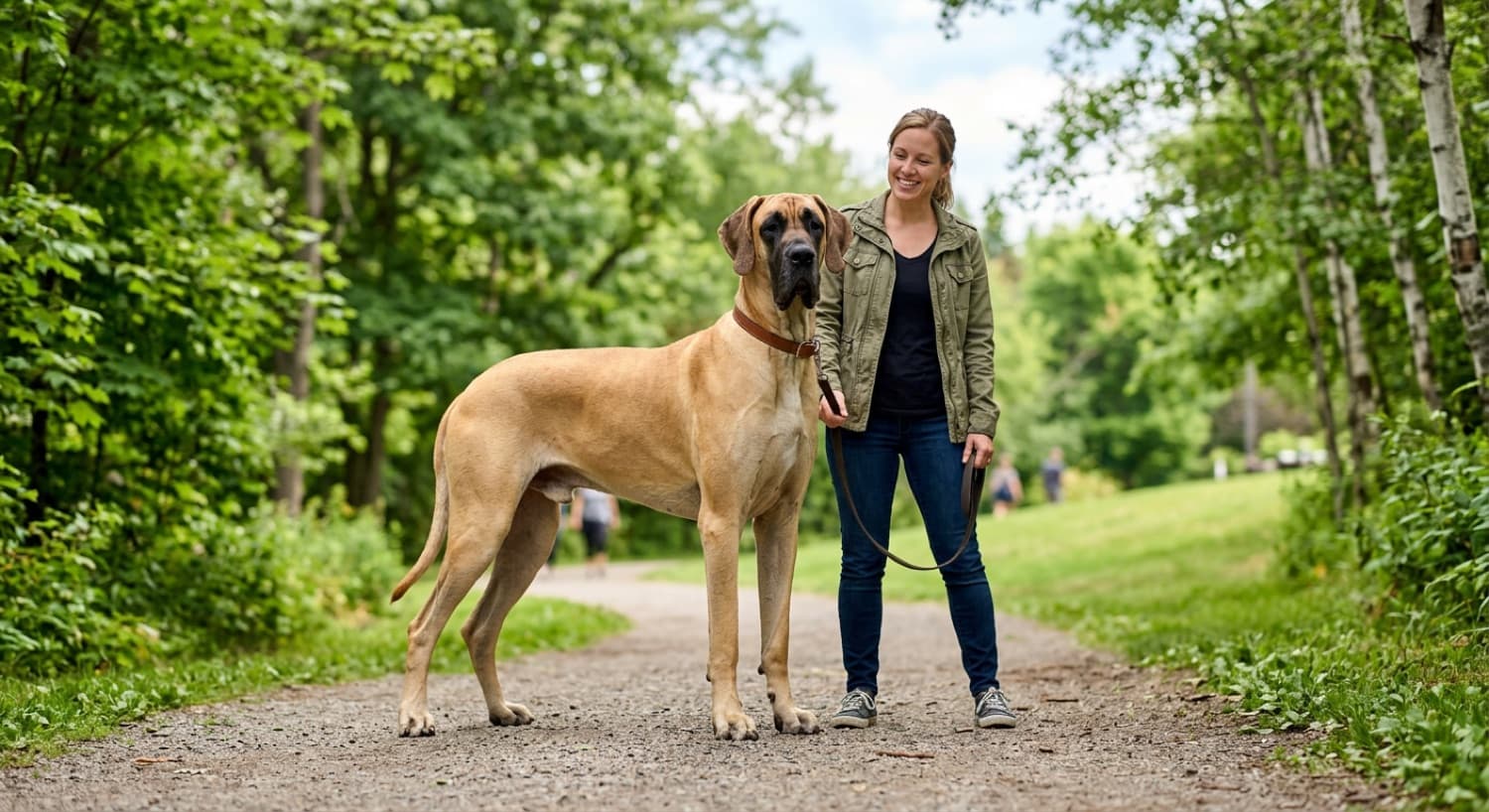
The growth-related diseases the wrong protocol causes
Four developmental orthopaedic conditions show up at meaningfully elevated rates when Great Dane puppy growth is forced too fast. The pathology and surgical management of each is covered in the dedicated Great Dane health issues guide. The short version of each is here because adopters should know the names and the prevention overlap.
Osteochondrosis dissecans (OCD)
A developmental joint disease where cartilage fails to form properly during growth, leaving a damaged area in the joint surface. Commonly affects the shoulder, elbow, hock, or stifle. Presents as lameness in a puppy between 4 and 10 months old that does not resolve with rest. Often requires surgical removal of the cartilage fragment. Surgical cost at an Edmonton specialty centre runs $3,000 to $6,000 per joint.
Hip dysplasia
Malformation of the hip joint where the femoral head and acetabulum do not fit correctly, leading to lifelong arthritis and pain. Genetic predisposition is real, but expression is meaningfully accelerated by fast growth and high body weight during the developmental window. Treatment ranges from medical management through joint replacement surgery. Joint replacement at an Edmonton specialty centre runs $8,000 to $14,000 per hip.
Panosteitis (pano)
Inflammation of the long bone shafts, causing shifting lameness in growing giant puppies. Most common between 5 and 18 months. Usually self-limiting by age 2 but painful and recurring during the active window. Diagnosed by radiographs showing characteristic patchy bone density changes. Treated with rest and anti-inflammatories. Costs $200 to $600 per episode in vet bills.
Hypertrophic osteodystrophy (HOD)
Inflammation of the growth plates themselves, often presenting with fever, swollen warm joints around the ankles and wrists, and reluctance to move. Less common than the other three but serious. Severe cases can leave permanent joint damage. Treatment is supportive care, anti-inflammatories, and sometimes immune-modulating drugs. Hospitalization at a serious case can run $2,000 to $5,000 at an Edmonton emergency centre.
Prevention overlap across all four: large-breed puppy food with the right AAFCO statement, controlled portions targeting BCS 4 of 9, restricted exercise until 12 months, no stairs or jumping during the open-growth-plate window, and avoidance of slip injuries on Edmonton ice and indoor smooth floors. None of these guarantees the puppy avoids developmental disease, because genetics drive the predisposition. All of them reduce the probability meaningfully.
Spay and neuter timing: no earlier than 18 to 24 months
Giant-breed neuter timing research has shifted meaningfully in the last decade. The UC Davis Veterinary Medical Teaching Hospital cohort studies on joint disease and neuter timing in large and giant breeds found materially higher rates of hip dysplasia, cranial cruciate ligament rupture, and elbow dysplasia in dogs neutered before growth plate closure. The mechanism is that reproductive hormones play a role in growth plate development and joint maturation, and removing them prematurely disrupts the normal closing process.
Current giant-breed guidance from the American Kennel Club, the American College of Theriogenologists, and most giant-breed parent clubs aligns on waiting until at least 18 months for Great Danes, with 24 months preferred for males. The conversation with your vet should weigh the documented joint disease risk against any individual case factors (behavioural concerns, accidental breeding risk, mammary cancer risk reduction in females).
The Edmonton rescue reality complicates this. Most rescue Great Dane puppies arrive already neutered because shelter contracts require pre-adoption neuter. Some shelters perform pediatric neuter at 8 to 12 weeks, others wait to 6 months. If you adopt a pre-neutered giant puppy, live with that reality. You cannot reverse the surgery. Compensate by tightening the other prevention factors: stricter diet adherence, more careful exercise restrictions, monthly BCS checks, joint supplements under vet direction in early adulthood, and pet insurance enrolment in week one of adoption because early-neuter giant breeds have a measurably higher lifetime ortho cost.
For owners who acquire a Great Dane puppy from a breeder (not the typical Pawfinder reader, but worth covering), the conversation with the vet should set the neuter timing in advance. Plan for 18 to 24 months. Talk to a specialty reproductive vet if the routine GP vet pushes a 6-month neuter as the default; that default is outdated for giant breeds.
Mistakes adopters make with Great Dane puppies
The recurring mistakes we hear from Edmonton rescues working with returned giant puppies:
- Feeding standard puppy food or high-protein adult food. Drives growth too fast. The fix is a large-breed puppy food with the AAFCO large-size growth statement on the bag.
- Free-feeding. Eliminates the owner ability to manage portions month to month. Switch to three measured meals a day, kitchen scale at every meal.
- Adding calcium supplements or unbalanced raw diets. Excess calcium is a known cause of giant-breed skeletal disease. The puppy food has enough; do not add more.
- Letting the puppy use stairs unsupervised. Baby gates at the top and bottom of every stair, supervised use only, carried for the first months. Stair falls during the open-plate window cause Salter-Harris fractures.
- Off-leash sprints, fetch with hard launches, or jogging alongside the owner before 12 months. Forced exercise on developing joints. Stick to leash walks at the puppy pace until adult height is reached.
- Allowing the puppy to jump in and out of vehicles. A 70 lb puppy jumping from an SUV cargo area is loading 5 to 7 times body weight through the front limbs. Use a folding car ramp or lift the puppy.
- Letting the puppy reach BCS 6 or higher. Most pet owners overestimate the right weight for a giant puppy. The target is 4 of 9, which looks slightly underweight. Trust the protocol.
- Neutering before 18 months on a general-practice vet recommendation. Outdated for giant breeds. Push for the giant-breed delayed-neuter conversation, or accept the trade-off if the puppy is pre-neutered.
- Zoomies on hardwood, laminate, or tile floors. Lateral force on developing joints. Install runners, allow zoomies on carpet only.
- Skipping monthly vet weigh-ins. The first year is the structural foundation. The monthly weigh-in plus BCS check is the only way to keep the growth curve on the target trajectory.
Each one of these is recoverable in isolation if caught early. Several of them stacked together compound the risk meaningfully. The rescue Danes that come back to Edmonton shelters with ortho problems usually have three or four of the above in their history, not one.
Edmonton winter Great Dane puppy considerations
Edmonton winter adds three specific challenges to growing a Great Dane puppy that southern climate owners do not face.
Ice slip injuries
Driveway ice, sidewalk ice, deck stair ice, and packed-snow ice at off-leash zones are all real growth-plate injury risks. A 60 lb Great Dane puppy slipping on icy concrete loads the shoulders and hips through a force vector the developing joints are not built to absorb. Mitigations: booties with grip soles ($30 to $80 for giant-fit booties), shovelled and sanded paths around the home, shorter winter outings on freeze-thaw days, and avoidance of icy off-leash zones during November and March thaw cycles.
Coat shopping for tall lean puppies
Great Danes have a short single coat with no undercoat, which is poor insulation against deep Edmonton cold. Below -15 Celsius a puppy needs a real insulated coat. Buying for a growing puppy is annoying because they outgrow each coat in 6 to 10 weeks. Most owners we work with buy two or three cheaper coats sized one up across the first year rather than one expensive coat that fits for two months. The coat should cover the chest, belly, and back without restricting leg movement. Booties round out the cold weather kit.
Indoor exercise substitution
Winter cuts outdoor exercise volume 30 to 40 percent across 5 to 7 months. For an adult Great Dane that is manageable. For a growing puppy it is a problem because the energy still needs an outlet, and the indoor outlet on smooth Edmonton floors is the injury risk discussed above. Structured indoor enrichment fills the gap: puzzle feeders for every meal, snuffle mats with kibble hidden in fabric, frozen Kongs, gentle scent games, slow obedience training sessions, and short structured play on carpeted surfaces. A 20 minute training session burns roughly the same calories as a 20 minute walk and tires the puppy mentally without loading joints.
The AVMA cold weather pet safety guidance reinforces the surface-injury risk for short-coated breeds and recommends the coat-plus-booties combination for sustained cold weather walking.
Veterinary partnership: monthly weigh-ins and proactive imaging
Monthly weigh-ins for the first year are the single most useful vet partnership for a giant-breed puppy owner. Most Edmonton vet clinics will let you walk in to use the scale at no charge. Pair the weight number with a Body Condition Score scored by the vet or the vet tech, and write both in a notes app. The trend is what matters more than any single number. A puppy on the slow controlled growth trajectory shows weight gain that tracks predictably with body length and BCS that holds at 4 of 9.
Beyond the monthly weigh-in, the proactive imaging conversation is worth having at 6 months and at 12 to 18 months. Radiographs of the hips, elbows, and shoulders at 6 months can identify early signs of dysplasia or osteochondrosis before the puppy is symptomatic, which opens the conservative management window. Radiographs at 12 to 18 months can confirm growth plate status before clearing the dog for higher-impact activities. The American Animal Hospital Association AAHA preventive care guidelines support tailored preventive imaging for breeds at elevated developmental disease risk.
For complex orthopaedic cases, the Western College of Veterinary Medicine in Saskatoon (WCVM) is the regional teaching hospital and referral centre for the Prairies. WCVM offers specialty orthopaedic consultation and surgical services that are not available at most Edmonton GP clinics. Edmonton has private specialty centres for the same case mix, and the referral path runs through your GP vet. Establish a relationship with a GP vet who is comfortable referring early, not late, on giant-breed cases.
Realistic Edmonton vet budget for the first year: routine wellness visits and vaccines $400 to $700, monthly weigh-ins free, optional growth radiographs $300 to $600 each, pet insurance $60 to $110 a month, and an emergency fund for unexpected ortho or GI emergencies. Plan a baseline of $1,500 to $3,000 across the first year not including major intervention. Major intervention can run far higher, which is the case for week-one pet insurance enrolment.
The first year is the structural foundation for the next decade
Great Danes have a short lifespan, typically 7 to 10 years. Compared to a 12 to 15 year breed, every year matters more, and the first year is the foundation. A Great Dane that completes the controlled-growth protocol with closed plates, healthy joints, and a lean Body Condition Score enters adulthood with the structural reserve to handle the years ahead. A Great Dane that grows too fast, gains too much weight, or sustains a developmental joint injury enters adulthood already compromised.
The arithmetic favours the disciplined first year. Two years of restricted exercise, measured meals, ramps, runners, and stair gates produce a structurally sound 2 year old. That dog runs for the next 5 to 8 years without joint pain, without surgery, without the cascade of meds and rehab that follows ortho complications. The alternative is a 3 year old already showing limping after exercise, a 5 year old needing hip replacement, and a 7 year old struggling to climb the front porch.
Edmonton owners often discount the disciplined protocol because the puppy seems to want more exercise, looks underfed at BCS 4, or finds the stair restrictions inconvenient. The discipline is the gift you give the adult dog. Every Great Dane breeder, every giant-breed rescue, and every veterinary orthopaedic surgeon we work with says the same thing. The first year is everything.
Multi-Great Dane household puppy logistics
Two or more Great Danes in one home adds a play-management variable that single-dog households do not have. Rough wrestling, chase games, and resource-guarding scuffles between Great Danes load joints heavily because the dogs are big enough that even gentle play involves real impact.
The multi-Dane routine if one of the dogs is a puppy:
- Supervised play, capped duration. 10 to 15 minute play sessions, broken up by structured rest. Long unstructured play escalates in ways that load growing joints.
- No chase games on hardwood or laminate. Two giant dogs zooming on smooth floors is the highest-risk play scenario in multi-dog households.
- Adult dog body-checks the puppy. Even play body-checks from an adult Great Dane onto a 6-month puppy can damage growth plates. Manage size mismatches actively.
- Separate feeding spaces. Eliminates resource-guarding scuffles at meals.
- Separate rest spaces. Each dog gets a crate, a bed, or a quiet spot.
- Match exercise volumes to the structural age, not the chronological match. The adult Dane can handle a longer walk than the puppy. Walk them separately if the routines do not align.
Multi-Dane households also see compounding insurance and vet cost, doubled food bills, and doubled gear cost. Plan the household budget accordingly. The prevention layer is the same, just applied to each dog with the inter-dog management on top.
Transitioning past the puppy protocol: 18 to 24 months and beyond
After growth plates close between 18 and 24 months, the puppy protocol relaxes gradually. The transition is not a single switch; it is a sequence of changes across several months.
- Food. Transition gradually from large-breed puppy food to large-breed adult food over 7 to 10 days by mixing in increasing ratios. Stay on a large-breed adult formula; the joint and calorie profile still matters for a 150 lb adult.
- Exercise. Add off-leash time, hikes, longer walks, and structured play. Build up gradually. Hard-impact activities like agility competition, frisbee, and high-jump fetch remain caution areas because of the body weight load even on closed joints.
- Stairs. Routine stair use is now safe with supervision. The ramps installed during the puppy phase can stay in place for senior years.
- BCS target. Shifts from 4 of 9 in the puppy phase to 5 of 9 in adulthood. Lean adult, not slightly underweight.
- Veterinary monitoring. Annual wellness panel, joint screening at 3 to 5 years, cardiac screening starts in early adulthood because of the breed cardiomyopathy risk (covered in the health issues guide).
- Joint supplements. Many giant-breed vets recommend starting glucosamine, chondroitin, and omega-3 supplements at 2 to 4 years to support joint health proactively.
Great Danes age into senior status earlier than standard breeds. By age 5 they are considered senior, and the senior care protocol (annual senior bloodwork, weight management at BCS 5, exercise tailored to joint comfort) begins. The short lifespan is the trade-off for the size, and the disciplined first year is what makes the senior years rewarding rather than expensive and uncomfortable.
Frequently asked questions
What should I feed a Great Dane puppy?
A large-breed puppy food with an AAFCO statement specifically for large-breed growth. The label must say the food is formulated for growth or all life stages including the growth of large-size dogs (those expected to reach 70 lbs or more as adults). Calcium needs to sit in the 1.0 to 1.5 percent range on a dry-matter basis, phosphorus 0.8 to 1.0 percent, and fat density should be lower than standard puppy food (around 12 to 16 percent). Standard puppy food and adult food are both wrong for a Great Dane puppy. Standard puppy food drives calorie and calcium intake too high, which forces faster growth than the breed should sustain. Adult food is also wrong because the nutrient ratios are not balanced for any growing dog. Feed three measured meals a day, never free-feed, weigh kibble on a kitchen scale, and target a Body Condition Score of 4 out of 9, which means the puppy looks slightly underweight by pet standards. That is correct for a growing giant.
When do Great Dane growth plates close?
Growth plates in a Great Dane typically close between 18 and 24 months. This is roughly twice as long as a standard breed (where plates close around 12 months) and longer than most large breeds (14 to 18 months). Adult height is usually reached by 12 to 14 months, but the bones are still soft and the joints are still developing for another 6 to 12 months after that. Muscle mass continues to develop until 24 to 36 months. The practical implication: a Great Dane that looks adult-sized at 14 months is still a structural puppy underneath, and any forced exercise, jumping, stair use, or repetitive impact during that window can permanently damage the joints. Slip an Edmonton ice-covered stair fall into that window and you can end up with a lifelong orthopaedic case.
How much exercise should a Great Dane puppy get?
Until 12 months, leash walks only. Two or three short walks a day, 15 to 30 minutes each, on flat ground at the puppy own pace. No off-leash sprints, no fetch with hard launches, no stairs except where unavoidable, no jumping in or out of vehicles, no agility, no jogging or running alongside the owner. From 12 to 18 months, gradually add controlled off-leash time on grass with calm play partners, but still no forced exercise. From 18 to 24 months, more freedom but continued caution on impact and on slippery surfaces. The general rule for giant-breed puppies is that the puppy sets the pace, never the owner. If the puppy is tired and lies down, the walk is over. If you are encouraging a giant puppy to push through fatigue, you are loading joints that have not closed yet.
Should my Great Dane puppy use stairs?
Minimize until 12 months and avoid entirely where possible. Up is lower risk than down because the descent loads the front limbs and shoulders harder. Carry the puppy on stairs while you can, which is roughly until 25 to 35 lbs at 8 to 10 weeks of age. After that, supervise on every flight, use a back-handle harness to assist if the puppy is unsure, and install non-slip runners on hardwood or laminate stairs. Edmonton condo and apartment stairs are concrete and unforgiving on impact. Edmonton basement stairs are often steep and open-back. Edmonton outdoor deck stairs add ice from October through April. Each of these is a real growth-plate injury risk for a Great Dane puppy. The strongest move is to install baby gates at the top and bottom of any stair the puppy is likely to use unsupervised, and to choose a main-floor sleeping setup so the stairs are not part of the daily routine.
Why is free-feeding wrong for a Great Dane puppy?
Free-feeding gives the puppy unlimited access to food, which drives faster growth and higher body condition than the breed should sustain. Giant-breed puppies that grow too fast develop osteochondrosis, panosteitis, hip dysplasia, and HOD at meaningfully higher rates than puppies grown slowly on controlled portions. The mechanism is that bones grow faster than the surrounding cartilage and joint structure can keep up, which leaves stress points that become lifelong damage. Controlled meal feeding, three times a day for puppies under 6 months and twice a day from 6 months on, lets the owner adjust portions based on monthly Body Condition Score checks. If the puppy is creeping toward BCS 5 instead of 4, you reduce the next month portion. If the puppy is dropping below BCS 4, you increase slightly. None of that is possible with a bowl that is always full. Every Great Dane breeder and giant-breed rescue we work with recommends measured meal feeding as the default.
What is the right Body Condition Score for a Great Dane puppy?
Body Condition Score 4 out of 9. That is slightly underweight by standard pet expectations. Ribs should be easily palpable with a thin layer of fat over them and visible from across the room in some lights. A clear waist when viewed from above. A pronounced abdominal tuck from the side. Most pet owners look at a BCS 4 giant puppy and think the dog looks underfed, but this is the correct target for a growing Great Dane. BCS 5 is acceptable. BCS 6 or above on a growing giant-breed puppy is actively harmful because the extra weight loads soft joints that have not closed yet. The AAHA Body Condition Score guidelines cover the 9-point scale in detail; have your vet score the puppy at every monthly weigh-in for the first year and adjust portions on the trend, not on cup math.
When should I switch my Great Dane from puppy food to adult food?
Between 18 and 24 months, after growth plates close. Some giant-breed protocols transition at 18 months on the assumption that height growth is finished, others wait to 24 months for the full muscle and bone maturation. Transition gradually over 7 to 10 days by mixing the old and new food in increasing ratios. The adult food should still be a large-breed formula because the rate of feeding and the joint demands of a 150 lb adult differ from a 50 lb adult. Some Great Danes do well on a large-breed adult food, others transition to a senior or joint-support formula by age 5 because giant breeds age faster than standard breeds. Work with your vet on the timing and the brand choice. Rescue Dane puppies sometimes arrive already on adult food prematurely; if you adopt a 14 month old Dane on adult food, talk to the vet about whether a temporary return to large-breed puppy food is worth the disruption.
When should I spay or neuter a Great Dane?
No earlier than 18 to 24 months for giant breeds. The UC Davis study on neuter timing and joint disease in large and giant breeds found materially higher rates of hip dysplasia, cruciate ligament rupture, and elbow dysplasia in dogs neutered before growth plate closure. The reproductive hormones play a role in growth plate timing and joint development. Removing them early disrupts that process. American Kennel Club guidance, vet reproductive specialists, and most giant-breed parent clubs now align on waiting until at least 18 months for Great Danes, with 24 months preferred for males. Rescue Dane puppies are often already neutered before adoption because shelter contracts require it. Live with that reality, work harder on the other prevention factors (diet, exercise, joint supplements as the dog ages), and consider pet insurance because early-neuter giant breeds have a higher lifetime ortho cost.
How does Edmonton winter affect Great Dane puppy growth?
Two ways. First, ice. Slips on driveway, sidewalk, or deck stair ice transmit sudden force through joints that have not closed. A 60 lb Great Dane puppy slipping on icy concrete loads the shoulders and hips through a force vector the developing joints are not built to absorb. Booties with grip soles, shovelled and sanded paths around the home, and shorter winter outings on freeze-thaw days are all worth the investment. Second, indoor surfaces. Edmonton homes during the 5 to 7 month winter mean the puppy spends most of their time on hardwood, laminate, or tile, all of which the puppy slips on. Zoomies on smooth floors are a known cause of growth plate injuries in giant-breed puppies. Install runners along the puppy usual routes, allow zoomies on carpet only, and redirect the energy into structured indoor play instead.
What are the common growth-related diseases in Great Dane puppies?
Four show up at meaningfully elevated rates when growth is forced too fast. Osteochondrosis dissecans (OCD) is a developmental joint disease where cartilage fails to form properly, commonly in the shoulder, elbow, hock, or stifle, and often requires surgery. Hip dysplasia is the malformation of the hip joint that leads to lifelong arthritis, accelerated by fast growth and high body weight. Panosteitis (pano) is inflammation of the long bone shafts, causing shifting lameness in growing giant puppies, usually self-limiting by age 2 but painful and recurring. Hypertrophic osteodystrophy (HOD) is inflammation of the growth plates themselves, often presenting with fever, swollen joints, and reluctance to move; it is uncommon but serious. The Great Dane health issues guide covers each condition in clinical detail. Prevention overlaps: large-breed puppy food, controlled portions, BCS 4 of 9, restricted exercise, and avoidance of stairs and jumping until growth plates close.
How much does a Great Dane puppy first year cost in Edmonton?
Realistic Edmonton budget for the first year, assuming a rescue adoption: adoption fee $400 to $700, large-breed puppy food at $90 to $160 a month (the puppy eats more in months 4 through 10 than as an adult), first-year vet care including spay or neuter delay protocol and vaccines $400 to $900, monthly weigh-ins (free at most vet clinics), optional growth radiographs at 6 and 12 months $300 to $600 each, pet insurance $60 to $110 a month, training class $200 to $400, gear (large-breed harness, leash, crate, beds, ramps) $400 to $800. Total first year, $4,500 to $7,500 not including emergency vet care. Pet insurance enrolment in week one of ownership is one of the highest-leverage moves for a Great Dane owner because ortho surgery in Edmonton runs $4,000 to $12,000 per joint. The Great Dane health issues guide covers the insurance carrier comparison.
Related Edmonton Great Dane guides
Adoptable Great Danes in Edmonton
Browse current Great Danes and Dane crosses listed with Edmonton-area rescues. Updated regularly.
Great Dane Adoption Edmonton
Edmonton Great Dane rescue sources, adoption costs, surrender patterns, and giant-breed-vs-buy honesty.
Great Dane Health Issues: Bloat, Heart, Bones
Great Dane health issues to plan for: bloat, dilated cardiomyopathy, wobbler syndrome in young Danes, bone cancer, giant-breed growth and kneecaps.
Great Dane Short Lifespan Edmonton
The 7 to 10 year reality, what shortens it, what extends it, and the senior care years for giant breeds.
Find your Edmonton Great Dane
Browse adoptable Great Danes and Dane crosses from Edmonton-area rescues. Adolescent surrenders past the highest-risk growth window are common and skip the puppy protocol entirely.
Browse All Edmonton Dogs →New dog? Start with these care guides
Everything a new adopter needs to set up a safe, happy home.