The short answer
Greyhounds should never be off-leash in unfenced spaces. The sighthound prey drive is genetic, the 45 mph top speed is real, and the recall failure once a chase starts is mechanical, not a training gap. Edmonton makes the problem worse with river-valley deer, urban coyote populations, and unfenced off-leash zones that all border wildlife corridors. The Edmonton playbook: fenced off-leash parks or private fenced yards for free running, a 15 to 30 foot biothane long-line on every unfenced trail for life, a 6 foot solid backyard fence with double gates, and a Y-shape back-clip harness instead of a flat collar. Italian Greyhounds and Galgos follow the same rule. One chase can be fatal.
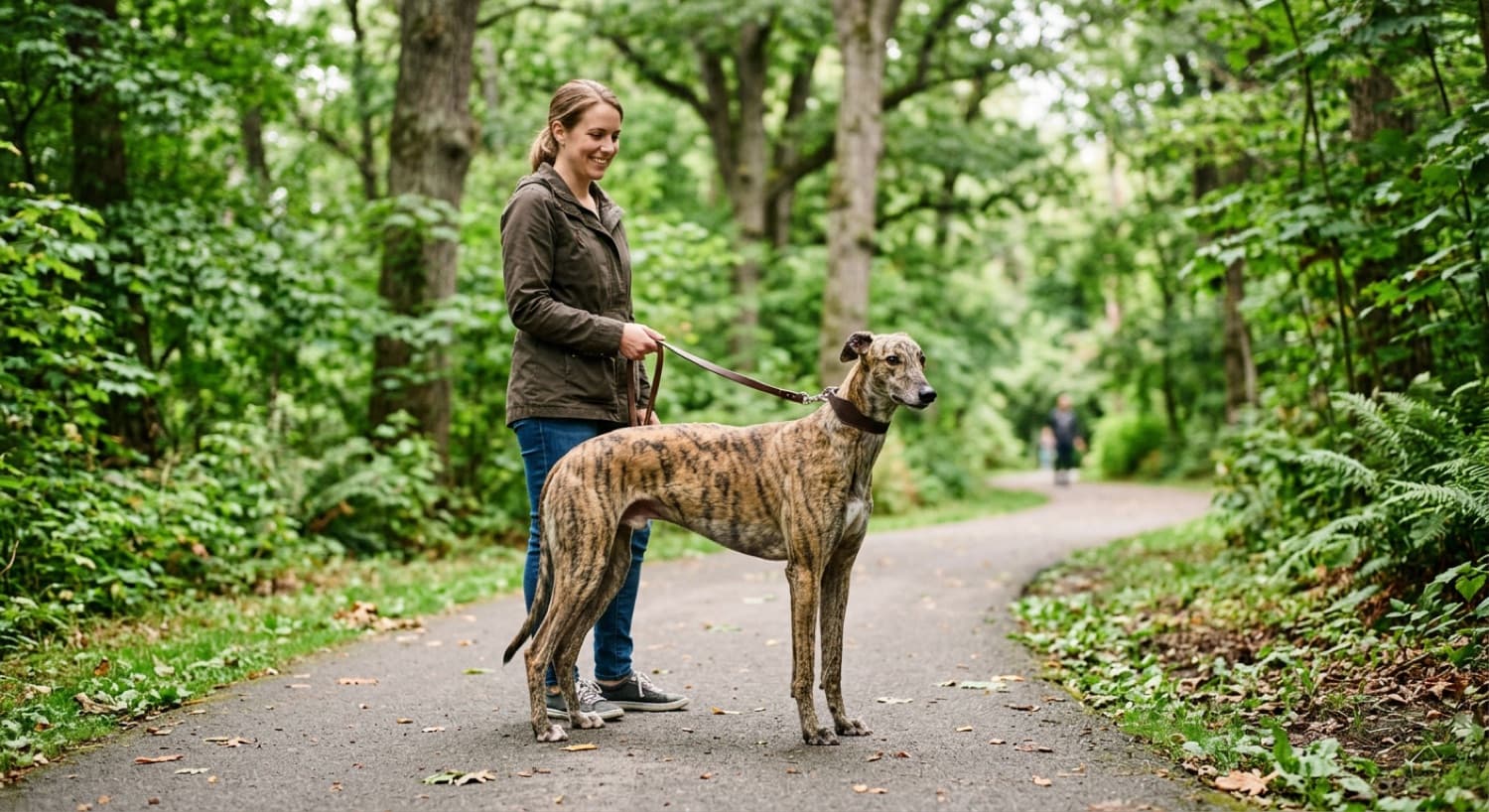
The sighthound prey drive: 5,000 years of selection
Greyhounds are the oldest documented dog breed in Western history, with selection breeding for visual prey pursuit traceable through Egyptian and Greek records spanning roughly five thousand years. Every line, every coat colour, every individual Greyhound carries the package. The eyes are positioned for binocular focus on moving prey at distance. The neck and spine flex for top-speed turns. The fast-twitch muscle distribution prioritises explosive acceleration over endurance. The brain wiring prioritises visual stimulus over auditory processing during arousal. None of this is trainable away. It is what the breed is.
The trigger range is roughly 100 to 300 yards depending on terrain and the size of the moving target. A deer crossing a clearing at 200 metres triggers a Greyhound the same way a thrown ball triggers a Labrador. The dog is not making a choice. The chase circuitry runs automatically, and the override that a Labrador uses to drop the ball when called does not exist in the same form for a sighthound under prey arousal.
This matters because it changes the question owners should be asking. The question is not how to train a Greyhound to recall off-leash. The question is how to build an outdoor life for a Greyhound that does not depend on recall holding under arousal. The answer to that second question is the body of this article.
The 45 mph reality on Edmonton terrain
Greyhounds top out at roughly 45 mph (72 km/h) and reach full speed in about five to seven seconds. That is faster than most cars accelerate from a stop in a residential zone, and faster than any handler can react. By the time a person registers that the chase has started, calls the recall word, and the Greyhound would in theory hear it, the dog is 150 to 200 metres away and accelerating.
Edmonton terrain compounds the consequences. River-valley trails feed directly onto major arterials in several places: Whitemud Drive bisects the south river valley, Groat Road crosses the central river valley, Fox Drive borders the southwest, and Yellowhead Trail cuts across the north escarpment. A Greyhound in full chase out of Mill Creek Ravine, Whitemud Ravine, or the Hawrelak south slope can reach a road in under a minute. Icy winter terrain adds a second hazard: a 45 mph stop on ice or packed snow is impossible, and the breed-specific injury risk from a high-speed fall onto frozen ground is documented in sighthound veterinary literature.
The American College of Veterinary Surgeons (acvs.org) documents sighthound-specific orthopaedic injury patterns from acceleration and high-speed turns. Tarsal injuries, central tarsal bone fractures, and gracilis muscle injuries are all overrepresented in Greyhounds compared to other breeds, and emergency repair for these injuries can run several thousand CAD even when surgical outcomes are favourable. A chase that ends in a fence collision, a road crossing, or a fall on ice produces the kind of injury that emergency surgery often cannot fully resolve.
The 45 mph number is the reason the long-line replaces off-leash time on unfenced trails. The handler does not need to outrun the dog. The handler needs to stop the chase before it starts.
Greyhound brain shut-off: why recall stops registering
The phrase Greyhound brain shut-off is sighthound community shorthand for a real behavioural phenomenon. Once a Greyhound commits to a visual chase, the auditory processing pathway goes quiet relative to the visual pursuit pathway. The owner standing behind the dog calling the recall word is genuinely not being heard the way a non-aroused dog would hear them. The dog is not ignoring the handler. The signal is not reaching the part of the brain that would weigh it against the chase reward.
This is consistent with the broader literature on arousal-driven behaviour. The American Veterinary Society of Animal Behavior (avsab.org) publishes position statements on humane training methods and the role of arousal in response inhibition. For sighthounds under prey arousal, the inhibition window narrows further than for most breeds. A Greyhound at moderate arousal (squirrel at 50 metres, dog interested but not committed) can still respond to a recall. A Greyhound at full arousal (deer at 100 metres breaking cover, chase started) cannot.
Training cannot move this line meaningfully. What training can do is build a recall reliable enough that the dog will respond at moderate arousal before the full arousal threshold is crossed. That is valuable, and worth doing, but it depends on the handler reading the dog correctly and recalling before the chase starts. In practice that depends on seeing the trigger before the dog does, which on Edmonton river-valley trails is not realistic. The deer is often visible to the Greyhound at 200 metres through gaps in the trees that the handler does not see at all.
The position we hold: never off-leash in unfenced spaces
This is the universal position in the Greyhound rescue and ownership community, and the position this site holds across every Greyhound article. Off-leash time for Greyhounds belongs in fully fenced spaces only. No exceptions for well-trained dogs, no exceptions for quiet trails at off-peak hours, no exceptions for Greyhound mixes with non-sighthound parentage. The package travels with the breed, and partial sighthound ancestry produces partial sighthound behaviour in unpredictable ways.
What fully fenced means. The fence is solid on every side. No gaps under the bottom edge larger than the dog can squeeze through. Gate latches are key-locked or carabiner-clipped, not standard wooden hooks. The perimeter has been walked by you, not just described by someone else. For a Greyhound at 45 mph hitting a fence weak point, a five inch gap can become a six inch gap on impact.
What unfenced means in Edmonton. Mill Creek Ravine, Terwillegar, Whitemud Ravine, Hawrelak, Capilano, Buena Vista, the Buena Vista Park off-leash zone, and every river-valley trail are unfenced. They border deer corridors, coyote travel routes, and rabbit habitat. The bylaw designates them as off-leash for general dog use; the bylaw does not adjust for breed-specific prey-drive risk. Bylaw-compliant and Greyhound-safe are not the same thing.
The long-line replaces off-leash time on unfenced trails. Fenced parks and private fenced yards replace off-leash time for free-running exercise. Both options give a Greyhound a full life. The owners who hold this position consistently over years are the owners whose Greyhounds live long lives. The owners who relax the rule because the dog has been fine for a long time are the owners who eventually call their rescue with the story everyone in sighthound rescue has heard before.
Common trigger species on Edmonton trails
The Greyhound trigger list is broader than most owners expect. Anything that moves fast across the field of vision can set off a chase. The mitigating factor is not eliminating triggers (impossible) but expecting them.
- Deer. The single most common Edmonton river-valley trigger. Resident deer in Whitemud, Mill Creek, Hawrelak south slope, Terwillegar perimeter, and Capilano. Most visible at dawn and dusk and through autumn rut.
- Rabbits. Year-round, every Edmonton residential neighbourhood with mature trees and shrub cover. Backyard rabbit sightings produce fence-line chase attempts that test the fence weekly.
- Squirrels. Year-round in tree-canopy zones. Lower trigger weight than ground prey but still chase-inducing for high-drive Greyhounds.
- Smaller dogs. A small fast-moving dog can read to a Greyhound as prey rather than a social peer. This is a documented sighthound risk at off-leash parks and the reason careful breed-size matching matters at fenced dog parks.
- Cats. Outdoor cats crossing a trail or a backyard. Indoor cats are addressed through cat-test evaluation in the rescue intake process.
- Coyotes. Edmonton river valley carries established coyote populations. A Greyhound chase that pulls the dog into ravine territory can trigger coyote defence behaviour, particularly in pup-rearing season (April through July).
- Joggers and cyclists. Fast-moving humans can trigger chase in some Greyhounds, particularly during early adoption when the dog is still learning to read human motion as non-prey.
The mitigation is the long-line. The handler does not have to spot every trigger before the dog does. The long-line stops the chase mechanically regardless of what set it off.
Cat compatibility and individual testing
Some Greyhounds live happily with cats. Roughly a third of ex-racing Greyhounds test as cat-safe through structured rescue evaluation, another third are workable with the right cat and careful introduction, and the final third are not safe with cats under any circumstance. The Northwest Canadian Greyhound League and similar sighthound rescue networks run formal cat tests as part of their adoption matching process, and the test result is the most reliable predictor for a cat household. Breed alone tells you nothing.
A formal cat test typically involves the Greyhound on a leash in a controlled space, a confident cat introduced at distance, and the evaluator reading the dog for prolonged staring, lip licking, body tension, low head posture, raised hackles, and forward predatory body positioning. A Greyhound who looks past the cat with relaxed body language and quickly disengages is a candidate for a cat home. A Greyhound who locks on with a low head and stalking posture is not. Rescue evaluators read this in seconds; owners often miss the signals.
Cat-test results do not transfer perfectly to other small pets. A cat-safe Greyhound may still chase rabbits or small dogs. The same evaluation logic applies for each species. Trust the rescue assessment, ask for specifics, and introduce slowly with baby gates and leashed sessions over the first several weeks. Most adoption failures in cat households happen in the first week because the introduction was rushed, not because the cat test was wrong.
Recall training: possible but never reliable enough
Build recall anyway. It improves daily life, makes long-line work easier, and gives the dog a useful behaviour for general management. What it does not do is make a Greyhound safe off-leash in unfenced spaces. Hold both ideas at once.
The basic protocol. Start in zero-distraction environments (indoor room first, then quiet fenced yard). Use a 15 to 30 foot biothane long-line, a back-clip Y-shape harness, and very high-value food (real meat, cheese, hot dog cut small, freeze-dried liver). Call your dog's name and the recall word once; reward the moment the dog turns toward you and again when the dog reaches you. Many short reps beat long sessions. Recall should be the most-rewarded behaviour in the dog's daily life. The Certification Council for Professional Dog Trainers publishes evidence-based recall protocols and certifies trainers who use force-free methods.
Some of the product links in this section are Amazon affiliate links — we may earn a small commission at no extra cost to you. It never changes which products we recommend.
What to expect. Most Greyhounds reach reliable recall in low-distraction environments within a few months. Reliable recall under fresh visual prey arousal at 100 metres is not a documented reproducible outcome and should not be the goal. The realistic ceiling is recall reliable enough to disengage from low-arousal triggers (a calm dog at distance, a stationary deer just spotted, a squirrel at 80 metres on the other side of a fence). Even that takes consistent reinforcement over years. The International Association of Animal Behaviour Consultants certifies behaviour consultants who work with sighthounds; if your Greyhound has serious arousal management issues, an IAABC-certified consultant is the right call.
What does not work. Punishment for recall failure (the dog learns the recall word predicts something unpleasant). Calling repeatedly when the dog is not coming (the word loses meaning). Aversive tools like prong collars, shock collars, and e-collars (counterproductive for soft-tempered sighthounds; arousal-driven chase does not respond to pain signals the way arousal-driven aggression sometimes does, and AVSAB position statements are clear on the welfare concerns). Calling only to leash up and end the fun (the dog learns recall equals end of fun; instead recall, reward heavily, then release back to whatever they were doing whenever safe).
Long-line protocol for Edmonton terrain
The long-line is the realistic alternative to off-leash time on unfenced trails. Done right, it gives the Greyhound real range to move, sniff, and explore, while keeping the option to stop a chase before it starts.
Gear specifications
| Component | Specification |
|---|---|
| Line material | Biothane (waterproof, washable, grippy when wet, does not stiffen in Edmonton cold) |
| Line length | 15 ft (busy zones), 20 ft (default), 30 ft (open prairie or quiet trails) |
| Harness | Y-shape back-clip, not a flat collar. Greyhound necks are unusually long and delicate. |
| Backup collar | Martingale collar for tag display and harness-clip-failure backup |
| What to avoid | Retractable leashes (spring fails under pull, no shock absorption, cord can snap) |
Pole and line drag prevention. Never wrap the line around your hand or tie it to your waist on icy Edmonton terrain. A 75 lb Greyhound hitting the end of a 20 foot line at full speed transmits enough force to pull a handler off their feet, dislocate a shoulder, or cause a wrist fracture on ice. The standard approach is to hold the line in a loose grip with friction and let it slide through if the dog hits the end hard. Some handlers use a hip-belt setup with a shock-absorber section, but the unwrap-on-impact discipline matters more than the gear.
Sniff-walks versus free roam. A long-line walk is not a substitute for free running; it is a different kind of outing. The Greyhound moves at variable pace, sniffs, ranges, stops. The handler walks behind, managing line slack, watching for triggers, redirecting before the dog locks on. This is enriching for the dog in a way leash heel work is not, and it is a real exercise outlet over a 45 to 60 minute walk on river-valley trails. Free-running exercise happens in fenced spaces separately.
Line-management practice. Practice in a quiet residential park before the first river-valley outing. Learn the line-coil technique (gather slack in figure-eight loops, release smoothly when the dog ranges out). Learn to drop the loop if the dog hits speed (dragging line is recoverable, an arm injury is not). Most Edmonton Greyhound owners get smooth at this within a few weeks; the gear is more forgiving than it looks once the muscle memory is in place.
Edmonton fenced off-leash options
Fenced off-leash space is the realistic free-running outlet for an Edmonton Greyhound. The supply is limited compared to unfenced ravine zones but it exists.
Municipal fenced off-leash parks. Most Edmonton off-leash zones are unfenced river-valley or ravine areas. A small number of municipal parks include fenced off-leash sections (typically attached to community centres or large neighbourhood parks); check the City of Edmonton parks listing for current status before going, because fencing is updated periodically and what was fenced two years ago may not be today. Walk the perimeter yourself before letting the Greyhound off-line, every visit. Sighthounds find gaps other breeds ignore.
Private fenced rental yards. Sniffspot and similar peer-to-peer fenced dog park rental services have expanded in the Edmonton metro. Listings typically run 5 to 20 CAD per hour for fully fenced acreage, with the upper end for large rural-perimeter properties. The advantage is exclusive use (no other dogs, controlled environment, you read the fence quality yourself before paying). The disadvantage is cost over time if it is your only free-running outlet. Many Edmonton Greyhound owners use private fenced rentals once or twice a month plus daily long-line walks.
Friends and family yards. A fenced backyard belonging to someone you trust, walked perimeter yourself, double-gate entry verified, is free and convenient. Greyhound-owning friends and rescue networks often coordinate yard shares for this reason.
What to avoid. Unfenced municipal off-leash zones (Mill Creek, Whitemud, Hawrelak, Terwillegar, Capilano, Buena Vista). Partially fenced areas where one boundary is open. Areas where you have not walked the perimeter yourself. A “mostly fenced” park is an unfenced park for a Greyhound.
Backyard fence requirements for Greyhounds
Six feet, solid construction, visual barriers, double-gate entry. Greyhounds are not high jumpers in the way working breeds are, and they are not diggers in the way Beagles and Huskies are, but they accelerate explosively in a confined space when a prey trigger crosses the fence line.
Edmonton backyard fence specs
| Fence detail | Holds a Greyhound? |
|---|---|
| 4 to 5 foot fence | Not adequate. Upgrade before adoption. |
| 6 foot chain link (visual through) | Height adequate, visual through-fence triggers raise arousal. Add visual barrier. |
| 6 foot solid wood, single gate | Baseline acceptable. Add carabiner backup on gate. |
| 6 foot solid wood, double-gate entry | Standard secure setup. Reduces delivery-driver escape risk. |
Visual barriers matter more for sighthounds. A chain link fence that lets the Greyhound watch every passing squirrel, neighbour dog, and rabbit raises the baseline arousal level meaningfully. The dog spends more time at the fence, hits the fence harder when the trigger appears, and is more likely to find a weakness. Solid wood breaks the visual line and lowers the resting arousal. If you cannot replace a chain link fence, add privacy slats or a fabric privacy screen on the inside.
Double-gate entry. An outer gate plus an inner gate, with the space between them small enough that the dog cannot accelerate to top speed. The delivery driver, plumber, or contractor opens the outer gate, walks into the buffer space, closes the outer gate behind them, then opens the inner gate. The two-stage entry catches the failure mode where someone leaves a gate open. Many Edmonton suburban builds (Riverbend, Terwillegar South, Summerside) can accommodate a retrofit double gate with modest carpentry; the cost is usually under 500 CAD for materials.
Gate latches and monthly perimeter walks. Replace standard wooden hooks with key-locked latches or carabiner-clipped chains. Edmonton frost heave shifts soil season to season; a gap-free fence in October can have a new opening by March. Walk the perimeter monthly looking for loose pickets, rotted boards, gaps under decks, and corner weaknesses. The corners and gate posts are the most common failure points.
Browse adoptable Greyhounds in Edmonton
Edmonton rescues that intake Greyhounds note cat-test results, prey-drive assessment, and fence requirements on every dog's profile. The fenced-only off-leash rule applies regardless of which dog you adopt. Read the foster notes carefully and confirm your fence meets the spec before applying.
See Edmonton Adoptable Dogs →
Edmonton river-valley wildlife: deer, coyotes, raccoons
The Edmonton river valley is the largest urban park system in North America, and it carries an active wildlife population that runs straight through every off-leash zone in the city. For a sighthound on an unfenced trail, the wildlife list is a trigger list.
Deer. The most common Greyhound chase trigger in Edmonton. Resident deer populations in Whitemud Ravine, Mill Creek, the Hawrelak south slope, the Terwillegar perimeter, Capilano, and the entire river-valley corridor. Most active at dawn and dusk; visible year-round. Autumn rut (October through November) sees more aggressive deer behaviour and more cross-trail movement. Winter sees food-stressed deer pushed onto lower-elevation trails, which is exactly where dog walkers go.
Coyotes. Edmonton has established urban coyote populations using the river-valley corridors as travel routes. Whitemud Ravine, Mill Creek, the Hawrelak south slope, and the Terwillegar perimeter all carry coyotes daily, with highest visibility at dawn and dusk. A Greyhound chase that pulls the dog deep into ravine territory can trigger a coyote response. Coyote pup-rearing season (April through July) is the highest-risk period for territorial defence. Winter coyotes are food-stressed and more willing to engage. A loose Greyhound in coyote territory is a same-hour emergency, not a wait-and-see situation.
Raccoons. Year-round, every Edmonton residential neighbourhood. Less common as a sighthound trigger than deer or rabbits but still chase-inducing for some dogs. Backyard raccoons at night produce fence-line excursions if the dog is left out alone after dark.
Rabbits and squirrels. Constant, everywhere. The everyday trigger that long-line discipline is built around. A Greyhound owner who lets up on the long-line because the trail looks empty has not yet seen the rabbit in the brush 20 metres ahead. The dog has.
Edmonton Bylaw 21244 and 14600: what applies
The City of Edmonton Animal Care and Control Bylaw 21244 restricts off-leash dog activity to designated zones, requires effective control of all dogs at all times, and carries fines that can reach the 250 CAD range for off-leash outside a designated zone. The bylaw is breed-neutral; Greyhounds receive the same treatment as every other dog. The Community Standards Bylaw 14600 covers nuisance issues (dog-at-large situations, barking complaints, neighbourhood disturbances).
Practical bylaw compliance for an Edmonton Greyhound. A 15 to 30 foot biothane long-line clipped to a back-clip harness is bylaw-compliant on regular trails and within designated off-leash zones (the line provides effective control, which is the bylaw test). The same long-line gives the Greyhound real range to move while keeping the chase mechanically blockable. Off-leash in a non-designated zone is a bylaw violation and a Greyhound safety risk simultaneously.
Bylaw-compliant and safe are not the same thing for this breed. A Greyhound off-leash in a designated unfenced off-leash zone is technically within the bylaw. The chase risk this article exists to address is the same in or out of designated zones. The fenced-only rule is a sighthound safety rule, not a bylaw rule, and it sits on top of bylaw compliance rather than replacing it.
Italian Greyhounds, Galgos, and other sighthounds
The sighthound package travels across the family. The rule applies to every breed in the group.
Italian Greyhounds. The toy size of the sighthound family at 7 to 14 lbs. Same prey drive, same chase commitment, same recall failure under arousal. Top speed is roughly 25 mph (still well past what a handler can run down). Smaller size makes Italian Greyhounds more vulnerable to road traffic, coyote encounters, and off-leash dog conflict, not less. Owners sometimes underestimate the risk because the dog looks like a lap pet; the prey-drive selection pressure is identical. Fenced-only off-leash. Long-line on unfenced trails. Same protocol.
Galgo Español. Spanish hunting sighthounds increasingly available through North American rescue networks. Bred for hare coursing over open Spanish terrain. Similar prey-drive profile to Greyhounds, sometimes higher. Roughly 40 mph top speed. Same rule, same gear, same fenced-only policy. Galgos often arrive in rescue with limited socialisation history due to the cultural treatment of the breed in Spain; many need extended decompression time and slow introduction to handlers before long-line work feels natural.
Other sighthounds. Whippets, Saluki, Borzoi, Afghan Hound, Pharaoh Hound, Sloughi, Azawakh, and other less common breeds carry the same package in varying intensities. Whippet-Greyhound crosses are common in Edmonton rescue and inherit the same prey drive. If a dog has documented sighthound ancestry, the rule applies. Partial sighthound mixes (Greyhound-Lab, Whippet-terrier) produce partial sighthound behaviour in unpredictable ways; the safest default is to assume the sighthound package is present until proven otherwise through a structured prey-drive evaluation.
Senior Greyhounds, multi-dog homes, and the “been fine for years” myth
Senior Greyhounds still chase. Sight declines with age, hearing fades, and reflexes slow, but the chase circuitry stays intact through the senior years. An 11-year-old Greyhound who has not run flat-out in two years will still commit to a chase if a deer crosses the trail at close range. The decline in physical capacity means the dog is more vulnerable in the chase (a fall on ice is more likely to break something, recovery from a coyote encounter is slower), not less likely to start one. Long-line stays on for life.
Multi-Greyhound households amplify chase risk. Sighthounds pack-chase. A single Greyhound who might pause for a half-second before committing to a marginal trigger will commit immediately if a housemate starts running. In a multi-Greyhound household, one dog spotting a deer produces both dogs in chase before either handler has registered what happened. The mitigation is the same long-line discipline, with both dogs on lines for outdoor walks and fenced-yard time for shared free running.
The “been fine for years” case. The owners who have not had a recall failure are usually owners who have not yet had the right combination of trigger, terrain, and timing. The Greyhound community sees this story regularly: dog walked off-leash for three years with no incident, one rabbit appeared at the wrong moment near a road, the dog died on the road. One chase can be fatal. Past success at off-leash time does not prove future reliability; it proves the trigger combination has not occurred yet.
The cost of using a long-line instead is small. The dog still ranges and sniffs. You keep the option to stop the chase before it starts. The cost of one wrong chase is final. This is why the sighthound community uses the phrase one chase, one tragedy. It captures the asymmetry between the marginal benefit of off-leash time and the catastrophic downside of getting it wrong once.
Frequently asked questions
Can I let my Greyhound off-leash in Edmonton?
Not in unfenced spaces, ever. This is the universal position across the Greyhound rescue and ownership community, and it is the position we hold across every Greyhound article on this site. Greyhounds are visual sighthounds bred for five thousand years to chase moving prey at full speed, and they can reach 45 mph (72 km/h) within seven seconds of starting. Once a Greyhound commits to a chase, recall is mechanically impossible because the part of the brain that processes the recall word goes quiet while the chase circuitry runs. Edmonton off-leash zones like Mill Creek Ravine, Terwillegar, Whitemud, Hawrelak, and Capilano are all unfenced and all border river-valley corridors that carry fresh deer, rabbit, coyote, and squirrel scent every day. A loose Greyhound in any of these zones who triggers on prey can cover a kilometre before you finish calling. Off-leash time for Greyhounds belongs in fully fenced spaces only. A long-line in unfenced areas is the realistic alternative for life.
Where are the fenced off-leash areas in Edmonton for Greyhounds?
Fenced off-leash options in Edmonton are limited but they exist. Most municipal off-leash parks are unfenced ravine or river-valley zones, which are not Greyhound-suitable. The realistic fenced options are small dedicated fenced dog parks (some Edmonton communities have these attached to community centres or large parks), private fenced backyards you arrange visits with through friends or family, and Sniffspot-style private rental dog parks where Edmonton property owners rent fully fenced yards by the hour. Sniffspot listings in the Edmonton metro typically run 5 to 20 CAD per hour for fully fenced acreage. Before bringing your Greyhound, walk the perimeter yourself looking for gaps, dig points under the fence, and gate latch quality. Sighthounds find weaknesses other breeds ignore. The general principle: verify the fence yourself, do not trust a listing description.
How fast can a Greyhound run?
Up to 45 mph (72 km/h), the fastest dog breed on earth, with acceleration from standing to full speed in about five to seven seconds. That speed is why the off-leash rule is non-negotiable. A 45 mph dog can clear a city block in eight seconds. By the time a handler registers the chase has started, calls the recall word, and the Greyhound would in theory hear it, the dog is already 200 metres away and accelerating. The chase circuitry in the sighthound brain prioritises visual pursuit at the expense of auditory processing. This is documented sighthound physiology, not a training gap. According to the American College of Veterinary Surgeons (acvs.org), Greyhounds also carry breed-specific athletic injury risk from acceleration and tight turns at speed; a chase ending in a fence collision, a road crossing, or a fall on icy Edmonton terrain produces injuries that emergency surgery often cannot fix.
Can recall training make my Greyhound safe off-leash?
Recall training is valuable and worth doing, but it does not make a Greyhound safe off-leash in unfenced spaces. Building reliable recall in low-distraction environments is achievable for most Greyhounds and improves daily life. Building recall reliable enough to override a moving rabbit at 100 metres has not been documented as a reproducible outcome by any credentialed sighthound trainer. The Certification Council for Professional Dog Trainers (ccpdt.org) and the International Association of Animal Behaviour Consultants (iaabc.org) both teach evidence-based recall protocols, and both acknowledge the breed-specific limit for sighthounds under prey arousal. The realistic position: train recall to the highest level you can reach, then keep the long-line on anyway because one rabbit can erase six months of work. Owners who have not had a recall failure are usually owners who have not yet had the right trigger at the right moment.
What is the right long-line for an Edmonton Greyhound?
A 15 to 30 foot biothane long-line clipped to a back-clip Y-shape harness. Biothane is waterproof, washable, does not stiffen in Edmonton winter cold, and stays grippy when wet or snowy. Skip retractable leashes entirely (the spring mechanism fails under hard pulling, the thin cord can snap or wrap around legs at speed, there is no shock absorption for a 45 mph hit, and Greyhound necks are too delicate for the impact). The 15 foot length works for paved river-valley pathways and busier zones; 20 feet is the versatile default; 30 feet works on quiet open prairie sections. Clip to a Y-shape back-clip harness, not a flat collar (Greyhounds have unusually long thin necks and a tracheal hit at speed can cause real injury). Many Edmonton Greyhound owners also use a martingale collar for tag display and backup security in case the harness clip fails. Pole and line drag prevention matters too: never wrap the line around your hand or tie it to your waist on icy terrain.
Are some Greyhounds safe with cats?
Some are, but never assume from breed alone. Roughly a third of ex-racing Greyhounds test as cat-safe through structured rescue evaluation, another third are workable with a confident cat and careful introduction, and the final third are not safe with cats under any circumstance. The Northwest Canadian Greyhound League and similar sighthound rescues run formal cat tests using a calm cat in a controlled space and reading the Greyhound for prolonged staring, lip licking, body tension, and predatory body positioning. A Greyhound who looks past the cat with relaxed body language is a candidate for a cat home; a Greyhound who hard-stares with a low head and forward body posture is not. The same evaluation applies for small dogs, rabbits, and other small pets. Trust the rescue assessment over breed generalisations. Never bring a Greyhound into a cat household without a documented cat test, and even then introduce slowly with baby gates, leashed sessions, and supervised escalation over several weeks.
What fence does my Edmonton backyard need for a Greyhound?
Six feet minimum, solid construction, no climb points, double-gated entry where possible. Greyhounds are not high jumpers like some working breeds, and they are not diggers like Beagles or Huskies, but they are explosive accelerators in a confined space. A five foot fence can be cleared by a Greyhound who hits a prey trigger near the fence line. Six foot solid wood is the right baseline. Visual barriers matter more for sighthounds than for scent-driven breeds because the trigger is what they see; a chain link fence that lets the dog watch every passing squirrel produces a much higher arousal baseline than a solid wood fence that breaks the visual line. Walk the perimeter monthly for loose pickets, gate latch wear, gaps under decks, and any new opening from Edmonton frost heave. Add a double gate at the main entry (an inner gate plus an outer gate) so a delivery driver leaving the outer gate open does not produce a loose Greyhound. Backyard gate latches should be key-locked or carabiner-clipped, not standard wooden hooks.
How do Edmonton river-valley deer affect Greyhound safety?
Deer are the single most common prey trigger for Edmonton sighthounds on river-valley walks. Whitemud Ravine, Mill Creek, the Hawrelak south slope, the Terwillegar perimeter, Capilano, and Buena Vista all carry resident deer, with sightings most common at dawn and dusk and through autumn rut. A Greyhound who picks up a deer at 100 to 200 metres can be in full chase before a handler has registered what the dog saw. Deer-chase consequences in the Edmonton river valley include road crossings (Whitemud Drive, Groat Road, Fox Drive), falls on icy slopes in winter, fence collisions when the deer goes through and the dog hits the fence, and coyote encounters when a chase pulls the dog deep into ravine territory. The mitigation is mechanical: long-line on every river-valley walk for life, no exceptions, even in winter when owners often relax because the valley looks empty. Winter is when food-stressed deer are most often pushed into lower elevation trails, which is exactly where Edmonton dog walkers go.
Does the rule apply to Italian Greyhounds too?
Yes, fully. Italian Greyhounds are the toy size of the sighthound family at 7 to 14 lbs, and they carry the same prey drive, the same chase commitment, and the same recall failure under arousal as their full-size cousins. Their top speed is lower (roughly 25 mph) but still well past what a handler can run down, and their small size makes them more vulnerable to road traffic, coyote encounters, and off-leash dog conflict. The fenced-only off-leash rule applies. The long-line on unfenced trails applies. Italian Greyhound owners sometimes underestimate the risk because the dog is small and looks like a lap pet; the prey-drive selection pressure is identical. Galgo Español dogs (Spanish hunting sighthounds increasingly available through North American rescue) carry the same package as well. Same rule, same long-line, same fenced-only policy.
My Greyhound has been fine off-leash for years. Why change?
Because reliability and luck are different things. The owners who have not had a recall failure are usually owners who have not yet had the right combination of trigger, terrain, and timing. Sighthound rescue networks see this story regularly: a Greyhound walked off-leash for three years, then one rabbit appeared at the wrong moment near a road, and the dog died on the road. One chase can be fatal. The cost of using a long-line instead is small (the dog still gets to range and sniff, you keep the option to stop the chase before it starts). The cost of one wrong chase is final. The Greyhound community uses the phrase one chase, one tragedy for this reason. Edmonton specifically adds coyote risk, deer triggers, river-valley road crossings, and ice that makes ending a chase mid-stride impossible. Switching to a long-line costs a Greyhound nothing meaningful and removes the only failure mode that ends in a vet emergency or worse.
How does Bylaw 21244 apply to Greyhounds in Edmonton?
The City of Edmonton Animal Care and Control Bylaw 21244 restricts off-leash dog activity to designated zones, requires effective control of all dogs at all times, and carries fines that can reach the 250 CAD range for off-leash outside a designated zone. There is no breed-specific provision for Greyhounds. The bylaw treats them the same as every other dog, which means an off-leash Greyhound in a non-designated zone is a bylaw violation. The Community Standards Bylaw 14600 covers nuisance issues like dog-at-large situations and barking complaints. Practically, a Greyhound on a 15 to 30 foot biothane long-line clipped to a harness is bylaw-compliant on regular trails and gives the dog real range. A Greyhound off-leash in a designated unfenced off-leash zone is technically compliant with the bylaw but creates the prey-drive risk this article exists to address. Compliance and safety are not the same thing for this breed.
More Edmonton Greyhound guides
Edmonton Adoptable Dogs →
Current Greyhound and sighthound listings from Edmonton rescues, with cat-test and prey-drive notes.
Greyhound Adoption Edmonton →
Edmonton rescue routes for Greyhounds, adoption costs, ex-racer pipeline, and the Northwest Canadian Greyhound League.
Greyhound Health Issues: Bone Cancer, Bloodwork →
Greyhound health issues to plan for: bone cancer, bloodwork that reads differently from other dogs, anaesthesia and cold, teeth, glaucoma and bloat.
Greyhound Winter Care Edmonton →
Thin-coat winter gear, frostbite risk, indoor warmth setup, and Edmonton deep-cold management.
New dog? Start with these care guides
Everything a new adopter needs to set up a safe, happy home.