The short answer
Greyhounds are unusually cold-vulnerable because of 4 to 5 percent body fat, a thin single coat with no undercoat, and a tall lean athletic body that radiates heat fast. Above 5C is fine with a light coat. From -5C to -15C, layered Greyhound-cut clothing plus booties and 10 to 15 minute sessions. From -15C to -25C, brief 3 to 5 minute potty breaks with full gear. Below -25C, indoor potty options. Indoor sleeping on raised orthopaedic beds is mandatory for the breed; an unheated garage or cold basement is not a Greyhound sleeping option. Italian Greyhounds shift every threshold down by one band. See our Edmonton Greyhound adoption guide for rescue sources and the health planning guide for anaesthesia and pannus context.
The Edmonton winter Greyhound reality
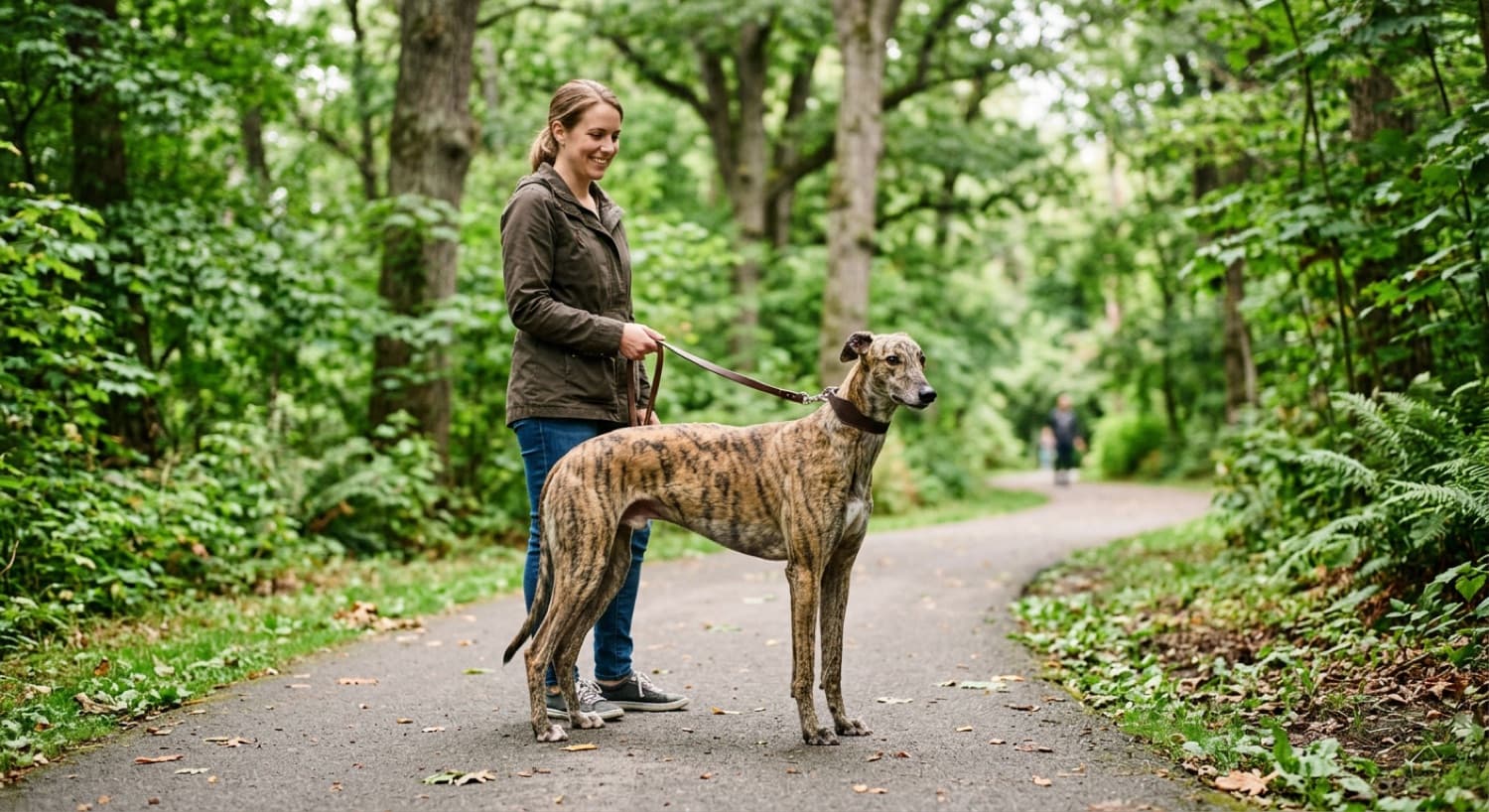
The Greyhound is not built for prairie deep cold. The reasons are structural and well documented. A fit adult Greyhound carries 4 to 5 percent body fat compared with 15 to 25 percent for most other breeds. The coat is a single short layer of thin fibre with no insulating undercoat. The body is tall, narrow, and lean, with a deep chest and long legs, which produces a high surface-area-to-volume ratio. All three of those traits compound into a dog that loses body heat faster than almost any other large breed of the same body weight. A 70 lb Greyhound chills in conditions that a 70 lb Labrador or Golden Retriever would handle comfortably.
None of this is overcomeable through conditioning. The coat does not thicken in response to cold exposure the way a double-coated breed coat does. The body fat does not increase meaningfully without adding unhealthy weight. A Greyhound that has lived in Edmonton for five winters still has the same physiology as a Greyhound that arrived from coastal Florida last week. The dog can learn to tolerate gear and routine, but the underlying cold vulnerability is permanent breed biology.
Edmonton sets a serious test for this physiology. Average January temperatures run -10C to -15C, with overnight lows of -25C to -30C as the normal pattern. Cold snaps reach -35C to -40C several times per winter, and unlike Calgary, Edmonton gets no chinook reprieve to break the cold for a few days. Deep cold stretches across November, December, January, February, and into March. Salt and ice on sidewalks and roads run from October through April. The cold-weather season for an Edmonton Greyhound is genuinely 5 to 6 months long.
What makes the routine work is conservative planning. Greyhound-cut insulated clothing with belly coverage. Booties for the deepest cold or paw wax for everyday salted-sidewalk walks. Short structured outings that scale to the temperature. Indoor sleeping on warm raised beds. Indoor exercise that covers the rest of the daily activity budget. The dog still gets exercise and still has a good winter. The cold-vulnerability risks just stop compounding. The AVMA cold weather pet safety guidance is explicit that thin-coated and lean breeds need shorter exposure than thick-coated dogs regardless of clothing.
Why Greyhounds chill faster than other large breeds
The cold vulnerability story for a Greyhound is not weight. It is the three physiological realities below, each of which independently accelerates heat loss and which combine into a unique cold profile that owners coming from other large breeds often underestimate.
Body fat: 4 to 5 percent versus 15 to 25 percent
Body fat is the primary insulation layer for any mammal in cold weather. A fit Greyhound carries 4 to 5 percent body fat. For comparison, most dogs run 15 to 25 percent, a pet Labrador often runs 20 to 30 percent, and a working sled dog can reach 30 percent or more before activity. The Greyhound has functionally no internal cold buffer. Heat generated by metabolism has nothing between it and the cold air. The dog cools fast and warms slowly. This is also why Greyhounds famously seek the warmest spot in any room and pile under blankets indoors. It is not preference; it is thermoregulation.
Coat: single short layer, no undercoat
The Greyhound coat is a single short layer of thin fibre lying close to the skin. There is no soft dense undercoat to trap warm air against the body. Compare with a double-coated breed like a Husky, German Shepherd, or Bernese Mountain Dog where the soft undercoat carries most of the insulation and the guard coat sheds water and snow. A Greyhound has only the guard layer, and it is thin. Wet snow soaks through the coat and chills the skin directly. Wind cuts through the coat without resistance. The coat is functional for the speed and heat dissipation work the breed was built for; it is not built for prairie winter.
Body shape: tall and lean
The Greyhound silhouette is tall, narrow, and long, with a deep chest, an arched topline, and long legs. The surface-area-to-volume ratio is high. Heat radiates outward from the entire surface area of the body, and the lean shape means more surface area per pound of body mass than a compact stocky breed of the same weight. A 70 lb Greyhound has substantially more skin and exposed area than a 70 lb Lab. More surface area means more heat loss, faster.
The compound effect
The three stack. Low fat means no insulation. Thin coat means no clothing layer. Lean shape means high heat-loss surface. Each factor on its own would create a more cold-vulnerable dog than average. Together they create one of the most cold-vulnerable large breeds in common ownership. The routine that works treats all three as fixed and builds the environment around them.
Temperature thresholds Edmonton Greyhound owners need
Wind chill matters more than ambient temperature. Environment and Climate Change Canada wind chill guidance classifies wind chills of -28 to -39 as frostbite possible in 10 to 30 minutes on exposed human skin, and -40 to -47 as frostbite possible in 5 to 10 minutes. Those numbers cap safe outdoor time for a Greyhound ear tip, nose, and paw pad faster than the ambient thermometer suggests. The thresholds below are for a healthy adult Greyhound. Italian Greyhounds, seniors, recently adopted dogs still acclimating, and dogs with cardiac compromise need stricter limits.
Above 5C: routine with a light coat
Walks of 30 to 45 minutes are comfortable with a light coat. Most Greyhounds prefer a thin fleece coat above 10C and a light insulated coat from 10C down to 5C. No paw protection needed unless sidewalks are heavily salted. This is the conditioning window in autumn when owners build the cold-weather routines that pay off through January. Italian Greyhounds may want a coat starting at about 10C.
+5C to -5C: insulated coat mandatory
Insulated Greyhound-cut coat with belly coverage from about 5C down. Sessions of 20 to 30 minutes work for most healthy adults. Watch for shivering. A Greyhound that stops sniffing, walks stiffly, or turns toward home is ready to be done. Italian Greyhounds need layered gear in this range. No booties needed unless the route includes heavy salt.
-5C to -15C: layered gear plus booties
Greyhound-cut insulated coat over a thin fleece base layer for most dogs. Booties or paw wax mandatory because salt and ice on the pads strip the protective lipid layer fast in deep cold. Sessions drop to 10 to 15 minutes. Sheltered river-valley routes pull ahead of exposed sidewalks. Check ear tips and paws partway through the walk. A Greyhound shaking its head or refusing forward movement is signalling cold discomfort.
-15C to -25C: brief outdoor breaks only
Coat plus inner fleece sweater mandatory. Booties or paw wax mandatory. Sessions drop to 3 to 5 minute potty breaks. Bathroom break within one block of the door, then back inside. Check ear tips, nose, paws, and the exposed belly every minute or two. Pale or waxy patches means head home immediately. Many Greyhounds prefer to be carried part of the route in this range, or refuse the outing entirely. Both responses are reasonable.
-25C to -35C: 2 to 3 minute potty breaks
Full layered gear. Pre-warm the dog with indoor activity for a few minutes before going out. Outdoor time is for one purpose only (bathroom break) and ends immediately. Move all the day's exercise indoors. Watch the dog closely for shivering that does not stop after coming back inside. Cold dry air at this range is genuinely dangerous for the breed.
Below -35C: indoor potty day
Indoor potty trays or pads come into their own for Greyhounds in this range. Outdoor breaks of 1 to 2 minutes only, with the dog returning immediately. For Greyhounds trained on indoor potty backup, full indoor potty for the day is the right call. The BC SPCA cold weather pet guidance recommends thin-coated and lean breeds stay indoors during extreme cold regardless of clothing. A -40C day is not a Greyhound walking day.
Two practical add-ons. The dog tells you. Lifted paws, shivering, refusing to walk, sitting down mid-walk, or turning back are all clear signals. A Greyhound that asks to be carried after one block is communicating cold pain. And the wind chill calculation matters every time. A -18C ambient with 25 km/h wind from an open street is functionally -28C for the exposed parts, and the thresholds above shift down by one band.
Frostbite signs and emergency response
Greyhound frostbite shows up faster than on thicker-coated breeds because the cold reaches the skin directly without a buffering undercoat. Five zones to check after every walk below -15C: ear tips, nose, paw pads, tail tip, and exposed belly. The exposed belly is the Greyhound-specific zone most generic frostbite guides miss; the breed silhouette puts the underside in continuous cold contact during winter walking.
Stage 1: monitor
Skin looks pale, waxy, or grayish. The area feels cold to touch and the dog often does not react to gentle pressure (sensation is lost). Get the dog indoors and rewarm gradually with lukewarm water or warm cloths. Do not rub. Friction damages partially frozen tissue. Most stage-one frostbite recovers fully, but the skin stays tender for several days and the area is more vulnerable to refreezing on the next outing.
Stage 2: emergency vet
As the area rewarms, it blisters, swells, or turns dark red, blue, or purple. The dog may show pain on touch and may refuse to put weight on a frostbitten paw. This is a same-day vet visit. Edmonton has 24-hour emergency veterinary services; call ahead and head in. Stage-two frostbite on a Greyhound usually requires pain management, antibiotics for secondary infection, and follow-up wound care.
Stage 3: full emergency
Tissue blackens and dies. The line between healthy and dead tissue appears over days. This is a full emergency, immediately. Dead tissue may require surgical removal, and ear tip or tail tip amputation is possible. Stage three is rare in pet Greyhounds and almost always involves prolonged extreme exposure or a wet-coat hypothermia event.
What not to do
Do not use hot water. Do not use a hair dryer on hot. Do not rub the area to warm it. Do not put the dog in a hot bath. All of those approaches damage partially frozen tissue further. Gradual rewarming with lukewarm cloths or water, plus indoor stillness while the area thaws, is the right pattern. The Edmonton Humane Society publishes winter pet-care guidance and the city emergency vet clinics stay open through the worst weather.
Greyhound-specific coats: why off-the-rack does not fit
The single highest-value piece of Edmonton Greyhound winter gear is a properly fitted Greyhound-cut coat. The reason generic large-dog coats fail on Greyhounds is the body shape. Most off-the-rack coats are cut for shorter-legged, broader-chested, shorter-torso silhouettes. On a Greyhound, the generic cut either slips off the deep narrow chest, leaves gaps at the rear from the longer torso, or fails to cover the abdomen at all.
What a Greyhound-cut coat looks like
A deep chest panel that wraps the breastbone and chest. A long torso run from base of neck to start of tail. Belly coverage with closures along the underside, often with snaps or velcro that follow the abdominal line. A rear flap or tail extension for additional rear coverage. Adjustable straps at the chest and waist to handle the breed's variable build (a racing-cut male and a smaller female of the same breed can have meaningful differences in chest and torso dimensions). Shoulder cutaway to allow full stride without binding. Most Edmonton Greyhound owners settle on Greyhound-specific brands or custom-fit through breed-rescue channels because the difference between a coat that fits and one that does not is genuine warmth versus genuine cold-contact gaps.
Layering for deep cold
One coat is not enough below about -15C. Most Edmonton Greyhound owners layer a thin fleece sweater or house coat under an outer insulated shell. The fleece base captures a warm air layer against the skin, the outer shell provides the windproof insulated barrier, and the combination handles the deep-winter weeks. Below -25C, some owners add a snowsuit-style coat with partial leg coverage; the legs are otherwise bare and lose heat fast at extreme cold. Layered gear takes longer to put on, which is part of why short outings at deep cold work better for the breed than long ones.
Coursing coat versus house coat versus outer shell
Three coat categories in a complete Edmonton Greyhound wardrobe. The coursing coat is a thin fitted layer for milder days (above 5C) or as a base layer under an outer shell. The house coat is a thin fleece worn indoors during the coldest stretches when the house feels cold to a low-fat low-coat dog; it lives on the dog at home in January and February. The outer shell is the insulated workhorse coat for walks below 5C, with belly coverage and a windproof outer fabric. Most Greyhound households accumulate all three across the first winter.
Drying after wet snow
Greyhound coats absorb wet snow and stay wet against the skin afterward. Towel the dog thoroughly after every wet-snow outing, paying attention to the chest, belly, and rear. A Greyhound with a wet underside sitting indoors stays chilled for hours; the dog feels cold long after the walk ends. A low-heat blow-dry on the chest and belly helps. Never use high heat near the lean body.
Paw protection: wax, booties, the narrow paw problem
Greyhound paws are narrow and deep rather than round. The fit challenge with off-the-rack booties is real: most are cut for medium-build dogs with rounder paws and slip off Greyhound paws within a block of walking. The salt and ice problem on Edmonton sidewalks is also real: road salt strips the protective lipid layer on paw pads, ice balls accumulate between the long Greyhound toes, and salt-cracked pads show up fast in untreated paws. Two approaches work.
Paw wax for everyday walks
A thick beeswax-based barrier applied to the pads before each walk blocks salt absorption and reduces drying. The default for most Edmonton Greyhound owners on everyday salted-sidewalk walks because it is fast to apply and the dog does not need to learn anything new. Apply 5 minutes before the walk so the wax sets. Reapply for any second outing. The wax wears off through the walk, which is what you want.
Booties for the coldest days and longest outings
Booties earn their place below about -15C and for longer outings on heavily salted routes. The fit challenge means most Edmonton Greyhound owners look specifically for booties with adjustable velcro at the ankle, grip soles for ice traction, and a snug toe box. Building tolerance takes 2 to 3 weeks of short indoor sessions with food rewards before deploying outdoors. Many Greyhounds give up on booties after a few attempts because the fit problem is genuinely frustrating; paw wax is the practical fallback for those dogs.
Post-walk paw rinse
Mandatory after any walk on salted sidewalks regardless of whether the dog wore wax or booties. Rinse all four paws in lukewarm water in the sink or a bowl by the door. Salt left on the pads continues to dry and irritate after the walk, and a Greyhound licking salt off paws can ingest enough to cause vomiting. The post-walk paw rinse is two minutes and prevents most winter paw issues.
Ice balls between toes
The long Greyhound toes accumulate ice balls in deep snow that the dog cannot dislodge by walking. The ice balls press the pads apart, cause pain, and lead to limping. Check paws every 5 minutes on deep-snow outings. Pull ice balls free by hand or with a quick rinse. Hair between the pads is minimal on Greyhounds (unlike fluffier breeds), but the toes themselves can still trap snow that compacts and freezes.
Indoor sleeping: warm, raised, orthopaedic, non-negotiable
Greyhounds cannot sleep in unheated spaces in Edmonton winter. This is not a comfort preference; it is a thermoregulation requirement for a low-body-fat thin-coated lean-bodied breed. A Greyhound in an unheated garage, cool basement, mudroom, or outdoor structure in January at -25C overnight will get genuinely cold and stay cold for hours. The dog cannot self-warm without metabolic resources it does not have.
Where the bed goes
A heated indoor space, away from drafts, away from cold tile floors, away from poorly insulated exterior walls. The warmest spot the dog can find in the house is usually the right spot, and most Greyhounds will find it on their own. Living rooms, bedrooms, and central hallways work well. Avoid the basement (cooler floor), the mudroom (cold drafts from the entry), and any room with a single-pane window or weak insulation. A drafty corner near a poorly sealed door is a cold-loss spot for a lean dog.
The bed itself
Thick orthopaedic foam, not a thin pad. The Greyhound bony silhouette (sharp elbows, prominent hips, deep chest, sit bones) creates pressure-sore risk on hard or thin surfaces. A 4 inch or thicker memory foam bed prevents the calluses, hygromas, and elbow sores the breed is famous for. Raised off cold floors by the bed itself (a thick foam base) or by an additional platform. Multiple beds around the house let the dog rotate to the warmest current spot. Most Edmonton Greyhound households have at least 2 to 3 beds in different rooms.
House coat indoors
Many Edmonton Greyhound owners run a lightweight fleece house coat on the dog during the coldest indoor weeks. A house that holds 19C to 21C in January still feels cold to a low-fat low-coat lean dog because there is no insulation between metabolism and air. A thin sweater or fleece house coat gives the dog a small additional buffer at home. The dog often relaxes more visibly with the house coat on; it is a tell that the cold is genuinely affecting comfort.
Burrowing under blankets
Greyhounds burrow under blankets readily and many actively prefer to sleep covered. A fleece throw blanket the dog can pull over itself is a high-value indoor accessory. Multi-Greyhound households often see the dogs pile together for shared body warmth, which is fine and expected behaviour for the breed. Letting the dog regulate by burrowing is the routine that works.
Browse adoptable Greyhounds in Edmonton
Greyhounds and Galgo Espanol dogs from Edmonton-area rescue networks. The winter routine is structured but the breed otherwise loves apartment and condo life. Foster temperament notes tell you which dogs have settled into Edmonton winters and which need acclimation time.
See Edmonton Adoptable Dogs →
Italian Greyhounds: tighter thresholds, more indoor accommodation
Italian Greyhounds are a separately recognised toy breed at 7 to 14 lb, not a small version of the Greyhound. The sighthound family resemblance is real (thin single coat, low body fat, lean body shape, prey drive), but the body mass is 5 to 10 times smaller. The cold-tolerance physics that make a standard Greyhound vulnerable apply more harshly to a 9 lb Italian Greyhound. Every threshold in this guide shifts down by one band.
Practical Italian Greyhound winter adjustments. A light coat starts at about 10C rather than 5C. Layered gear (fleece base plus insulated outer shell) is mandatory below freezing. Sessions of 5 to 10 minutes from -5C to -15C. Brief 2 to 3 minute potty breaks below -15C with full layered gear. Indoor potty options for January and February as the default rather than the exception. The dog needs indoor pajamas or a fleece house coat during the coldest stretches because room temperature feels cold to a 9 lb low-fat dog.
Italian Greyhound paw protection is more challenging because of paw size. Toy-breed booties exist but the fit is even more variable than for standard Greyhounds. Most Edmonton Italian Greyhound owners settle on paw wax and short outings rather than fighting booties. Indoor potty pads carry most of the deep-winter routine. The breed is not built for prairie deep cold without serious indoor accommodation, and owners who try to maintain a normal outdoor walking routine through -30C end up with a chronically uncomfortable dog.
Galgo Espanol: similar profile, Mediterranean origin
The Galgo Espanol is the Spanish hunting sighthound, similar in size and structure to the standard Greyhound but a separate breed developed in Spain for hare coursing. Many Galgos arrive in Edmonton through international rescue networks coordinated with Spanish welfare organisations (see the adoption guide for the pipeline detail). The cold-tolerance profile is essentially identical to the standard Greyhound: same thin single coat, same low body fat, same lean body shape. The thresholds in this guide apply directly.
What differs is acclimation. Galgos arrive from a Mediterranean climate where winter rarely drops below 0C and summer routinely exceeds 30C. The dog has never experienced -25C, has never walked on ice, has never seen snow above ankle depth. Plan for 10 to 14 weeks of conservative routine for a Galgo first Edmonton winter. The dog learns the gear and the routine, but the experiential acclimation takes longer than for a retired US racer who has at least seen winter weather at a northern US track. Most Galgo rescue placements include the foster home climate detail; ask the rescue.
Indoor humidity and dry winter air
Edmonton indoor air through the heating season runs dry, often 15 to 25 percent relative humidity in well-insulated homes. Dry air affects Greyhounds two ways. Skin becomes flaky and itchy, and the breed already has thin skin with visible vasculature, so the dryness shows up faster than on thicker-coated dogs. And the tip of the nose can crack and bleed in extreme low-humidity conditions. A small humidifier in the room the dog sleeps in (target 35 to 45 percent humidity) addresses both. Coat conditioner for any persistent dry-skin patches helps. A thin layer of pet-safe balm on the nose tip during the driest weeks prevents cracking. The skin-care load is modest but visible enough that most Edmonton Greyhound owners build a winter routine around it.
Edmonton-specific risk amplifiers
Three Edmonton realities make the breed-typical cold vulnerability sharper than in other Canadian cities.
No chinook reprieve. Calgary gets warm winds that periodically push temperatures above 0C through deep winter, breaking the cold-stretch pattern. Edmonton gets none. Deep cold runs continuously for weeks at a time through January and February, with limited recovery windows. The Greyhound routine does not get a break to ease the gear-and-short-outing pattern.
4 to 5 month exposure. Edmonton cold weather starts in late October and runs through April. Salt and ice are present on sidewalks from late October through early April. The routine that works in January has to work for half the calendar year, which is why most Edmonton Greyhound owners build a complete winter wardrobe (coursing coat, house coat, outer insulated shell, booties or paw wax, harness adjustments for the layered gear) rather than treating winter gear as a January-only investment.
Continuous salt and ice. The melt-freeze cycles that produce thaw-refreeze ice patches run from October through April. Salted sidewalks and brined roads run the same window. The paw protection routine is a half-year commitment. The post-walk paw rinse is part of every winter walk.
Senior Greyhounds in Edmonton winter
Senior Greyhounds (roughly 9 years and up) need a tighter winter routine than the breed average. Joint stiffness is more pronounced in cold and an older Greyhound that managed -15C walks last winter may visibly struggle this winter on the same conditions. Cardiac compromise (more common in senior Greyhounds, sometimes related to athlete heart versus dilated cardiomyopathy considerations covered in the health guide) reduces cold tolerance further. The lean body that already runs cold has less reserve.
Practical senior adjustments. Shift every threshold in this guide down by one band. A coat becomes mandatory above freezing rather than below 5C. Indoor warm-up walks of 5 minutes before going outside help loosen stiff senior backs and hips before the dog hits cold. Joint supplements like glucosamine and omega-3 under vet direction help some seniors tolerate cold better. Indoor potty options take pressure off the routine on the coldest days. A senior Greyhound does not need to prove anything by walking outside at -30C.
Cardiac and joint signs to watch for in winter: increased cough that does not resolve, exercise intolerance the dog did not show last year, reluctance to walk that was not there before, hesitation before stairs that used to be routine, any episode of weakness or fainting. The Greyhound health guide covers the cardiac workup and the athlete-heart versus DCM distinction. Senior winter is the season any new signs tend to show up; flag them with the vet rather than assuming the dog is just slowing down.
Pannus and winter UV reflection from snow
Pannus is the autoimmune chronic superficial keratitis that affects Greyhounds at elevated rates. UV exposure drives flare-ups. Most Edmonton owners associate pannus risk with summer (long daylight, UV 7 to 8 at the solstice), but winter snow reflection can push UV exposure higher than expected on bright clear days. The bright white snow surface reflects UV back upward into the dog eye in addition to the direct sunlight from above. For Greyhounds with diagnosed pannus, the topical cyclosporine routine continues year-round and many owners use canine sunglasses on bright winter walks, not just summer ones. The diagnostic and ongoing management protocol is covered in detail in our Greyhound health guide; this article flags the winter-specific consideration that the snow-reflection UV is real.
Anaesthesia scheduling and deep cold
Greyhounds lose body heat fast under anaesthesia because of low body fat and lean body shape. The breed-specific anaesthesia protocol always includes active warming throughout the procedure, but the room and ambient conditions matter too. Some Edmonton Greyhound owners and their vets time non-urgent surgical work (elective dental cleanings, lump removals, hip imaging) for periods that are not deep-cold cold snaps. A -35C day where the dog has to be transported in a cold car before and after the procedure adds cold stress on top of anaesthesia recovery. This is not a hard rule; emergency procedures happen when they happen. For elective scheduling, ask your vet whether mid-spring or early autumn windows give a smoother recovery. The full sighthound anaesthesia protocol detail is in our Greyhound health guide.
The Greyhound shivers myth: shivering is an honest signal
New Greyhound owners sometimes worry their dog shivers excessively or treat shivering as a behaviour problem. It is neither. Greyhounds shiver early and often because cold genuinely affects them at temperatures other dogs handle comfortably. The shivering is the thermoregulation system working as designed; muscle contractions generate heat. If your Greyhound is shivering on a walk, the dog is cold. End the walk or add gear. If the dog is shivering indoors, add a house coat or move the bed to a warmer spot. Some Greyhounds also shiver from excitement, mild anxiety, or anticipation, and the body language difference is usually clear (cold shivering is whole-body and continuous; excitement shivering is briefer and often accompanied by tail wagging or focused attention). When in doubt, treat shivering as cold first.
Indoor exercise on extreme-cold days
The Greyhound exercise budget is unusual. The breed wants two short sprints or brisk walks per day, then sleeps 16 to 18 hours. That budget shifts almost entirely indoors during Edmonton deep cold. Indoor exercise for a Greyhound is mostly mental work plus low-impact physical activity.
Puzzle feeders and scent work
High-value indoor enrichment. Feed every meal from a puzzle toy rather than a bowl during deep-winter weeks. Hide treats around the apartment for scent-find work. Snuffle mats give a 15 minute focused session. Most Greyhounds engage well with scent and food puzzles despite the breed not being a scent hound; the structured problem-solving works for any dog. A 20 minute puzzle session functionally replaces a short walk for mental satisfaction.
Gentle indoor play
Slow hallway walking on-leash, controlled tug at low intensity with a soft toy, supervised gentle play on rugs (never bare hardwood). Avoid zoomies on slippery surfaces. The lean Greyhound body slips easily and the breed is prone to muscle strains from sudden directional change on slick floors. A few short play sessions distributed through the day beat one long block. Two Greyhounds in the same household often self-play with gentle low-impact bouncing that owners can supervise.
Daycare as a winter pressure valve
A midday daycare day twice a week through January and February gives the dog sustained indoor social play in a heated space and absorbs the rest of the week's indoor-heavy routine. Ask any rescue you adopted from for current sighthound-aware daycare recommendations; the breed-aware separation matters because some general daycares group Greyhounds with high-energy chase-game breeds, and the size and speed mismatch can lead to play injuries.
Multi-Greyhound household winter logistics
Greyhounds in groups handle Edmonton winter slightly better than solo dogs because of shared body warmth at sleep, but the household logistics scale linearly with each added dog. The wardrobe doubles or triples (each dog needs sized gear including coat, sweater, and ideally booties). The post-walk drying routine takes longer. The indoor exercise rotation needs staging so two or three Greyhounds do not slip and tumble in shared zoomies on hardwood.
Most Edmonton multi-Greyhound households settle into an arrangement where one dog at a time goes out on deep cold days. Two reasons. Gearing two dogs simultaneously takes 10 minutes and the first dog gets impatient. And supervising one dog at a time on icy stairs, narrow walkways, or salted sidewalks is safer. The dogs pile together for shared warmth indoors and self-regulate temperature better than a single Greyhound alone. Foster-network rescue placements through the Northwest Canadian Greyhound League and similar specialty networks often pre-screen owner readiness for multi-Greyhound winter routine logistics.
Travel and boarding in winter
Vehicle transport in winter is its own consideration. A cold car interior chills a Greyhound fast, especially if the dog rides in the cargo area of an SUV or hatchback. Pre-warm the car for 5 to 10 minutes before loading the dog. Use a thick blanket or pad on the cargo floor so the dog is not directly on cold metal or carpet over metal. A house coat for the dog through the ride keeps the cold from the car interior off the skin. For longer drives, build in stops where the dog can warm up at indoor rest stops rather than potty breaks outside in -25C parking lots.
Boarding facilities and pet hotels are a common Edmonton winter need for Greyhound owners travelling without the dog. Ask the facility about heating, sleeping arrangement (indoor crate or kennel run), and whether the facility accommodates a low-body-fat lean breed. Some facilities are set up only for thicker-coated dogs and have cold outdoor potty yards that are appropriate for a Husky but inappropriate for a Greyhound. The dog needs an indoor heated sleeping space and short outdoor breaks with the owner-supplied coat. Most Edmonton specialty-aware facilities accommodate this when asked specifically.
Hypothermia: recognising and responding
Hypothermia in a Greyhound is the genuine winter emergency beyond frostbite. A wet-coat Greyhound caught in a sudden temperature drop, a dog accidentally left in a cold car, or a dog that escaped into the river valley in deep cold can develop hypothermia within an hour. Early signs include sustained whole-body shivering, sluggish movement, slowed reactions, and the dog seeking warm contact urgently. The American College of Veterinary Surgeons describes mild hypothermia at core temperatures of 32 to 35C, moderate at 28 to 32C, and severe below 28C. Normal canine core temperature is 38.3 to 39.2C.
Mild hypothermia response. Get the dog indoors. Towel-dry thoroughly. Wrap in dry blankets, not wet ones. Offer warm (not hot) water to drink if the dog is alert. Monitor for warming and improved alertness over 30 to 60 minutes. If shivering stops on its own but the dog stays warmer and more alert, recovery is on track.
Moderate or severe hypothermia is an emergency. Signs include shivering stopping despite the dog still being cold (the body has lost the ability to generate heat), muscle stiffness, slowed breathing, lethargy that does not improve with warming, or unresponsiveness. Get to an Edmonton emergency vet immediately. Do not attempt aggressive rewarming at home with hot water or heating pads; rapid rewarming can cause shock. Wrap the dog in dry blankets, support gradual warming during transport, and let the emergency clinic manage the actual rewarming with monitored protocols.
Adopting a Greyhound from a warmer climate
The Greyhound coat does not thicken in response to local climate. A Greyhound that has lived its life in coastal Florida (where many retired US racers originate) or Spain (where Galgo Espanol rescue intake originates) does not gradually become more cold-tolerant in Edmonton the way a Husky might. Acclimation is mostly behavioural and routine-based, and the cold-vulnerability physiology stays permanent.
Late autumn adoption (October to early December). The dog acclimates gradually as Edmonton temperatures drop through the season. The first deep cold snap arrives after 4 to 6 weeks of progressively colder outdoor time. Pair with the standard 3-3-3 decompression rule for the first 30 days and keep winter outings conservative regardless of the dog's background. Build the layered-gear tolerance during this window so the routine is in place before the first -30C cold snap.
Deep winter adoption (January to February). A Greyhound arriving from Florida or Spain in January hits -30C in the first week. Shift the temperature thresholds above down by one band for the first 8 to 10 weeks. Be conservative with session length. Some Greyhounds tolerate the shock fine; others refuse to leave the apartment for several days. Both responses are normal. Indoor potty backup is the right plan for the first month rather than the exception. Most rescues placing dogs in January know the foster home climate detail and can describe how a specific dog has responded.
Spring adoption (March to May). The easiest decompression season for any Edmonton rescue dog. The Greyhound adjusts to Edmonton as it warms, has the full summer and autumn to settle into the household, and meets the first deep cold as an established family member with the household routine already in place. Most Edmonton Greyhound rescue staff recommend spring adoption for first-time sighthound owners specifically because the first winter is then a known-dog situation, not a brand-new adoption stacked on a brand-new climate.
Galgo Espanol acclimation takes longer than US racer acclimation because of the bigger climate gap. Plan for 10 to 14 weeks of conservative routine. The dog has never seen snow, has never walked on ice, and has never experienced -25C. Build the gear and the routine progressively. Foster-home transfer notes that include cold-weather observations are particularly valuable for Galgo placements.
Frequently asked questions
How cold is too cold for a Greyhound in Edmonton?
Greyhounds chill earlier than almost any other large breed because of 4 to 5 percent body fat and a paper-thin single coat with no undercoat. Above 5C, routine walks are fine with a light coat. From 5C down to -5C, an insulated Greyhound-cut coat is mandatory and sessions of 20 to 30 minutes are comfortable. From -5C to -15C, layered gear plus booties and sessions of 10 to 15 minutes. From -15C to -25C, brief 3 to 5 minute potty breaks with full gear and active monitoring of ear tips and paws. Below -25C, indoor potty options if the dog has been trained on pads, with outdoor breaks of 2 to 3 minutes only. Below -35C, indoor potty is the right answer for almost every Greyhound. Italian Greyhounds shift every threshold down by one band because of their 7 to 14 lb body mass.
Why do Greyhounds chill faster than other dogs the same size?
Three structural realities stack. First, body fat. A fit Greyhound carries 4 to 5 percent body fat compared with 15 to 25 percent for most other dogs. Fat is the primary insulation layer. With almost none of it, the dog has no internal buffer against cold loss. Second, coat. The Greyhound has a single short coat with no undercoat. There is no dense underlayer of fluffy fibre to trap warm air against the skin. Third, body shape. The Greyhound is tall and lean with long legs and a deep narrow chest. The surface-area-to-volume ratio is high, which means heat radiates outward faster than in a compact stocky breed of the same body weight. A 70 lb Greyhound loses heat faster than a 70 lb Labrador because the Lab has more body fat, a double coat, and a more compact silhouette. None of this is overcomeable through conditioning. It is breed physiology.
Do I really need a Greyhound-specific coat or will any large dog coat work?
A Greyhound-specific coat is genuinely worth the cost. Off-the-rack large-dog coats are cut for a more standard silhouette with shorter legs, broader chests, and shorter torsos. On a Greyhound, generic coats either slip off the deep narrow chest, leave gaps at the rear, or fail to cover the abdomen. Greyhound-cut coats are tailored for the breed shape with a deep chest panel, a longer torso run, belly coverage, and often a tail or rear flap for additional rear coverage. The two categories that work are insulated everyday coats for routine winter walking and lighter coursing-style coats for milder days. Many Edmonton Greyhound owners layer a fleece house coat under an outer insulated shell for the deepest cold. Expect to spend 80 to 180 CAD on a quality Greyhound-cut coat; the cost amortises across 5 to 7 years of use and is the single highest-value piece of cold-weather gear for the breed.
What about booties for Greyhounds?
Booties are worth the effort below -10C but the fit challenge is real. Greyhound paws are narrow and deep rather than round. Most off-the-rack booties are designed for medium-build dogs and slip off Greyhound paws within a block. Look for booties with adjustable velcro straps at the ankle, grip soles for ice traction, and a snug toe box. Build tolerance over 2 to 3 weeks of short indoor sessions with food rewards before the first outdoor deployment in deep cold. The alternative many Edmonton Greyhound owners use is a thick beeswax-based paw wax for everyday salted-sidewalk walks and reserve booties for the coldest days and longest outings. Salt and ice ball buildup between the long Greyhound toes is the practical winter paw problem; a post-walk lukewarm rinse and dry handles both. Salt-cracked pads show up fast in untreated Greyhound paws.
Where should a Greyhound sleep in winter?
Indoors, in a heated space, on a thick orthopaedic bed. This is not optional for the breed. Greyhounds cannot sleep in an unheated garage, mudroom, or outdoor structure in Edmonton winter. The low body fat that defines the breed also means the dog cannot self-warm overnight in a cool space. A thick orthopaedic foam bed (not a thin pad) raised off cold floors prevents pressure sores on the bony hips, elbows, and sit-bones the breed is famous for. Many Edmonton Greyhound owners also use a fleece blanket the dog can burrow under and a lightweight house coat for poorly heated rooms. If your house has a cold basement, cold tile floor, or a drafty room, the Greyhound bed does not go there. Most Greyhounds will choose the warmest spot in the house on their own; let them. Multi-Greyhound households often see the dogs pile together for shared body warmth, which is fine and expected.
Are Italian Greyhounds different?
Yes, meaningfully tighter. Italian Greyhounds are the toy size of the sighthound family at 7 to 14 lb. They carry the same thin single coat and low body fat as full-size Greyhounds, but on a much smaller body that loses heat faster. Every temperature threshold in this guide shifts down by one band for an Italian Greyhound. A light coat starts at about 10C rather than 5C. Layered gear is mandatory below freezing. Sessions are shorter. Indoor pajamas during the deep-winter weeks are common in Edmonton Italian Greyhound households because the dog feels cold even at room temperature when the windows are losing heat. Booties are more challenging because of paw size. Many Italian Greyhound owners run indoor potty options for January and February as the default rather than the exception. The breed is not built for prairie deep cold without serious indoor accommodation.
What does Greyhound frostbite look like?
Greyhound frostbite shows up on the ear tips, nose, paw pads, tail tip, and exposed belly faster than on thicker-coated breeds. Stage one shows pale, waxy, or grayish skin that feels cold to touch and where the dog has lost sensation. Get the dog indoors and rewarm gradually with lukewarm water or warm cloths. No hot water. No hair dryer on high. No rubbing. Stage two shows blistering, swelling, or dark red or purple colour as the area rewarms. This is a same-day vet visit. Stage three is tissue death and a full emergency. Greyhound ear tips are particularly vulnerable because they are thin, exposed, and the breed often does not show pain on the cold side. Check all five zones (nose, ears, paw pads, tail tip, exposed belly) after every walk colder than -15C. The Greyhound shape exposes the belly more than most breeds; a coat with full underside coverage prevents the most common cold-contact injury.
Should Greyhounds exercise outdoors at all on deep cold days?
Brief potty breaks only below -20C, and even those are timed and gear-dependent. The Greyhound exercise budget is unusual: the breed wants two short sprints or brisk walks rather than long endurance work, and 16 to 18 hours of sleep covers most of the day. That budget shifts almost entirely indoors during Edmonton deep cold. Indoor enrichment includes scent games, puzzle feeders, structured trick training, gentle hallway walking, and short low-impact play sessions. Avoid zoomies on hardwood (the lean Greyhound body slips and slides, and the breed is prone to muscle strains). A daycare day twice a week through January and February gives the dog indoor sniff time and social play that the cold-weather routine cannot otherwise provide. Most Edmonton Greyhounds settle into a deep-winter routine of 3 short outdoor potty breaks plus indoor mental work, and the dog is genuinely satisfied with this. Greyhounds are not endurance athletes asking for hour-long winter walks.
How long does cold acclimation take for a Greyhound from a warmer climate?
Plan for 8 to 12 weeks of conservative routine for the first Edmonton winter, longer for a dog from coastal BC, the southern US, or Spain (Galgo Espanol dogs commonly arrive from a Mediterranean climate). The Greyhound coat does not thicken meaningfully with cold exposure. There is no double coat to develop. Acclimation is mostly behavioural: the dog learns to tolerate clothing and booties, builds indoor potty habits as a backup, and the owner builds the temperature-threshold routine. Shorten every threshold in this guide by one band for the first month of a transferred Greyhound winter. Build clothing tolerance through autumn with low-stakes outings so the gear is normal by the first deep cold snap. Most Greyhound rescues placing dogs in Edmonton know the foster home climate and can describe the dog observed cold tolerance specifically. Ask, and trust the foster read.
Can senior Greyhounds handle Edmonton winter?
With a tighter routine than adult dogs. Senior Greyhounds (roughly 9 years and up) feel cold sooner because joint stiffness is more pronounced in winter, cardiac compromise reduces cold tolerance, and the lean body shape that already runs cold has even less reserve. Shift every threshold in this guide down by one band for seniors. A coat becomes mandatory above freezing. Indoor warm-up walks of 5 minutes before going outside help loosen stiff senior backs and hips. Joint supplements like glucosamine and omega-3 under vet direction help some seniors tolerate the cold. Cardiac signs to watch for in winter include increased cough that does not resolve, exercise intolerance the dog did not show last year, and any fainting episode. Many senior Greyhounds prefer indoor potty options on the coldest days and the household routine should accommodate that. The Greyhound health guide covers cardiac and DCM screening in detail.
What about the multi-Greyhound household in winter?
Easier on the dogs than the single-Greyhound household, harder on the owner. Greyhounds in groups pile together for shared body warmth and self-regulate temperature better than a solo dog. The same orthopaedic beds and indoor heating still apply, but two or three Greyhounds sleeping together on a large bed will run warmer than any of them alone. Practical adjustments. The coat wardrobe doubles or triples (each dog needs sized gear), the post-walk drying routine takes longer, and the indoor exercise rotation requires staging so the dogs do not slip-and-tumble in shared zoomies. Many Edmonton multi-Greyhound households settle into an arrangement where one dog goes out at a time on deep cold days, both because gearing two dogs simultaneously takes 10 minutes and because supervising one dog at a time on icy stairs and walkways is safer. Multi-Greyhound rescue placements through the Northwest Canadian Greyhound League or other specialty networks often pre-screen for owner readiness on the winter routine.
Related Edmonton Greyhound guides
Adoptable Greyhounds in Edmonton
Browse current Greyhounds, Italian Greyhounds, and Galgo Espanol listings with Edmonton-area rescues. Updated regularly.
Greyhound Adoption Edmonton
The Northwest Canadian Greyhound League, retired racer and Spanish Galgo pipelines, costs, and the application sequence.
Greyhound Health Issues: Bone Cancer, Bloodwork
Greyhound health issues to plan for: bone cancer, bloodwork that reads differently from other dogs, anaesthesia and cold, teeth, glaucoma and bloat.
Greyhound Recall and Off-Leash Edmonton
The fenced-only rule, long-line gear, Edmonton off-leash zone reality, and the 45 mph chase circuitry.
Find your Edmonton Greyhound
Browse adoptable Greyhounds from Edmonton-area rescues. Filter by age and energy to find a Greyhound whose pace fits your apartment routine and the winter protocol you can run.
Browse All Edmonton Dogs →New dog? Start with these care guides
Everything a new adopter needs to set up a safe, happy home.