The short answer
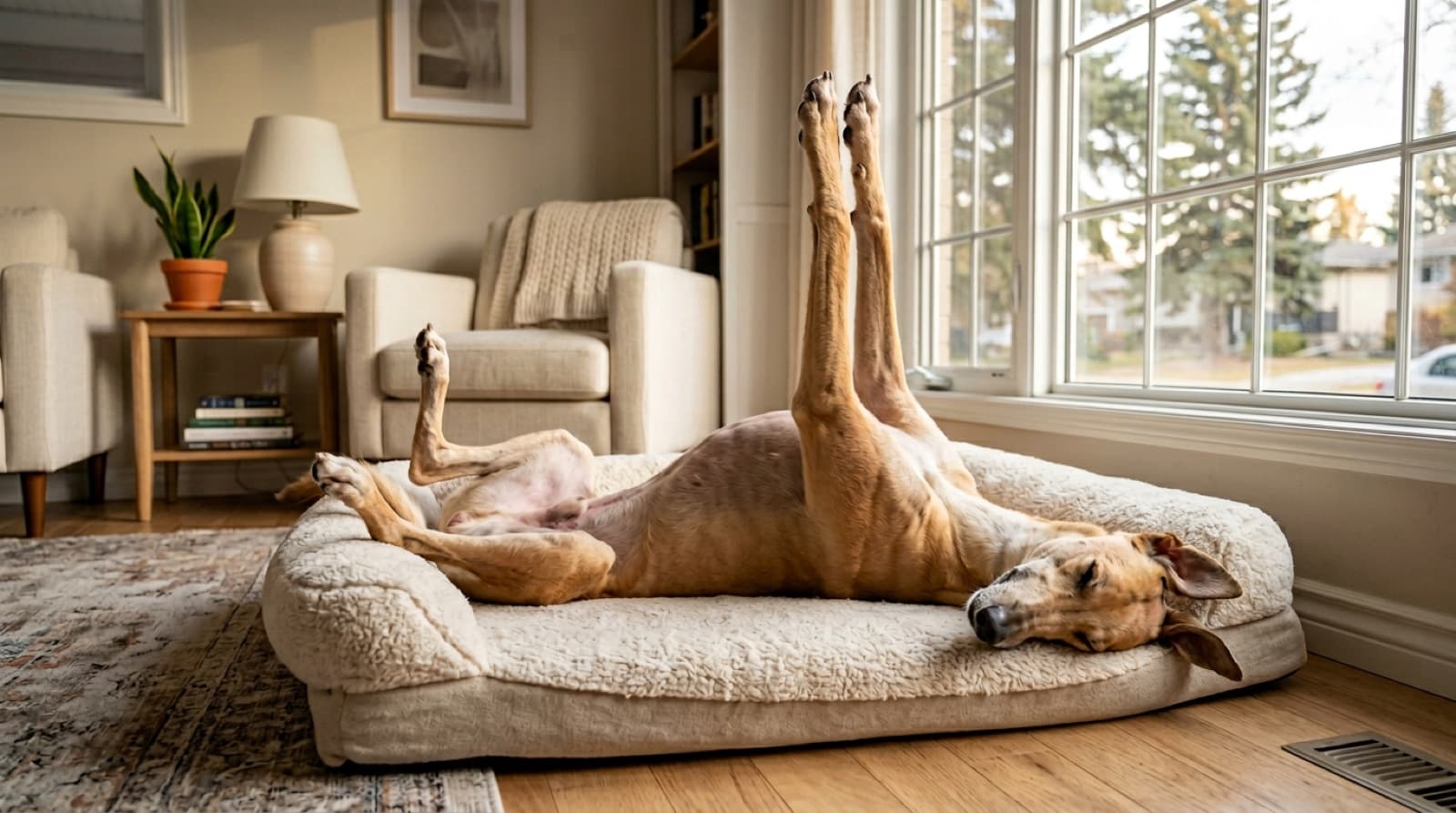
Greyhounds are the 45 mph couch potato. Sleep 18 to 22 hours a day. Rarely bark. Lean their full body weight against you. Sleep startle is the breed-defining rule: never approach a sleeping Greyhound (it triggers a reflex bite from the sighthound survival wiring). Roach pose (sleeping on back, legs in air) is the sign of complete comfort. Lean body with visible ribs and spine is breed-normal (~7% body fat vs 15-20% for most breeds). Cat and small-dog testing is mandatory before adoption (retired racing prey-drive varies dog by dog). Mandatory winter coat plus booties in Edmonton; the breed has almost no insulation. Off-leash recall is unreliable due to prey drive; leashed-only in unfenced areas. Adoption pathways: the Northwest Canadian Greyhound League, ROAR, occasional general-rescue listings.
Sleep startle: the rule kids must learn
The breed-defining sighthound reflex. A sleeping Greyhound startles awake aggressively when touched, sometimes growling, snapping, or biting before fully waking. Never wake a sleeping Greyhound by touch. Use voice from a distance.
Sleep startle is a hardwired survival response, not behavioural defiance. Sighthounds evolved to sleep with full alert capacity because they hunted in open environments where surprise attack was a real threat. The reflex persists in pet Greyhounds despite millennia of domestication.
Practical management:
- Never wake by touch. Use voice from a distance: “Hey buddy” or the dog's name.
- Teach kids absolutely never to approach a sleeping Greyhound. Not just touching: not sitting next to, not lying near, not climbing on.
- Provide a designated bed in a quiet low-traffic area where the dog can decompress.
- Adult late-night accidental contact: speak first, wait for the dog to acknowledge, then touch.
Most sleep-startle bites happen when: small children climb on a sleeping Greyhound; adults reach to move a dog from a couch without first speaking; late-night accidental contact. Edmonton family households need to install this rule on day one. The reflex never resolves; it requires lifetime accommodation.
The AKC Greyhound breed profile describes the breed as “independent, noble, sweet-tempered” but the sleep-startle reality is a breed-specific rule the breed-club community emphasises.
The 45 mph couch potato reality
Greyhounds are the most paradoxical temperament in dogdom. Built for 45 mph sprints (genuinely the fastest land mammal over 800 metres after the cheetah), dispositioned for the couch. Most Greyhounds sleep 18 to 22 hours per day.
Daily exercise needs: one or two short sprints (20 to 30 minutes total) plus a leisurely leashed walk, then back to sleep. Calmer than most small breeds. Edmonton apartment Greyhound owners report the breed as one of the most apartment-friendly large dogs because the energy peaks are short and the rest of the day is genuinely low-key.
This is the breed for: households that want a big dog without the constant exercise demand of a Lab or Border Collie; condo or apartment owners under Edmonton Bylaw 21244 who need a quiet breed; retired or work-from-home owners who appreciate a couch companion; first-time large-breed owners willing to learn sighthound-specific rules.
This is NOT the breed for: marathon training partners; constant outdoor adventure households; guard-dog roles; high-stimulus active-family contexts.
The lean body reality
Greyhounds are naturally lean. Healthy adult body fat ~7% (compared to 15 to 20% for most breeds). The visible last 2 to 3 ribs are normal and healthy in Greyhounds. The pelvic bones can be visible. The spine is sometimes visible mid-back. None of these are signs of underfeeding.
New Greyhound owners often try to “fatten up” their dog because the body shape looks underweight by Lab or Golden standards. This usually leads to actual overweight Greyhounds with the same elevated obesity-related health risks as other breeds.
Body-condition reference for healthy Greyhounds:
- Rib visibility: yes
- Spine visibility: yes for the last few vertebrae
- Hip bones: palpable but not protruding sharply
- Slight tuck behind the ribs
- Narrow waist when viewed from above
Typical adult weights: male Greyhounds 65 to 85 lbs lean; female Greyhounds 55 to 70 lbs lean.
If your vet specifically tells you the dog is underweight (rare), follow the vet plan. Otherwise trust the breed's natural lean body. The Greyhound Health Initiative and breed-club body-condition guides are the standard references your Edmonton vet may use.
Browse adoptable Greyhounds in Edmonton
Most Edmonton Greyhound adoptions go through breed-specific rescue (the Northwest Canadian Greyhound League, ROAR). Cat-tested and small-dog-tested dogs are clearly documented in adoption paperwork.
See Available Greyhounds →Cat and small-dog testing is mandatory
Retired racing Greyhounds were trained to chase small fast-moving lures (resembling rabbits or other small animals) for years before retirement. Some develop strong prey drive on small animals and cannot safely live with cats. Some never developed strong prey drive and live happily with cats. Some are “cat tolerant” with adult cats but unsafe with kittens or rabbits.
The variability is real. Reputable breed-specific rescues cat-test their dogs before adoption.
Edmonton breed-specific rescue networks:
- The Northwest Canadian Greyhound League (NCGL) — runs formal cat-test evaluations and discloses results before adoption.
- ROAR (Reality Of Adopted Racing greyhounds) — BC-based, serves Alberta. Cat-tests and small-dog-tests before placement.
- Edmonton Humane Society — occasional Greyhound intake; behavioural assessment in foster.
Cat-safe Greyhounds carry that designation in adoption paperwork. NEVER assume an untested Greyhound is cat-safe. Specifically test before bringing a cat into the home, or before adopting a Greyhound into a cat-household.
The prey-drive testing process: the dog is exposed to a small dog or cat under controlled conditions (often a stuffed lure first, then a calm small dog with handlers on both sides). The dog's response is documented. Greyhounds with strong prey drive show stalking, focused stare, lunging, or chasing. Greyhounds without strong drive are calm, possibly curious, no chase intent.
The same caution applies to off-leash zone exposure: a Greyhound that is fine with small dogs in your home may chase a fleeing small dog at an off-leash zone where speed and distance trigger the chase. Recall on a Greyhound off-leash is breed-typically unreliable (the prey drive overrides recall in high-stimulus environments). The detailed off-leash protocol lives in our sibling Edmonton Greyhound recall and off-leash guide.
The retired racing Greyhound adjustment
Retired racing Greyhounds typically arrive at Edmonton adoption with the following baseline: they have never lived in a home (lifelong kennel housing), never seen stairs, glass doors, mirrors, hardwood floors, tile floors, or family furniture; never been alone without other Greyhounds; never been free-fed; never met cats or small animals; never seen children in domestic settings.
First 30 to 60 days are heavy adjustment. Most owners report:
- The dog avoids stairs for the first week or two (carry or slip-train).
- Startled by glass doors and mirrors (cover or mark with tape initially).
- Needs help understanding free-roaming the house (start with one room and gradually expand).
- Anxious when left alone the first time (start with very short departures, build up).
- Needs explicit teaching of “house manners” things other breeds learn as puppies (couch boundaries, food-on-counter rules, doorway etiquette).
By 3 months in, most retired racers have fully adjusted. By 6 months, they are typically settled members of the household. The breed's adaptability is remarkable given the extreme transition.
Edmonton rescues (the Northwest Canadian Greyhound League, ROAR via Alberta networks) provide foster home decompression and basic in-home training before adoption to reduce the new-owner adjustment workload.
Edmonton winter and the Greyhound thin coat
Greyhounds have minimal body fat and a thin single-coat that provides almost no insulation against Edmonton cold. The thermoregulation challenge is real.
Practical winter care:
- Insulated coat is mandatory below +5C. Every Greyhound wears one in Edmonton winter, not optional.
- Booties or paw wax below -5C.
- Walk duration shortens dramatically below -10C (5 to 15 minutes only).
- Indoor potty pads or backyard quick trips below -15C.
- No walks at all below -25C wind chill.
The breed loses heat fast through the bare belly, lean limbs, and exposed thin coat. Frostbite on ear tips and tail tip happens faster than in heavier-coated breeds. The detailed Edmonton winter protocol lives in our sibling Edmonton Greyhound winter-care guide.
Behaviourally, Edmonton winter shifts most Greyhounds into even more sleep (a breed that already sleeps 18 to 22 hours daily can hit 22+ hours in deep January cold). Indoor enrichment becomes more important during the 5 to 6 month winter to prevent boredom-driven behavioural issues. Most Edmonton Greyhound owners report no behavioural problems through winter because the breed naturally accepts indoor downtime.
Frequently Asked Questions
Are Greyhounds high-energy or calm?
Both, paradoxically. Greyhounds are the most paradoxical temperament in dogdom: built for 45 mph sprints (genuinely the fastest land mammal over 800 metres after the cheetah), dispositioned for the couch. Most Greyhounds sleep 18 to 22 hours per day. They want one or two short sprints (20 to 30 minutes total) plus a leisurely leashed walk, then back to sleep. They are calmer than most small breeds. Edmonton apartment Greyhound owners report the breed is one of the most apartment-friendly large dogs because the energy peaks are short and the rest of the day is genuinely low-key. This is the breed for the household that wants a big dog without the constant exercise demand of a Lab or Border Collie. It is NOT the breed for marathon training partners or constant outdoor adventure households.
What is sleep startle and why does it matter?
Sleep startle is the breed-defining sighthound reflex where a sleeping Greyhound startles awake aggressively when touched, sometimes growling, snapping, or biting before fully waking. It is a hardwired survival response, not behavioural defiance. Sighthounds evolved to sleep with full alert capacity because they hunted in open environments where surprise attack was a real threat. The reflex persists in pet Greyhounds despite millennia of domestication. Practical management: never wake a sleeping Greyhound by touch. Use voice from a distance. Teach kids absolutely never to approach the dog while sleeping, including not just touching but not sitting next to or lying near. Provide a designated bed in a quiet low-traffic area. Most sleep-startle bites happen when small children climb on a sleeping Greyhound, when adults reach to move a dog from a couch without first speaking, or during late-night accidental contact. Edmonton family households with Greyhounds need to install this rule on day one. The reflex never resolves; it requires lifetime accommodation.
What is the roach pose and is it normal?
Roach pose (also called "cockroach pose," "dead bug," or simply "roaching") is the Greyhound's signature sleeping position: flat on the back, legs straight up in the air, sometimes splayed in different directions. It is a sign of complete comfort and trust. A Greyhound that roaches has fully relaxed into the home. New rescue Greyhounds typically take 4 to 12 weeks of adjustment before they first roach. When they do, owners feel like the dog has "arrived" psychologically. Why the position works for Greyhounds and not most other breeds: the breed's narrow body, deep chest, and low body fat make the position physically comfortable. Most other breeds find the position uncomfortable. The pose has no medical significance and requires no intervention. Some Greyhounds prefer sleeping curled up; some prefer side-sleeping; some discover roaching at age 6 after never doing it before. All variations are normal.
Why is my Greyhound so lean and is it healthy?
Greyhounds are naturally lean. Healthy adult body fat ~7% (compared to 15 to 20% for most breeds). The visible last 2 to 3 ribs are normal and healthy in Greyhounds. The pelvic bones can be visible. The spine is sometimes visible mid-back. None of these are signs of underfeeding. New Greyhound owners often try to "fatten up" their dog because the body shape looks underweight by Lab or Golden standards. This usually leads to actual overweight Greyhounds with the same elevated obesity-related health risks as other breeds (joint stress, cardiovascular issues, shortened lifespan). The body-condition reference for Greyhounds: rib visibility yes, spine visibility yes for the last few vertebrae, hip bones not protruding sharply but palpable, slight tuck behind the ribs, narrow waist when viewed from above. Adult male Greyhounds: 65 to 85 lbs typical, lean. Adult female Greyhounds: 55 to 70 lbs typical. If your vet specifically tells you the dog is underweight (rare), follow the vet plan. Otherwise trust the breed's natural lean body. The Greyhound Health Initiative and breed-club body-condition guides are the standard references your Edmonton vet may use for breed-specific body-condition scoring.
Do Greyhounds bark?
Rarely. The breed is famously quiet. Most Greyhounds bark only at specific significant events (stranger at the door, prey-drive trigger, occasional play barking with other Greyhounds). Many Greyhound owners report their dog has barked fewer than 10 times in years of ownership. This makes the breed exceptionally apartment-friendly under Edmonton Bylaw 21244 noise provisions. Edmonton condo Greyhound owners typically have zero noise complaints, dramatically different from Husky, Beagle, or Pomeranian condo experiences. The trade-off: Greyhounds do not raise an alarm for break-ins or intruders. The breed is not a guard dog. Greyhounds will note an intruder, possibly lean against the intruder for petting, and then resume sleeping. If you are looking for a guard dog, this is the wrong breed. If you are looking for a quiet large breed for condo or apartment living, this is one of the best.
Why does my Greyhound lean against me?
Leaning is breed-typical affectionate behaviour. Most Greyhounds lean against their preferred people with full body weight, often in standing-still positions where the dog plants the entire side of their body against the owner's leg or hip. The behaviour is not anxiety or attention-seeking. It is the breed's standard way of expressing connection. New Greyhound owners are sometimes startled by 70 lbs of dog committing to the lean. Practical adjustments: brace before petting (the dog will lean as soon as you start), make sure you are stably positioned (the lean can shift your balance), avoid leaning while wearing thin pants (Greyhound nails can scratch on the way out of the position). The lean is also a comfort behaviour in stressful situations: at the vet, around new people, during fireworks. Many Edmonton Greyhound owners report the lean as their favourite breed behaviour.
Are Greyhounds good with kids?
Generally yes, with the breed-specific sleep-startle rule taught carefully. The breed is calm, patient, and tolerant of normal child interaction. Most Greyhounds enjoy being part of a family with kids 6+. Two specific kid-Greyhound concerns: (1) Sleep startle (covered above): kids must absolutely never approach a sleeping Greyhound, never sit on or next to one, never climb on. (2) Body size and bony body: a Greyhound is 65 to 85 lbs of mostly muscle and bone. A child running into a Greyhound at full speed will hurt themselves (and possibly the dog). The breed is not a wrestling-style play partner for small kids. Adult-supervised, gentle interactions work well. Toddlers and Greyhounds: high management. The toddler accidentally rolling onto a sleeping Greyhound triggers sleep startle. The toddler trying to climb hurts both parties. Most rescues will not place Greyhounds with toddlers because of these risks. Elementary-aged kids (6 to 12) and Greyhounds: often a beautiful match. The dog's calm patience and the kid's capacity to understand rules combine well.
Are Greyhounds good with cats?
Case by case, depending on the specific dog. Retired racing Greyhounds were trained to chase small fast-moving lures (resembling rabbits or other small animals) for years before retirement. Some develop strong prey drive on small animals and cannot safely live with cats. Some never developed strong prey drive and live happily with cats. Some are "cat tolerant" with adult cats but unsafe with kittens or rabbits. The variability is real. Reputable breed-specific rescues cat-test their dogs before adoption. The Northwest Canadian Greyhound League (NCGL) and ROAR (Reality of Adopted Racing greyhounds, BC-based but serves Alberta) both run formal cat-test evaluations and disclose results before adoption. Cat-safe Greyhounds carry that designation in adoption paperwork. NEVER assume an untested Greyhound is cat-safe. Specifically test before bringing a cat into the home, or before adopting a Greyhound into a cat-household. The retired-racing Greyhound prey-drive testing is the breed's most-asked question, and the rescues take it seriously. Multi-cat Edmonton households with experienced rescue support typically find cat-safe Greyhounds successfully.
What about small dogs?
Similar caveat as cats. Some Greyhounds chase small dogs (less than 25 lbs) due to retired-racing prey-drive conditioning. Some are fine with small dogs. The variability is real and the prediction requires evaluation. Most reputable Edmonton breed-specific rescues small-dog-test their Greyhounds. The retired-racing prey-drive testing is a defined evaluation: the dog is exposed to a small dog under controlled conditions (often a stuffed lure first, then a calm small dog with handlers on both sides). The dog's response is documented. Greyhounds with strong prey drive show stalking, focused stare, lunging, or chasing. Greyhounds without strong drive are calm, possibly curious, no chase intent. Edmonton multi-dog households considering a Greyhound should adopt only small-dog-tested dogs and follow rescue introduction protocols carefully. The same caution applies to off-leash zone exposure: a Greyhound that is fine with small dogs in your home may chase a fleeing small dog at an off-leash zone where speed and distance trigger the chase. Recall on a Greyhound off-leash is breed-typically unreliable (the prey drive overrides recall in high-stimulus environments). The detailed off-leash protocol lives in our sibling Edmonton Greyhound recall guide.
How do retired racing Greyhounds adjust to home life?
The 3-3-3 adjustment rule applies plus a breed-specific learning curve. Retired racing Greyhounds typically arrive at Edmonton adoption with the following baseline: they have never lived in a home (lifelong kennel housing), never seen stairs, glass doors, mirrors, hardwood floors, tile floors, or family furniture, never been alone without other Greyhounds, never been free-fed (they ate on a schedule with hundreds of other dogs), never met cats or small animals, never seen children in domestic settings. The first 30 to 60 days are heavy adjustment. Most owners report: the dog avoids stairs for the first week or two (carry or slip-train), is startled by glass doors and mirrors (cover or mark with tape initially), needs help understanding free-roaming the house (start with one room and gradually expand), is anxious when left alone the first time (start with very short departures, build up), needs explicit teaching of "house manners" things other breeds learn as puppies (couch boundaries, food-on-counter rules, doorway etiquette). By 3 months in, most retired racers have fully adjusted. By 6 months, they are typically settled members of the household. The breed's adaptability is remarkable given the extreme transition. Edmonton rescues (NCGL, ROAR via Alberta networks) provide foster home decompression and basic in-home training before adoption to reduce the new-owner adjustment workload.
Does Edmonton winter affect Greyhound temperament or care?
Greyhounds have minimal body fat and a thin single-coat that provides almost no insulation against Edmonton cold. The thermoregulation challenge is real. Practical winter care: insulated coat is mandatory below +5C (every Greyhound wears one in Edmonton winter, not optional), booties or paw wax below -5C, walk duration shortens dramatically below -10C (5 to 15 minutes only), indoor potty pads or backyard quick trips below -15C, no walks at all below -25C wind chill. The breed loses heat fast through the bare belly, lean limbs, and exposed thin coat. Frostbite on ear tips and tail tip happens faster than in heavier-coated breeds. The detailed Edmonton winter protocol lives in our sibling Edmonton Greyhound winter-care guide. Behaviourally, Edmonton winter shifts most Greyhounds into even more sleep (a breed that already sleeps 18 to 22 hours daily can hit 22+ hours in deep January cold). Indoor enrichment becomes more important during the 5 to 6 month winter to prevent boredom-driven behavioural issues. Most Edmonton Greyhound owners report no behavioural problems through winter because the breed naturally accepts indoor downtime.
Bottom line for Edmonton Greyhound adopters?
Right for you if: looking for a calm large breed (not high-energy), comfortable with cat-testing or small-dog-testing process if you have those pets, willing to install the sleep-startle rule on day one (no touching sleeping dogs, ever), willing to commit to mandatory winter coat plus booties plus shortened winter walks, comfortable with leashed-only off-leash strategy (the breed cannot be trusted off-leash in unfenced areas; recall is unreliable due to prey drive), Edmonton suburb home or condo with low-trigger environment. Wrong for you if: looking for a guard dog (Greyhounds do not bark or alarm), wanting a marathon training partner or constant outdoor adventure dog, multi-cat household without willingness to cat-test rigorously, expectation of off-leash freedom in unfenced areas, household with toddlers (most rescues will not place), expectation that the breed is "high-energy" because of the speed reputation. The breed is the 45 mph couch potato. Honest expectations match honest reality. Edmonton rescue Greyhound pathways: the Northwest Canadian Greyhound League (NCGL), ROAR (BC-based, ships to Alberta), occasional listings through Edmonton Humane Society and other general rescues. Most retired racing Greyhounds arrive through the breed-specific networks with documented cat-test, small-dog-test, and adjustment-history information. Adult and senior Greyhound adoption is the path most Edmonton owners take.
Adoptable Greyhounds in Edmonton
Live listings from the Northwest Canadian Greyhound League, ROAR, Edmonton Humane Society, and other Edmonton-area rescues.
Greyhound Adoption Edmonton
Rescue pipelines, costs, retired racer vs pet-line Greyhound, adoption process.
Greyhound Recall + Off-Leash
Why Greyhound off-leash recall is unreliable, prey-drive override, leashed-only safety, fenced-area alternatives.
Greyhound Winter Care Edmonton
Mandatory coat plus booties, temperature thresholds, frostbite zones, indoor potty alternatives.
New dog? Start with these care guides
Everything a new adopter needs to set up a safe, happy home.