The short answer
Husky adolescence runs 8 to 18 months with peak chaos at 8 to 14 months. Recall fails. Destruction often beats puppy teething. Howling and door-dashing peak together. Edmonton winter amplifies it because exercise volume drops while indoor time triples, and the adolescent finds the extra energy somewhere. The training did not stop working. The dog is teenagering, and most Huskies settle meaningfully by 18 to 24 months with consistent force-free training, environmental management, and mental enrichment that does not depend on a 90-minute river-valley walk at -35. Aversive training (prong, e-collar, alpha rolls) elevates bite risk in independent breeds and is the wrong response to this phase.
The Edmonton rescue surrender pattern
SCARS, Zoe's Animal Rescue, and the Edmonton Humane Society see a steady surrender spike for Huskies aged 10 to 16 months. The pattern is consistent: owners survived puppy phase, trained their Husky at 4 to 7 months, watched the dog respond well, then hit the adolescent regression at 8 to 14 months and concluded the training failed.
The training did not fail. The dog is teenagering with full adult body and adolescent brain. Most Edmonton Husky owners report adolescent destruction worse than puppy teething because adult jaw force on a body that still has puppy impulse control causes more damage than baby teeth ever could. Surrendered Huskies during this phase are heartbreaking because the dog is typically 4 to 8 months from settling.
This is also the phase when the aversive training industry (“balanced” trainers, prong collar coaches, e-collar consultants) markets hardest to Husky owners. Their promised quick fixes elevate bite risk in independent breeds. The right response to the teenage phase is not pain; it is patience, force-free training consistency, environmental management, and a serious indoor mental enrichment plan that holds up through Edmonton January.
Phase breakdown: 8 to 18 months
- Onset (6 to 8 months). Sexual maturity hormones begin, training starts to slip in subtle ways. The dog who held a sit at 5 months starts breaking it at 7 months. Easy to miss as a real regression rather than a one-off.
- Peak chaos (8 to 14 months). The teenager collapse. Recall fails in distraction. Hard play biting returns. Counter-surfing emerges. Selective hearing. Boundary testing. Destructive chewing peaks. Door-dashing escalates. This is the phase most owners interpret as “the training stopped working.”
- Gradual settling (14 to 18 months). Consistent owners see training re-integration. Skills return faster than they did the first time because the foundation is still there underneath. Impulse control improves. Recall slowly returns in lower-distraction environments.
- Mental maturity (18 to 24 months). Most Huskies fully mentally mature here, which is faster than working breeds like Rottweilers (2 to 3 years). Larger males and working-line dogs sometimes 30 months.
Why Huskies have a shorter adolescent phase than Rottweilers or Boxers: Huskies are smaller (35 to 60 lbs vs 80+ lbs working breeds) and mature faster. But the destructive intensity per kilo is often higher because of the energy plus boredom plus escape drive combination.
Critical owner mindset. This is a stage, not a failure. The dog is not being defiant. The adolescent brain is literally rewiring, and the rewiring temporarily blocks access to training pathways laid down at 4 to 6 months. Force-free trainers familiar with the breed provide adolescent-specific support, and the Edmonton rescues will share trainer recommendations during the foster phone screen if you ask.
Why Edmonton winter amplifies adolescent destruction
An adolescent Husky needs roughly 90 minutes of daily structured exercise. Edmonton January, at -35 wind chill, makes 90 minutes outside physically unsafe for paw pads after about 20 minutes. The energy gap goes somewhere. It usually goes into your couch.
This is the Edmonton-specific differentiator from breed advice written for milder climates. Three things stack in November through March:
- Exercise volume drops. The 90-minute river-valley walk in October becomes a 30-minute neighbourhood loop when wind chill hits -30 to -40. Salt on sidewalks cracks paw pads. The Environment and Climate Change Canada wind chill chart classifies -28 to -39 as “frostbite possible in 10 to 30 minutes” on exposed human skin, which is a reasonable proxy for exposed paw pads on a working-line Husky who refuses to wear boots.
- Indoor time triples. The dog spends more hours per day in line-of-sight of chewable surfaces. Couches, drywall corners, baseboards, door frames, and crate doors all become candidates.
- Daylight contracts. Edmonton December gives roughly 7.5 hours of daylight. A chunk of that is dark commute. The dog is alone in the dark house more.
The solution is not more outdoor time at -35. It is more indoor mental enrichment. Food puzzles, frozen Kongs, snuffle mats, scent work games, short 5 to 10 minute training sessions throughout the day, and structured chew rotations. Adolescent Husky brains tire faster on mental work than on physical work in this climate, and a mentally tired Husky destroys far less than a physically half-tired one.
What gets destroyed when the enrichment plan does not hold up: furniture (couches torn apart, $1,500 to $4,000 to replace), drywall (digging at walls, especially near windows where outdoor sounds trigger), doors (chewed door frames, opened doors), basement carpet, personal items (shoes, electronics, kids' toys), crates (escape attempts, sometimes injuries), and the yard fence (digging accelerates as soon as the ground thaws). Typical Edmonton repair bills land at $1,000 to $5,000 across the 6 to 12 month destructive window.
Prevention stack: 60 to 90 min daily structured exercise (split into shorter sessions in deep cold), 30 to 60 min daily mental enrichment (food puzzles, snuffle mats, training, scent work), designated chews (Benebones, beef tendons, frozen Kong) on rotation, environmental management with baby gates limiting access to high-value rooms when alone, crate as safe space (never as punishment, and not all Huskies tolerate crates), and a force-free trainer assessment if the destruction pattern is escalating rather than fluctuating.
Why “alpha” and dominance trainers are dangerous for adolescent Huskies
This is the most important Edmonton Husky owner training knowledge. The aversive training industry (“alpha trainer,” “balanced trainer,” dominance coach, prong-and-e-collar consultant) markets hardest to owners during exactly this phase. The promised quick fixes elevate bite risk in independent breeds.
Why dangerous for Huskies specifically:
- Pain plus aversion produces fear in independent breeds rather than compliance.
- Husky independent thinking combined with pain-based correction produces either shutting down or escalating reactivity.
- Suppresses warning growls without changing the underlying state. Dog stops warning, goes straight to biting later.
- Damages the owner-dog relationship in ways that are slow to repair.
- Sometimes appears to work short-term, then creates lasting problems that surface at 18 to 36 months.
- Trauma during the adolescent rewiring period produces lasting fear and reactivity patterns.
What force-free looks like: reward-based training with treats, praise, and play. No prong, no e-collar, no choke chain, no alpha rollover. Manages environment and builds alternative behaviours. Long-term solutions rather than quick fixes. Family-inclusive so kids can apply the same cues.
Certifications to look for in an Edmonton trainer: CCPDT, KPA, IAABC, or Fear Free Certified. The science is not Pawfinder editorial: the International Association of Animal Behaviour Consultants, the Certification Council for Professional Dog Trainers, and the American Veterinary Medical Association all carry position statements against aversive correction tools, citing elevated fear, aggression, and bite risk. The AKC Siberian Husky breed profile independently describes the breed's independent thinking as a training reality, not a discipline problem.
Investment: $80 to $150 per private session over 4 to 6 sessions, total $320 to $900. The return is a well-trained adult Husky versus the lifelong reactivity many owners report after aversive training. Red flags in trainer choice: recommends prong, e-collar, or choke chain; uses “alpha” or “dominance” framing; promises rapid behaviour change; uses physical corrections (alpha rolls, neck grabs); ignores or dismisses growling as “dominance” rather than warning.
Many adolescent Huskies who failed at “balanced” trainers later thrived with a force-free approach. The reverse pattern is rare. Edmonton Humane Society, SCARS, and Zoe's Animal Rescue will share Edmonton force-free trainer recommendations during the foster phone screen.
River-valley recall failure during adolescence
Husky recall is typically reliable to 6 months, fails 8 to 14 months, sometimes returns 18 to 24 months with continued work, and for a meaningful number of dogs never becomes fully reliable. Edmonton off-leash culture creates pressure to test this in the river-valley zones. Resist.
The Edmonton river-valley reality: off-leash at 6 months in Hawrelak is not off-leash at 14 months in the same park. The recall regression is dramatic. Husky prey drive on the corridor wildlife (squirrels, rabbits, occasional coyote tracks) overrides training. Deep snow muffles sound, which means a Husky 50 metres ahead in deep powder may not hear a recall call. The corridor itself runs for kilometres, so a lost adolescent can travel a long way before anyone catches up.
Safe progression through adolescence:
- Puppy (4 to 7 months): short off-leash sessions in low-distraction times, typically reliable.
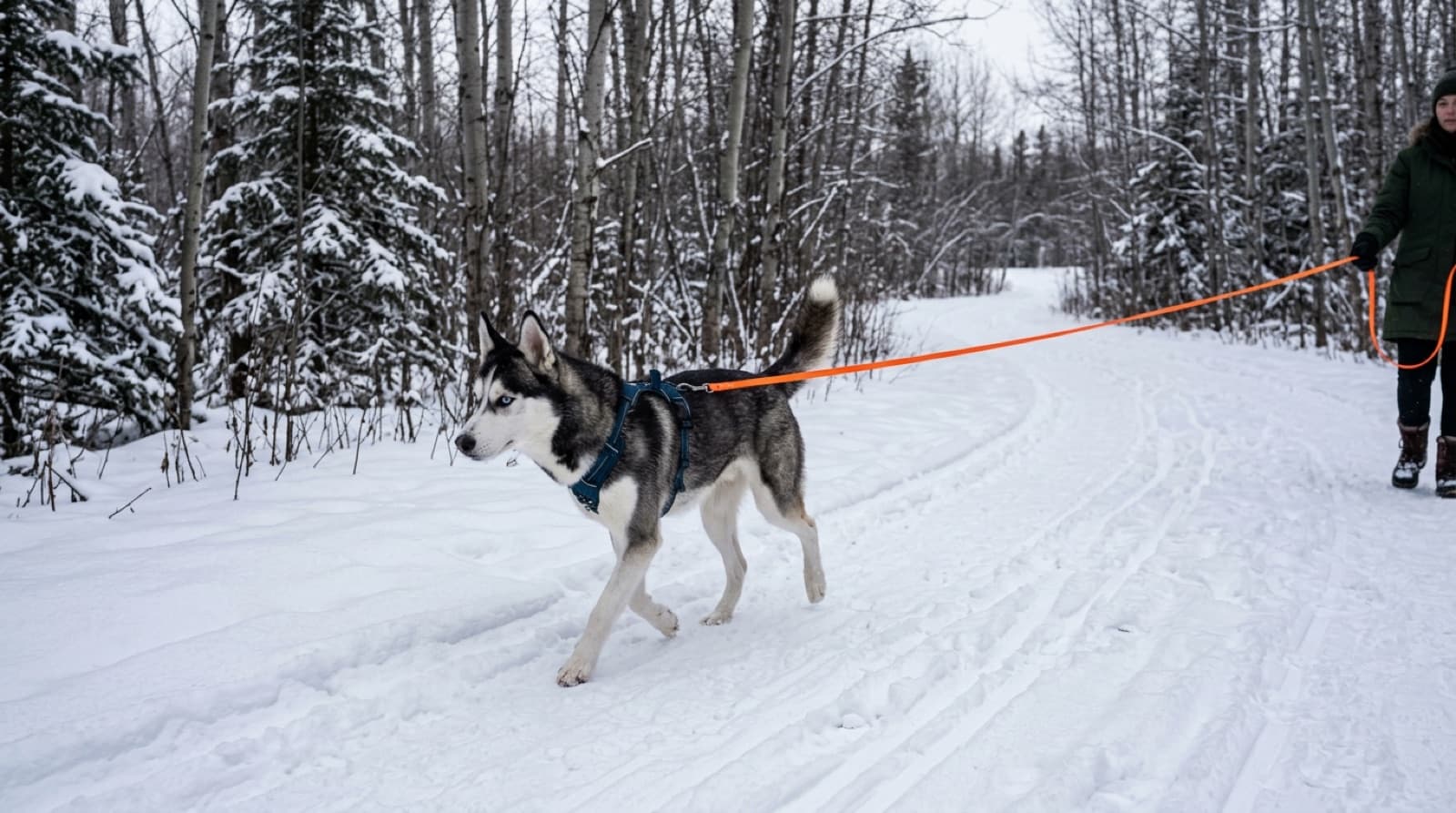
- Early adolescent (8 to 12 months): long-line only (10 to 15 metres of biothane). The river-valley side trails work well for long-line.
- Late adolescent (14 to 18 months): gradual short off-leash in low-distraction windows (early winter morning, quiet weekday). Long-line backup.
- Maturing (18 to 24 months): selective off-leash if recall is reliable in test environments.
- Adult (24+ months): some Huskies become reliable off-leash, many do not. Honest acceptance of which kind of dog you have is part of the process.
Recall training during adolescence. Use high-value rewards (cooked chicken, hot dogs, freeze-dried liver; kibble is insufficient for an adolescent Husky in distraction). Never call the dog for an unwanted outcome (leash on, vet visit, bath); doing so poisons the recall cue. Practice the Premack principle: call, reward, then RELEASE back to play. Vary the reward schedule. Practice in increasing distraction environments. An Edmonton force-free trainer can troubleshoot specific recall failures.
Bylaw 21244. The Edmonton Animal Care and Control Bylaw requires dogs to be under voice or visual control even within designated off-leash zones. The fine for failing to leash or control a dog is $250. Bylaw officers patrol the river-valley parks. The City of Edmonton dogs services page is the canonical reference.
Many Edmonton Huskies live wonderful lives never reliably off-leash. Honest acceptance plus adequate structured exercise plus long-line or fenced-yard freedom equals a thriving Husky. Off-leash status is not a measure of the dog's happiness.
Hard play biting, aggression or normal?
Most adolescent Husky play biting is normal but problematic.
Normal: hard mouthing during play, tugs at clothing during walks, nips during zoomies, bites during over-arousal, play bows alternating with biting toys.
Concerning: growling combined with biting (warning before bite), bites that break skin, resource-related biting around food or toys, fear-based biting when cornered or startled, stranger-directed biting, increasing intensity over time.
Why Huskies are mouthy: high prey drive expressed through play, sled-dog work expressed through tugging behaviours, adolescent regression of bite inhibition, sometimes raised in litters without proper bite inhibition learning, insufficient exercise channelling into over-arousal play.
Protocol:
- End play the instant teeth touch skin. The Husky learns teeth equals play stops. Most Husky-effective consequence available.
- Never play rough with hands. Wrestling, hand-slapping play, and tug-of-war using hands all invite mouthing. Use toys.
- Redirect to a toy immediately when mouthing starts.
- High-value tugs are fine and useful; let the Husky win sometimes to build confidence and relationship.
- Never use hand corrections (slapping, holding the muzzle closed). Teaches the dog that hands are scary or that fighting back is appropriate.
- A tired Husky is less mouthy. Adequate exercise reduces play biting independently of training.
Adult-onset biting at 3+ years is a different scenario. Behavioural consult. Possible medical (pain, thyroid, vision change). Resource guarding. Reactivity. Force-free trainer plus a vet check plus sometimes a veterinary behaviourist.
Edmonton family safety: kids must understand the teeth-equals-play-stops rule. Never wrestle with the Husky. Adult supervision essential during the adolescent biting phase. Some families add muzzle conditioning (Baskerville-style basket muzzle, used as a positive-associated safety tool rather than punishment) during the peak phase, especially in households with multiple young kids.
The phases owners go through
- Puppy honeymoon (8 to 16 weeks home): adorable and manageable. Owner confident.
- Puppy settling (4 to 8 months): training works, dog responds, owner doubles down on training class.
- Adolescent crash (8 to 14 months): training appears to stop working. Daily challenges. Owner confidence shaken. This is the Edmonton rescue intake peak. Surrenders include heartbroken owners who concluded their Husky was “broken.”
- Gradual re-emergence (14 to 18 months): consistent owners see slow improvement. Training “click” returns.
- Maturity (18 to 24 months): the Husky everyone admires. Calm, devoted, settled. The dog the owner adopted for.
The payoff. Huskies who survive adolescence with attentive force-free owners become outstanding family dogs. The breed reputation for adventure plus loyalty plus clown energy is real, but the dog you signed up for is the post-adolescent version, not the 11-month-old eating your couch.
The Edmonton SCARS-pipeline overlay. Many Edmonton Husky adoptions involve a SCARS dog pulled from northern Alberta and placed in foster at 10 to 14 months, then adopted into the new home at the same age. That means the new owner inherits the 3-3-3 adjustment phase (3 days decompress, 3 weeks settle, 3 months feel at home) on top of the adolescent regression. The two phases overlap and amplify. Owners who do not know this is happening interpret the chaos as “this dog is broken” or “we are not the right home.” In most cases, neither is true; the dog is teenagering and adjusting simultaneously. Six months in, most of these adoptions settle. The rescues will tell you this if you ask; the foster phone screen is designed partly to set this expectation.
Senior Husky alternative. A senior Husky (8 years and up) from SCARS, EHS, or Zoe's skips adolescence entirely. Lifespan of 12 to 15 years for the breed means a meaningful 4 to 7 year companionship with a dog who is already calm, often less escape-prone, and frequently overlooked at the shelter. For first-time Husky owners or families without bandwidth for the adolescent phase, the senior route is the honest recommendation.
The bottom line. This phase ends. Force-free training is not optional for the breed. Aversive methods elevate aggression in independent dogs and will cost you more in the long run than any quick fix saves in the short run. Investment in a force-free trainer plus a real Edmonton-winter enrichment plan plus patience equals adolescent Husky becoming the settled adult the rescues describe.
Browse adoptable Huskies in Edmonton
Adolescent regression makes more sense when you know the rescue context. Live Edmonton listings from SCARS, EHS, Zoe's, and the rest of the Edmonton network update regularly.
See Available Huskies →Frequently Asked Questions
When does the Husky teenage phase start and end?
Adolescence runs roughly 8 to 18 months, sometimes stretching to 24 months in larger males and working-line dogs. The phase breakdown most Edmonton owners experience: 6 to 8 months sexual maturity hormones begin and training starts to slip in subtle ways, 8 to 14 months peak chaos with recall failure and destructive chewing and boundary testing, 14 to 18 months gradual settling as consistent training re-integrates, and 18 to 24 months full mental maturity. Edmonton rescue intake peaks for Huskies aged 10 to 16 months. SCARS, Zoe's, and the Edmonton Humane Society see steady surrenders from owners who concluded their training failed. It did not fail. The dog is teenagering.
Why is my one-year-old Husky suddenly ignoring commands she knew at six months?
Classic adolescent regression. Hormonal change affects impulse control even in spayed and neutered dogs. The adolescent brain is literally rewiring, which temporarily blocks access to training pathways laid down at 4 to 6 months. Physical strength peaks at 12 to 18 months before mental control catches up. Boredom intensifies because puppy-level enrichment no longer satisfies. Confidence grows as the dog discovers its own size and independent thinking. Maintain training consistency, go back to basics in higher-distraction environments, use real high-value rewards (cooked chicken, freeze-dried liver, salmon skin) since adolescent Huskies are less food-driven than Labs, run 5 to 10 minute sessions multiple times a day, manage the environment with leash and long-line at parks, and accept that most skills return by 14 to 18 months with consistent work.
Is adolescent destructive chewing really worse than puppy teething?
For most Edmonton Husky owners, yes. Adult jaw force on a body that still has puppy impulse control causes far more damage than the teething stage. A 35 to 55 lb adolescent can dismantle crates, open lever-style door handles, and breach gate latches in ways a teething puppy cannot. The duration is also longer: puppy teething runs 4 to 6 months, the adolescent destructive phase runs 6 to 12 months. Edmonton-specific factor: the destruction window overlaps with the long winter. From November through March the adolescent Husky cannot deplete its energy outside the way it could in September, and the indoor destruction escalates accordingly. Typical Edmonton owner repair bills land at $1,000 to $5,000 and sometimes higher when door frames, drywall, and yard fencing are all involved.
Why does Edmonton winter make adolescent destruction worse?
Three reasons stacked. First, exercise volume drops. A 90-minute river-valley walk in October becomes a 30-minute neighbourhood loop in January when wind chill is -35 and paw pads start cracking after fifteen minutes on salted sidewalks. The under-exercised adolescent finds the extra hour of energy somewhere, and that somewhere is usually the couch. Second, indoor time triples. The dog spends more hours per day with line-of-sight to chewable surfaces. Third, daylight contracts. Edmonton December gives roughly seven and a half hours of daylight, and a chunk of that is dark commute time for the owner. The dog is alone in the dark house more. The solution is not more outdoor time at -35; it is more indoor enrichment. Food puzzles, frozen Kongs, snuffle mats, scent work, and short structured training sessions throughout the day. Adolescent Husky brains tire faster on mental work than they do on physical work in this climate.
Should I use an alpha or dominance trainer to fix my teenage Husky?
No. The aversive training industry preys on Husky owners during exactly this phase, promising fast fixes through prong collars, e-collars, alpha rolls, and leash corrections. Peer-reviewed research on dog training methods is consistent: aversive correction tools elevate fear, aggression, and bite risk, especially in independent breeds. The mechanism that makes it worse for Huskies specifically is that pain-based correction suppresses warning growls without changing the underlying state, which means the dog stops warning and goes straight to biting later. The breed's sled-dog independent thinking also responds badly to pain: many Huskies either shut down or escalate. Force-free trainers carrying CCPDT, KPA, IAABC, or Fear Free certification handle adolescent Husky cases well. Edmonton has multiple force-free certified trainers; the Edmonton rescues will share recommendations during the foster phone screen. Expect $80 to $150 per private session over four to six sessions, total $320 to $900. The return is a well-trained adult Husky versus the lifelong reactivity many owners report after aversive training.
My adolescent Husky bites hard during play. Aggression or normal?
Most adolescent Husky play biting is normal but problematic. Normal: hard mouthing during play, tugs at clothing during walks, nips during zoomies, bites during over-arousal. Concerning: growling combined with biting (warning before bite), bites that break skin, resource-related biting around food or toys, fear-based biting when cornered or startled, stranger-directed biting, and increasing intensity over time. Protocol: end play immediately when teeth touch skin so the Husky learns teeth equals play stops, never play rough with hands because wrestling invites mouthing, redirect to toys the instant mouthing starts, use high-value tugs and let the Husky win sometimes, never use hand corrections like slapping or muzzle-grabbing, and accept that a tired Husky is a less mouthy Husky. Adult-onset biting at three years and older is a different scenario and warrants a force-free trainer plus a vet check to rule out pain.
Does the river-valley off-leash zone work for adolescent Huskies?
Use a long-line, not true off-leash. The Edmonton river-valley off-leash zones (Hawrelak south slope, Mill Creek Ravine, Whitemud Ravine) are the best winter Husky setup the city offers, but they are also the worst environment for adolescent recall regression. Deep snow muffles sound, the river-valley wildlife corridor concentrates squirrel and rabbit scent, and the corridor itself runs for kilometres which means a lost Husky can travel a long way before anyone catches up. The honest pattern most Edmonton owners settle on is a 10 to 15 metre biothane long-line in the off-leash zone year-round, with true off-leash reserved for low-distraction windows once the dog matures past 18 to 24 months. Edmonton Bylaw 21244 requires dogs to be under voice or visual control even within designated off-leash zones; the fine for failing to control is $250. Bylaw officers patrol the river-valley parks.
Adolescent Husky escape behaviour, what changes?
Adolescent escape attempts intensify dramatically. Puppies make occasional attempts; adolescents commit. Fence climbing on 4 to 6 ft fences becomes routine. Digging under chain-link works through frozen ground less easily but accelerates in spring and fall. Many Huskies learn to operate lever-style door handles around 12 to 18 months. Gate latch failure is common. Door-dash on package delivery and dog-walker handoffs is the most common Edmonton escape scenario. The 6 ft dig-proofed wood fence is the minimum, with the snow-drift caveat that Edmonton January often turns a 6 ft fence into a 4 ft fence by February when drifts pile against the leeward side. A GPS tracker (Tractive or Fi are the two most commonly used by Edmonton owners), current microchip registration, and a visible City of Edmonton licence tag form the insurance layer for the day the gate gets left open. Most Edmonton Husky owners will live through at least one escape during adolescence.
My adolescent rescue Husky just adjusted from SCARS, and now this. What is happening?
This is the common Edmonton scenario. SCARS pulls Huskies and Husky mixes from northern Alberta communities at high volume, and many arrive at Edmonton foster homes aged 10 to 14 months. By the time they meet you, they are at the peak of adolescent regression and simultaneously working through the 3-3-3 rule (3 days to decompress, 3 weeks to settle, 3 months to feel at home). The two phases overlap and amplify each other. The first 3 days look withdrawn and overwhelmed. Weeks 1 to 3 look like boundary testing and possible separation anxiety. Months 1 to 3 look like training regression and possible escape attempts. Months 3 to 6 typically bring dramatic improvement, and the adolescent peak resolves over the following year. What helps: predictable daily routine, environmental management first (crate, baby gates, leash inside near doors), force-free training that does not expect previous training to be intact, a vet check to rule out medical issues, and ongoing support from the rescue. SCARS, EHS, and Zoe's all offer post-adoption support.
Adolescent Husky vocalisation in an Edmonton apartment, what happens?
Vocalisation peaks at 8 to 14 months and apartments amplify it. Husky scream carries through walls, howling sessions sometimes run 30 minutes or longer, and the breed is generally vocal for life. The Edmonton Community Standards Bylaw covers nuisance noise and is enforced through 311 complaints. A persistent vocal Husky in an apartment generates noise complaints, possible bylaw warnings, condo board involvement, and in extreme cases eviction pressure. Management options: 60 to 90 minutes of daily structured exercise, daily mental enrichment (food puzzles, snuffle mats, training sessions), ignore attention-seeking vocalisation rather than rewarding it, work with a force-free trainer on desensitisation to triggers, never use bark collars (especially e-collar bark collars which elevate anxiety in independent breeds), white noise to mask outdoor triggers, pre-departure exercise, and in severe cases anti-anxiety medication prescribed by your vet. The honest read: apartment plus adolescent vocal Husky is a high-stakes pairing in Edmonton. Suburban houses with vocal-tolerant neighbours fare better.
When does the adolescent Husky finally calm down?
Most Huskies show meaningful calming at 18 to 24 months. Some sooner (smaller females sometimes settle by 18 months), some later (larger males or working-line dogs sometimes 30 months). Year one is chaos. Year two is settling. Year three is the dog you adopted for. What helps: force-free training consistency, adequate exercise and mental enrichment, social opportunities (well-matched daycare, dog friends), stable home routine, force-free trainer support during peak adolescence, and patience. What delays calming: inadequate exercise, boredom-driven destruction patterns, aversive training that damages the relationship, unaddressed anxiety, multiple home transitions, and lack of structure. What stays Husky-like forever: wiggle-butt greetings, zoomies into senior years, vocalisation, independent thinking, sometimes-unreliable off-leash recall, and the daily exercise requirement. The breed does not become a low-maintenance dog; it becomes a well-mannered active dog.
Bottom line, can I survive Edmonton Husky adolescence?
Yes, with realistic expectations. The phase ends. The owners who succeed accept that 8 to 18 months is a stage rather than a personality, manage the environment proactively (6 ft dig-proofed fence, baby gates, GPS tracker, current microchip), maintain training consistency through the regression, use force-free methods only, build a real Edmonton winter exercise plan that leans on indoor mental enrichment when it is too cold for the river valley, and call for help when they need it. The owners who struggle are usually first-time dog owners without an experienced support network, owners with tight schedules and long work hours, families with multiple young kids during the knockdown-and-nipping phase, apartment renters in noise-sensitive buildings, and owners without fenced yards. If any of those describe you and you are still pre-adoption, consider a senior Husky (8 years and up) from SCARS, EHS, or Zoe's. Senior Huskies skip adolescence entirely, and a 12 to 15 year breed lifespan still means a meaningful 4 to 7 year companionship.
Adoptable Huskies in Edmonton
Live listings from SCARS, Edmonton Humane Society, Zoe's, GEARS, and the rest of the Edmonton rescue network.
Husky Adoption Edmonton
Rescue pipelines, adoption fees, fencing reality, Pomsky warnings, and the northern-Alberta intake context.
Husky Escape Prevention
Six-foot dig-proofed fencing, winter snow-drift management, GPS trackers, and the first-hour Lost Pet Edmonton plan.
Husky Winter Care Edmonton
Temperature thresholds, frostbite signs, paw protection, river-valley off-leash, and cold-weather exercise routines from -10 to -40C.
New dog? Start with these care guides
Everything a new adopter needs to set up a safe, happy home.