The short answer
Huskies escape because the breed is wired to run and chase, not because they were trained badly. In Edmonton the layered fix is a 6 foot solid wood fence, dig-proofing buried along the bottom edge, and snow shovelled away from the fence line through winter so drift does not turn your 6 foot fence into a launch ramp. Add a GPS tracker on the dog whenever they leave the house, a current microchip registration, and a long-line on every unfenced trail. Edmonton coyote presence makes a loose Husky a same-hour emergency. Call 311 and post Lost Pet Edmonton inside the first hour.
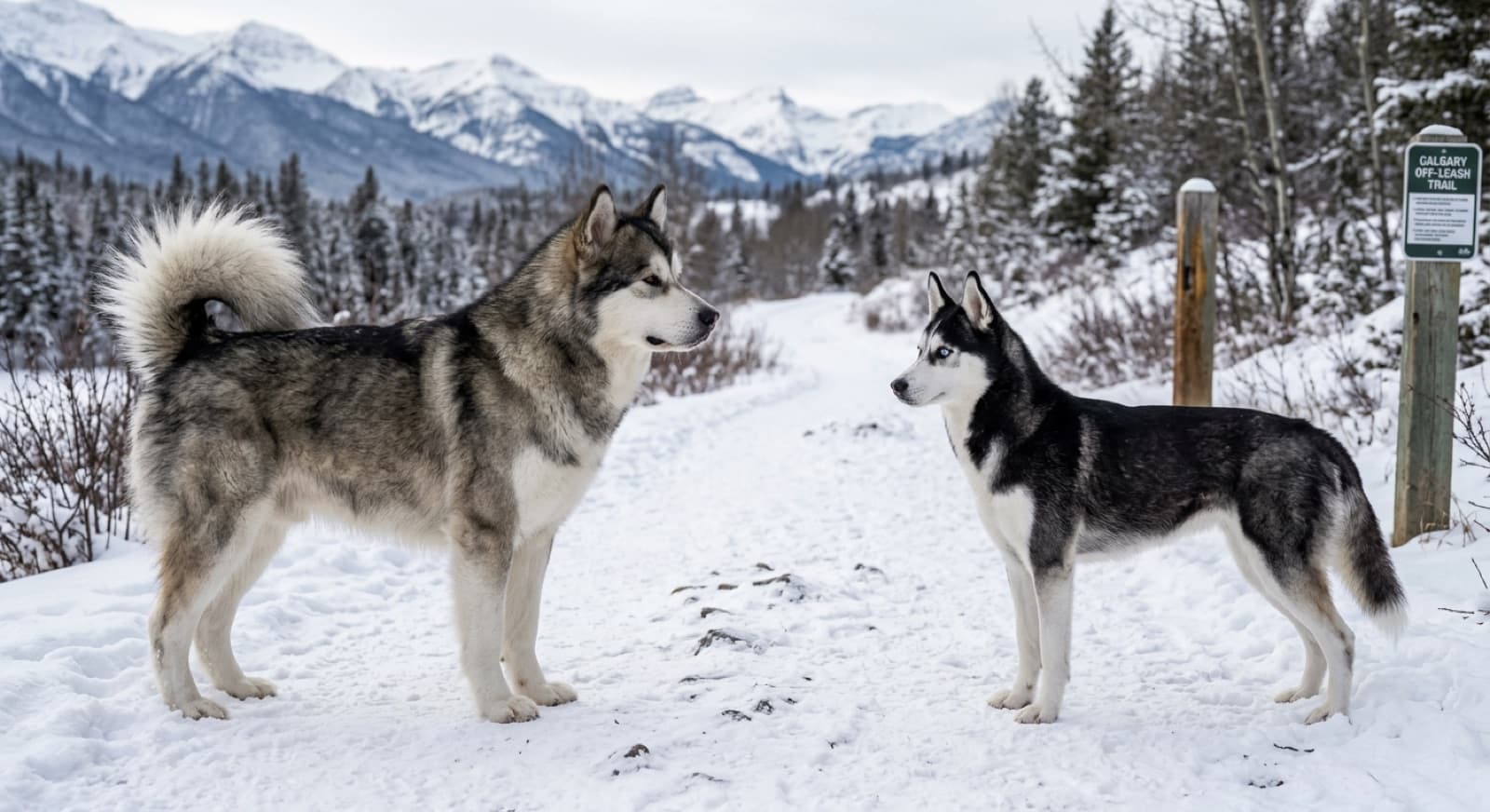
Why Huskies escape
Three traits stack to produce the classic Husky escape. None of them is a behaviour problem; all of them are the breed working exactly as designed. Understanding the cause is the start of fixing the gap.
Runner instinct. Centuries of selective breeding for endurance sled work shaped a dog who runs because the body wants to run. A loose Husky is not running away from you. The dog is doing what the breed was made to do. This is also why recall under arousal is so unreliable. The dog is not ignoring you; the dog is running.
Prey drive. Most Huskies carry high prey drive. A squirrel scent at the fence line, a rabbit in the alley, a cat darting across the yard, any of these can trigger a chase response that overrides recall and self-preservation. Edmonton backyards back onto alleys, green strips, and river-valley corridors that are full of small wildlife. The dog smells what you cannot. The chase response fires before any training kicks in.
Boredom under-exercise. The under-exercised Husky is the escape-prone Husky. A Husky who has had a 90 minute brisk walk and a structured chew session is much less interested in scaling the fence than one who has been alone in the yard for six hours. Exercise is not a substitute for fencing; it is a layer that lowers the daily motivation to test the perimeter. Both layers matter.
Combine the three. A 4 PM rabbit scent at the fence line of a bored, under-exercised Husky in a yard with a 2 foot snow drift against the fence is the recipe Edmonton owners learn from a phone call at 4:15 PM. The fix is mechanical first, behavioural second.
Suburban Edmonton fence reality
Most suburban Edmonton homes (Mill Woods, Castle Downs, Riverbend, Terwillegar South, Summerside, Windermere) come with 6 foot wood privacy fences, which is the right starting point for a Husky. Some older neighbourhoods and infill builds have 4 to 5 foot fences that are inadequate. Some yards have chain link, which works structurally but adds the visual prey trigger of squirrels visible through the mesh.
The Edmonton fence specs that hold
| Fence height | Holds an adult Husky in Edmonton? |
|---|---|
| 3 to 4 feet | No. Will not hold most adult Huskies. Replace before adoption. |
| 5 feet | Holds most. Determined dogs jump. Athletic Huskies clear it. |
| 6 feet solid wood | Standard Edmonton secure height. Holds the vast majority. |
| 7 feet, or 6 feet plus coyote roller | Holds athletic outliers and persistent jumpers. |
Material matters. Solid wood beats chain link. With chain link, the dog can see the squirrel they want to chase, which raises jump attempts. Solid wood removes the visual prey trigger. Open-slat decorative fences are worse than chain link because they offer both sight lines and climbable horizontal rails. If your yard came with chain link or open-slat and you are committed to keeping the Husky, plan a wood-fence upgrade or add an opaque wind-mesh panel along the existing fence.
Dig-proofing the bottom edge. Three options that work in Edmonton soil. L-footer chicken wire (cheapest, around CAD 40 to 80 in materials): 18 inches of chicken wire bent at 90 degrees, buried 6 inches into the soil and extending 12 inches out from the fence base. The dog tries to dig, hits wire, gives up. Paving stones along the fence line (CAD 80 to 200): heavy enough that the dog cannot move them. Concrete trench (most permanent, CAD 200 to 500 in materials): a poured strip along the fence base. Pick one and install before your Husky discovers the gap, not after.
The reality for some Huskies. Some individuals will clear any reasonable home fence. For those dogs the only secure outdoor option is a covered run: a fully enclosed kennel with a roof over the top and dig-proofing under the floor. Covered runs are common at sled-dog kennels for a reason. If your dog has cleared a 6 foot fence more than once, the next step is not a 7 foot fence; it is a covered run for outdoor time and supervised yard sessions only.
Winter snow drift, the under-appreciated Edmonton threat
This is the layer Edmonton Husky owners learn about in February. A 6 foot fence in October is a 6 foot fence. A 6 foot fence in February with a 3 foot snow drift packed against it is a 3 foot fence. Crusted -25 C snow supports a Husky’s weight; the drift becomes a ramp. Owners who never had a summer escape get one in winter because the geometry of the fence changed and they did not notice.
The fix is unglamorous: rake or shovel snow away from the fence line every time it snows. Some Edmonton Husky owners walk the perimeter with a snow shovel after every storm. It is the most tedious task in Husky ownership here. It is also the one that prevents most winter escapes. The corners and gate posts are the high-risk drift collection points; check them first.
Cold itself does not slow a Husky. The breed is cold-adapted and a winter escape can run further than a summer escape because the body does not fatigue as fast. A loose Husky at -20 C is not in distress from the temperature. The dog is moving, and the dog will keep moving.
GPS trackers and the insurance layer
Even the best fence can fail. The front door opens during a delivery, the gate gets left ajar by a kid or a plumber, the dog slips a leash on a walk. A GPS tracker on the collar or harness is the insurance for that day. For Edmonton Husky owners it is close to standard kit.
The market is dominated by two cellular trackers commonly discussed in Canadian dog-owner circles: Tractive (subscription-based, app-based live tracking, accurate to a few metres in urban Edmonton) and Fi (hardware-focused, optional subscription, step counter, durable build). Both function across Edmonton on cellular service. We do not endorse either; we mention both as the units owners we talk to most often use. Compare current pricing, subscription terms, and battery life before buying.
The microchip and licence layer. The City of Edmonton Animal Care and Control Bylaw requires licensing for dogs over six months. Microchipping is the second piece. The chip itself does not transmit location; what it does is reunite the dog with you when a stranger drops them at a vet clinic or shelter. The single most common reason recoveries drag is an outdated chip registration. Update it every time you move or change your phone number. Pair the chip with a visible Edmonton licence tag on the collar for the fastest direct-to-owner returns.
The bell. Some Edmonton Husky owners clip a small bell to the harness for outdoor walks. It is a low-tech audibility layer: if the dog gets ahead of you on a trail or in a backyard, you can hear them moving. Not a substitute for GPS. Useful as a layer of last resort, especially with multi-dog households.
The off-leash reality (and the long-line solution)
Edmonton off-leash parks are all unfenced. Terwillegar, Mill Creek Ravine, Hawrelak, Whitemud Ravine, Capilano. None are fenced. All border river-valley corridors with active coyote presence. A Husky off-leash in those zones who picks up a prey scent can be a kilometre away before you have caught up.
The position we hold consistently across our Edmonton Husky guides: full off-leash for Huskies belongs in fully fenced spaces only. Your own yard, with the fence and dig-proofing above. A verified fenced indoor or outdoor facility you have walked the perimeter of. Nowhere else.
The long-line is the realistic compromise. A 30 to 50 foot biothane line clipped to a back-clip harness gives the dog real freedom to sniff and range while keeping the option to stop them at any moment. Biothane is waterproof, washable, does not stiffen in Edmonton cold, and stays grippy when wet. Pair with a sturdy back-clip harness (not a flat collar; the line can transmit a sudden jerk that hurts the neck on a collar).
Avoid retractable leashes for Huskies. They break under strong pulling, the spring mechanism can fail under cold or stress, and the thin cord can wrap around legs at speed. Standard 6 foot leash for streets and transit, biothane long-line for trails.
Some adult rescue Huskies never reach reliable off-leash status. That is OK. Long-line work plus secure-yard time can give a Husky a full life. The owners who get into trouble are the ones who decide a year of training has earned trust, take the leash off at Terwillegar, and discover the recall does not hold under squirrel arousal. That single failure can be fatal.
Long-line recall training
The long-line is also the right training tool for building recall over months. The dog learns to come when called while you retain the safety of the line. The goal is not to graduate off the line in three weeks; the goal is to make the recall reliable enough that one squirrel does not undo six months of work.
The basic protocol. Start in low-distraction environments (your own yard, a quiet residential street at off-peak hours). Use a 30 to 50 foot biothane line, a back-clip harness, and very high-value treats (real meat, cheese, freeze-dried liver). Call your dog’s name and the recall word once; reward when the dog turns toward you and again when the dog reaches you. Practice many short reps, not long sessions. Recall should be the most-rewarded behaviour in the dog’s daily life.
Graduate distraction levels carefully. Quiet yard, then quiet park, then busier park, then off-leash zone with the long-line still attached. Most Huskies plateau at moderate distraction. Reliable recall under prey arousal is the unicorn; many dogs never get there. Build with the line on at all times until you have hundreds of successful reps across high-distraction environments. Then keep the line on anyway.
What does not work. Punishing the dog for not coming. Calling repeatedly when the dog is not coming (this teaches the dog the recall word means nothing). Calling when you cannot enforce (off the long line, distance too great). Calling the dog only to leash up and end the fun (this teaches recall = end of fun; instead recall, reward heavily, then release back to play). The mechanics matter as much as the gear.
Browse adoptable Huskies in Edmonton
Edmonton rescues that intake Huskies note escape history and fence requirements on every dog’s profile. Read the foster notes carefully if your fence is anything less than 6 foot solid wood with dig-proofing. Some Huskies are surrendered specifically because the previous yard could not contain them.
See Edmonton Adoptable Dogs →
When your Husky escapes: the first hour
The protocol matters as much as the prevention. The first hour is when most successful recoveries happen. Print this list and put it on the fridge.
- Do not chase. Huskies read chase as a game and run further. Stop, breathe, look at the GPS app.
- Activate the GPS tracker. Get the bearing and distance. Watch for direction of travel.
- Drive in the dog’s direction. Faster than walking. Stop at intersections, get out, listen. Huskies often vocalize while running. The howl carries.
- Call City of Edmonton 311. File a loose-dog report with Edmonton Animal Care and Control. They log pickups and dispatch officers to known sightings.
- Post on Lost Pet Edmonton. The Lost Pet Edmonton Facebook group is highly active and turns sightings into recoveries within hours. Photo, last seen location, your phone number, GPS direction if you have one. Cross-post to any neighbourhood Facebook group you belong to.
- Contact Edmonton Humane Society. Their lost-and-found service receives stranger-turned-in dogs daily. Send a photo, description, microchip number, and your phone number.
- If you spot the dog: get low, turn sideways, no eye contact. Use a happy voice. High-value treats (cheese, hot dog, real meat) in a sealed pouch. Many loose Huskies will come close out of curiosity if you do not look threatening. Crouch and let them come to you.
- Walk likely paths. Squirrels, parks, river-valley trails. Edmonton Huskies frequently end up at Hawrelak, in Mill Creek Ravine, on a residential lawn near a bird feeder, or at someone’s backyard with food smells.
- Carry a slip lead. Many first captures happen because a stranger calls the dog over with food. You need to be able to secure the dog instantly when you arrive.
- Door-knock the streets near last sighting. A neighbour’s back-yard food bowl can stall the dog long enough for you to arrive.
In our experience tracking loose-dog cases through the Edmonton rescue and bylaw networks, recoveries happen fastest when GPS, social media, and Edmonton Animal Care and Control are all activated within the first hour. The cases that drag on are usually the ones with no GPS, an outdated microchip registration, and an owner who chased on foot for two hours before posting anywhere.
Coyote presence: why an Edmonton Husky escape is an emergency
Edmonton has an established urban coyote population that uses the river-valley parks as travel corridors. Whitemud Ravine, Mill Creek, the Hawrelak south slope, the Terwillegar perimeter all carry coyotes daily, especially at dawn and dusk. A loose Husky who runs into the ravines can encounter a pack within minutes.
Coyote interactions with off-leash dogs follow a few patterns. A single coyote may try to lure the dog deeper into the ravine. A pack may follow at a distance, sometimes following an off-leash dog back toward the handler. In pup-rearing season (April through July) a coyote will actively defend territory and pups against a dog. In deep winter, food-stressed coyotes are more aggressive in any direction.
A Husky off-leash in a ravine who triggers a coyote response is in serious risk. The Husky may engage; the coyotes have the territorial advantage and almost always travel in pairs or larger groups. Injuries to dogs in Edmonton coyote encounters require emergency vet care; some are fatal.
This is why a Husky escape in Edmonton is not a wait-and-see situation. The dog can travel several kilometres in an hour, and the river-valley corridors are the most likely direction. Activate the protocol above immediately. Do not wait for the dog to come home on its own. The Alberta SPCA tracks wildlife-related dog incidents in Edmonton and the surrounding areas; their reports support how seriously this needs to be taken.
House escapes: the front door, the gate, the screen
Many Edmonton Husky escapes do not start with the fence. They start with the front door during a delivery, the gate left open by a contractor, the screen door bumped open by a kid, or a backyard gate latch that the dog learned to nose open. The mechanical fixes are simpler than people expect.
Front-door management. Install a pressure-mount baby gate or a child-safe gate at the entry, so the dog physically cannot reach the door when it opens. The gate also gives you a place to teach a place command (a mat or bed in the entry zone) where the dog learns to wait when guests arrive. Layer the mechanical gate with the training; do not rely on training alone with a Husky.
Gate latches and child-locks. Backyard gate latches are the second most common escape route. Standard wooden gate hooks can be lifted by a determined Husky nose. Upgrade to a key-locked latch or a carabiner-clipped chain. Some Edmonton owners add a child-lock or a padlock on every backyard gate, with the key kept in a known household spot. Any contractor or service tech who enters the yard gets a verbal reminder to close the gate behind them; a written sign on the gate inside helps.
Screen doors. Standard screen doors are not Husky-proof. The dog leans, the screen pops. If you use a screen door in summer, install a Husky-proof storm door or keep the inner door closed when the dog is alone in the front room.
Multi-layer thinking. Every escape route deserves two layers: a primary (the latch, the door, the fence) and a backup (the carabiner, the baby gate, the dig-proofing). When the primary fails, the backup catches it. Edmonton Husky owners who have not had an escape are usually owners who have built two layers into every exit point.
Frequently asked questions
How do I keep a Husky from escaping in Edmonton?
Three layers, in order. First, infrastructure: a 6 foot solid wood fence with dig-proofing along the bottom edge (buried chicken wire, paving stones, or a concrete footing). Second, winter snow management: rake or shovel snow away from the fence line through the season so a 3 foot February drift does not turn your 6 foot fence into a 3 foot fence. Third, a GPS tracker on the dog whenever they are out of the house. Treat escape as a physical-infrastructure problem first and a training problem second. The breed will run if the gap exists; your job is to remove the gap.
What fence height does a Husky need in Edmonton?
6 feet minimum for an adult Husky, solid wood preferred over chain link. Most suburban Edmonton fences (Mill Woods, Castle Downs, Riverbend, Terwillegar South) are already 6 foot wood, which is the right starting point. Athletic outliers may need 7 feet or a 6 foot fence plus a coyote roller along the top rail. The bottom edge is non-negotiable in Edmonton because Huskies dig as readily as they jump, and frost-heave soil means the gap under a fence can shift season to season. Add chicken wire buried 12 to 18 inches deep, paving stones along the fence base, or a concrete footing. Then rake snow away from the fence line all winter so drift does not give the dog a launch ramp.
Why do Huskies dig under fences?
Two reasons stacked. First, the breed was developed for endurance sled work and carries a strong drive to move, dig, and explore on its own. Second, prey drive: a squirrel, rabbit, or cat scent on the other side of the fence triggers a chase response that overrides most training. The dog is not bored or angry; the dog is responding to a wildlife trigger you cannot smell. Edmonton backyards back onto green spaces, alleys, and river-valley corridors that are full of squirrels and rabbits, which is why digging is more common here than in pure-suburban-cul-de-sac neighbourhoods. Physical dig-proofing is the only fix that holds.
How do Edmonton winters change Husky fence security?
Snow drift is the under-appreciated threat. A 6 foot fence in October may effectively be a 4 foot fence in February if a 2 foot drift has packed against the fence line. Crusted -25 C snow supports a Husky’s body weight, which turns the drift into a launch ramp. Owners who never had an escape in summer get one in February. The fix is mechanical: rake or shovel snow away from the fence line every time it snows. Some owners run a small shovel pass weekly through deep winter. It is the most tedious Husky-ownership task in Edmonton and the one that prevents most winter escapes.
Can I let my Husky off-leash in Edmonton parks?
In unfenced spaces, almost never. Edmonton off-leash parks like Terwillegar, Mill Creek Ravine, Hawrelak, and Whitemud are all unfenced and most border river-valley corridors with active coyote presence. A Husky off-leash in those zones who picks up a prey scent can be a kilometre away before you have caught up. The realistic position: full off-leash for Huskies belongs in fully fenced spaces only (your own yard or a verified fenced facility you have walked the perimeter of). On unfenced trails, use a 30 to 50 foot biothane long-line clipped to a back-clip harness. Many adult rescue Huskies never reach reliable off-leash status, and that is OK.
What GPS tracker should I use for my Husky?
GPS trackers are close to standard kit for Edmonton Husky owners. The two most commonly discussed cellular trackers are Tractive (subscription-based, accurate to a few metres, app-based live tracking) and Fi (hardware-focused, optional subscription). Both work on cellular networks across Edmonton and the surrounding area. Pair the tracker with current microchip registration and a City of Edmonton dog licence (required under the Animal Care and Control Bylaw for dogs over six months). The GPS gets you to the dog. The chip and licence get the dog to you if a stranger finds them first. Layered insurance.
What do I do in the first hour if my Husky escapes in Edmonton?
Do not chase on foot; Huskies read chase as a game and run further. Get the GPS bearing, drive in that direction, and stop at intersections to listen for the dog (Huskies often vocalize while running). Call City of Edmonton 311 to file a loose-dog report with Edmonton Animal Care and Control. Post immediately to the Lost Pet Edmonton Facebook group with photo, last-seen location, and your phone number. Contact Edmonton Humane Society lost-and-found service, which receives stranger-turned-in dogs daily. If you see your dog, get low, turn sideways, avoid eye contact, and offer high-value food (cheese, hot dog). Many recoveries happen because a stranger hands the dog a sandwich, not because the owner chased it down.
How dangerous are Edmonton coyotes to a loose Husky?
Real concern, not hypothetical. Edmonton river-valley parks (Whitemud Ravine, Mill Creek, Hawrelak south slope, Terwillegar) have established coyote populations that travel along the corridors at dawn and dusk. A loose off-leash dog who triggers a coyote pack can be followed back toward the handler or pulled into a chase further into the ravine. Spring and early summer (April through July, pup-rearing season) is the highest-risk window. A loose Husky in winter, when coyotes are food-stressed, is also at elevated risk. This is why a Husky escape in Edmonton is a same-hour emergency, not a wait-and-see situation.
How do I stop my Husky from bolting through the front door?
Two mechanical fixes plus a training fix. First, install a child-safe gate or pressure-mount baby gate at the entry, so the dog physically cannot reach the door when it opens. Second, add a secondary leash or house-line tethered to a fixed point near the entry for when the dog is in the front room with visitors. Training-wise, teach a place command (mat or bed away from the door) and practice with treat-rewarded stay during door openings. Many Edmonton Husky escapes happen during delivery handoffs, packages, and dog-walker arrivals. The mechanical layer is faster than the training layer and works on day one.
Does microchipping help recover a lost Husky in Edmonton?
Yes, and it is required under City of Edmonton rules for licensed dogs. The chip itself does not transmit location, but it is what reunites your dog with you if a stranger drops them at a vet clinic, the Edmonton Humane Society shelter, or Edmonton Animal Care and Control. Make sure your chip is registered to your current address and phone number; an outdated chip registration is the single most common reason recovery drags from hours into days. Update the chip registry whenever you move or change phone numbers. Pair the chip with a visible Edmonton dog licence tag on the collar for fastest direct-to-owner returns.
More Edmonton Husky guides
Edmonton Adoptable Dogs →
Current Husky and Husky-mix listings from Edmonton rescues, with foster-tested escape and fence notes.
Husky Adoption Edmonton →
Edmonton rescue routes for Huskies, adoption costs, surrender patterns, and the breed-vs-buy reframe.
Husky Health Issues: Eyes, Skin, Thyroid →
Siberian Husky health issues to plan for: juvenile cataracts, corneal dystrophy and PRA, zinc-responsive skin disease, hypothyroidism, epilepsy and degenerative myelopathy.
Husky Winter Care Edmonton →
Cold tolerance, paw care, winter coat management, and the Edmonton-specific exercise protocol when temperatures drop below -20 C.
New dog? Start with these care guides
Everything a new adopter needs to set up a safe, happy home.