The short answer
Huskies shed a lot, year-round, with two dramatic coat-blow seasons (spring March-April and fall September-October). Brush weekly baseline with an undercoat rake plus slicker; brush daily during coat-blow. Never shave a Husky. The double coat regulates temperature in both winter and summer, and shaving damages the coat permanently. Bathe every 8 to 12 weeks in winter (less than most owners expect; over-bathing strips oils). Edmonton dry winter (15-25% indoor humidity) calls for a humidifier and reduced bathing. The Husky is NOT hypoallergenic. Tool kit: $80 to $200 minimum, $300 to $700 with a high-velocity dryer. Professional Edmonton coat-blow appointment $80 to $150. Shedding is the dominant ongoing care commitment of Husky ownership; if it is a deal-breaker for your household, pick a different breed.
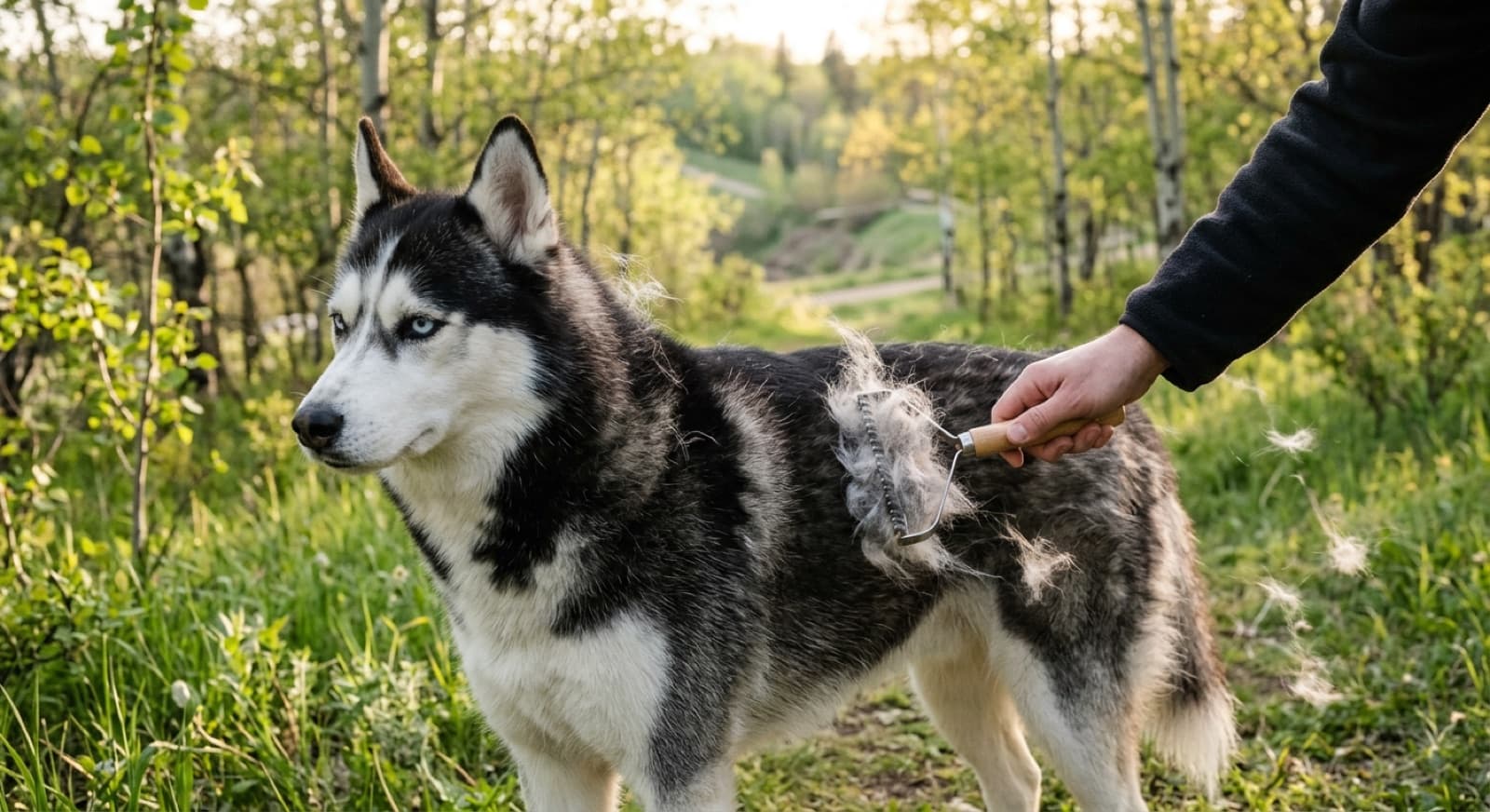
The double-coat science (why never shave)
Shaving a Husky destroys the double coat's temperature regulation function and can cause permanent damage. Never shave a Husky. Never let a groomer talk you into a summer shave. The only exception is medical (vet-performed for a small surgical area).
The Husky double coat consists of two distinct layers, each with a specific function:
- Undercoat. Dense soft insulating layer. Traps air against the skin. Provides thermal regulation in BOTH winter (retains body heat) and summer (insulates against external heat and sun).
- Guard coat. Longer outer layer of straight guard hairs. Sheds water, deflects sun, protects against debris.
The summer shave myth. Owners commonly think a Husky is hot in summer and shaving will cool the dog down. This is wrong on the biology. The undercoat that traps body heat in winter ALSO insulates against external heat in summer; the still air against the skin is a buffer against the hot outside air. Shaving removes this insulation and exposes skin directly to sun and heat, making the dog hotter not cooler.
The damage is often permanent. Shaved double-coated dogs often grow the coat back patchy and uneven. The guard hairs may not regrow at all in some areas. The undercoat may grow back wirier or sparser. Some shaved Huskies never recover the original coat texture. The breed-club and veterinary consensus is unambiguous: never shave a Husky, never shave any double-coated breed (Husky, Malamute, Samoyed, German Shepherd, Bernese Mountain Dog, Golden Retriever, Akita, etc.).
The American Kennel Club and the Canadian Kennel Club both publish guidance against shaving double-coated breeds for cosmetic or perceived-comfort reasons. The AKC notes shaving “doesn't eliminate shedding, but it does damage the topcoat and can increase the chances of skin issues or sunburn,” and damages the undercoat's temperature regulation.
Tool kit + cost breakdown
| Tool | Purpose | Budget | Premium |
|---|---|---|---|
| Undercoat rake | Targets soft undercoat; the primary coat-blow tool | $20 to $35 | $60 to $100 (Mars Coat King) |
| Slicker brush | Surface coat finishing; daily brush | $15 to $30 | $50 to $90 (Chris Christensen) |
| Wide-tooth comb | Tail feathering, ears, mat detection | $10 to $20 | $30 to $50 |
| High-velocity dryer | Optional but transformative for coat-blow | $150 to $250 (B-Air) | $400 to $700 (K9III) |
| Nail clippers/grinder | Joint health; non-negotiable | $20 to $40 | $60 to $100 |
| Vacuum (heavy-duty) | Daily home maintenance | $300 to $500 | $600 to $900 (Dyson) |
Some of the product links in this section are Amazon affiliate links — we may earn a small commission at no extra cost to you. It never changes which products we recommend.
Basic at-home kit: $80 to $200. Full home grooming setup with HV dryer: $300 to $700. Vacuum is a separate household investment. Professional Edmonton groomer for blow-out alone: $80 to $150 per visit; budget 2 to 4 visits per year if using professionals.
Browse adoptable Huskies in Edmonton
Shedding is the dominant care commitment. Foster home observation of coat type (standard vs wooly) matters for matching grooming time to your household capacity.
See Available Huskies →The Edmonton dry-winter angle
Edmonton winters run long and dry. Indoor furnace-heated air through 5 to 6 months of cold-season weather drops indoor humidity to 15 to 25%, well below the 40 to 50% range that is comfortable for skin and coat. Static increases, the coat can feel drier, and skin-sensitive dogs may flare with dandruff or hot spots.
The Edmonton-specific responses:
- Indoor humidifier. Aim for 35 to 45% humidity in main living areas. Whole-house furnace humidifier is the gold standard. Multiple portable humidifiers work for smaller homes.
- Reduced bathing frequency. Stretch bath schedule to every 8 to 12 weeks through winter to preserve coat oils.
- Omega-3 supplementation. Quality fish-oil supplement supports skin and coat through dry months. Discuss dosing with your Edmonton vet; dosing varies by body weight, joint or skin condition, and the specific fish-oil concentration.
- Weekly brushing remains. Matting risk increases with dry brittle coat. Skipping the brushing schedule because the dog is shedding less in winter creates problems by the time spring coat-blow arrives.
- Watch for dry-air skin issues. Flaking, persistent itching, dandruff, hot spots. Vet check if any persist beyond a week of humidifier and supplementation.
Frequently Asked Questions
How much does a Siberian Husky shed?
A lot, year-round, and dramatically twice per year. The Husky double coat consists of a dense soft undercoat and a longer guard-hair top coat; the breed evolved for Arctic and Siberian winters and the coat is purpose-built for extreme cold. Year-round daily shedding produces light to moderate fur on furniture and clothing. Twice a year (typically spring March-April and fall September-October) the Husky "blows coat" for a 2 to 4 week period where the undercoat releases in large clumps. During coat-blow seasons you will brush out handfuls of undercoat daily and find fur on every surface in the house. Owners commonly describe coat-blow as needing to vacuum daily and clean the lint trap multiple times per laundry cycle. There is no way to eliminate Husky shedding; the entire breed-care strategy is managing it through brushing, never shaving, and accepting that fur is a permanent feature of Husky ownership.
Why should I never shave a Husky?
Shaving destroys the double coat's function and can cause permanent damage. The Husky undercoat is the insulating layer that regulates temperature in BOTH winter (traps body heat) and summer (insulates against external heat and sun). Shaving removes the temperature regulation system entirely and exposes the skin to direct sun damage. The undercoat grows back unevenly and the guard hairs may grow back wrong or not at all, resulting in patchy permanent coat damage. Some shaved Huskies never fully recover the original coat texture. The "my Husky is too hot in summer" reason owners use to justify shaving is incorrect: the double coat actively cools the dog by trapping a layer of insulating air against the skin and the longer guard hairs deflect sun. Shaving makes summer heat WORSE for a Husky, not better. The veterinary and breed-club consensus is unambiguous: never shave a Husky, never shave any double-coated breed, never let a groomer talk you into a summer shave. The only exception is medical (e.g., a vet shaving a small surgical area; the coat regrows normally in such cases).
What grooming tools do I actually need for a Husky in Edmonton?
The Edmonton Husky grooming kit, in priority order: (1) An undercoat rake, the most important tool. Targets the soft undercoat that drives coat-blow. Quality options: Furminator deShedding tool, Coastal Pet Safari undercoat rake, Mars Coat King. Use weekly year-round and daily during coat-blow seasons. (2) A slicker brush for finishing and surface coat. Quality options: Chris Christensen Big G or Mars Slicker. (3) A wide-tooth comb for tail feathering, ears, and behind-the-ear matting. (4) A high-velocity dryer (optional but transformative during coat-blow). The dryer blows loose undercoat out in 30 to 45 minutes vs hours of hand brushing. Quality home options: K9III, B-Air Bear Power, Flying Pig. Budget $200 to $500. Professional groomers in Edmonton often use these and a "blow-out" service is an option (typically $80 to $150). (5) Nail clippers or grinder (any quality brand; nail care is non-negotiable for joint health). Total kit cost: $80 to $200 minimum without dryer, $300 to $700 with dryer.
How does the Edmonton dry winter affect Husky coat health?
Edmonton winters are dry. Indoor furnace-heated air through 5 to 6 months drops indoor humidity to 15 to 25%, well below the 40 to 50% range that is comfortable for skin and coat. Static increases, the coat may feel drier and more brittle, and skin issues can flare in dogs prone to them. Practical Edmonton-specific responses: (1) Indoor humidifier helps both dog and humans. Aim for 35 to 45% humidity in main living areas. Whole-house humidifier on the furnace is ideal; multiple portable humidifiers work in smaller homes. (2) Less frequent bathing in winter (every 8 to 12 weeks rather than every 6) to preserve coat oils. (3) Quality fish-oil supplement (omega-3) supports skin and coat health through dry months. Discuss dosing with your Edmonton vet; dosing varies by body weight, joint or skin condition, and the specific fish-oil concentration. (4) Brushing remains weekly even in deep winter; matting risk increases with dry brittle coat. (5) Watch for dry-air skin issues: flaking, itching, dandruff. Vet check if persistent.
How often should I brush a Husky?
Weekly year-round; daily during coat-blow seasons. The weekly baseline (about 20 to 30 minutes with an undercoat rake plus slicker brush) prevents matting, removes loose undercoat before it lands on furniture, distributes coat oils, and gives you regular hands-on skin check time (lumps, parasites, hot spots). During spring and fall coat-blow (typically 2 to 4 weeks each season), brush daily for 30 to 60 minutes. The volume of undercoat released during coat-blow is dramatic; daily brushing prevents matting, reduces indoor fur accumulation, and shortens the overall coat-blow duration. Skipping daily brushing during coat-blow does not eliminate the shedding; it just delays it and creates matting problems. Many Edmonton owners schedule professional "blow-out" appointments during coat-blow seasons ($80 to $150 per appointment at an Edmonton groomer using a high-velocity dryer); a single professional appointment can complete what would take 4 to 6 hours of home brushing.
How often should I bathe a Husky?
Less often than most owners expect. The Husky double coat is naturally clean and the undercoat sheds dirt and debris readily. Over-bathing strips coat oils and can dry skin, particularly in Edmonton dry winters. Baseline schedule: every 8 to 12 weeks in winter, every 6 to 8 weeks in summer, plus as-needed if the dog rolls in something genuinely smelly or is otherwise dirty. Use a mild dog-specific shampoo (Earthbath Oatmeal & Aloe, Burt's Bees, or veterinary-recommended brands; never human shampoo or dish soap which strip oils and disrupt skin pH). For coat-blow seasons, a bath at the start can help loosen the undercoat for brushing-out. Critical bathing steps: (1) Fully wet the coat down to the skin (the double coat resists water and needs thorough soaking). (2) Lather and rinse the undercoat as well as the guard coat. (3) Rinse completely; shampoo residue causes skin irritation. (4) Towel dry then high-velocity blow dry or air-dry in a warm location. Wet undercoat takes hours to fully dry and damp coat next to skin can lead to hot spots.
Are Huskies hypoallergenic?
No. The Husky is one of the highest-shedding breeds and is NOT hypoallergenic. Owners with mild dog allergies sometimes report tolerating Huskies surprisingly well, others react severely. The relevant allergen (Can f 1 protein) is in dog saliva, skin dander, and urine, not in fur directly, but the fur carries it and a heavily shedding dog distributes more dander throughout the home. If anyone in the household has documented dog allergies, the breed selection question is critical: do not adopt a Husky without an extended trial in a Husky-owning home first to test the specific household reaction. Truly hypoallergenic breed candidates (Poodles, Bichon Frise, Maltese, Portuguese Water Dog, soft-coated Wheaten Terrier) have very different coats. The Husky double coat is the opposite of hypoallergenic: it releases the maximum amount of allergen-carrying dander year-round. Marketing claims that Huskies are "low-allergen" or "less allergenic than other breeds" are not accurate.
What about Husky shedding in apartments and condos in Edmonton?
Manageable but demanding. Edmonton condo and apartment Husky ownership requires: (1) A high-quality vacuum (Dyson V-series, Shark, or comparable; budget $400 to $800). Vacuum every other day baseline, daily during coat-blow. (2) Robot vacuum running daily as supplement (Roomba or comparable). (3) Lint roller stations near doorway, couch, and bedroom. (4) Acceptance that fur will be on every surface and on guests' clothing despite best efforts. (5) Bedroom door closed if you want to maintain a fur-free sleep space. (6) Vehicle interior protection (seat covers; the car will have fur permanently). (7) HVAC filter upgrade to a higher MERV rating (10 to 13) and changed monthly during coat-blow. Condo carpet is the biggest practical challenge; hard flooring is much easier to manage. Some Edmonton condo boards have weight or breed restrictions that affect Husky placement; check the board policy before adopting. The shedding problem is a major reason Huskies appear in Edmonton rescue: owners underestimate the volume and return the dog within 6 to 18 months.
How do Husky coat colours and types vary?
Coat colour does not affect shedding volume or grooming requirements significantly; all standard Husky colours have similar double coat. Recognised colours per Canadian Kennel Club standards include: black and white, grey and white, red and white, sable and white, agouti, and pure white. Markings range from full mask to no mask, with various face patterns. Eye colour can be blue, brown, parti (one of each), or split (sectoral heterochromia within one eye); eye colour is independent of coat colour. Coat types within the breed: (a) Standard coat (most common; medium length double coat). (b) Wooly coat (longer guard hairs, much fluffier, mats more easily, requires more brushing time). Wooly is technically a fault in show standards but common in rescue. Wooly-coat Huskies need substantially more grooming time than standard coats, about 1.5 to 2 hours of weekly brushing vs 20 to 30 minutes. Foster home should disclose coat type during the adoption phone screen for a wooly Husky.
How do I handle Husky shedding furniture and clothing?
A practical Edmonton Husky household kit: (1) Throw blankets on every couch and chair the dog uses; wash weekly. (2) Roomba running daily (set schedule for when you are not home). (3) Lint rollers at every doorway and in every car. (4) Quality vacuum with a dog-specific attachment (most Husky owners go through one cheap vacuum a year and learn to invest in quality). (5) HVAC filter changed monthly during coat-blow seasons. (6) Bedroom door closed if you want any fur-free zone. (7) Accept that black clothing and Husky ownership are at war; lighter colours show fur less. (8) Car seat covers if the dog rides in the vehicle. (9) Outdoor brushing sessions whenever weather permits to keep coat-blow shedding outside (Edmonton wind-still summer evenings on the deck are ideal). (10) Vacuum the dog directly with a quality pet attachment (most Huskies tolerate this with positive training). The mental shift Husky owners eventually make: fur is not dirt, it is just always there. Embrace it or pick a different breed.
What does Husky professional grooming cost in Edmonton?
Edmonton Husky grooming prices vary by service. Standard bath and brush: $60 to $100 per visit. Bath, brush, nail trim, ear clean, gland expression: $80 to $130. Coat-blow "blow-out" service using a high-velocity dryer (2 to 3 hours): $80 to $150 per visit. Most Husky owners use professional grooming 2 to 4 times per year (once per coat-blow season minimum), spending $200 to $600 per year total. The economics work if you compare against the time you save (4 to 6 hours of home brushing per coat-blow season vs a 2 hour appointment). Many groomers will not work with a poorly brushed-out matted Husky; if the coat is severely matted the price may include a de-matting fee or the groomer may decline and refer you to a vet for shave-down (the only acceptable shave situation; severe matting cuts off circulation and requires removal). Maintaining the home brushing schedule prevents matting and keeps grooming costs reasonable.
Bottom line for Edmonton Husky shedding?
Husky shedding is the dominant ongoing care commitment of Husky ownership. The brushing schedule is non-negotiable (weekly baseline, daily during coat-blow). The never-shave rule is non-negotiable. The acceptance that fur will be permanently part of your home is required. Edmonton-specific considerations: dry winter indoor air calls for a humidifier and reduced bathing frequency; coat-blow seasons (spring March-April and fall September-October) need extra brushing time or a professional blow-out appointment. Budget for the right tools ($80 to $200 minimum, $300 to $700 with high-velocity dryer); the cheap brush will not work and will frustrate you. Decision framework: if shedding is a deal-breaker for your household, pick a different breed (Poodle, Bichon, or another truly low-shed breed). If you accept the shedding reality and commit to weekly brushing, an adult Husky from Edmonton rescue (SCARS, Edmonton Humane Society, Zoe's Animal Rescue, AHHRB, AARCS Edmonton fosters) is a beautiful active companion that handles Edmonton winter better than almost any other breed. Coat-blow seasons end. The dog is worth it.
Adoptable Huskies in Edmonton
Live listings from SCARS, Edmonton Humane Society, Zoe's, AHHRB, and AARCS Edmonton fosters.
Husky Adoption Edmonton
Edmonton rescue pipelines, costs, foster network, the surrender pattern.
Husky Winter Care Edmonton
-30C tolerance, paw care, indoor dry air, winter activity infrastructure.
Husky Escape Prevention Edmonton
6 ft dig-proofed fencing, never off-leash rule, GPS tracking, escape recovery.
New dog? Start with these care guides
Everything a new adopter needs to set up a safe, happy home.