The short answer
Adopt from Edmonton rescue ($500 to $900). Labradoodles appear regularly through SCARS, Edmonton Humane Society, Zoe's Animal Rescue, AHHRB, and AARCS Edmonton fosters. Doodle crosses appear with similar frequency. Coat lottery is real: F1 Labradoodles vary from straight (Lab-like, sheds) to curly (Poodle-like, low-shedding). F1B (75% Poodle backcross) is more reliably low-shedding. Foster home observation is the most reliable coat-type predictor. Not reliably hypoallergenic; individual dogs vary substantially. Grooming commitment is substantial: $600 to $1,300/year professional plus daily home brushing for curly coats. Most Labradoodles are surrendered between 12 and 24 months when grooming and adolescent energy exceed original owner expectations. 12 to 14 year lifespan.
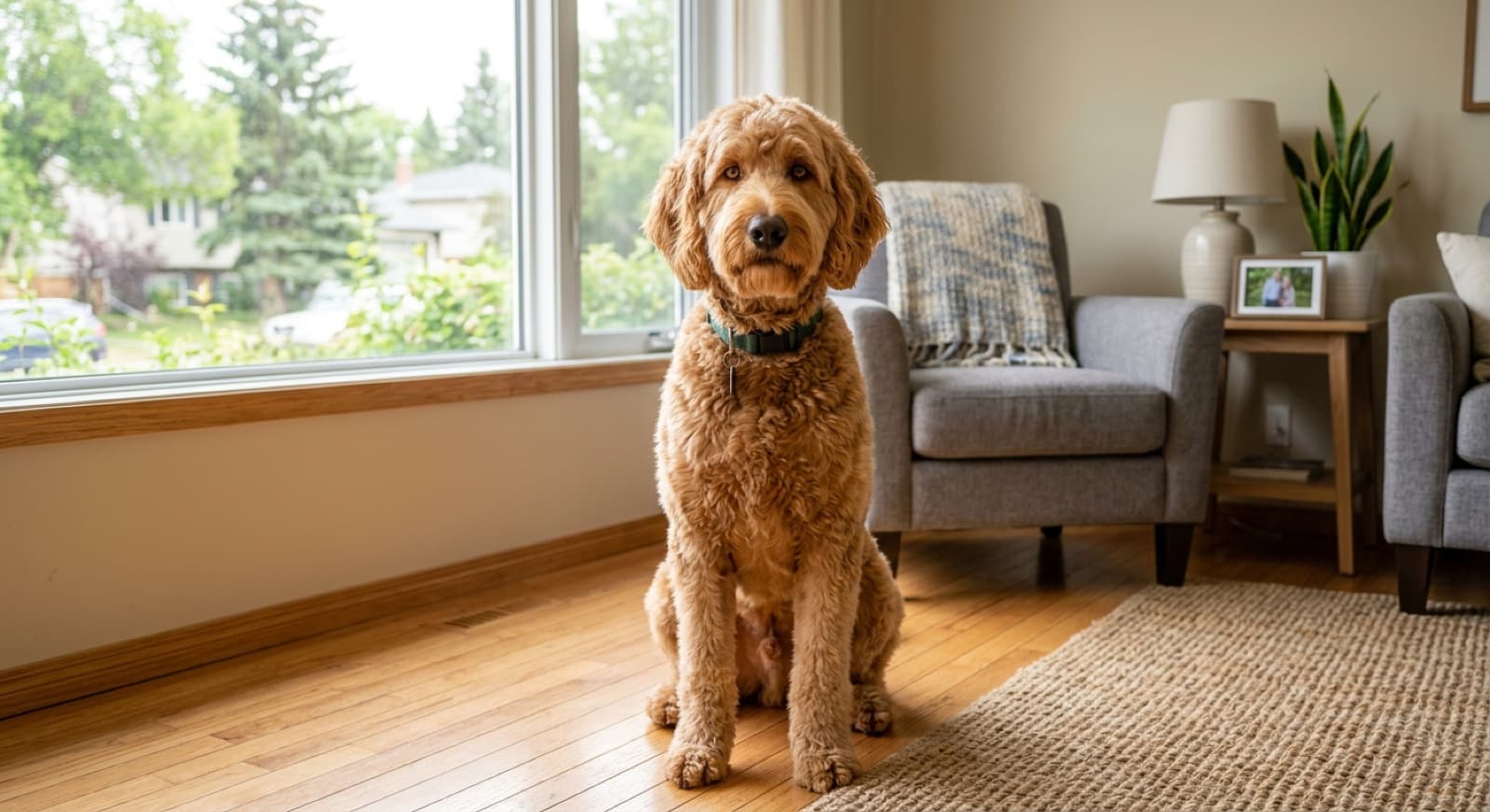
Browse adoptable doodles in Edmonton
Labradoodles and doodle crosses appear regularly. Foster home observation of coat type is more reliable than the generation label.
See Available Dogs →The coat lottery
Labradoodle coat is unpredictable in F1 crosses and only partially predictable in later generations. If you have allergies and need a low-shedding coat, foster-home observation matters more than the breed label.
F1 Labradoodle puppies in the same litter can range from heavily-shedding straight-coat dogs (similar to a shaggy Lab) to tight-curly low-shedding dogs (similar to a Poodle), with most landing somewhere in the middle (wavy fleece coat with moderate shedding).
Generation framework:
- F1 (first generation): 50% Lab + 50% Poodle. Coat unpredictable.
- F1B (first generation backcross): 25% Lab + 75% Poodle. More reliably low-shedding.
- F2: F1 + F1. 50% each but with more variable coat than F1 because of complex genetic mixing.
- F2B: F2 + Poodle backcross.
- Multi-generational (sometimes “F3” or “multigen”): later generations bred Labradoodle-to-Labradoodle, sometimes producing more consistent coat type.
- Australian Labradoodle: multi-generational with additional breed influence (Cocker Spaniel, English Cocker, Curly Coat Retriever in some lines).
For Edmonton rescue adopters, the generation label matters less than the foster-home coat observation. Ask explicitly during the phone screen about coat type, shedding level observed in the foster home, and grooming frequency the foster has been doing. The American Kennel Club does not formally recognise Labradoodles as a breed because the genetics remain variable.
Grooming and care reality
Grooming is substantial. Most Labradoodle surrenders to Edmonton rescue happen between 12 and 24 months when owners realise the grooming commitment exceeds what they expected.
- Curly-coated (more Poodle influence): daily brushing to prevent matting, professional grooming every 6 to 8 weeks at Edmonton groomer prices of $80 to $150 per visit.
- Wavy fleece (intermediate): weekly brushing baseline with occasional matting in problem areas (ears, armpits, tail feathering), professional grooming every 6 to 8 weeks.
- Straight coat (more Lab influence): weekly brushing, less professional grooming needed.
Many Labradoodle owners maintain a shorter “puppy cut” trim that simplifies daily care. Ear care matters significantly (drop ears with infection risk from Poodle coat texture and Cocker influence in some Australian Labradoodle lines); weekly check and clean. Bath every 4 to 6 weeks. Nail trim every 3 to 4 weeks.
The Canadian Kennel Club registers Labrador Retriever and Standard Poodle as separate purebreds; Labradoodle is not a CKC-recognised breed because the genetics remain variable across lines.
Frequently Asked Questions
Where can I adopt a Labradoodle in Edmonton?
Labradoodles appear in Edmonton rescue regularly but place quickly because the breed is highly desired. SCARS (Second Chance Animal Rescue Society), Edmonton Humane Society, Zoe's Animal Rescue, AHHRB (Alberta Homeward Hound Rescue Bureau), and AARCS Edmonton fosters all see Labradoodles and doodle crosses through the year. National doodle rescue networks coordinate placement across Canada when foster homes are available. Most rescue Labradoodles are surrendered between 12 and 24 months when the adolescent energy and grooming commitment exceed what the original owners expected. Doodle crosses (Labradoodle-Lab, Labradoodle-Poodle backcross, Labradoodle-Goldendoodle mixes) appear with similar frequency to first-generation Labradoodles.
What is the Labradoodle origin?
The Labradoodle was originally bred in Australia in 1989 by Wally Conron at the Royal Guide Dogs Association. The intent was a Labrador Retriever guide dog with the low-shedding coat of a Standard Poodle for a visually impaired client whose husband was allergic. The breeding succeeded for that specific dog but Conron later expressed regret about how the breed exploded as a designer cross because most subsequent breeding did not maintain the original health-testing standards. Today Labradoodles are produced widely by breeders of varying ethics: some maintain rigorous OFA, eye, and DNA testing on parent stock; others produce puppies without health screening. The "Australian Labradoodle" is a related but distinct line that incorporates Cocker Spaniel and other breeds in addition to Labrador and Poodle; it is registered through specific Australian and international Labradoodle associations.
How much does it cost to adopt a Labradoodle in Edmonton?
Edmonton rescue adoption fees for Labradoodles typically run $500 to $900 covering spay/neuter, current vaccinations, microchip, and a baseline vet workup. The fee is well below ethical breeder pricing ($2,500 to $5,000 for a properly health-tested Labradoodle puppy from a breeder with OFA hip and elbow tested parents, eye certified, and DNA tested for breed-specific concerns; Australian Labradoodles often $3,500 to $6,000+). Initial setup costs after adoption: medium-large dog harness ($40 to $80), 6-ft leash, slicker brush and stainless comb plus optional high-velocity dryer ($80 to $500 home setup), nail clippers, food bowls. Annual ownership cost $2,000 to $3,500: quality food ($400 to $700), routine veterinary care ($500 to $800), pet insurance ($400 to $700), grooming every 6 to 8 weeks at Edmonton groomer prices of $80 to $150 per visit ($600 to $1,300/year), Edmonton dog licence (confirm current fee with the City of Edmonton).
What is the coat lottery reality?
Labradoodle coat is unpredictable in first-generation (F1) crosses and only partially predictable in later generations. The Poodle parent contributes curly low-shedding coat; the Labrador parent contributes straight shedding coat. F1 Labradoodle puppies in the same litter can range from heavily-shedding straight-coat dogs (similar to a shaggy Lab) to tight-curly low-shedding dogs (similar to a Poodle), with most landing somewhere in the middle (wavy fleece coat with moderate shedding). The coat type is not predictable from the puppy stage; coat sometimes changes between 6 and 18 months. For rescue Labradoodles, coat type is already known by the time the dog enters foster care so foster home observation is the most reliable predictor. Adopters who specifically need a low-shedding dog for allergy reasons should verify coat type with the foster home before committing.
What is the F1, F1B, F2 generation framework?
A naming convention for Labradoodle generations. F1 (first generation): Labrador parent + Poodle parent, 50% each. Coat unpredictable. F1B (first generation backcross): F1 Labradoodle parent + Poodle parent, resulting in 25% Lab + 75% Poodle. Coat more reliably low-shedding because of the higher Poodle percentage. F2 (second generation): F1 Labradoodle parent + F1 Labradoodle parent, resulting in 50% each but with more variable coat than F1 because the genetic mixing is more complex. F2B: F2 + Poodle backcross. Multi-generational (often labeled "F3" or "multigen"): later generations bred Labradoodle-to-Labradoodle for multiple generations, sometimes producing more consistent coat type. The "Australian Labradoodle" is technically multi-generational with additional breed influence (Cocker Spaniel, English Cocker, Curly Coat Retriever in some lines). For Edmonton rescue adopters, the generation label matters less than the foster-home coat observation; ask explicitly during the phone screen.
Are Labradoodles hypoallergenic?
Not reliably. No dog breed is genuinely hypoallergenic; all dogs produce the Can f 1 allergen protein in saliva, skin dander, and urine. Labradoodles vary substantially in shedding by coat type: tight-curly coats shed less and produce less airborne dander; straight or shaggy coats shed similarly to Labradors. Even within an F1B (75% Poodle) litter, individual dogs vary. People with mild dog allergies sometimes tolerate Labradoodles well, particularly those with curly low-shedding coats; people with severe dog allergies should spend extended time with a specific dog before committing because reactions vary by individual. For Edmonton rescue Labradoodles, ask the foster home about household allergy testing if you have allergies; the foster's observation of a real household over weeks is more reliable than breed generalizations.
Are Labradoodles good first dogs for Edmonton families?
Yes for many households, with realistic expectations. Labradoodles are generally affectionate, family-oriented, friendly with most children when properly introduced, sociable with other dogs, intelligent and trainable. The breed-specific demands: moderate to high exercise needs (45 to 90 minutes daily including mental enrichment, depending on the Labrador influence), professional grooming every 6 to 8 weeks ($600 to $1,300/year), substantial home grooming time depending on coat type (curly coats need daily brushing to prevent matting; straight coats need weekly), training commitment for the adolescent energy phase. Adult Labradoodles from Edmonton rescue (3+ years) often skip the most intense adolescent phase and arrive with documented temperament and coat type. Many Labradoodles are surrendered specifically because the grooming commitment was underestimated, so adopters who accept the grooming reality typically succeed where original owners did not.
How does Labradoodle grooming work in Edmonton?
Substantial commitment varying by coat type. Curly-coated Labradoodles (more Poodle influence): daily brushing to prevent matting (15 to 30 minutes with slicker brush and stainless comb), professional grooming every 6 to 8 weeks at $80 to $150 per visit at Edmonton groomers. Wavy fleece coats (intermediate): weekly brushing baseline with occasional matting in problem areas (ears, armpits, tail feathering), professional grooming every 6 to 8 weeks. Straight coats (more Lab influence): weekly brushing, less professional grooming needed but still benefits from periodic trim. Many Labradoodle owners maintain a shorter "puppy cut" trim that simplifies daily care. Ear care matters significantly (drop ears with infection risk from the Cocker influence in some Australian Labradoodle lines and Poodle coat texture); weekly check and clean. Edmonton dry winter (15-25% indoor humidity from furnace heat) can dry coat and skin; a humidifier helps both dog and humans. Bath every 4 to 6 weeks. Nail trim every 3 to 4 weeks.
What are common Labradoodle health issues to plan for?
The breed lifespan is 12 to 14 years. Breed-specific health concerns inherited from both parent breeds: hip and elbow dysplasia (both Lab and Poodle risk; OFA-tested parents are responsible breeding), progressive retinal atrophy and other eye conditions (both parent breeds; eye certification matters), obesity tendency (inherited from Lab line; the POMC gene mutation in some Labs affects satiety signaling; lean body condition matters), bloat/GDV (deep-chested risk; slow-feeder bowl, two meals daily, no elevated bowl, no vigorous exercise within 30 to 60 minutes of feeding), allergies common, ear infections (drop ears with coat texture trapping moisture), Addison's disease (inherited from Poodle line in some cases), epilepsy in some lines. Pet insurance enrolled at adoption is valuable. Edmonton specialty orthopedic and ophthalmology referrals available; WCVM Saskatoon handles complex cases.
How do Labradoodles handle Edmonton winters?
Variable based on coat type. Curly-coated Labradoodles handle Edmonton cold reasonably well; the dense curly coat provides moderate insulation. Straight-coated Labradoodles with more Lab influence handle cold similarly to Labradors (which is to say, well in moderate cold but benefit from a coat in -25C+ wind chill). Wavy fleece coats are intermediate. Mandatory equipment for Edmonton winter: a quality coat for sub-zero walks (more important for straight-coat dogs), booties for heavily salted Edmonton sidewalks (salt accumulates in curly coats and irritates paws), coat layering during -25C wind chill. Healthy adult Labradoodles tolerate -15C walks for 30 to 45 minutes with a coat; below -25C wind chill they need shorter outings. Indoor dry winter air can dry coat and skin; a humidifier helps. Watch for ice-ball buildup between paw pads after walks.
What about Australian Labradoodle vs standard Labradoodle?
Two related but distinct lines. Standard Labradoodle: cross between Labrador Retriever and Standard or Miniature Poodle, often F1 or F1B, varies widely in coat and temperament because breeding standards are not strictly enforced. Australian Labradoodle: multi-generational breeding that incorporates Cocker Spaniel (English and American), Curly Coat Retriever, and Irish Water Spaniel in addition to Labrador and Poodle, with the goal of producing a more consistent low-shedding coat and temperament. Australian Labradoodles are registered through specific associations and ethical breeders maintain rigorous health testing. Price reflects the breeding investment: Australian Labradoodle puppies from reputable breeders often $4,000 to $7,000+. For Edmonton rescue adopters, the distinction matters less than the individual dog's observed coat and temperament; foster home observation is the most reliable predictor.
Bottom line for Edmonton Labradoodle adoption?
Labradoodles are wonderful Edmonton companions for households committed to the grooming routine. Affectionate, intelligent, family-friendly, often well-suited to households with mild dog allergies (depending on coat type), 12 to 14 year lifespan. The breed-specific demands: professional grooming every 6 to 8 weeks ($600 to $1,300/year), substantial home grooming time for curly coats, exercise needs varying by Lab vs Poodle influence (45 to 90 minutes daily including mental enrichment), training commitment for adolescent energy. Adopt from SCARS, Edmonton Humane Society, Zoe's, AHHRB, AARCS Edmonton fosters; $500 to $900 fee covers spay/neuter, vaccines, microchip, baseline workup. Doodle crosses (Labradoodle-Lab, Labradoodle-Poodle backcross, Goldendoodle-Labradoodle) appear with similar frequency and are equally well-suited candidates. Adult adoption (3+ years) skips the adolescent energy peak and arrives with documented coat type and temperament. Verify coat type with the foster home before committing if you have allergies.
Adoptable Dogs in Edmonton
Live listings from SCARS, EHS, Zoe's, AHHRB, and AARCS Edmonton fosters.
Goldendoodle Adoption Edmonton
Closely related doodle cross; similar coat lottery, generation framework, and grooming reality.
Doodle Generations F1 vs F1B Edmonton
Deep dive on the generation framework applicable to all doodle crosses including Labradoodle.
Labrador Retriever Adoption Edmonton
Lab parent breed; many Labradoodle traits inherit from this side of the cross.
New dog? Start with these care guides
Everything a new adopter needs to set up a safe, happy home.