The short answer
Lab adolescence runs 6 to 30 months, longer than most breeds. Land shark phase returns at 6 to 12 months (bite inhibition installed in puppyhood seems to vanish; it didn't, hormones obscure it). Counter-surfing emerges at 12 to 18 months (Lab specialty; one successful score creates a lifetime habit). Adolescent regression at 8 to 10 months drops recall and leash manners (training not lost, just temporarily harder to access). Destructive chewing peaks at 12 to 24 months. Edmonton winter is the worst combination because reduced exercise plus indoor confinement plus boredom plus holiday treats equals peak surrender season. Daycare 2 to 4 days per week ($35 to $55/day) is the most successful winter strategy. Force-free trainer relationship by 8 to 10 months regardless. Survive the phase: the reward is 8 to 12 years of devoted calm adult Lab.
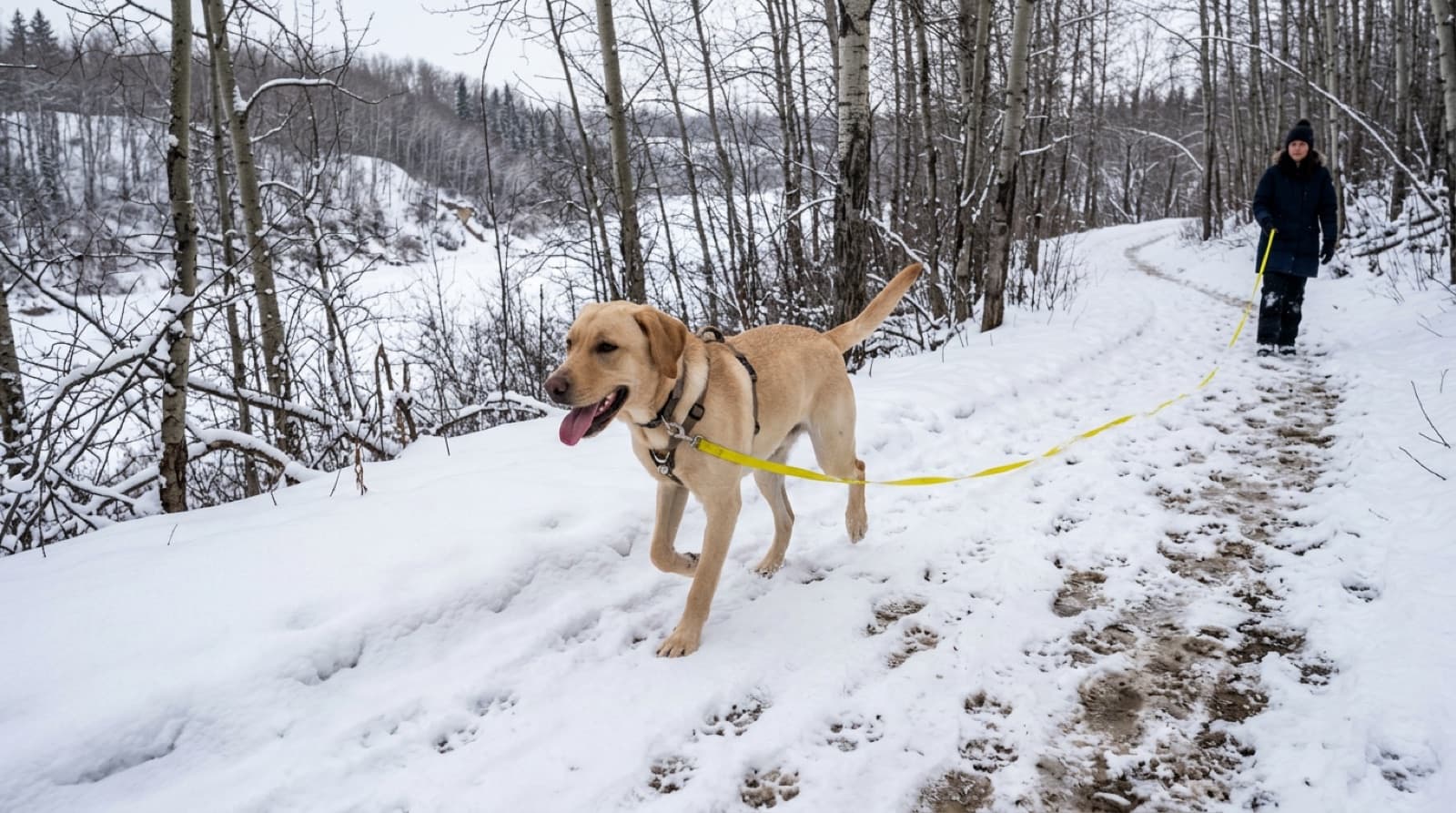
Edmonton Lab surrenders peak at 1 to 3 years
SCARS, Edmonton Humane Society, and Zoe's Animal Rescue all see Lab surrenders most weeks, and the surrendered dogs are overwhelmingly 1 to 3 years old. The pattern is consistent: owners survived puppy phase, completed basic obedience at 4 to 6 months, watched the dog respond well, then hit the adolescent regression at 8 to 10 months. The land shark returned at the same time. Counter-surfing started a month later. The owners concluded the dog was “out of control” and considered surrender.
The dog is teenagering. Lab adolescence is the longest of any common family breed, and the popular impression of “Labs are easy” only applies to the post-adolescent dog. The 6 to 18 month window is the chaos most owners do not know to expect. Surrendered Labs during this phase are heartbreaking because the dog is typically 12 to 18 months from the calm adult the owner adopted for.
This is also the phase when the aversive training industry markets hardest to Lab owners. The promised quick fixes through prong, e-collar, or alpha rollover do not solve adolescent regression; they elevate reactivity in a food-motivated breed and damage the relationship at exactly the wrong developmental moment.
The phase breakdown: 0 to 30 months
| Age | Phase | What to expect |
|---|---|---|
| 0 to 12 weeks | Puppy phase | Manageable energy, 18 to 20 hr/day sleep |
| 12 wks to 6 mo | Puppy chaos, land shark 1 | High energy, mouthing, basic training installs well |
| 6 to 18 mo | Adolescent chaos, land shark 2 | Peak destruction, counter-surfing emerges, leash and recall regression |
| 18 to 30 mo | Gradual maturation | Visible improvement, periods of regression continue |
| 30+ mo | Adult settling | Energy moderates, training holds, calm devoted adult emerges |
The reframe most Edmonton Lab owners need: a Lab is a 12-month puppy plus 12 to 24 months of adolescent challenge plus 8 to 12 years of calm devoted adult. The first 30 months are the price of admission for the next decade.
The land shark phase returns at 6 to 12 months
The land shark phase is Lab community shorthand for the prolonged biting, mouthing, and chomping period. It runs 8 to 16 weeks initially, then RETURNS in adolescence at 6 to 12 months with adult teeth and adult jaw force.
Why Labs are land sharks: bred as retrievers, Labs use their mouth as their primary tool for interacting with the world. Combined with high energy, food motivation, and excitement levels, this manifests as constant mouthing of hands, sleeves, ankles, furniture, and anything in reach.
The phases of Lab biting:
- 8 to 16 weeks: classic puppy mouthing, sharp small teeth, frequent contact with hands, requires bite inhibition training
- 16 to 24 weeks: typically reduces as adult teeth come in. Owners think the phase is over
- 6 to 12 MONTHS: land shark returns. Bite inhibition learned in puppyhood appears to vanish. Adolescent Lab uses adult teeth (much harder bite force) for play, frustration, and mouthing
- 12 to 18 months: gradually reduces if training is maintained
The land shark return catches most owners off guard because they thought the biting phase was done. The training response: re-establish bite inhibition consistently with yelp plus redirect, immediate timeout for hard bites, no rough housing for 6 to 12 months, and increased structured exercise to bleed off the over-arousal energy that drives the mouthing. Most Edmonton Labs respond within 4 to 8 weeks of consistent retraining.
Counter-surfing emerges at 12 to 18 months
Counter-surfing is the Lab specialty. The combination of tall-enough body, food-motivated genetics, and self-rewarding behaviour pattern makes prevention mandatory: one successful counter score creates a lifetime habit.
The food-motivation piece is partly genetic. Peer-reviewed research has linked a POMC gene variant common in Labrador Retrievers to reduced satiety signalling, which means the dog stays hungry longer after eating than other breeds do. Counter-surfing is the behavioural expression.
The Edmonton Lab counter-surfing protocol:
- Prevention first. Never leave food unattended on counters or tables. Even 30 seconds is enough for an adolescent Lab to score. The dog cannot rehearse the behaviour if there is nothing to steal.
- Counter management. Clear counters of everything interesting before stepping away. “Counter check” becomes muscle memory.
- Training alternatives. Train a “place” cue (dog goes to designated bed or mat during food prep). Reward heavily for staying out of the kitchen.
- Reliable “leave it” built in lower-distraction settings before deploying in the kitchen.
- Management tools. Baby gates blocking kitchen access during meal prep are effective and inexpensive.
- Never punish after the fact. The Lab cannot connect the punishment to the behaviour.
- Address underlying boredom. Under-exercised and under-stimulated Labs counter-surf more than well-tired ones.
The hard truth: counter-surfing is one of the hardest Lab behaviours to fully eliminate. Most Edmonton Lab owners manage it lifelong rather than fully extinguish it. Strict counter management plus training alternatives plus consistent prevention equals manageable.
Why Edmonton winter compounds Lab adolescence
An adolescent Lab needs 90 to 120 minutes of vigorous daily exercise. Edmonton January at -35 wind chill makes that physically unsafe for paw pads after about 20 minutes. The energy gap goes somewhere, and that somewhere is usually the furniture.
Three factors stack from November through March:
- Exercise volume drops. The 90-minute river-valley walk in October becomes a 30-minute neighbourhood loop in deep cold. The Environment and Climate Change Canada wind chill chart classifies -28 to -39 as “frostbite possible in 10 to 30 minutes” on exposed skin, which is a reasonable proxy for unprotected Lab paw pads on salted Edmonton sidewalks.
- Indoor time triples. The dog spends more hours per day in line-of-sight of chewable furniture and unattended counters.
- Holiday treats and family stress. December through January brings family visits, table scraps, schedule disruption, and a generally over-aroused household. All of it amplifies adolescent behaviour.
The Edmonton winter adolescent Lab survival protocol:
- Daily structured exercise non-negotiable. 60 to 90 minutes outdoor at -15C and warmer with paw protection (boots or musher's wax). Supplement with indoor exercise below -15C.
- Daycare 2 to 4 days per week. $35 to $55/day in Edmonton. This is the most successful adolescent Lab winter strategy. Mid-day exhaustion plus social interaction equals manageable evening Lab.
- Structured indoor enrichment. Frozen Kongs, snuffle mats, food puzzles, training sessions, scent games. Mental work tires Labs as much as physical work.
- Stair runs. Five to ten minute sessions multiple times daily. Indoor fetch in hallways with soft toys.
- Adolescent training class often runs year-round in Edmonton indoor facilities. Use winter as the training-class season.
- Schedule play dates with friends' adult dogs. Calmer dogs help adolescent Labs learn social regulation.
- Patience. By April and May the longer days return and the river valley reopens to longer walks. Winter adolescence is the hardest combination and it ends.
Reality check: if you adopted a Lab puppy in October, you are entering Edmonton winter with an adolescent Lab. This is the hardest scenario. Plan daycare plus training class plus indoor enrichment as essential, not optional.
Why aversive trainers are dangerous for adolescent Labs
The aversive training industry (“balanced” trainer, prong-and-e-collar coach, dominance consultant) markets hardest to owners during exactly the adolescent phase. The promised quick fixes do not solve adolescent regression.
Why aversive is worse for adolescent Labs specifically:
- Pain plus arousal in a food-motivated breed often produces redirected mouthing or escalated reactivity rather than the calm response the trainer promised.
- The adolescent brain is in active synaptic reorganisation; trauma during this window produces lasting fear and reactivity patterns.
- Aversive correction suppresses warning growls without changing the underlying state. The dog stops warning and goes straight to biting later.
- Damages the owner-dog relationship at exactly the wrong developmental moment.
- Sometimes appears to work short-term, then creates lasting problems that surface at 24 to 36 months.
The science is not Pawfinder editorial. The International Association of Animal Behaviour Consultants, the Certification Council for Professional Dog Trainers, and the American Veterinary Medical Association all carry position statements against aversive correction tools, citing elevated fear, aggression, and bite risk.
What force-free looks like: reward-based training with treats, praise, and play. No prong, no e-collar, no choke chain, no alpha rollover. Manages environment and builds alternative behaviours. Long-term solutions. Family-inclusive so kids can apply the same cues.
Certifications to look for in an Edmonton trainer: CCPDT, KPA, IAABC, or Fear Free Certified. Investment: $80 to $150 per private session, $200 to $400 for a 6-week adolescent group class. Total across the adolescent window: $480 to $1,500. The return is a well-mannered adult Lab versus the reactive Lab some owners report after aversive training. Edmonton rescues will share Edmonton force-free trainer recommendations during the foster phone screen.
Knocking over kids and grandparents
Lab body-slamming and jumping during over-excitement is a real Edmonton family safety concern, especially around toddlers and elderly relatives. An 80-pound adolescent Lab going full-speed at hip height is enough to knock down a grandparent or send a kid to urgent care.
Training protocol:
- “Four on the floor” greeting. Train alternative greeting behaviour. Calm sit equals pets and treats. Jumping equals no attention; the owner walks away. Strict consistency from ALL family members is the part that actually matters.
- “Place” cue. Train the Lab to go to a designated bed or mat when guests arrive. Practice with low-stimulation arrivals (family members coming home), build to high-stimulation (visiting kids, holiday parties).
- Management during high-risk periods. Leashed Lab with a controllable handler when toddlers visit. Baby gates separating the Lab from young children during peak excitement times.
- Never reward jumping behaviour. No pets, no eye contact, no talking to a jumping Lab. The instant they have four feet on the floor, attention returns.
- Exercise before high-stimulation events. Tired Lab is a calmer Lab. Run or walk before guests arrive.
- Force-free Edmonton trainer support if jumping persists past 18 months. $80 to $150 per private session.
- Seniors and elderly-visiting setup. Keep the Lab leashed or in another room during visits. Do not rely on training alone if grandma's safety depends on it.
The hard rule for Edmonton Lab families with kids: jumping and body-slamming behaviour must be addressed by 18 months. Adolescent Labs that have not learned greeting manners by 18 months tend to maintain the behaviour into adulthood.
Browse adoptable Labradors in Edmonton
The 1 to 3 year window is when most Lab surrenders happen, which is also when the adoption pipeline is fullest. Live Edmonton listings from SCARS, EHS, Zoe's, and the rest of the Edmonton network update regularly.
See Available Labradors →Frequently Asked Questions
When does a Labrador actually calm down?
Most Labs calm down meaningfully around 2 to 3 years old, which is the longest adolescence of any common family breed. The phase breakdown most Edmonton owners experience: 0 to 12 weeks is manageable puppy energy with 18 to 20 hours of sleep per day, 12 weeks to 6 months is puppy chaos and the first land shark phase, 6 to 18 months is adolescent chaos with land shark phase 2 plus peak destruction and counter-surfing emergence and leash plus recall regression, 18 to 30 months is gradual maturation with visible improvement and periodic regression, and 30+ months brings the adult settling where energy moderates and training holds. Some working-line or field-line Labs stay high-energy until 3 to 4 years. The reframe most Edmonton owners need: a Lab is a 12-month puppy plus 12 to 24 months of adolescent challenge plus 8 to 12 years of calm devoted adult. The first 30 months are the price of admission for the next decade.
What is the land shark phase and why does it return at 8 months?
The land shark phase is Lab community shorthand for the prolonged biting, mouthing, and chomping period that defines the breed. It runs 8 to 16 weeks initially, appears to resolve at 16 to 24 weeks as adult teeth come in, then RETURNS in adolescence at 6 to 12 months. The return catches most owners off guard because they assumed the puppy biting was done. The mechanism: adolescent Lab now has adult teeth and adult jaw strength, the bite inhibition installed in puppyhood is temporarily obscured by hormonal change, and play arousal escalates faster than impulse control has caught up. Training response: re-establish bite inhibition consistently with yelp plus redirect, immediate timeout for hard bites, no rough housing for 6 to 12 months, and increased structured exercise to bleed off the over-arousal energy that drives the mouthing. Most Edmonton Labs respond within 4 to 8 weeks of consistent retraining and the worst is past by 12 to 18 months.
Why does my Lab counter-surf and how do I stop it?
Counter-surfing is the Lab specialty. The combination is tall enough to reach kitchen counters at 12 to 18 months, food-motivated genetics (the POMC gene variant common in Labs reduces satiety signalling so the dog stays hungry), and self-rewarding behaviour pattern (one successful counter score creates a lifetime habit because eating the steak IS the reward, regardless of what you do next). The Edmonton Lab counter-surfing protocol: prevention first (never leave food unattended on counters or tables, even for 30 seconds), dedicated counter management (clear counters of everything interesting before stepping away), training alternatives (the "place" cue sending the Lab to a designated mat during food prep), reliable "leave it", baby gates blocking kitchen access during meal prep, and addressing underlying boredom because under-stimulated Labs counter-surf more. The hard truth: counter-surfing is one of the hardest Lab behaviours to fully eliminate. Most Edmonton Lab owners manage it lifelong rather than extinguish it. Strict counter management plus training alternatives plus consistent prevention equals manageable.
My Lab training disappeared at 8 months. What happened?
Adolescent regression. The dog has not forgotten the training; the dog is just not prioritising it the same way. The neurological mechanism: the adolescent brain undergoes major synaptic reorganisation between 8 and 18 months, hormonal changes shift attention and motivation, and biologically programmed independence-seeking emerges. The training response that works for Edmonton Labs: maintain existing cues rather than teaching new ones, run multiple short sessions per day (3 to 5 sessions of 5 to 10 minutes each) rather than one long session, pay-bump the rewards (cooked chicken, freeze-dried liver, salmon skin beat baseline kibble during adolescence), reduce free choice with a 10 to 15 metre biothane long-line on river-valley walks to prevent recall failure rehearsal, manage the environment to prevent failure rather than correcting after, accept the phase, and enrol in an adolescent training class with a force-free certified Edmonton trainer (CCPDT, KPA, IAABC, or Fear Free certification). Most Edmonton Labs return to roughly 80% of pre-adolescent training by 18 to 24 months and 95%+ by 24 to 30 months, IF the foundation is not damaged through repeated failure rehearsal during adolescence.
How do I survive Edmonton winter with an adolescent Lab?
Edmonton winter plus Lab adolescence is the perfect storm and it is the time of year most Edmonton Labs are surrendered. The factors stack: energy undersupply (an adolescent Lab needs 90 to 120 minutes of vigorous daily exercise, Edmonton winter limits outdoor time), destructive behaviour emerges from the under-exercise plus indoor confinement plus boredom combination, family stress builds with a homebound destructive Lab, and the river-valley off-leash zones become harder to use safely (deep snow, ice underfoot, paw pad cracking on salted sidewalks). The Edmonton winter adolescent Lab survival protocol: daily structured exercise non-negotiable (60 to 90 minutes outdoor at -15C and warmer with paw protection, supplement with indoor work below -15C), daycare 2 to 4 days per week is the most successful winter strategy ($35 to $55/day in Edmonton), structured indoor enrichment (frozen Kongs, snuffle mats, food puzzles, training sessions, scent games), stair runs as an indoor exercise rotation, indoor fetch in hallways with soft toys, ongoing adolescent training class, and patience because by April the longer days return.
How do I stop my Lab from knocking over kids and grandparents?
Lab body-slamming and jumping during over-excitement is a real Edmonton family safety concern, especially around toddlers and elderly relatives. The training protocol: train a "four on the floor" greeting where calm sit equals pets and treats but jumping equals no attention and the owner walks away (strict consistency from EVERY family member matters more than the cue itself), train a "place" cue sending the Lab to a designated mat when guests arrive (practice with low-stimulation arrivals before high-stimulation holiday gatherings), management during high-risk periods with the Lab leashed and handled when toddlers visit and baby gates separating the dog from young children during peak excitement times, never reward jumping behaviour (no pets, no eye contact, no talking to a jumping Lab), exercise before high-stimulation events because a tired Lab is a calmer Lab, and a force-free Edmonton trainer if jumping persists past 18 months ($80 to $150 per private session). The hard rule for Edmonton Lab families with kids: jumping and body-slamming must be addressed by 18 months. Labs that have not learned greeting manners by 18 months tend to maintain the behaviour into adulthood.
What about destructive chewing in adolescent Labs?
Destructive chewing is a major reason for Edmonton Lab surrenders during the 12 to 24 month window. The 12 to 18 month Lab destroys couch cushions, baseboards, shoes, books, and the corners of door frames, and the owner concludes the dog is "destroying everything" and considers surrender. The reality: this is normal adolescent Lab behaviour driven by boredom, lingering teething aftermath, lack of appropriate chew alternatives, and Edmonton winter indoor confinement amplifying every factor. The Edmonton protocol: environmental management (Lab in crate or pen when unsupervised, baby gates blocking high-value rooms, shoes and books and remotes put away), appropriate chew alternatives on rotation (frozen Kongs, beef tendons, Benebones, dental chews; avoid rawhide which carries choking and obstruction risk per veterinary consensus), daily exercise because most destructive chewing decreases dramatically with adequate physical and mental work, never punish after the fact (the Lab cannot connect the punishment to the behaviour), address separation anxiety if chewing happens primarily when the dog is alone (different problem, different protocol), and daycare during work hours preventing 8-hour stretches of unsupervised chewing temptation. Most destructive chewing resolves by 24 to 30 months.
Does the river-valley off-leash work for an adolescent Lab?
Yes, but with a long-line through the regression window. The Edmonton river-valley off-leash zones (Hawrelak south slope, Mill Creek Ravine, Whitemud Ravine, Terwillegar in calmer weather) are some of the best urban exercise routes in Canada and work well for Labs of all ages. The catch with adolescents: recall regression makes true off-leash unsafe between 8 and 18 months because Labs follow scent, follow other dogs, and follow the splash of geese on the river. A 10 to 15 metre biothane long-line in the off-leash zone gives the Lab enough freedom to bleed off energy while preventing the recall-failure rehearsal that makes the regression worse. Edmonton Bylaw 21244 requires dogs to be under voice or visual control even in designated off-leash zones; the fine for failing to control a dog is $250. Bylaw officers patrol the river-valley parks. The honest pattern most Edmonton Lab owners settle on is long-line through the adolescent window, then gradual return to true off-leash from 24 months onward in low-distraction times.
Should I use a prong, e-collar, or balanced trainer to fix the adolescent Lab?
No. The aversive training industry markets hardest to owners during exactly this phase, promising fast fixes through prong collars, e-collars, alpha rolls, and leash corrections. Peer-reviewed research on dog training methods is consistent: aversive correction tools elevate fear, aggression, and bite risk in dogs across breeds, and the elevation is particularly notable in food-motivated breeds where reward-based training has a strong baseline already. The mechanism that makes aversive worse for adolescent Labs specifically: pain plus arousal in a dog with strong food drive often produces redirected mouthing or escalated reactivity rather than the calm response the trainer promised. Force-free trainers carrying CCPDT, KPA, IAABC, or Fear Free certification handle adolescent Lab cases well. Edmonton has multiple force-free certified trainers; the Edmonton rescues will share recommendations during the foster phone screen. Expect $80 to $150 per private session over 6 to 10 sessions during the peak adolescent phase, total $480 to $1,500. The return is a well-mannered adult Lab versus the reactive Lab some owners report after aversive training.
When should I escalate to a force-free trainer for an adolescent Lab?
Most Edmonton Lab owners benefit from a force-free certified trainer by 8 to 10 months regardless of how the dog is behaving, because that is when the adolescent regression is starting and proactive professional support shortens the chaos window. Escalate sooner if any of these emerge: bites that break skin (even during play), resource guarding around food or toys, fear-based reactions to specific triggers (men in hats, other dogs, vacuum, doorbell), destructive behaviour that does not respond to environmental management and exercise volume, recall failure in moderate-distraction environments, or any new behaviour that surprised you and feels like it is escalating. Investment: $80 to $150 per private session, group classes $200 to $400 for a 6-week adolescent class. The Edmonton rescues will share trainer recommendations during the foster phone screen. Verify CCPDT, KPA, IAABC, or Fear Free certification before booking, and walk away from any trainer who recommends prong, e-collar, choke chain, or alpha rollover.
How is rescue Lab adolescence different from puppy adolescence?
Two main differences. First, rescue Labs often arrive with training gaps that were never installed in the first place rather than regressed training that needs re-accessing. The 14-month Lab who came to Edmonton through SCARS, Edmonton Humane Society, or Zoe's Animal Rescue may not have had a structured "puppy classes" phase at 12 to 16 weeks, which means bite inhibition, leash manners, and "place" cue need to be installed during adolescence rather than refined. Second, rescue Labs are simultaneously going through the 3-3-3 adjustment phase (3 days to decompress, 3 weeks to settle into routine, 3 months to fully bond) on top of adolescence. The two phases overlap and amplify each other through the first 3 to 6 months in the new home. What helps: predictable daily routine, environmental management first (crate, baby gates, leash inside near doors), force-free training that does not assume previous training is intact, a vet check to rule out medical contributors to behaviour, and ongoing support from the rescue. Edmonton rescues prefer return over crisis surrender 6 to 12 months later; the return is not failure, it is an honest acknowledgment that the fit is not right.
Bottom line, can I survive Edmonton Lab adolescence?
Yes, with realistic expectations. Most Edmonton Lab surrenders are 1 to 3 years old, exactly the difficult adolescent window. Plan accordingly: daycare during work hours through the worst months, force-free trainer relationship by month 8, environmental management for counter-surfing and chewing, a real Edmonton winter exercise plan that leans on indoor enrichment when the river valley is too cold, and patience for the regression. The dogs that get adopted at 4+ tend to stay in their forever homes because they are past the chaos. Senior Lab alternative: a senior Lab (8 years and up) from SCARS, Edmonton Humane Society, or Zoe's Animal Rescue skips adolescence entirely. Lifespan of 10 to 14 years for the breed means a meaningful 4 to 6 year companionship with a dog who is calm, often house-trained, and frequently overlooked at the shelter. For first-time Lab owners or families without bandwidth for the adolescent phase, the senior route is the honest recommendation.
Adoptable Labradors in Edmonton
Live listings from SCARS, Edmonton Humane Society, Zoe's, GEARS, and the rest of the Edmonton rescue network.
Labrador Adoption Edmonton
Rescue pipelines, adoption fees, working-line vs English-line, family-fit reality.
What to Feed a Labrador: Food, Diet & Portions
What to feed a Labrador: how to choose a food, large-breed puppy formula, portions for a breed built to overeat, the raw-diet truth, and foods to avoid.
Labrador Water & Ice Safety Edmonton
North Saskatchewan River, ice-break season, water rescue gear, summer swim spots.
New dog? Start with these care guides
Everything a new adopter needs to set up a safe, happy home.