The short answer
Both are excellent. Pick a Labrador if you want shorter coat (less grooming time), 60 to 90 min daily exercise capacity, faster Edmonton rescue access (Labs are the most common breed across SCARS, EHS, Zoe's, AARCS Edmonton), or lower breeder pricing ($1,500 to $3,500). Pick a Golden Retriever if you want slightly lower exercise demands (45 to 60 min daily), prefer the longer coat (accepting $60 to $120 professional grooming every 8 to 12 weeks), and have pet insurance ready from week one. The defining health concerns differ sharply: Lab obesity epidemic (60%+ rate; POMC gene mutation in ~25% of Labs disrupts satiety) vs Golden lifetime cancer rate (60% per Morris Animal Foundation lifetime study). Both lifespan 10 to 12 years. Both handle Edmonton winters comfortably.
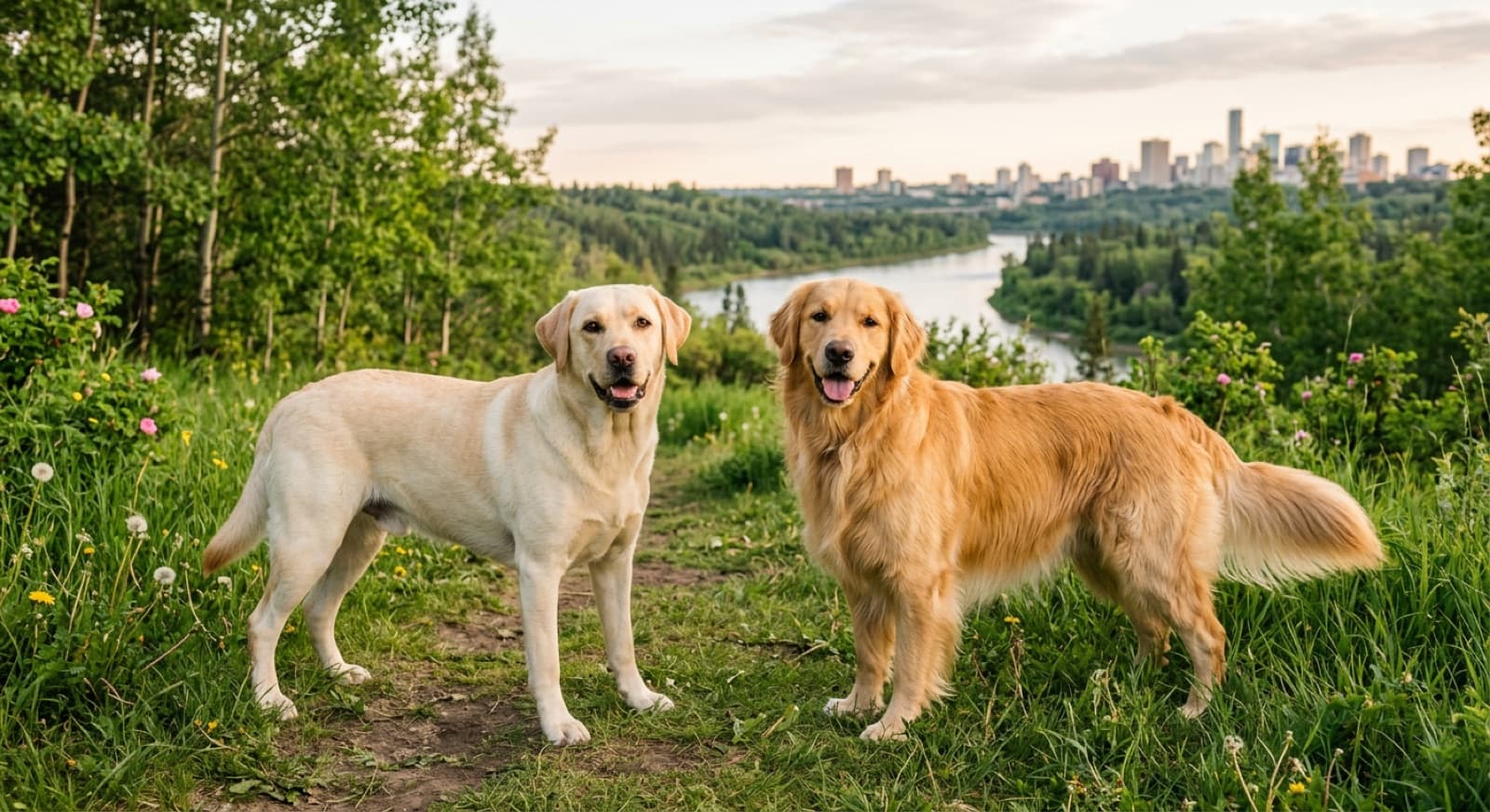
Side-by-side comparison
| Feature | Labrador Retriever | Golden Retriever |
|---|---|---|
| Adult weight | 55 to 80 lbs | 55 to 75 lbs |
| Coat | Short double coat | Long feathered double coat |
| Colours | Black, yellow, chocolate | Light to dark gold; English Cream |
| Daily exercise | 60 to 90 minutes | 45 to 60 minutes |
| Home grooming | 10 to 15 min weekly + coat-blow seasons | 1 to 2 hr weekly + coat-blow seasons |
| Professional grooming | Optional, $40 to $70 | Every 8 to 12 weeks, $60 to $120 |
| Defining health concern | Obesity (60%+ rate; POMC gene) | Cancer (60% lifetime mortality) |
| Lifespan | 10 to 12 years | 10 to 12 years |
| Edmonton rescue availability | High (most common breed) | Lower (places quickly when listed) |
| Rescue adoption fee | $300 to $700 | $300 to $700 |
| Ethical breeder pricing | $1,500 to $3,500 | $2,000 to $4,500 (Cream $4,500 to $8,000+) |
Individual variation within each breed is substantial. Foster-home observation matters more than breed averages for matching a specific dog to your household.
The health story that drives the choice
Each breed has a defining lifetime health concern. The Labrador faces an obesity epidemic driven partly by genetics. The Golden faces the highest cancer rate of any breed. Both demand pet insurance enrolled within the first weeks of adoption.
Labrador: obesity epidemic. Veterinary studies report adult Labrador obesity rates over 60%, the highest of any breed. Research published in Cell Metabolism identified a POMC (proopiomelanocortin) gene mutation present in roughly 25% of Labs that disrupts the satiety signal, leaving affected dogs feeling chronically hungry. Obesity cascades into hip and elbow dysplasia (already a breed risk), cruciate ligament tears, diabetes, exercise intolerance, and shortened lifespan. Lean-body-condition management is the entire breed-care strategy: strict portion control, measured feeding (no free-feeding), Body Condition Score 4 of 9 (you can feel ribs without pressing), and regular weight checks. Edmonton specialty veterinary orthopedics handles dysplasia and cruciate surgery; complex cases refer to WCVM Saskatoon.
Golden: lifetime cancer rate. The Morris Animal Foundation Golden Retriever Lifetime Study tracks over 3,000 Goldens across their lifetimes. Findings document a 60% lifetime cancer mortality rate, the highest of any breed. Common cancers include hemangiosarcoma (spleen, heart; often catastrophic and fast-moving), lymphoma (often treatable with chemotherapy), mast cell tumours, and osteosarcoma. Owners cannot meaningfully prevent the breed predisposition but pet insurance enrolled at adoption covers the financial side; hemangiosarcoma diagnosis to treatment can run $5,000 to $15,000. Edmonton oncology specialty referrals work alongside primary vet care; WCVM Saskatoon handles complex protocols. Quality-of-life decisions are part of senior Golden ownership.
Shared concerns: hip and elbow dysplasia (both breeds), chronic ear infections (drop-eared breeds with humid ear canals; weekly check and clean), bloat/GDV (both breeds; large deep-chested dogs), allergies (both breeds), hypothyroidism. Both breeds benefit from OFA hip and elbow certification of the parents if buying from a breeder.
Browse adoptable Labs and Goldens in Edmonton
Both breeds appear in Edmonton rescue (Labs more frequently than Goldens). Open the search to either breed to find a match faster.
See Available Dogs →Exercise and grooming reality
Exercise: Labs typically need 60 to 90 minutes of structured daily activity; Goldens typically need 45 to 60 minutes. Both require genuine activity (walking, off-leash play, fetch, swimming) not just yard time. Both benefit from mental enrichment (food puzzles, scent work, training refreshers, supervised explore time).
Edmonton off-leash dog areas suit both breeds year-round. Hawrelak Park, Terwillegar Park, Mill Creek Ravine, Whitemud Ravine, Buena Vista Park all welcome both retrievers; both love water and the North Saskatchewan River swim spots are a summer highlight. Winter -25C wind chill requires modified routines for both breeds: shorter outdoor durations, indoor enrichment substitution, paw protection (booties or paw balm), salt-free routes where possible.
Grooming. The bigger practical difference. Labs need weekly brushing with a deshedding tool (10 to 15 min sessions) plus bath every 6 to 8 weeks. Annual coat blow in spring and fall is significant (about 2 weeks of heavy shed each season). Professional grooming is optional ($40 to $70 if used).
Goldens need 1 to 2 hours of weekly home brushing plus professional grooming every 8 to 12 weeks ($60 to $120 at an Edmonton professional groomer). Mat prevention matters behind ears, in armpits, and tail feathering. Annual coat blow is similar timing to Labs but more dramatic visually. Ear care is critical for both breeds (weekly check and clean as needed). The grooming time investment difference is real: a Golden owner accepts roughly an extra hour per week in grooming time plus four to six professional appointments per year over a Lab owner.
Edmonton rescue availability
Labs and Lab mixes are substantially more available than Golden Retrievers in Edmonton rescue. SCARS intakes Labs and Lab crosses regularly from northern Alberta communities. Edmonton Humane Society sees Labs frequently. Zoe's Animal Rescue and AARCS Edmonton fosters also list Labs steadily. Common Lab mixes include Lab-Shepherd, Lab-Husky, Lab-Border Collie, and Lab-Pit Bull crosses.
Goldens appear less often in Edmonton rescue: they are highly desired by adopters, breeders meet some demand, and when one does land in rescue the application volume is heavy. Goldendoodle (Golden + Poodle) and Goldador (Lab + Golden) crosses appear more often than purebred Goldens.
Practical implication: open the search to either breed and you place faster than holding out for one specific breed. Many Edmonton families end up adopting a Lab-Golden mix or a Lab-Shepherd cross that combines retriever traits with adjacent influence.
Frequently Asked Questions
Which is better for Edmonton families: Labrador or Golden Retriever?
Both are top-3 family breeds in Canada and either makes an excellent Edmonton family dog. The honest tiebreakers: choose a Labrador if you want slightly higher energy (60 to 90 min daily exercise), shorter coat (less grooming time and lower professional grooming costs), faster Edmonton rescue availability (Labs are the most-common breed across SCARS, Edmonton Humane Society, Zoe's Animal Rescue, and AARCS Edmonton fosters), and lower breeder pricing ($1,500 to $3,500). Choose a Golden Retriever if you want slightly lower exercise demands (45 to 60 min daily), prefer the longer coat aesthetic (accepting weekly brushing plus $60 to $120 professional grooming every 8 to 12 weeks), and do not mind a slightly longer Edmonton rescue search (Goldens move quickly when listed). Both share friendly child-compatible temperaments, high trainability, water-loving instincts, and good Edmonton winter tolerance. Both lifespan 10 to 12 years.
What are the main health differences between Labradors and Golden Retrievers?
Each breed has a defining lifetime health issue and they are quite different. Labradors face a documented obesity epidemic: studies from veterinary teaching hospitals report obesity rates over 60% in adult Labs, the highest of any breed. The driver is partly a POMC (proopiomelanocortin) gene mutation present in roughly 25% of Labrador Retrievers, which disrupts the satiety signal so affected dogs feel chronically hungry. Obesity then cascades into hip and elbow dysplasia, cruciate ligament tears, diabetes, exercise intolerance, and shortened lifespan. Golden Retrievers face the highest cancer rate of any breed: the Morris Animal Foundation Golden Retriever Lifetime Study (tracking over 3,000 Goldens) documents a 60% lifetime cancer mortality rate. Common cancers include hemangiosarcoma (spleen, heart), lymphoma, mast cell tumours, and osteosarcoma. Both breeds also share hip and elbow dysplasia risk (build a relationship with an Edmonton orthopedic specialist if your dog ages into hip issues, with referrals to WCVM Saskatoon for complex cases) and chronic ear infections (drop-eared breeds with high humidity in the ear canal). Both 10 to 12 year lifespans. Pet insurance enrolled within the first weeks of adoption is essential for both because pre-existing condition exclusions are strict in Alberta.
Which breed handles Edmonton winters better?
Both handle Edmonton winter comfortably. Both were bred for cold-water retrieving (Labs from Newfoundland coastal waters; Goldens from Scottish Highland streams), so cold tolerance is built into the breed standard. The Golden has a slight edge in extreme cold (-30C and colder) due to a thicker double coat with longer outer guard hairs. The Lab has a slight edge in summer (the shorter coat sheds less heat retention). Both happily play in snow at -10C to -20C without jackets for healthy adults. Both need indoor exercise alternatives during -30C cold snaps and Edmonton wind chill advisories; daily walks beyond 20 minutes in -25C wind chill require paw protection (booties or paw balm), salt-free routes where possible, and shorter durations. Edmonton off-leash river-valley dog areas (Hawrelak Park, Terwillegar Park, Mill Creek Ravine, Whitemud Ravine, Buena Vista Park) suit both breeds; both love water and the North Saskatchewan River swim spots in summer are equally welcome to both. Edmonton verdict: both excellent, choose on other factors.
Which is more available in Edmonton rescue?
Labs and Lab mixes are substantially more available than Golden Retrievers. SCARS (Second Chance Animal Rescue Society) intakes Labs and Lab crosses regularly from northern Alberta communities including some First Nations partnership work; the breed accounts for a meaningful share of any given week's inventory. Edmonton Humane Society sees Labs frequently. Zoe's Animal Rescue and AARCS Edmonton fosters also list Labs steadily. Goldens by comparison appear less often in rescue: they are highly desired by adopters, breeders meet some demand, and when one does land in rescue the application volume is typically heavy and the dog places quickly. Common Lab mixes in Edmonton rescue include Lab-Shepherd, Lab-Husky, Lab-Border Collie, and Lab-Pit Bull crosses. Golden mixes appear less often but Goldendoodle (Golden + Poodle) and Goldador (Lab + Golden) crosses do show up. Practical implication: open the search to either breed and you place faster than holding out for one specific breed.
Which has lower adoption and ownership cost in Edmonton?
Both have similar Edmonton rescue adoption fees of $300 to $700 covering spay/neuter, vaccinations, microchip, and a baseline vet workup. Breeder pricing diverges: ethical Labrador breeders in Alberta typically price $1,500 to $3,500 for a properly health-tested puppy; ethical Golden Retriever breeders price $2,000 to $4,500, with the English Cream Golden Retriever subset commanding $4,500 to $8,000+. Annual ownership cost is similar for both breeds: $1,800 to $3,500 covering quality large-breed food ($600 to $1,200), routine veterinary care ($400 to $800), pet insurance ($500 to $1,200), Edmonton dog licence ($25 to $50 per Bylaw 21244), winter gear (booties, jackets for senior dogs or short-coat damage), and supplies. The Golden has slightly higher ongoing grooming costs ($60 to $120 every 8 to 12 weeks at an Edmonton professional groomer plus heavier home brushing) that add roughly $400 to $700 per year over a Lab. Lifetime cost difference between the two breeds is modest; pet insurance handles the bigger swing (cancer treatment for a Golden hemangiosarcoma diagnosis can run $5,000 to $15,000, similar range to advanced orthopedic surgery for an obesity-driven Lab cruciate tear).
Should I get a Lab or Golden puppy or an adult?
For most Edmonton families, an adult (1 to 7 years) of either breed is significantly easier than a puppy of either. Adolescence (8 to 30 months) is intense for both: chewing, mouthing, jumping, training overwhelm, energy spikes, recall regression. Adult dogs from rescues have established temperaments, are typically house-trained, and have moved past the worst adolescence phase. Foster-home temperament notes from SCARS, EHS, Zoe's, AHHRB, and AARCS Edmonton are invaluable for matching dog to household. If you specifically want a puppy: Labs appear in Edmonton rescues more often as puppies than Goldens do. Both rescue puppy fees: $300 to $700. Both breeder puppies require the same essentials regardless of breed: large-breed puppy food (controlled growth), limited high-impact exercise until growth plates close (~14 to 18 months), early force-free training (CCPDT, KPA, IAABC, or Fear Free certified Edmonton trainer) starting at 8 to 10 weeks. Many Edmonton adopters open the search to either breed to find a match faster.
How do exercise needs compare?
Both are active retrievers needing genuine daily exercise. Labradors typically need 60 to 90 minutes of structured activity daily: walking, off-leash play, fetch, swimming, scent games. The breed was developed for endurance retrieving across cold water; modern Labs retain the energy even if not working. Golden Retrievers typically need 45 to 60 minutes of daily activity, slightly less intensive than Labs on average. Both benefit from mental enrichment: food puzzles, basic obedience refreshers, scent work, supervised explore time. Both excel at dog sports if temperament suits (rally, dock diving, scent work, obedience trials). Edmonton infrastructure: both breeds thrive at Hawrelak, Terwillegar, Mill Creek, Whitemud, and Buena Vista off-leash areas year-round. Summer water access on the North Saskatchewan River is a highlight for both. Winter -25C cold snaps require modified routines for both: shorter outdoor durations, indoor enrichment substitution, paw protection. A bored under-exercised Lab in a small condo through January is the classic Edmonton surrender story; the same is true for an under-exercised Golden but slightly less common because the breed is less driven on average.
How do grooming needs compare?
Substantial difference here. Labradors have a short double coat, brush weekly with a deshedding tool (Furminator or undercoat rake), bath every 6 to 8 weeks. Annual coat blow in spring and fall is significant (about 2 weeks of heavy shed each season), other times shedding is light to moderate. Professional grooming is optional for Labs (nails, ear clean, anal glands) at roughly $40 to $70 per visit if used. Total Lab home grooming time: 10 to 15 minutes per week plus coat-blow seasons. Golden Retrievers have a longer double coat requiring weekly brushing (30 to 45 min sessions) and professional grooming every 8 to 12 weeks at $60 to $120 per visit at an Edmonton groomer. Mat prevention is a real consideration, particularly behind ears, in armpits, and tail feathering. Annual coat blow is similar to Labs but the longer coat means more dramatic shedding visually. Bath every 6 to 8 weeks at home or with the groomer. Ear care is critical for both (drop-eared breeds with chronic ear infection risk); weekly ear check and clean as needed. Nails trim or grind every 3 to 4 weeks for both. Total Golden grooming time: 1 to 2 hours of home brushing per week plus professional appointments.
What about temperament differences?
Both breeds rank in the top 3 of friendliness, child-compatibility, and trainability for North American dog breeds. Both were developed as soft-mouth retrievers working closely with hunters and have generations of breeding for cooperative human-focused temperament. Subtle differences within the shared friendly base: Labradors are typically slightly more outgoing and exuberant; the Lab "everyone is my friend" energy can be overwhelming to small children, elderly visitors, or other dogs who prefer reserved greetings. Goldens are typically slightly more gentle and measured; the breed often reads household mood and adjusts. Both are exceptionally trainable. Both have very high prey drive in some bloodlines (squirrels, rabbits, ground birds); off-leash recall reliability needs structured training. Both are velcro dogs that bond intensely with family; separation anxiety risk is real for both if early independence training is skipped. Both are NOT guard dogs and will typically greet intruders warmly. Both are excellent with children when introduced properly; both can knock toddlers down by accident with sheer enthusiasm during adolescence. Foster-home observation from Edmonton rescue is the best predictor of any specific dog's temperament regardless of breed.
What is a Goldador and is it common in Edmonton rescue?
A Goldador is the deliberate or accidental cross between a Labrador and a Golden Retriever. They typically weigh 60 to 80 lbs (between Lab and Golden), have a medium-length coat (lighter than a Golden, longer than a Lab), and live 10 to 12 years. Goldadors often combine the best of both: the Lab's playful athletic energy and the Golden's gentle measured temperament. They can be easier to live with than either purebred for some households because the Golden parent moderates Lab adolescent intensity and the Lab parent moderates Golden velcro tendencies. Health risks are inherited from BOTH parents, however: obesity risk from the Lab line, cancer risk from the Golden line, hip and elbow dysplasia from both. Pet insurance enrolled early is just as important as for either purebred. Edmonton rescue presence: Goldadors appear in SCARS, EHS, and AARCS Edmonton inventory occasionally; not as common as Lab crosses (Lab-Shepherd, Lab-Husky) but more common than purebred Goldens. Adoption fees match the purebreds: $300 to $700.
Are Labs or Goldens better as first dogs for Edmonton families?
Both are excellent first-dog choices and both are commonly recommended to first-time owners by trainers and rescues. Both have forgiving temperaments that tolerate first-time owner mistakes. Both are highly trainable so first owners can build a real training relationship without specialist experience. The honest considerations for first-time owners: Lab adolescence is more intense than Golden adolescence on average; the 8 to 24 month phase of a Lab can stress a first-time owner who underestimated energy and training requirements. A Golden tends to be slightly more biddable through adolescence. Both breeds will surrender to rescue if first-time owners underestimate exercise commitment, training time investment, and the impact of grooming (especially with Goldens). Edmonton support resources: book a force-free trainer (CCPDT, KPA, IAABC, or Fear Free certified) within 4 weeks of bringing the dog home; budget 1 to 2 group classes through the first 12 months for socialisation and structure. Foster-home temperament notes are gold for first-time owners; ask the rescue specifically about which dogs match a less-experienced household.
Bottom line for Edmonton families?
Both Labradors and Golden Retrievers are among the best family dog choices available in Edmonton rescue. The differences (exercise needs, grooming time, signature health concerns, breed availability, breeder cost) matter for matching the dog to your specific household but neither breed is meaningfully better than the other for most Edmonton families. Pick Labrador if: you want shorter coat with less grooming time, you have a slightly more active lifestyle with 60 to 90 min daily exercise capacity, you want faster Edmonton rescue access, you are budget-conscious on breeder pricing, you can commit to lean-body-condition management (POMC gene mutation means strict portion control matters). Pick Golden Retriever if: you want the longer coat aesthetic and accept the grooming time investment, you have slightly lower daily exercise capacity (45 to 60 min), you are willing to wait a bit longer for Edmonton rescue availability, you have pet insurance enrolled from week one (Golden cancer risk is significant). Pick either if: open to both speeds the rescue match substantially. Adult Lab or Golden from Edmonton rescue (3+ years) skips the most intense adolescent phase for either breed; foster-home temperament notes from SCARS, EHS, Zoe's, AHHRB, or AARCS Edmonton are the most reliable predictor of household fit.
Adoptable Dogs in Edmonton
Live listings from SCARS, Edmonton Humane Society, Zoe's, AHHRB, and AARCS Edmonton fosters.
Labrador Retriever Adoption Edmonton
Rescue pipelines, costs, family fit, the obesity-management reality.
What to Feed a Labrador: Food, Diet & Portions
What to feed a Labrador: how to choose a food, large-breed puppy formula, portions for a breed built to overeat, the raw-diet truth, and foods to avoid.
Labrador Adolescence Survival Edmonton
Surviving the 8 to 30 month phase: training, energy management, force-free trainers.
New dog? Start with these care guides
Everything a new adopter needs to set up a safe, happy home.