The short answer
Professional groom every four to six weeks, daily beard wipe, weekly brushing at home. The Mini Schnauzer has a wiry double coat plus signature furnishings (beard, eyebrows, skirt, leg feathering) that drive a more involved routine than the body alone suggests. Hand-stripping preserves the harsh wiry texture and salt-and-pepper colour the breed standard describes; clipping is faster, cheaper, and what most Edmonton pet Mini Schnauzers receive. Plan on $70 to $110 every four to six weeks for a full clip, plus daily beard care, weekly brushing of leg furnishings, and a humidifier through Edmonton's dry winter months.
How the Mini Schnauzer coat actually works
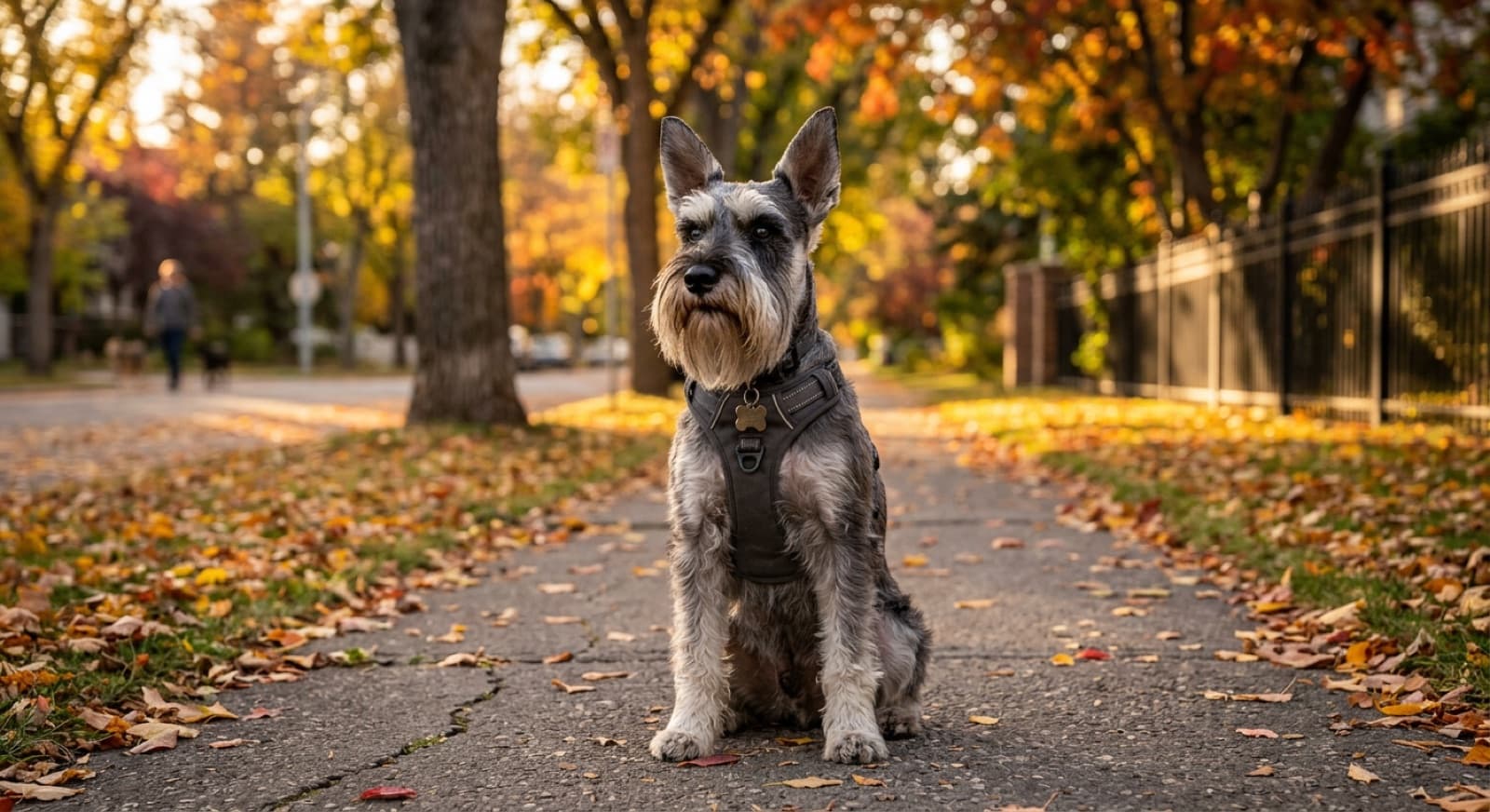
A Mini Schnauzer has a double coat: a harsh, wiry topcoat over a softer, denser undercoat. The two layers work together. The wiry topcoat sheds water, deflects dirt, and protects the skin. The undercoat traps body warmth and provides insulation. The breed was developed as a German farm ratter, and the coat reflects that work: a practical, weatherproof, low-shedding double layer that allowed the dog to move through barns and fields without picking up burrs and water like a single-coated breed would.
The Canadian Kennel Club Miniature Schnauzer breed standard describes the coat as a double coat with a hard, wiry outer coat and a close undercoat. The standard also describes the head furnishings (the beard and eyebrows) as fairly long and the body and head colour as salt and pepper, black and silver, or solid black, with the leg and head furnishings often appearing lighter than the body. That description matters because it tells you what the coat is built to look and feel like, and what a correctly groomed Mini Schnauzer should present.
Two practical things follow. First, the wiry double coat is low-shedding, which is why allergy-sensitive adopters often look at Mini Schnauzers (the breed sheds substantially less than a Lab or a Golden, though no dog is truly hypoallergenic). Second, the coat needs more than a body clip to look right. The signature features (beard, eyebrows, leg furnishings, body furnishings on the skirt and belly) all need their own care routine. A Mini Schnauzer that has been groomed with only a body clip and no face shaping looks like a generic small terrier, not a Schnauzer.
Hand-stripping vs clipping: the big decision
The first grooming decision for a new Mini Schnauzer owner is how the coat is going to be maintained. There are two methods and they produce visibly different results.
Hand-stripping is the traditional method. Dead harsh topcoat hair is plucked out by hand or with a stripping knife, allowing new harsh hair to grow in. The undercoat stays untouched. Done correctly, hand-stripping preserves the wiry texture, the colour intensity and pattern, and the weather-resistant feel the standard describes. The work is slow, the salon needs the experience and the equipment, and the cost runs higher. A hand-stripping session takes ninety minutes to two hours and runs $140 to $250 at an Edmonton hand-stripping-experienced salon. The interval is usually every eight to twelve weeks for a full strip, with shorter touch-up sessions or daily rolling work in between. Hand-stripping is what conformation show Schnauzers receive, and it is what owners who want the breed-correct coat texture and colour opt into.
Clipping uses electric clippers to shorten the coat to a uniform length, usually around half an inch on the body. The cut is fast, available at almost every Edmonton groomer, and runs $70 to $110 every four to six weeks. The trade-off is that clippers cut topcoat and undercoat together at the same line. Over months and years the texture softens, the colour fades toward grey, and the weather-resistant harsh feel diminishes. For a pet dog this is purely cosmetic. It does not hurt the dog, does not affect skin health, and does not change the coat's practical function in any meaningful way. The dog still sheds minimally, still handles Edmonton weather well, and still looks like a Schnauzer to most people.
Which is right for you? For nearly every Edmonton pet Mini Schnauzer, clipping is the practical answer. Hand-stripping requires an experienced salon (not every groomer offers it), costs more per session, and most pet owners cannot tell the texture difference after a few months anyway. If you want the show-correct coat, want the colour pattern preserved long-term, or plan to show your dog, hand-stripping is the correct choice and worth seeking out the salon experience. Otherwise, ask for a clean Schnauzer pattern clip at a breed-knowledgeable salon and move on.
One nuance. Many salons offer a hybrid approach where the body is clipped but the head, beard, eyebrows, and leg furnishings are scissor-finished by hand. This is the standard pet Schnauzer routine and gives you most of the visual breed character at the clipped price point. If the groomer skips the scissor face work and just runs clippers across the head, the Schnauzer look is gone. That is the question to ask when booking: do you scissor-finish the face?
What a professional Edmonton groom includes
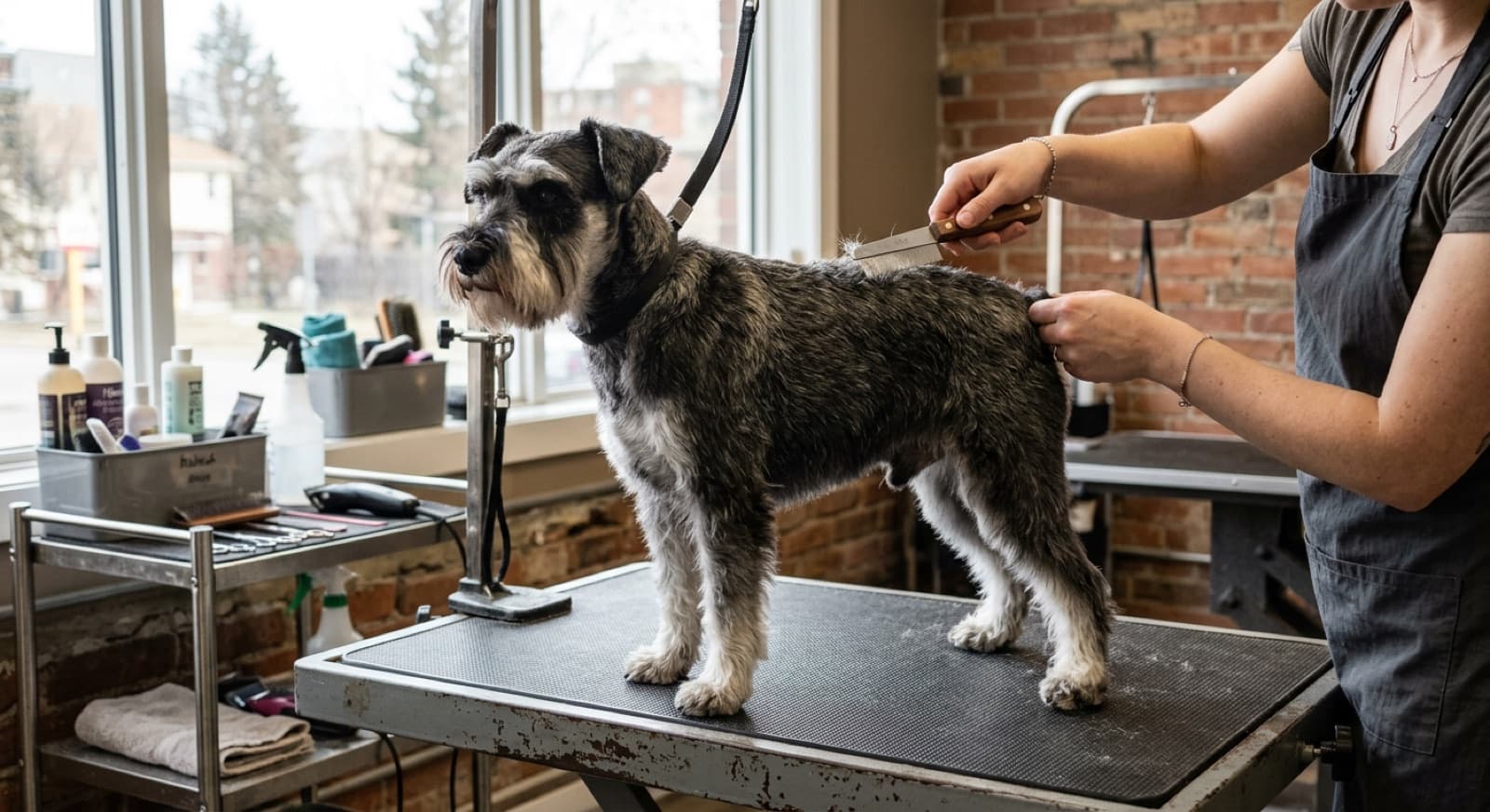
A full professional clip groom for an Edmonton Mini Schnauzer includes a bath, blow-dry, full brush-out of the leg furnishings and skirt, clipper body work, scissor face shaping (beard, eyebrows, rectangular head silhouette), sanitary trim, paw-pad trim, ear cleaning, and nail trim. Total time is usually ninety minutes to two and a half hours, depending on coat condition and the dog's tolerance.
The body clip runs about half an inch in length on a standard pet Schnauzer pattern. The hindquarters and tail are clipped short. The shoulders and back are clipped short. The skirt (the longer hair along the belly and lower flanks) is left longer, scissor-blended into the shorter body clip. The leg furnishings on all four legs stay long and are scissored to a clean column shape. The chest is clipped short and the front leg furnishings are scissored down to a clean fall. Done well, the result is a clean rectangle when viewed from the side, with the long head furnishings (beard, eyebrows) and the long leg columns providing the silhouette the breed is known for.
The face is the make-or-break part of the visit. The beard is washed, conditioned, and combed forward. The eyebrows are combed forward and scissor-shaped to fall slightly to the side, framing the eyes without dropping into them. The head is shaped to give a rectangular profile when viewed from the side, with a clear stop above the eyes and the muzzle continuing the rectangle forward. A groomer who scissor-finishes the face well is the difference between a Schnauzer that looks like the breed standard and a Schnauzer that looks like a generic small terrier with long face hair.
The signature beard: daily wipes and weekly comb
The beard is the most recognisable Mini Schnauzer feature and the most demanding part of the home routine. It is also a sponge for food, water, drool, and whatever the dog sniffs through. Without daily attention the beard mats near the chin, yellows around the mouth, and can develop low-grade skin irritation underneath where moisture stays trapped.
The daily routine is short. After each meal and after every long drink, wipe the beard with a damp cloth and then dry with a clean towel. Combing the beard through once a day with a fine metal comb lifts any debris and catches early mats near the chin before they tighten. Once a week, a deeper comb-out from skin outward catches anything the daily quick combs missed.
At bath time, work a gentle dog shampoo through the beard, scrub the chin and lip-line areas thoroughly, and rinse until the water runs completely clear. Shampoo residue causes itching and skin redness under the beard, and the residue is harder to detect under thick beard hair than on body coat. A light conditioner pass on the beard after shampoo adds slip and reduces mat formation between baths.
Beard yellowing between grooms is normal and mostly cosmetic. The cause is a combination of dried saliva, food residue, water mineral content, and the dog's own porphyrin pigments. Daily wiping reduces it substantially. If you want to brighten the beard for a special occasion, a dog-safe whitening shampoo works as a localised wash on the beard followed by a thorough rinse, but do not use it daily because over-washing dries the skin underneath. Some Mini Schnauzer owners keep the beard trimmed shorter for easier maintenance, which is a perfectly reasonable trade-off if daily wipes are not realistic in your household. The breed character holds even with a shorter beard, as long as the eyebrows and the leg furnishings are still groomed in pattern.
The signature eyebrows: scissor work and eye protection
The Schnauzer eyebrow is sculpted, not just left long. The correct shape is full and forward, slightly angled toward the outside of the face, framing the eye without dropping into it. The brow is meant to draw attention to the dog's direct gaze, which was part of the working farm dog character: alert, focused, watchful.
Most of the eyebrow work is the groomer's, scissor-finished at every visit. Between visits, your job is daily monitoring. A quick check each morning makes sure no hair has grown into the inner eye corner, where it can scratch the cornea and cause squinting or rubbing. A gentle comb-through with a small comb keeps the brows tidy and lifts any sleep debris from the inner corner. If you see your Mini Schnauzer squinting, blinking heavily, or rubbing the face on the carpet, an eyebrow hair has likely caught a cornea and needs trimming back immediately. If the eye is red, weepy, or sensitive to touch, the dog needs a vet check for a possible corneal abrasion before the next groom.
Owners who want to trim eyebrows at home can do small touch-up work between visits. The key is small, careful scissor work with curved scissors held flat against the line of the eyebrow, never pointing toward the eye. Trim a tiny amount at a time and step back to check the shape between cuts. A bad eyebrow trim is visible from across the room and grows out slowly (six to ten weeks before the line softens). Most owners leave eyebrow shaping to the groomer and limit home work to the daily comb-and-check routine.
The skirt and leg furnishings
Furnishings is the grooming term for the longer hair left on a Mini Schnauzer's legs, belly, chest, and skirt. The body is clipped short. The furnishings stay long and provide most of the visual breed character. They are also the most mat-prone parts of the dog because friction, moisture, and dirt accumulate where the long hair meets the body.
Three to five brushings per week is the right rhythm for the furnishings. Five minutes per session is plenty for a clipped Mini Schnauzer in good coat condition. Work systematically through each leg from the paw upward, then the chest, then the belly and skirt. A pin brush is the daily tool. A slicker brush with fine bent wires is used twice a week to lift any loose undercoat and catch tangle starts. A metal greyhound-style comb passes through last to verify no tangles remain (if the comb snags, the brushwork is not finished).
The four matting hotspots on a Mini Schnauzer are the armpits (where the front leg meets the chest), the groin (where the back leg meets the belly), behind the ears (where head movement creates friction), and the skirt where it meets the body coat (where friction from harness, collar, or normal movement compresses the hair). A daily five-minute scan of these four spots catches mats early when they still brush out. A mat left for two weeks usually requires the groomer to cut it out, which leaves a visible thin spot for six to ten weeks of regrowth.
Skip Furminator-style deshedding tools on a Mini Schnauzer. They are designed for short coats and they cut hair shafts, which damages the texture of the wiry topcoat and the furnishings over time. The right tools are a pin brush, a slicker brush, and a metal comb. That is the whole kit for daily and weekly home work.
Edmonton groomer pricing and waitlists
A full professional clip groom in Edmonton runs $70 to $110 every four to six weeks. The price covers bath, blow-dry, full brush-out, clipper body work, scissor face shaping, sanitary trim, paw-pad trim, ear cleaning, and nail trim. Mobile groomers and higher-end salons charge $120 to $160 for the same service. Hand-stripping at a hand-stripping-experienced salon runs $140 to $250 per session on a longer interval. Quick puppy intro grooms for under-six-month puppies are usually $50 to $75. Annual budget for a clipped pet Mini Schnauzer in Edmonton is roughly $700 to $1,100 for grooming alone, or $900 to $1,500 if you include occasional skin-condition baths or extra de-mat work.
Why every four to six weeks and not every six to eight like a Golden or a Lab. The body clip grows from half an inch to nearly an inch in four to five weeks, which is when the coat starts looking shaggy around the face, the leg columns lose their clean lines, and the matting hotspots become harder to manage at home. Stretching to eight weeks usually means a more expensive visit because the groomer has to brush out two extra weeks of furnishings work, sometimes with a de-mat surcharge.
Edmonton waitlists are a real factor. Established groomers run three to six weeks for new clients during normal months and longer through November and December when holiday-grooming bookings spike. The practical strategy is to book your next appointment when you check out of the current one, rather than calling around when you notice the coat looking shaggy. A breed-knowledgeable Schnauzer groomer who scissor-finishes the face is worth seeking out and keeping. Switching groomers mid-cycle usually means a couple of off-pattern visits while the new groomer learns your dog's coat.
What to ask when booking a new salon. Ask whether they have Schnauzer experience and what their standard Schnauzer pattern looks like. Ask whether they scissor-finish the face or clipper-only. Ask whether they offer hand-stripping if that matters to you. Ask how they handle a wiggly dog at the face-shaping stage (calm desensitisation, not restraint). The National Dog Groomers Association of America lists certified groomers across Canada including in Edmonton. Certification is not a guarantee of skill, but it signals continuing-education commitment and breed-pattern training.
Browse adoptable Edmonton Mini Schnauzers
Rescue Mini Schnauzers in Edmonton arrive with foster notes on current coat condition and grooming tolerance, which makes the first few visits to a new salon much smoother. Many come in good clipped pattern from their previous home and are ready for a four to six week routine right away.
See Available Mini Schnauzers →Bath frequency at home
Most Mini Schnauzers do not need a bath between groomer visits if the four to six week professional cadence holds. The wiry double coat resists dirt and odour better than a silky single coat or a smooth-coated breed. Over-bathing strips the natural skin oils, dries the skin underneath the furnishings, and accelerates the texture softening that clipping already drives.
That said, two situations call for a home bath. First, the dog rolls in something, gets noticeably dirty, or has a digestive accident that needs cleaning. A targeted spot wash or full bath is appropriate. Second, a Schnauzer comedo syndrome diagnosis (the breed-specific skin condition described later in this guide) typically requires a benzoyl peroxide medicated bath every two to four weeks on a vet-set protocol, separate from the regular groom schedule.
For routine home baths, use a gentle dog shampoo formulated for sensitive skin. Avoid human shampoo (wrong pH for canine skin) and avoid medicated shampoos unless your vet has prescribed them. Work the shampoo through the body coat, the leg furnishings, and the beard. Rinse thoroughly because residue causes itching and dull coat. A light conditioner pass adds slip to the furnishings and reduces breakage during brush-out. Always blow-dry on low heat while brushing the leg furnishings and skirt in sections. Air-drying invites mats because the wavy furnishings tangle as they dry unsupervised.
Senior Mini Schnauzers with thinner skin can stretch home baths to a longer interval and benefit from a switch to a senior or oatmeal-based shampoo. The American Animal Hospital Association preventive care guidance treats bathing as a tool for skin and coat health, not a fixed-schedule chore. Frequency depends on the individual dog and coat condition, not the calendar.
Schnauzer comedo syndrome: the breed-specific skin condition
Schnauzer comedo syndrome is a skin condition specific to the Mini Schnauzer breed. Small blackhead-like comedones develop along the back, usually in a strip from the base of the neck to the base of the tail. They look like black raised dots when you part the coat and inspect the skin. In mild cases they are cosmetic and not painful. In moderate to severe cases the lesions become secondarily infected, the area becomes red and itchy, and a vet visit is needed.
The exact cause is not fully understood, but the working theory is a follicular keratinisation defect specific to the breed. The condition is genetic, lifelong, and managed rather than cured. The American College of Veterinary Dermatology recognises Schnauzer comedo syndrome as a breed-specific dermatosis and treats it with topical cleansing protocols.
From a grooming perspective, what changes. A diagnosed Mini Schnauzer typically needs a benzoyl peroxide medicated wash applied to the back two to four times a week on a vet-set protocol. The wash is worked into the affected skin, left for the contact time the bottle specifies, and rinsed thoroughly. Some dogs do better with an oatmeal or hypoallergenic shampoo as a base bath every two to four weeks alongside the spot cleansing. Avoid mat formation in the affected area, because mats trap moisture and worsen the condition. Some owners find a slightly shorter body clip helpful during active flares because it makes home cleansing easier.
The medical work-up, severity assessment, and prescription protocol live in our Mini Schnauzer health issues guide. That article covers the clinical picture, when to see a vet, the role of antibiotics in secondary infections, and the long-term management approach. For grooming, the takeaway is straightforward: comedo syndrome adds a back-cleansing step to your home routine, does not change the overall four to six week clip schedule, and is best managed with vet input from the start.
Ear, nail, and eye routine
Mini Schnauzers have semi-erect folded ears with a moderate ear canal. Better than full drop ears for airflow but still vulnerable to moisture and debris accumulation. A weekly ear-cleaning routine prevents most chronic ear infections. Use a vet-approved ear cleaning solution, fill the ear canal, gently massage the base for ten to fifteen seconds, let the dog shake their head, then wipe the visible ear with a cotton pad. Do not use cotton swabs deep in the canal because they push wax further in and risk eardrum damage. Strong odour, dark waxy discharge, redness inside the ear flap, head shaking, head tilting, or sensitivity when the ear is touched all point to infection that needs a vet visit, not more cleaning.
Nail trims run every two to three weeks. Mini Schnauzers do not wear nails down naturally because indoor lifestyle and small body weight create almost no abrasion. Nails grow continuously and overlong nails change foot mechanics, contribute to splayed toes over time, and can curl into the paw pad on a small dog. A small dog nail clipper or a rotary grinder both work. Trim a small amount weekly rather than a big amount monthly because the quick gradually recedes when nails stay short. Black nails on Mini Schnauzers (common) make the quick harder to see. Trim conservatively, look for the chalky white core or the pinkish hint in the cut surface as a stop signal. If nail trims are a battle, let the groomer handle them at every visit rather than fighting at home.
Eye check is daily. Look for tear residue collected at the inner corner, hair grown into the eye, and any redness or squinting. A damp cotton pad wipes the inner corner clean. The Mini Schnauzer face shape and eyebrow position generally protect the eyes well between professional grooms, but the daily check is a five-second habit that catches problems early.
Winter coat care in Edmonton
Edmonton winters are harder on the Mini Schnauzer beard and skin than on the body coat. The wiry double coat handles cold reasonably well, better than a Yorkie or Pomeranian for the same outdoor session length, and the dog usually stays comfortable through a normal Edmonton winter day with sensible walk timing. The bigger problem is the indoor environment. Forced-air heating drops indoor humidity into the teens or twenties in January, which dries out the beard, the leg furnishings, and the skin underneath all three. Repeated transitions from cold outdoor air to dry indoor heat compress the coat further.
The winter routine. Brush the leg furnishings and skirt three to five times a week without exception. Run a humidifier in the rooms your dog spends the most time in (aim for 40 to 50 percent indoor humidity, measured with a $15 hygrometer). Wipe and dry the beard after every meal and drink, with extra attention after outdoor walks where snow and ice often freeze into the beard near the chin. Rinse paws with lukewarm water after walks on salted sidewalks, then towel dry between the toes. De-icing salt is genuinely hard on paw pads and dogs lick their paws which adds an ingestion risk. A leave-in conditioning spray used sparingly on the furnishings reduces static during the driest months.
A sweater or coat is sensible for any Mini Schnauzer in deep Edmonton cold below -20 C. The double coat traps some warmth but it is not built for sustained extreme cold, and a small dog loses body heat fast in deep winter. For dogs under fifteen pounds (some small Mini Schnauzers and many Schnauzer mixes), a coat earlier in the temperature range and shorter walks are smart. The Edmonton Humane Society and most local vet clinics flag dry winter skin and matted beard hair as two of the top seasonal grooming complaints in the city.
Mill Creek Ravine and Hawrelak Park are reasonable Mini Schnauzer winter walks at sensible session lengths. Most healthy adults handle thirty to forty-five minutes at -15 C with a coat. Watch for paw-lifting, shivering, or reluctance to keep going as signals to turn back. Indoor play, training sessions, and short hallway fetch fill the gap on -25 C days.
Senior Mini Schnauzer grooming adjustments
From around ten years of age, the Mini Schnauzer coat changes. Coat density decreases, growth slows, the skin thins and becomes more sensitive, and the dog tolerates long sessions on the grooming table less well than they did at five.
What changes about the routine. Brushing stays the same frequency but uses a softer hand and a pin brush rather than a firm slicker on thinning areas. Many senior Mini Schnauzers do better with a shorter body clip (half an inch instead of three quarters or one inch) because shorter sessions on the grooming table are easier on stiff joints and shorter coat is easier to keep clean. Bath frequency can stretch slightly because the coat does not get dirty as fast in a less active senior. Some salons offer senior-friendly grooming appointments with shorter sessions, more breaks, and seated work where needed. Ask about senior protocols when you book.
Watch for sudden changes that point to a vet workup rather than a grooming change. Patchy thinning, bilateral symmetrical hair loss along the flanks, dull coat that does not respond to bathing, new heavy dandruff, or a sudden change in coat texture can all signal hypothyroidism or Cushing's disease, both of which are common in senior Mini Schnauzers. The medical detail and workup steps live in our Mini Schnauzer health issues guide. A grooming change does not fix an underlying endocrine problem.
Multi-Schnauzer household logistics
Owners with two or three Mini Schnauzers run into a few practical scheduling issues. Two dogs at $70 to $110 each every four to six weeks works out to $1,400 to $2,200 a year, three dogs $2,100 to $3,300. Some Edmonton salons offer a small multi-pet discount, typically 5 to 10 percent off the second and third dog when booked the same day. Mobile groomers handling multiple dogs in one visit sometimes offer a similar discount.
Scheduling matters. Booking all dogs in the same visit means the household gets a clean four to six week cycle and you only deal with the trip once. The downside is a long groomer day for the salon and a longer wait for the dogs to be done. Splitting visits across two appointments two weeks apart spreads the cost evenly across the month and makes each visit shorter, but doubles the trips. There is no universally right answer. Most multi-Schnauzer households settle into whichever pattern matches their schedule and groomer relationship.
Home maintenance scales reasonably well. The daily beard wipe takes thirty seconds per dog. The weekly brushing of leg furnishings takes five minutes per dog. A multi-Schnauzer household quickly develops a rhythm where everyone gets the routine without it feeling like a chore. Stocking the right tools at home (a pin brush per dog, shared slicker, shared metal comb, beard cloths) keeps the daily routine simple.
Frequently asked questions
How often does a Mini Schnauzer need to be groomed?
Every four to six weeks at a professional groomer for most pet Mini Schnauzers in Edmonton. The wiry double coat plus the signature beard, eyebrows, and leg furnishings grow continuously, and the cut starts looking shaggy and matt-prone past six weeks. Show-coat dogs being hand-stripped run on a different cycle (a stripping session every eight to twelve weeks, plus daily rolling work between sessions). At home you add three to five short brushing sessions per week, a daily beard wipe, and an ear and eye check.
What is the difference between hand-stripping and clipping a Mini Schnauzer?
Hand-stripping pulls out the dead harsh topcoat by hand or with a stripping knife, which preserves the wiry texture, the salt-and-pepper colour pattern, and the weather-resistant feel the breed was bred for. It is the correct method for the show ring and for owners who want the coat the standard describes. Clipping uses electric clippers to shorten the coat to a uniform body length. Clipping is faster, cheaper, more widely available in Edmonton, and is what most pet Mini Schnauzers receive. The trade-off is that clippers cut both topcoat and undercoat at the same line, which over time softens the texture, fades the colour, and reduces the harsh weatherproof feel. For a pet dog this is purely cosmetic and not a welfare issue, but if you want the classic Schnauzer look and texture, ask specifically for hand-stripping at a stripping-experienced salon.
How much does Mini Schnauzer grooming cost in Edmonton?
A full professional clip groom in Edmonton runs $70 to $110 every four to six weeks. That covers a bath, blow-dry, full brush-out, clipper body work, scissor face shaping (beard, eyebrows, rectangular head silhouette), sanitary trim, paw-pad trim, ear cleaning, and nail trim. Mobile groomers and higher-end salons sit at $120 to $160. Hand-stripping is a different price point: $140 to $250 per session at a hand-stripping-experienced salon, plus a longer session length. Quick puppy intro grooms for under-six-month puppies are often $50 to $75. Annual budget for a clipped Mini Schnauzer in Edmonton is roughly $700 to $1,100 for grooming alone.
How do I clean a Schnauzer beard?
Wipe the beard daily with a damp cloth after each meal and after every drink, then dry with a clean towel. The beard is the breed signature and also a sponge for food, water, and saliva. Without daily attention it gets matted, smelly, yellow-stained around the mouth, and can develop low-grade skin irritation underneath. Comb through the beard once a day with a fine metal comb to lift any debris and check for mats forming near the chin. Bath time, use a gentle dog shampoo, work it into the beard and rinse thoroughly. If the beard yellows badly between baths, a damp cloth with a small amount of dog-safe whitening shampoo helps, but stop short of daily shampoo because over-washing dries the skin underneath. Some owners keep the beard trimmed shorter for easier maintenance, which is a reasonable trade-off if daily wipes are not realistic in your household.
Do I need to trim Schnauzer eyebrows?
Yes, but the work is mostly the groomer's. A Mini Schnauzer eyebrow is shaped to fall forward and slightly to the side, framing the eye without dropping into it. Your groomer trims and shapes the eyebrows every visit, usually scissor-finished. Between visits, your job is a quick daily check to make sure hair has not grown into the eye corners, and a gentle comb-through to keep the brows tidy. If you see your dog squinting, blinking heavily, or rubbing the face, an eyebrow hair has likely caught a cornea and needs trimming back immediately (or a vet check if the eye is irritated). Avoid cutting eyebrows yourself unless you are comfortable with small scissor work on a wiggly dog. A bad eyebrow trim is visible from across the room and grows out slowly.
Can I groom a Mini Schnauzer at home?
Daily and weekly maintenance, absolutely. The full clip with face shaping, body work, and scissor finishing is harder than it looks and most owners get better results paying a groomer every four to six weeks. Home maintenance work that pays off: daily beard wipe, three to five brushings per week of the leg furnishings and skirt, weekly ear check, nail trim every two to three weeks, and paw-pad trim between visits if hair grows over the pads. If you want to learn the clip yourself, plan on a quality pair of dog clippers (around $200 to $350), a good slicker brush, a metal comb, curved scissors for face work, a non-slip grooming surface, and patience through the first six to twelve sessions while the dog and you learn the routine. The first few self-clips will look uneven and that is normal.
How often should I bathe a Mini Schnauzer?
Every four to six weeks works for most Mini Schnauzers, which usually lines up with the professional groom visit. The wiry double coat does not get oily as quickly as a silky single coat and over-bathing strips the natural skin oils and dries the skin. If the dog rolls in something or gets noticeably dirty between grooms, a spot wash or quick rinse is fine. Use a gentle dog shampoo, rinse thoroughly because residue causes itching, follow with a light conditioner on the furnishings and beard, and always blow-dry on low heat while brushing the leg furnishings and skirt. Air-drying invites mats. Mini Schnauzers with the breed-specific skin condition comedo syndrome often need a medicated bath every two to four weeks instead, on a protocol set by your vet.
What is Schnauzer comedo syndrome?
A breed-specific skin condition where small blackhead-like comedones develop along the back, often visible as black raised dots on the skin under the coat. It is cosmetic in mild cases and not painful, but the lesions can secondarily become infected and progress to itchy or sore areas. Daily or every-other-day cleansing of the affected area with a vet-recommended benzoyl peroxide shampoo (used as a localised wash on the back, then rinsed) usually controls it. The medical work-up, severity assessment, and prescription protocol live in our <Link href="/alberta/dog-adoption-edmonton/resources/mini-schnauzer-health-issues-edmonton">Mini Schnauzer health issues guide</Link>. For the grooming side: a Schnauzer comedo syndrome diagnosis adds a back-cleansing step to your home routine, but it does not change the overall coat-care approach.
How do I get a Mini Schnauzer groomer who knows the breed in Edmonton?
Phone-screen the salon before booking. A breed-knowledgeable Edmonton groomer should be able to describe the standard Schnauzer face shape (rectangular when viewed from the side, eyebrows forward, beard full and long), confirm scissor-finish work on the face rather than clipper-only, and offer either a Schnauzer-pattern clip or hand-stripping if you ask for it. If they describe the cut as a generic short body with longer face and you are not given a face-shape conversation, you may end up with a Yorkie or Westie shape on your Schnauzer. Ask whether they have experience with Schnauzer comedo syndrome cleansing if your dog has it, and whether they can spot the early signs if you suspect it. Established Edmonton groomers run three to six weeks for new clients during normal months. Book your next appointment when you check out of the current one.
How do I care for a Mini Schnauzer coat in Edmonton winter?
Edmonton dry indoor heat is harder on the coat and beard than the cold itself. Forced-air heating drops indoor humidity into the teens or twenties in January, which dries out the beard, the leg furnishings, and the skin underneath. Winter routine: brush the furnishings three to five times a week without exception, run a humidifier in the rooms your dog spends the most time in (aim for 40 to 50 percent indoor humidity, measured with a $15 hygrometer), wipe and dry the beard after every meal and drink because frozen beard ice from outdoor walks compounds the dryness, and rinse paws with lukewarm water after walks on salted sidewalks. The Mini Schnauzer double coat handles Edmonton cold reasonably well, better than a Yorkie or a Pomeranian for the same outdoor session length, but a sweater is sensible below -20 C and a snug coat for any dog under fifteen pounds.
Do senior Mini Schnauzers need different grooming?
Yes, with a few practical adjustments. From around ten years of age the coat thins, growth slows, and the skin becomes more sensitive. Brushing stays the same frequency but with a softer hand and a pin brush rather than a firm slicker on thinning areas. Many senior Mini Schnauzers do better with a shorter body clip (half an inch instead of three quarters) because shorter sessions on the grooming table are easier on stiff joints and the shorter coat is easier to keep clean. Most Edmonton groomers can offer senior-friendly appointments with shorter sessions, more breaks, and seated work where needed. Watch for sudden changes: patchy thinning, bilateral symmetrical hair loss, dull coat, or new dandruff can signal hypothyroidism or Cushing's disease, both of which are common in senior Mini Schnauzers and need a vet workup rather than a grooming change.
Related Edmonton Mini Schnauzer guides
Edmonton Adoptable Dogs
Current Edmonton-area listings from SCARS, Zoe's, EHS, GEARS, Hope Lives Here, AHHRB, and AARCS Edmonton fosters, including Mini Schnauzers and Schnauzer mixes when available.
Mini Schnauzer Adoption Edmonton
Where Edmonton rescue Mini Schnauzers come from, real adoption fees, the pancreatitis-driven surrender pattern, Schnoodle and Snorkie mixes, and what foster notes reveal before you apply.
Mini Schnauzer Health Issues Edmonton
Pancreatitis, bladder stones, diabetes, Cushing's disease, Schnauzer comedo syndrome, dental disease, and Edmonton internal medicine specialty access.
Mini Schnauzer Pancreatitis Diet Edmonton
The lifelong low-fat protocol, prescription food categories, safe treats, the avoid list, holiday and barbecue trigger seasons, and the Edmonton emergency response sequence.
Find your Edmonton rescue Mini Schnauzer
Browse current Edmonton-area Mini Schnauzer and Schnauzer-mix listings. Foster notes on coat condition, current cut, and grooming tolerance help you set up the first groomer visit smoothly.
Browse Edmonton Mini Schnauzers →New dog? Start with these care guides
Everything a new adopter needs to set up a safe, happy home.