The short answer
Samoyeds thrive in Edmonton winter. Bred by the Samoyedic people of northwestern Siberia to herd reindeer and sleep among the family in deep Arctic cold, a Sammy in fresh -25C snow is the happiest version of the breed you will see all year. The owner work is the opposite of most cold-weather articles: you do not need to protect a Samoyed from the cold. You need to manage ice balls in the coat, salt irritation on the pads, indoor dry-air dryout, and a dog who never wants to come inside. Pair this with the Samoyed health guide for cold-weather cardiac and thyroid notes, and the Samoyed grooming guide for coat blow and undercoat work.
The Samoyed winter physiology
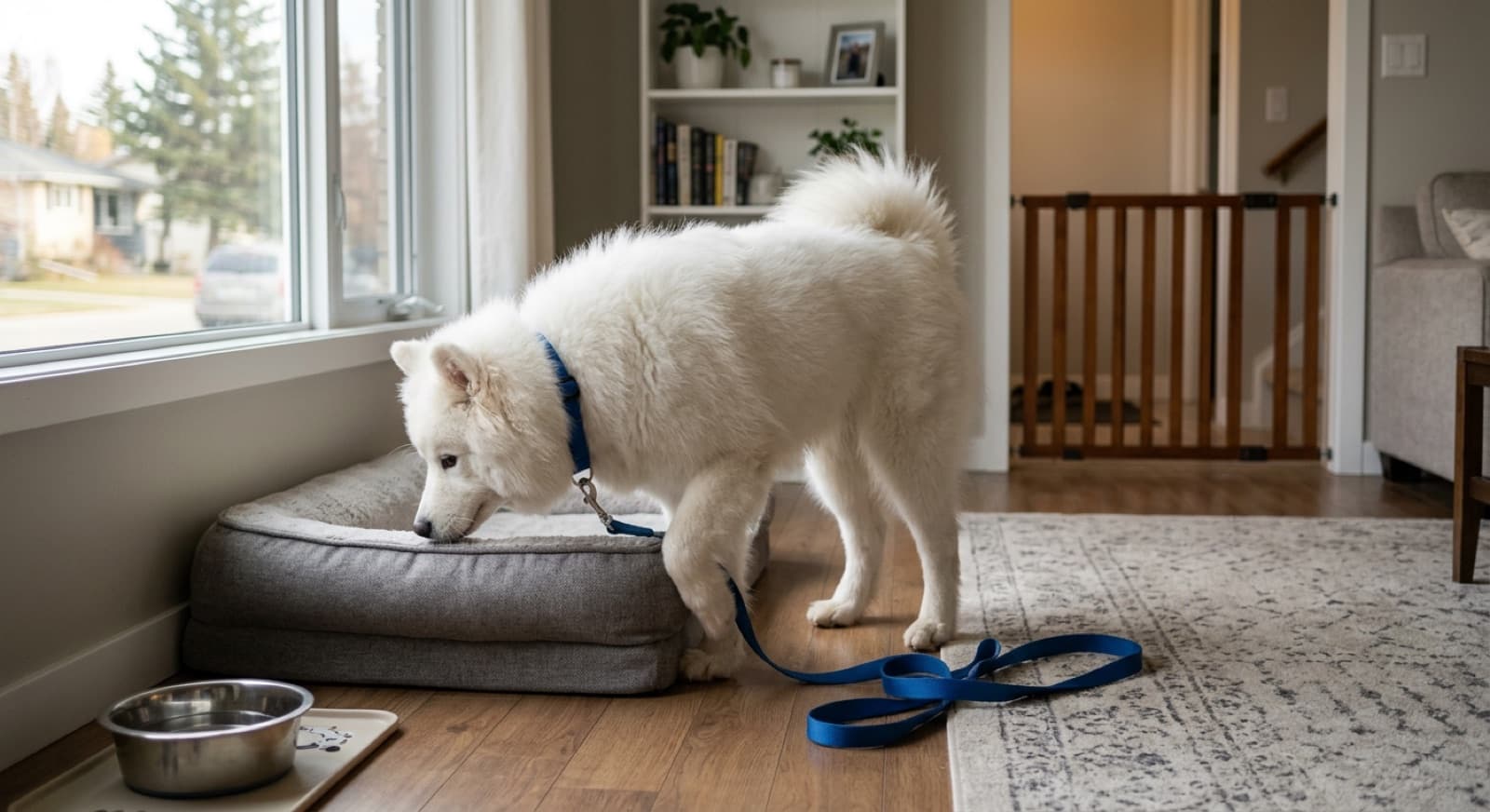
The Samoyed comes from the Siberian Arctic. The Samoyedic people developed the breed over centuries to herd reindeer across the tundra, haul sledges across frozen rivers, and sleep inside the family tent for shared warmth at -40C. Every visible trait of the modern Samoyed traces back to that working history, and almost all of them serve a cold-weather function.
The double coat is the headline feature. The dense, woolly undercoat traps a thick layer of warm air against the skin and provides insulation rivalling that of any working sled breed. The longer, straight, water-resistant topcoat sheds snow and blocks wind. The two layers work together as an air-buffer system that, as the American Kennel Club Samoyed breed profile notes, keeps the dog comfortable in conditions that would kill thinner-coated breeds within hours.
The signature Sammy smile is not decoration. The upturned corners of the mouth prevent saliva from running down the lips and freezing into icicles around the muzzle in extreme cold. The deep chest and lean working build are tuned for sustained low-intensity effort across snow. The dense paw fur grows down between the pads and around the toes to insulate the feet against the ground.
The white coat colour reflects more solar radiation than darker coats, which matters less in winter than in summer but contributes to year-round thermal balance. Every part of the Samoyed makes sense in an Arctic context. Almost none of it makes sense in a hot prairie summer (which is why the summer grooming guide exists), but in Edmonton January the breed is in their native conditions.
Why Samoyed winter is the inverse problem
Most Edmonton dog winter articles cover one of two scenarios. Either the dog is a thin-coated breed (Pug, Yorkie, Italian Greyhound, Whippet) that needs coats, boots, brief outings, and active warming. Or the dog is a working breed without the extreme cold tolerance of the Arctic spitz family (Lab, Boxer, German Shepherd) that benefits from common-sense thresholds and selective gear in deep cold.
The Samoyed sits in a third category. The dog does not need warming, gear, or shortened outings until conditions push past -35C. The owner work is the management of a Samoyed who wants to be outside at -30C for hours when the family wants to come inside, who tracks snow and ice through the house, who pulls the leash toward every fresh snowbank, and who experiences indoor heated air as uncomfortable while the coat dries out.
The four real Edmonton Samoyed winter problems are: ice balls in the coat feathering and between the toes, salt and de-icer chemical exposure on the paw pads, indoor heated dry air at 15 to 20 percent humidity drying out the coat and skin, and channelling the high enrichment need of a dog who is in their happiest months of the year.
None of those are protective problems. All of them are management problems. The rest of this guide is organised around them.
Temperature thresholds Edmonton owners need to know
The following ranges are for a healthy adult Samoyed in good condition. Puppies under six months, seniors over ten, and any Sammy with cardiac, thyroid, or orthopaedic conditions need stricter limits.
+5 to -5C: comfortable
Routine activity, full off-leash time, long sniff walks all work. Many Samoyeds find this range mildly warm and prefer cooler conditions for active play. Salt is the main concern on cleared sidewalks; a post-walk paw rinse handles it.
-5 to -15C: in element
The Samoyed sweet spot. All-day outdoor with shelter access works. Most Edmonton Sammies are at their most energetic and content in this range. Off-leash sessions of 60 to 90 minutes are standard. Watch for ice-ball buildup in leg feathering after deep-snow play.
-15 to -25C: still comfortable
Outdoor activity continues with brief warming breaks every 30 to 45 minutes. Ice-ball check at each break. Indoor humidity matters more as the daily indoor-outdoor swing widens. Most adult Samoyeds remain fully content in this range; many actively prefer it to the warmer end of the scale.
-25 to -35C: paw check critical
Ice balls compound fast. Paw and ear checks every 20 to 30 minutes. Sessions shorten to 30 to 60 minutes with warming breaks. Most Samoyeds remain visibly happy; the owner work is the limiting factor. Environment and Climate Change Canada wind chill guidance rates wind chill -28 to -39 as frostbite possible in 10 to 30 minutes on exposed human skin, and the same range applies to a Sammy nose, ear tips, and any paw pad exposed to ice.
-35 to -40C: supervised pulses
Outdoor time drops to 20 to 40 minute pulses with active movement throughout. No static cold exposure. Paw protection (booties or wax) becomes mandatory. Watch the ear tips, nose, and tail tip closely after re-entry; these are the Samoyed frostbite zones the coat does not cover. River-valley off-leash zones pull strongly ahead of rim parks for wind shelter in this range.
Below -40C: indoor day
Bathroom breaks of 2 to 5 minutes only, with the dog returning indoors immediately. Edmonton hits this range a handful of days each winter. The AVMA cold weather pet safety guidance is explicit that no breed is immune at these temperatures. Move the day exercise indoors with puzzle feeders, scent games, structured training, and controlled tug. A bored indoor Sammy will tell you about it; the destructive pattern follows fast.
Ice balls: the daily Samoyed winter routine
The Samoyed coat catches snow at every feathered area: between the toes, on the leg feathering at the back of the front legs and the inside of the rear, along the belly, and through the tail plume. In dry powder at -20C the snow brushes out easily. In wet sticky snow above -10C, or after any deep play session, the snow packs in, refreezes against body heat, and forms hard ice balls the dog cannot remove without help.
The daily Edmonton winter Samoyed routine that works:
- Trim paw fur in October. The long hair growing between the pads is the single biggest ice-ball trap. A careful trim with rounded scissors every 8 to 10 weeks through winter prevents most of the buildup. Do not shave; leave enough hair to insulate the pad.
- Apply paw wax before walks. A thick beeswax-based barrier on the pads and between the toes reduces ice-ball adhesion. Apply 5 to 10 minutes before the walk so the wax sets. Reapply for any second outing.
- Check paws every 15 to 20 minutes on deep-snow walks. If you see the dog lift a paw repeatedly, that is the signal. Warm the ice ball between your hands until it melts, then continue or head home.
- Post-walk towel-down. Towel the belly, the leg feathering, between the toes, and the tail plume before the dog spreads cold meltwater through the house. Check the chest undercoat; if it feels wet rather than just cold, block any second outdoor trip until the coat dries.
- Trim leg feathering in late autumn. A light tidying trim of the longest feathering on the back of the legs and the inside of the rear reduces the ice-ball catch area without compromising insulation. Skip this step if you show the dog; for pet Sammies it makes January noticeably easier.
The other Samoyed winter detail most new owners learn the hard way: indoor melt. A Sammy who comes inside loaded with snow drops slow-melting puddles wherever the dog rests. A boot tray or a designated tile area inside the entry, paired with a thick absorbent towel pile, saves the hardwood and the carpets. Several Edmonton Samoyed owners we know keep a high-velocity dog dryer at the door specifically for the worst snow days.
Salt, de-icer, and the paw protection question
Samoyed paws are built for cold. The pad fat content is high, circulation in the feet is strong, and the breed handles bare-paw walks in dry powder at -25C without issue. The problem in Edmonton is not the cold itself. It is the combination of cold, salt, and the de-icer brine that Edmonton applies to main streets and sidewalks from late November through March. The combination strips the protective lipid layer off the pad and causes the cracked-pad pattern most Edmonton Samoyed owners see by January.
The two-part protection routine:
- Pre-walk paw wax or boots. Wax is the lower-friction default; most Samoyeds tolerate it from the first application. Boots work for the worst stretches of January when wax wears through quickly on long walks; expect a build-up period of short indoor sessions with food rewards before the dog accepts boots outside. Many Samoyeds refuse boots permanently; if the dog refuses, wax does the job.
- Post-walk paw rinse. Rinse all four paws in lukewarm water in a laundry sink or a shallow bowl by the door. Salt and brine left on the pads continues to dry and irritate after the walk, and the dog will lick the salt off and ingest it, which causes vomiting in volume. The post-walk rinse adds two minutes to the trip and prevents most Edmonton winter paw issues.
Cracked or bleeding pads from sustained salt exposure are a vet visit. The treatment is straightforward (cleaning, sometimes antibiotic ointment, occasional bootie wear during healing) but ignoring early cracks leads to infection. The Edmonton Humane Society publishes winter pet-care guidance and most Edmonton emergency vet clinics are open through cold snaps if a Samoyed comes home limping.
Snow nose: the harmless cosmetic change
New Samoyed owners often panic in January when the dog black nose starts fading to pink or light brown. The condition is called snow nose, or seasonal hypopigmentation, and it is harmless. The dark pigment fades during winter months in response to reduced sunlight and the cold-cycle behaviour of the tyrosinase enzyme that produces melanin. Full pigmentation typically returns by late spring or early summer.
Classic snow nose presents as a smooth, flat, evenly distributed fade across the nose surface. The texture is normal; the colour change is the only visible difference. The condition is reported in many Northern breeds (Samoyed, Siberian Husky, Alaskan Malamute, Golden Retriever, Labrador Retriever) and is documented in veterinary dermatology references including those summarised by the American College of Veterinary Dermatology.
When to call the vet: if the pigment loss is patchy rather than even, if the nose surface becomes raised or ulcerated or crusty, if pigment loss spreads to the lips, around the eyes, or onto the pads (which can indicate autoimmune skin disease like discoid lupus erythematosus or pemphigus complex), or if the dog shows pain or itching at the affected area. Classic seasonal snow nose is none of those things; it is a quiet, even, painless fade that comes back in spring.
Indoor dry-air management: the humidifier matters
Edmonton winter indoor humidity in heated homes typically sits at 15 to 25 percent. The natural outdoor January humidity is similar but the outdoor cold compensates; the indoor dry-warm combination dries out a Samoyed coat, irritates the skin, increases static, and contributes to coat-blow flake and dander through January and February. The dog scratches more, the brush-out finds more dead undercoat, and the household vacuum runs more often.
A humidifier sized to the main living area, kept at 35 to 45 percent, makes a real difference within a week. Skip the upper end of that range; condensation on Edmonton single-pane windows leads to mould problems on sills and around frames. Most Edmonton Samoyed owners run a single mid-sized cool-mist humidifier in the main living area through January and February. Whole-home humidifiers integrated with furnaces work too if the home is set up for them.
Pair the humidifier with two coat-supporting routines. First, a salmon-oil or omega-3 supplement at the vet-recommended dose for the dog body weight, started in October and continued through April, supports the natural oil production in the skin and the coat. Second, a leave-in conditioner spray applied during the weekly winter brush-out keeps the coat manageable and reduces static. Both are low-effort, both compound, and both make a visible difference by mid-January.
Browse adoptable Samoyeds in Edmonton
Samoyeds and Sammy crosses come through Edmonton-area rescues periodically. If you want a dog who is genuinely in their element through six months of Edmonton winter, this is the breed. Browse current Samoyeds and Sammy-mix listings from Edmonton rescues.
See Edmonton Adoptable Dogs →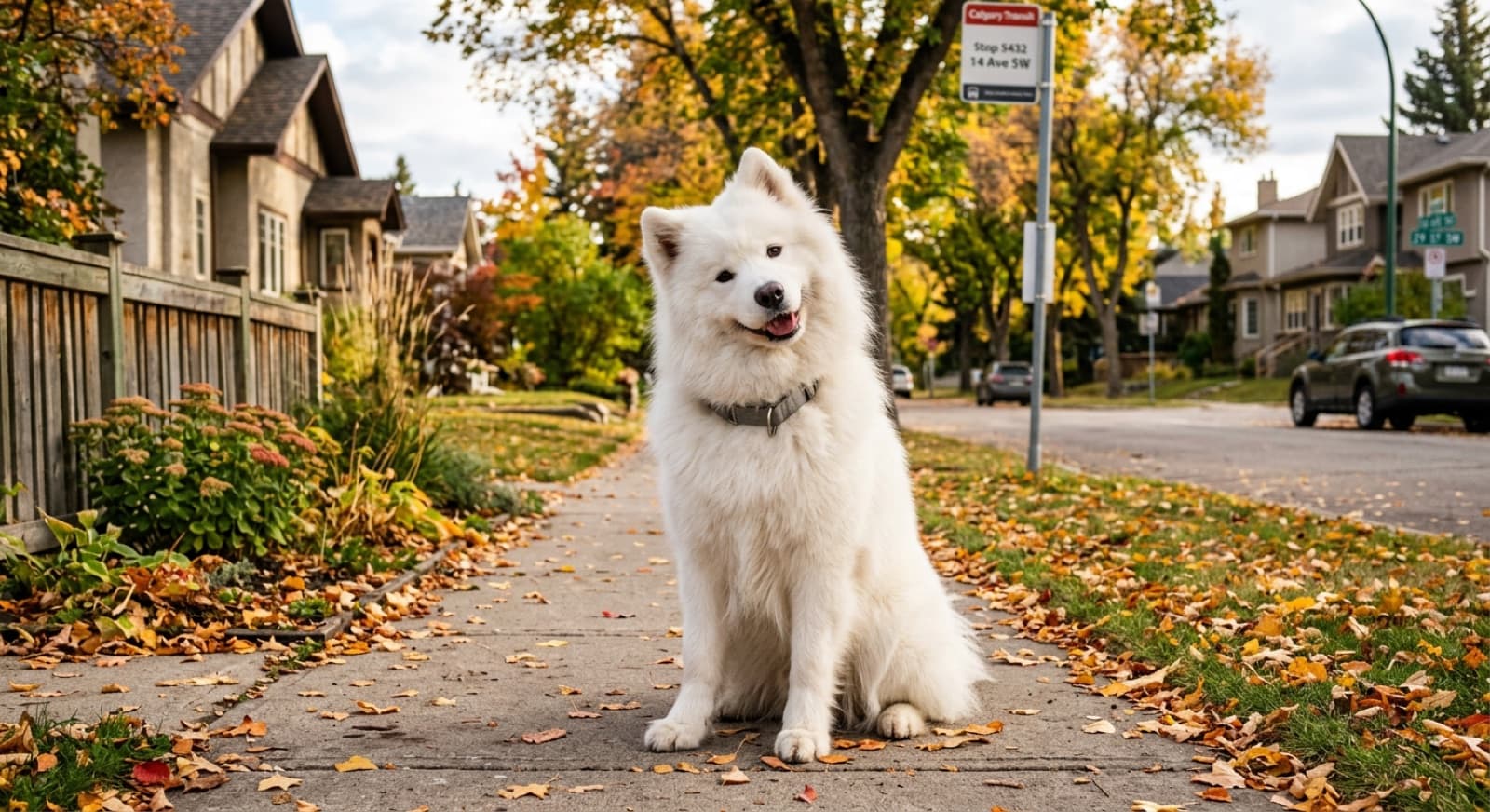
Outdoor play: snow burrowing as enrichment
A Samoyed in fresh snow is the breed at peak expression. Snow burrowing, snow rolling, snow chasing, and the trademark Samoyed pounce-into-deep-powder behaviour are all genuine enrichment for the dog. The Sammie smile genuinely intensifies in winter conditions. Edmonton owners who treat winter outdoor time as a chore to get through are missing the best months of the year with this breed.
Practical winter enrichment routines that work in Edmonton:
- Daily off-leash session in a river-valley zone. Mill Creek Ravine, Hawrelak south slope, or Whitemud Ravine. Wind-sheltered, packed-trail conditions, river-valley microclimate 3 to 5C warmer than the rim. Most Edmonton Samoyed owners default to these from December through March.
- Snow-burrowing time in a fenced yard. If you have one, let the dog dig. The behaviour burns mental and physical energy, satisfies a deeply wired instinct, and is genuinely calming for the dog afterward. The yard recovers in spring.
- Friend dog meet-ups in cold conditions. A Sammy with one or two friend dogs in -25C fresh snow is the happiest combination. Watch over-arousal in groups (Samoyeds get vocal and herdy at peak energy), offer water every 20 to 30 minutes despite the cold, and end the session before any dog is exhausted.
- Fetch in fresh powder. The dog cannot grab the toy as fast as on grass, the running pattern shifts to bounding, and the workout intensity for the same time investment is higher. Use a bright orange or yellow toy; white snow plus white Sammy means a buried toy disappears.
Supervision is the constant. A Samoyed who is genuinely loving the snow does not signal exhaustion or hypothermia the way a less cold-tolerant breed does. Watch the ear set (a dropped, less-alert ear posture late in the session is a fatigue signal), the gait (any slowing or stiffness), and the willingness to engage with the next round of play. End the session before the dog stops wanting it.
The Edmonton off-leash calculus in winter
Samoyeds are generally more biddable than Huskies and many Edmonton Sammies maintain reliable recall through winter, especially adults who arrive from foster networks with confirmed off-leash history in their notes. The exceptions matter. Some Samoyeds have a strong prey drive for rabbits and the occasional Sammy locks onto a coyote scent or a deer trail and goes deaf for 20 to 60 seconds. The honest pattern most Edmonton Samoyed owners settle on:
- True off-leash in designated zones in low-distraction windows, primarily mid-morning and early afternoon when coyote activity drops.
- 10 to 15 metre biothane long-line at dawn and dusk in coyote-heavy corridors (most of the river-valley west side, Whitemud Ravine, parts of Mill Creek).
- Leashed transit to and from the off-leash zone, which is the bylaw requirement and also the right safety call near roads.
Coyote concentration is real. Edmonton river-valley coyotes are most active at dawn and dusk year-round, with the highest density April through July during pup-rearing. In winter the food landscape thins and coyotes follow rabbit populations through the same corridors Samoyed owners use. The size differential matters; a 50 lb adult Samoyed is usually safe from coyote conflict but a Sammy puppy under 30 lbs or a Samoyed cross at smaller weight is not. Keep the dog in sight. Recall and re-leash at any coyote sighting. Never let the dog chase.
Bylaw 21244, the Edmonton Animal Licensing and Control Bylaw, requires dogs to be leashed to and from off-leash zones, under voice or visual control inside them, and the handler must carry a leash and pick up waste. The fine for failure to leash or control a dog is $250. The City of Edmonton dogs services page is the canonical reference. Bylaw officers patrol the river-valley off-leash zones less heavily in winter than in summer but enough that the fine is a real consideration in heavy-traffic corridors.
Skijoring, bikejoring, and Samoyed-suitable winter sports
The Samoyed working roots show in pulling sports. Skijoring (the dog pulls the owner on cross-country skis), bikejoring (same setup with a fat bike on packed trails), and recreational dog sledding are all practiced by Edmonton dog-sport communities and most Samoyeds take to them quickly with proper training. The breed is not a Siberian Husky in raw pulling power, but a 50 to 60 lb adult Samoyed in good condition can pull a fit adult on skis comfortably for 5 to 15 km sessions.
The equipment is real and the build-up matters. A purpose-built pulling harness (X-back or H-back design, not a standard walking harness), a gangline with a quick-release at the human end, and a waist belt with shock absorption are the standard kit. Starter equipment runs $150 to $300. Training proceeds in stages: harness desensitisation, pulling on flat ground with no human weight, then progressive load. Skipping the build-up usually leads to a dog that tangles itself in the gangline and a human who falls hard on packed trail ice.
Verify the off-leash and pulling designation of any route before deploying. Not every Edmonton trail allows pulling sports; the river-valley off-leash zones generally do, with the same recall and bylaw rules applying. Cross-country ski trails inside the river-valley park system may prohibit dogs on groomed track sections; check the signage at each trailhead. Local cross-country ski clubs in Edmonton are usually open to dog-friendly trail recommendations if you ask.
Cold-weather hydration: still matters
Winter dehydration is real and most owners under-water their Samoyed in January. The indoor heated dry air pulls moisture through the dog respiratory system, the cold outdoor air dehydrates further through panting on active walks, and many dogs drink less in winter than in summer because the heat-driven thirst signal is absent. Senior Samoyeds and Sammies with kidney or thyroid issues are at the highest risk.
The hydration routine that works:
- Multiple fresh water sources around the house, refreshed twice daily. Warm stale water gets refused; warm tap-temperature water gets accepted.
- Carry water on any walk longer than 30 minutes. A collapsible silicone bowl plus a 500 ml insulated water bottle is the standard kit.
- Watch the urine colour. Pale yellow is well-hydrated; dark amber is dehydrated and means more water.
- Snow eating in small amounts is fine on walks but is not a substitute for water. The energy cost of melting cold snow inside the dog is real and undermines hydration on long sessions.
- For dogs working hard (skijoring, long off-leash sessions, bikejoring), electrolyte support is reasonable; coconut water at room temperature or a vet-approved canine electrolyte solution covers the sodium loss. Skip human sports drinks; the sugar load is wrong for dogs and some contain xylitol which is fatal.
Senior Samoyed winter care
Samoyed cold tolerance declines after age eight to ten, sometimes earlier in dogs with cardiac or thyroid issues. The threshold shift is genuine; a nine-year-old Sammy that was comfortable for an hour at -30C two winters ago may want to come inside at 30 minutes now. The change is gradual, not sudden, and watching for it is the senior winter routine.
The senior signals to watch:
- Slowed pace on familiar walks. A drop from previous baseline that persists over several walks is the early signal.
- Lifted paws or repeated paw licking. The pad sensitivity to cold and salt increases with age.
- Shivering. Rare in Samoyeds even in deep cold; a real signal when it appears in a senior.
- Reluctance to start the walk. Some senior Samoyeds simply prefer indoor time on the coldest days. Respect the preference; the dog is telling you something.
- Post-walk stiffness. Cold compounds arthritis. A senior Sammy who is stiff or slow after walks needs a vet conversation about joint supplements, NSAIDs, or other arthritis management.
Senior winter management combines a few low-cost interventions: a heated indoor bed in the dog usual rest area, vet-approved joint supplements, shorter and more frequent walks rather than one long session, slightly higher indoor humidity to support the aging coat, and a tighter temperature threshold (most Edmonton senior Samoyed owners cap routine activity at -25C rather than the adult threshold of -35C). The Samoyed health guide covers the cardiac and thyroid monitoring that matters most in senior winters.
Puppy Samoyed winter: slow exposure
Samoyed puppies under six months have not finished growing in their adult double coat. The undercoat is thinner, the topcoat is shorter, and the cold tolerance is meaningfully lower than the adult breed average. A 12-week-old Samoyed puppy in -25C is not in their native conditions yet; they are a thin-coated young dog in deep cold, and the protocol matches.
The puppy winter rules:
- Below -15C, supervised pulses only. 10 to 20 minute sessions, paw protection, no static cold exposure.
- Watch for shivering, which signals the session is over. Puppies signal cold more clearly than adults.
- Build outdoor tolerance gradually. Multiple short outings beat one long session. The puppy coat develops faster in dogs who spend regular short stretches outdoors in cool weather.
- Skip booties until the dog accepts them indoors first. A puppy fighting boots in deep cold is a recipe for a refused boot for life.
- Limit the indoor-outdoor temperature swing. Pulling a puppy from +22C indoor to -25C outdoor and back repeatedly stresses the developing thermoregulation. Pre-walk indoor cool-down (3 to 5 minutes near the entry) helps.
The adult coat usually finishes growing in by month nine to twelve, and at that point the standard adult thresholds apply. Most Samoyeds at month 12 in Edmonton are in their first full winter as a fully-adult-coated dog, and the difference between month nine and month 12 is visible in cold tolerance.
Travel and boarding in winter
Most Edmonton Samoyeds prefer winter to summer for travel. A Sammy in a car at -10C with the heat off is comfortable; the same dog in the same car at +25C with the AC failing is in genuine heat stress within 20 minutes. Winter road trips work well for the breed; cabin temperature should sit at 16 to 20C rather than the human-comfortable 22 to 24C, and a 20 minute stretch break every two hours covers both the dog and the human needs.
Air travel is the harder conversation for owners of thick-coated breeds. Most airlines move dogs over 22 lbs as cargo, and cargo holds in Canadian winter conditions can swing between +15C on the ground and -5 to +5C at altitude depending on the aircraft and route. The risk is not deep cold; it is the temperature swing combined with the stress of cargo handling. The AKC flying-with-dogs guidance covers the breed-specific considerations and most veterinarians will write a fit-to-fly letter only after a recent exam.
Boarding through Edmonton winter works well for Samoyeds at facilities with outdoor exercise yards; the dog gets sustained cold-weather movement and the indoor heated kennel is comfortable for sleep. Daycare days through January and February are also a common safety valve for owners who cannot run the full daily exercise programme through the worst weeks; the dog gets social play in a heated indoor space and the owner avoids the destructive-pattern fallout from a Sammy who is under-exercised in deep winter. Ask any boarding or daycare facility about their cold-weather outdoor protocol before committing.
Edmonton Samoyed Winter FAQ
Tap a question to expand
How cold is too cold for a Samoyed in Edmonton?▼
Do Samoyeds get ice balls between their toes?▼
Should I worry about my Samoyed eating snow?▼
What is snow nose on a Samoyed?▼
Can I let my Samoyed off-leash in Edmonton winter?▼
Do Samoyeds need a coat or jacket in Edmonton?▼
How do I manage indoor dry air for a Samoyed in winter?▼
Are Samoyeds good in -30C off-leash play with other dogs?▼
How is Samoyed winter different from Husky winter in Edmonton?▼
What about senior Samoyed winter care?▼
Should I bathe my Samoyed during Edmonton winter?▼
Related Edmonton Samoyed guides
Adoptable Dogs in Edmonton
Browse current Samoyeds and Sammy crosses listed with Edmonton-area rescues. Updated regularly.
Samoyed Adoption Edmonton
Edmonton Samoyed rescue sources, adoption costs, surrender patterns, and breed-vs-buy honesty.
Samoyed Health Issues: Diabetes, Eyes, Kidneys
Samoyed health issues to plan for: a very high diabetes risk, eye disease and glaucoma, inherited kidney disease in young males, skin disease, sulfa sensitivity and hips.
Samoyed Grooming Edmonton
Coat blow, undercoat rakes, professional groom timing, the never-shave rule, and Edmonton seasonal coat care.
Find your Edmonton Samoyed
Browse adoptable Samoyeds and Sammy crosses from Edmonton-area rescues. Foster-tested temperament notes help you find one whose pace fits your winter routine.
Browse All Edmonton Dogs →New dog? Start with these care guides
Everything a new adopter needs to set up a safe, happy home.