The short answer
Vizslas are the breed where separation anxiety is breed-defining. The Velcro-dog label is not marketing; it is the result of centuries of selection for close human partnership in hunting. Most adult Vizslas cannot be left alone for 4 or more hours without significant distress, and 8-hour commute days produce chronic SA in the majority of dogs. The Edmonton playbook combines force-free desensitisation (6 to 12 weeks of structured graduated alone-time work), behavioural medication when warranted (fluoxetine, clomipramine, or trazodone prescribed by a DACVB-trained vet), and real coverage: doggy daycare two to three days per week, a midday dog walker, work-from-home compatibility, or family co-ownership. Aversive tools and crate-and-wait approaches make Vizsla SA worse, not better.
The Vizsla Velcro-dog reality
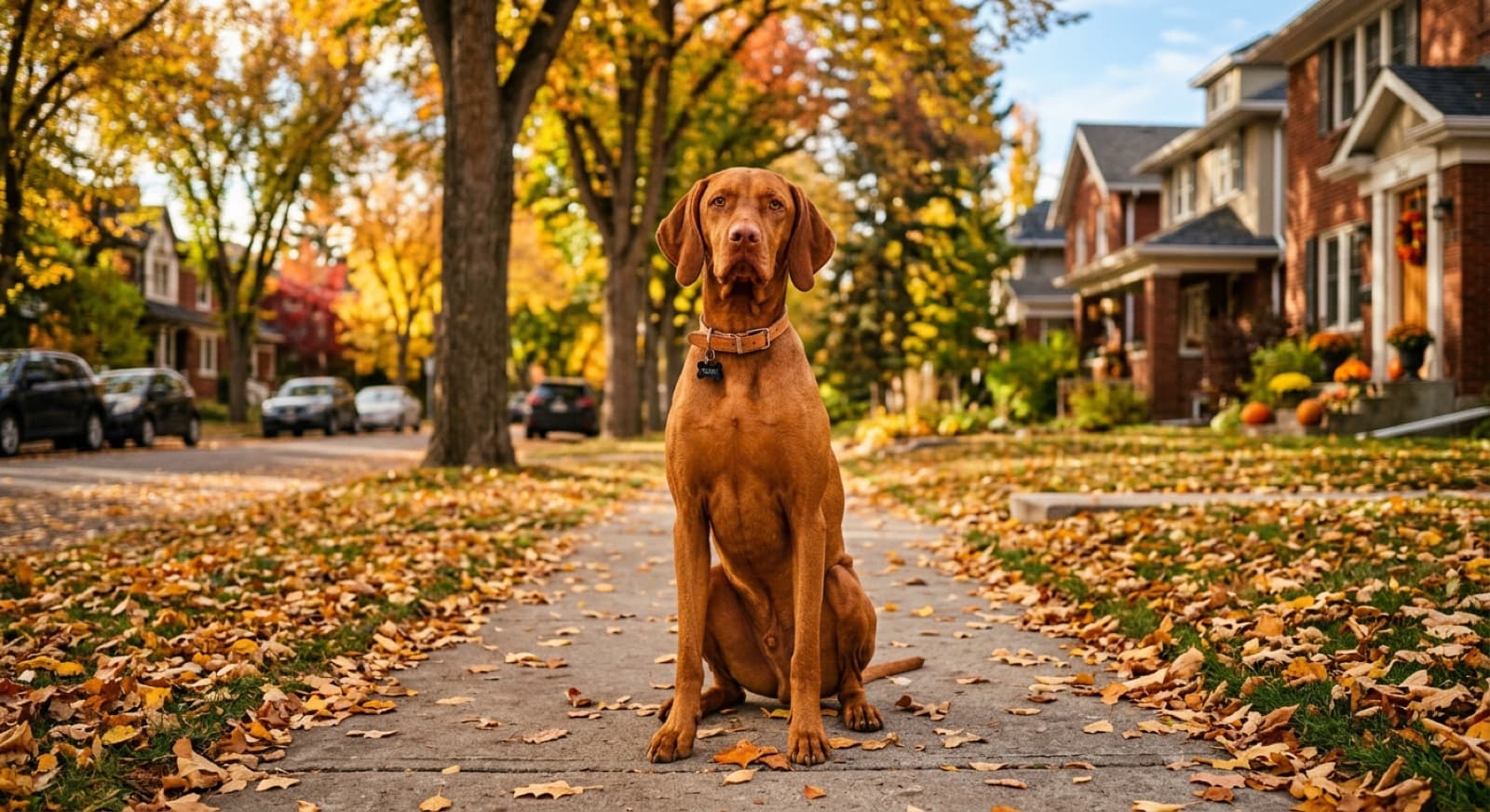
The Vizsla earned the Velcro-dog label honestly. The breed was developed by Magyar nobility across the Hungarian plains as a close-working pointer-retriever for falconry and small-game hunting. Selection pressure favoured dogs that worked within sight of the handler, checked in constantly, and lived in the household rather than the kennel. Centuries of this selection produced a dog whose entire behavioural architecture assumes a human is nearby.
The result is a 40 to 65 pound rust-coloured dog that follows you to the bathroom, sleeps under the covers, leans into every available human, and finds physical contact regulating. None of that is neurotic; it is the breed working exactly as selected. The same temperament that makes the Vizsla one of the most affectionate breeds in any household is also the temperament that makes prolonged solitude genuinely distressing.
The training implication is that protocol cannot fight the biology. A Vizsla will always prefer your company, will always notice your departure, and will always have stronger feelings about being alone than a more independent breed. The goal is not a Vizsla that does not care whether you are home. The goal is a Vizsla that can handle reasonable solitude without panic, with a structured coverage plan filling the gaps that solitude tolerance does not stretch to.
Why Vizslas develop separation anxiety
Three factors converge to make SA breed-defining in Vizslas. The first is genetic predisposition from centuries of close-handler selection. The second is the historical living pattern: Vizslas were household dogs, not kennel dogs, raised inside the family from puppyhood with continuous human contact. Working dogs left alone in barns or kennels were culled from breeding programs. The third is acquired learning: a Vizsla puppy who experiences distress when left alone learns that absence equals panic, and the pattern persists into adulthood unless deliberately retrained.
For the typical Edmonton adopter, the practical takeaway is that the Vizsla in front of you is more likely to have SA than not. The breed-level baseline is high, and adult rescue Vizslas frequently arrive at the rescue precisely because their previous home failed to manage SA. The Edmonton surrender pattern is almost always exercise mismatch or separation anxiety; SA is often the deciding factor that produces the formal surrender.
The pattern is not destiny. A Vizsla raised with gradual independence work from puppyhood, paired with consistent coverage in adulthood, can develop a stable solitude tolerance of 3 to 4 hours without distress. A Vizsla left alone for 8-hour commute days without coverage, especially during the first year, often develops entrenched SA that takes 6 to 12 months of structured work and medication to resolve. The pre-adoption decision is the highest-leverage one; structure is harder to install retroactively than to build from the start.
Separation anxiety presentations in Vizslas
Vizsla SA shows up across a predictable set of behaviours. Most owners see two or three of these, not all of them. Severity varies; the presence of any one of these in a dog left alone routinely warrants intervention.
- Destructive chewing. Door frames, baseboards, window sills, crate bars, furniture near exits. The focus on exit points is diagnostic; a dog chewing the door frame is trying to follow you, not redirecting random energy.
- Inappropriate elimination. Urination or defecation in a fully house-trained adult dog while alone. This is panic-driven loss of bladder or bowel control, not a house-training regression.
- Sustained vocalisation. Barking, howling, whining that continues for the entire absence or large portions of it. Neighbour complaints in Edmonton condos and apartments are often the first warning sign.
- Self-injury. Bloody paw pads from scratching at doors. Broken teeth from biting crate bars. Torn nails from digging at carpets near exits. Skin abrasions from pacing in small spaces.
- Escape attempts. Jumping or climbing fences, breaking through screens or windows, breaking out of crates. Vizsla athleticism amplifies the risk; this is not a couch-bound breed.
- Refusal to eat or drink. A high-value food chew left untouched at departure, water bowl unchanged on return. Anxiety overrides appetite.
- Excessive greeting intensity. Frantic jumping, crying, whining, urinary excitement on return that takes 10 or 15 minutes to settle. The intensity is proportional to the distress during absence.
- Anticipatory anxiety. Pacing, panting, vomiting, hiding as you put on your coat, pick up your keys, or approach the door. The dog has learned the departure routine and the dread starts before you leave.
A small home video camera is the single most useful diagnostic tool. Many Vizsla owners assume their dog is fine alone because the dog seems calm at the door; the camera footage often shows pacing, panting, and vocalisation for the entire absence. Without the footage, you are making the protocol decision blind.
Chronic stress and the health cost
Vizsla SA is not just a behaviour problem; it is a chronic stress condition with health consequences. Sustained cortisol elevation suppresses immune function, disrupts digestion, contributes to weight loss in some dogs and weight gain in others, and accelerates wear on the cardiovascular system. The Vizsla left alone 8 hours a day for years often shows the same patterns as a chronically stressed working dog: poor coat condition, recurrent low-grade illness, gastrointestinal sensitivity, and shortened working lifespan.
Pain and underlying medical conditions amplify SA presentations and get missed in active breeds. A Vizsla with subclinical hip dysplasia, dental pain, or gastrointestinal sensitivity tolerates separation worse than an asymptomatic dog. The vet workup should happen before or alongside the behaviour modification plan, not after. The sibling article on Vizsla health issues covers the orthopaedic, endocrine, and ophthalmic concerns that should rule in or out as part of an SA workup.
Practical implication: the cost of leaving SA untreated compounds. Each year of chronic distress takes a measurable toll. Adopters sometimes treat the SA workup as an optional improvement project; the framing that lands better is preventive medical care for a documented breed vulnerability. The math on the cost of treatment versus the cost of long-term chronic stress favours treatment in every case.
Force-free methodology is the standard of care
The American Veterinary Society of Animal Behavior (AVSAB) position statement on humane training is unambiguous: aversive tools (prong collars, choke chains, shock collars, alpha rolls) are associated with increased fear, anxiety, and aggression in dogs. For SA cases, the risk profile is worse, not better. A panicking Vizsla corrected for distress vocalisation pairs the panic with pain and intensifies the underlying anxiety. The intervention that should reduce SA makes it worse.
The crate-and-wait approach falls into the same category. Locking an SA Vizsla in a crate and waiting for the dog to settle is the canine equivalent of treating a panic disorder with extended confinement. The dog does not settle; the dog learns that escape is impossible and develops learned helplessness, often with self-injury along the way. Vizsla self-inflicted injuries from crate panic are common enough that experienced trainers default to gated rooms or open-floor management rather than crates for diagnosed SA cases.
Credentials that mean something
Dog training is unregulated in Alberta. Anyone can call themselves a trainer. The credentials that mean something are independent third-party certifications: CCPDT (Certification Council for Professional Dog Trainers), which administers the CPDT-KA and CPDT-KSA exams, and IAABC (International Association of Animal Behaviour Consultants), which credentials CDBC-level behaviour consultants with assessment portfolios and continuing education. For SA, IAABC consultants often have stronger specialty depth than generalist CPDT trainers; ask about caseload history with diagnosed separation anxiety specifically.
Gradual desensitisation protocol
The evidence-based protocol for SA is graduated alone-time training. The principle is that the dog stays under threshold throughout: each absence is brief enough that the dog does not enter panic. As the dog handles brief absences without distress, duration extends. Over 6 to 12 weeks, the tolerance window expands from seconds to hours.
Week 1 to 2: foundation
Identify your dog's starting threshold. For some Vizslas with mild SA, that is 5 minutes alone. For a dog with entrenched SA, it may be 30 seconds. Build sessions of brief absences below threshold. The dog gets a high-value chew or food puzzle at departure. Arrivals are low-key, not greeting parties. Practise the departure routine in pieces (pick up keys without leaving, put on a coat without leaving) so the cues lose predictive value.
Week 3 to 6: extending duration
Absences move from seconds to several minutes, then to 15 and 30 minutes. Video footage confirms the dog stays calm; settling for the duration is non-negotiable progress, not just absence of destruction. If the dog escalates at any point, the next session is shorter. Setbacks are normal; the recovery is the protocol.
Week 6 to 12: real-world generalisation
Absences extend to 1, 2, and 3 hours. The departure routine is varied: different doors, different times, different cues. The dog should be calm or sleeping for the duration on video. By week 12, most successful cases handle 3 to 4 hours alone with composure.
The critical caveat: during the 6 to 12 weeks of desensitisation, the dog must not actually be left alone past their current threshold. This is the coverage requirement. If your work schedule has the dog alone 8 hours a day during this period, the protocol resets every workday and the work never builds. Coverage is the foundation; the desensitisation rides on top.
Behavioural medications
For Vizsla SA cases that do not progress with desensitisation alone, behavioural medication paired with continued protocol work is the next step. Medication is not a substitute for the desensitisation; it is the platform that makes desensitisation possible by lowering the panic baseline so the dog can learn. The combination has the strongest evidence base in the veterinary behaviour literature, and the American College of Veterinary Behaviorists recommends combination therapy as standard of care for clinical SA.
Fluoxetine
A daily SSRI similar to human Prozac. Builds a baseline anxiolytic effect over 4 to 8 weeks. The most-prescribed first-line option for canine SA. Side effects can include initial appetite reduction, mild sedation, or gastrointestinal upset, usually resolving within 2 weeks. Cost: $20 to $50 per month depending on weight and pharmacy.
Clomipramine
A tricyclic antidepressant. Clomicalm is the licensed veterinary form in Canada specifically labelled for canine separation anxiety. Similar mechanism to fluoxetine, different side-effect profile. Some dogs tolerate one better than the other. Cost: $40 to $100 per month.
Trazodone
A shorter-acting medication often added to fluoxetine or clomipramine for situational calming around specific departures. Effect comes on within 1 to 2 hours and lasts 6 to 8 hours. Useful for the dog whose daily baseline is reasonable on the SSRI but whose departure-specific panic still needs additional support. Cost: $15 to $40 per month at typical dosing.
Total combined medication cost runs $30 to $150 per month depending on the dog's weight, the drugs used, and pharmacy pricing. Generic options exist for most of these and reduce cost meaningfully. A primary-care vet can prescribe the common SA medications; complex cases or treatment-resistant presentations warrant a DACVB consult. Skipping medication when warranted to “see if training alone works” extends the timeline and the chronic-stress exposure; the evidence base does not support training-only protocols for clinical SA.
When to escalate to a veterinary behaviourist
The DACVB referral threshold for SA is lower than for most other behaviour presentations. Three reasons. First, true clinical SA rarely resolves with training alone; the evidence base supports combination therapy. Second, Vizsla SA tends to be entrenched given the breed-level baseline. Third, the cost of delay is real: months of chronic stress with welfare and health implications.
Escalate to a DACVB for any of these:
- Your Vizsla cannot be left alone at all without panic.
- Home-alone destruction includes self-injury (broken teeth, bloody paws, torn nails).
- Vocalisation is producing neighbour complaints in a condo or apartment.
- A 4 to 6 week force-free desensitisation plan has not produced visible progress.
- The dog is refusing to eat or drink while alone.
- SA presents alongside other behaviour concerns (resource guarding, generalised anxiety, noise phobia).
- Your primary vet recommends medication but is not comfortable with combination therapy or dose adjustment.
The closest DACVB-staffed program for Edmonton is the Western College of Veterinary Medicine at the University of Saskatchewan in Saskatoon. Consultations may run through referral from your primary vet or by telehealth. Expect $400 to $800 for an initial workup and a structured follow-up plan, with medication costs additional. For an entrenched Vizsla SA case, this is the right tier and worth the cost.
Browse adoptable Edmonton Vizslas
Foster temperament evaluation is more diagnostic than breed label for SA risk. Current Vizsla and Vizsla-mix listings from SCARS, EHS, AARCS Edmonton fosters, Zoe's, AHHRB, GEARS, and Hope Lives Here. Foster notes describe each dog's actual tolerance for solitude and the coverage support the placement will need.
See Edmonton Adoptable Dogs →Doggy daycare reality
Doggy daycare two to three days per week is one of the most common coverage tools for Vizsla SA. The dog gets structured social time, physical exercise, and mental stimulation during what would otherwise be a long solitary day. For many Vizslas, daycare days are the regulating element that makes the other days manageable.
Quality matters more than convenience. The criteria for a Vizsla-appropriate daycare include staff-to-dog ratios at or under 1:15, structured rest periods built into the day (not continuous play, which over-arouses a Vizsla), separation by size and energy level, written behaviour and incident reporting, and visible cleanliness with clear health protocols (vaccination, parasite control, intake screening). Staff certifications through CCPDT, IAABC, or pet-care credentialing programs signal commitment beyond the minimum.
Edmonton has a range of daycare options across the city. Without endorsing specific facilities, the screening questions to ask: what is the staff-to-dog ratio, what is the structured rest schedule, how are dogs grouped, what credentials do staff hold, what is the incident reporting process, and can you do a trial day with reports back. Vizslas tend to thrive in smaller, structured daycare environments and burn out in large, continuous-play warehouses.
Cost runs $35 to $55 per day in Edmonton at most facilities, with multi-day packages discounted. Two to three days per week works out to roughly $300 to $600 per month. This is part of the real ongoing cost of Vizsla ownership; budget for it before adoption rather than discovering it after.
Dog walker reality
A midday dog walker breaks up a long solitary day with structured exercise, a potty break, and human contact. For Vizslas, the social piece matters as much as the exercise; the dog comes back to solitude with a regulated nervous system rather than escalating distress. Twice-daily walks (morning and midday) work well for Vizslas whose owners work standard schedules; once-daily walks at midday work for owners who can do a long morning exercise session before leaving.
Quality criteria are similar to daycare: insurance and bonding, written incident reporting, clear vaccination and health requirements, references from current clients with similar breeds, and the willingness to do a meet-and-greet before booking. A Vizsla walker should understand the breed-specific exercise needs (real running, not slow neighbourhood strolls) and should be comfortable with the leash-pulling and high-energy patterns that come with the breed.
Family or friend pet-sitters work too, especially for cost-sensitive households. The trade-off is reliability: a paid professional shows up on schedule; a family member may not. For Vizslas, schedule consistency matters more than the identity of the walker; the dog adapts to a predictable routine and destabilises with unpredictable absences. If using family support, structure the arrangement formally with set days and times.
Cost in Edmonton runs $20 to $35 per visit for a 30 to 45 minute walk. A weekday midday schedule works out to roughly $400 to $700 per month. Combined with daycare two days per week, the total monthly coverage cost for a working-household Vizsla often lands in the $600 to $1,000 range. This is the real cost of the breed in a commute-schedule household.
Work-from-home compatibility
Work-from-home is the highest-compatibility setup for a Vizsla. The dog has near-continuous human presence, naps under the desk, gets brief exercise breaks throughout the day, and never crosses the solitude threshold that triggers SA. Vizsla owners who work from home full-time often describe the easiest dog ownership experience of their lives; the breed is built for this setup.
Hybrid schedules work too, especially for dogs whose solitude tolerance is in the 3 to 4 hour range. A typical hybrid week might be three days at home, two days in office with a dog walker or daycare covering the office days. The dog gets sufficient continuous human time and sufficient coverage on the gap days. Most Vizsla SA cases are manageable with this kind of mixed setup.
The setup that does not work is a full-time office commute with no coverage. Adopters who plan this and assume the dog will adapt produce the largest share of SA-driven surrenders. The Edmonton job market includes growing remote and hybrid options across tech, government, and professional services; this is part of the practical adopter screening, not lifestyle judgement.
Family co-ownership and pet-sitter networks
Multi-person households spread coverage naturally. A two-adult household with offset schedules can often cover a Vizsla without external daycare or walkers. Adult children, partners, parents living in the home, or close family living nearby all provide coverage redundancy. The Vizsla in a multi-adult household with one adult typically home tends to do well even when the primary bonded human is at work.
Pet-sitter networks formal or informal also work. A trusted neighbour who lets the dog out at midday in exchange for reciprocal pet care, a retired parent who takes the dog during the day, a friend who works from home in the same building or neighbourhood. These arrangements need formal scheduling to provide the consistency Vizslas require; informal “whenever you can” arrangements destabilise rather than support.
For solo-adult households, the calculation changes. A solo adopter with a full-time commute and no nearby family support is signing up for $600 to $1,000 per month in coverage costs plus 6 to 12 weeks of intensive desensitisation work, often with medication. This is doable for committed adopters with the resources; the rescue conversation about whether this is the right placement is honest and important.
Edmonton workplace reality
Edmonton has a growing dog-friendly workplace ecosystem in tech offices, creative agencies, and some professional services. Bringing a Vizsla to work, where the policy supports it, is the highest-fit coverage setup of all; the dog goes everywhere the owner goes and never experiences problematic solitude. The workplace conversation is worth having at the job-search and offer stages, not after adoption.
Commute structure matters. A 30-minute commute leaves the dog alone shorter than a 60-minute commute. A lunch-hour walk-back works for owners who live within 15 minutes of the office. The Edmonton geography means inner-city addresses (Oliver, Garneau, Strathcona) tend to be Vizsla-friendlier than suburban commute distances because the lunch-hour option stays on the table.
Practical screening question for an Edmonton Vizsla adopter: across a typical work week, what is the longest single stretch the dog will be alone, and what coverage exists for that stretch. If the answer is 8 hours with no coverage, the placement needs different structure before adoption, not after. Rescues that pre-screen on this question reduce their own surrender rates.
Edmonton condo and apartment SA
The Vizsla in an Edmonton condo or apartment faces an amplifying factor: neighbours. Sustained vocalisation that would be invisible in a detached home becomes a documented noise complaint in a building with shared walls. City of Edmonton Bylaw 21244 includes nuisance provisions that can be applied to chronic barking, and condo bylaws often add additional restrictions on noise that produces neighbour complaints.
The relationship management piece matters. Neighbours who know the dog exists, know SA is being treated, and see the household working on it tend to be patient. Neighbours who experience daily barking from an unknown dog file complaints faster. Proactive communication with adjacent units, especially during the 6 to 12 week desensitisation period when occasional vocalisation is most likely, prevents most escalation. Doors with white-noise machines on the inside dampen the sound that reaches the hallway and adjacent units.
Building selection matters at the adoption stage if the household plans to move. Concrete construction (most Edmonton high-rises built since 1980) sound-dampens better than wood-frame walk-ups. Top-floor units have no upstairs neighbour to disturb. Corner units share walls with fewer adjacent units. Buildings with explicit pet-friendly policies and other dog owners tend toward higher tolerance for normal pet sounds. None of this substitutes for treating the SA; all of it reduces the consequences if a SA flare produces an episode of barking.
The Vizsla puppy SA window
Puppyhood is when the breed-level SA risk gets locked in or trained out. A Vizsla puppy left alone for long stretches between 8 and 16 weeks learns that absence equals distress, and the pattern often persists into adulthood. A Vizsla puppy raised with structured gradual independence learns that brief absences are normal, low-stakes, and survivable, and the adult solitude tolerance builds from there.
The protocol from day one: brief absences the puppy handles without distress (often starting at 30 seconds to 2 minutes), paired with a high-value chew at departure and low-key arrivals. Build duration in small increments, never reaching the point of panic. Practise multiple times daily during weekends so the puppy gets repetitions without high stakes. The departure routine pieces (keys, coat, door) get desensitised early.
For a working-household Vizsla puppy, daycare and dog-walker support during the first 4 to 6 months is not optional. The puppy cannot do 8-hour solitary days during the formative period without locking in SA. Adopters who plan a Vizsla puppy adoption around a commute schedule with no coverage produce the most predictable adult SA cases the rescue system sees. The investment in early coverage pays back across the 12 to 15 year lifespan of the dog.
Senior Vizsla SA changes
SA can change in senior Vizslas (roughly age 8 onward). Some dogs settle into deeper solitude tolerance as activity needs reduce and routines become predictable. Others develop new or worsening SA driven by cognitive dysfunction syndrome (the canine equivalent of dementia), reduced sensory input (hearing loss, vision loss), or chronic pain conditions that emerge with age.
The diagnostic for new senior SA is the same as for any senior behaviour change: rule out pain and medical contributors first. Hearing loss can produce a dog that startles at sounds and seeks human reassurance more intensely. Vision loss compounds anxiety in unfamiliar absences. Cognitive dysfunction can disrupt the dog's memory of normal departure routines, making each absence feel novel and alarming. A senior wellness panel with bloodwork, blood pressure, and cognitive assessment is the starting point.
Behavioural medications for senior SA are generally well tolerated and often have additional benefits for cognitive function. Selegiline has labelling for canine cognitive dysfunction and may help SA presentations that have a cognitive component. The senior protocol skews toward shorter departures, more predictable routines, and earlier medication intervention. The DACVB referral threshold is lower for senior dogs because the cost of waiting is higher relative to remaining lifespan.
Multi-Vizsla households
A common assumption is that adding a second Vizsla will fix the first dog's SA. The evidence does not support this. SA is about the absence of the bonded human, not the absence of another dog. The second dog watches the first dog panic and may learn to panic too. Households with two anxious Vizslas instead of one are a documented pattern in rescue intake.
The exception is the dog with mild over-attachment rather than true SA. Some of these dogs do settle better with company, particularly if the second dog is a confident, calm adult who models settling behaviour. The math works only when the SA diagnosis is mild and the second dog is carefully selected as a temperament match. Buying a second puppy as an SA solution rarely works; the puppy needs raising too and adds rather than reduces total household stress during the first year.
For genuine clinical SA, the path is treatment, not addition. Desensitisation, medication, coverage. Add a second dog later if the household wants one, on its own merits, after the first dog's SA is stable.
Crate training for Vizsla SA
Crates and Vizsla SA are a complicated combination. Some Vizslas settle well in a covered crate with a high-value chew and find the small space reassuring. Others escalate panic to the point of breaking teeth on bars, tearing nails, or rubbing skin raw against the door. The breed's combination of athleticism, anxiety, and motivation to escape produces some of the worst crate-injury cases trainers see.
Never assume a crate will help an SA Vizsla without testing carefully. The introduction is gradual: door open initially, brief intervals, owner present, food rewards for entering and settling. Video the early sessions to confirm calm rather than masking distress. If the dog escalates panic at any point, the crate is not the right tool for this individual and forcing the issue produces injuries plus worse SA.
For dogs where crating does not work, a baby-gated room or open-door access to a safe space is the alternative. Vizsla-proofing the space (cords managed, dangerous chewable items removed, soft bedding provided) matters more than the specific containment style. The goal is a safe, calm environment, not the smallest possible space.
The structured Vizsla day
The structured day for a Vizsla being treated for SA looks something like this. Details vary; the components matter.
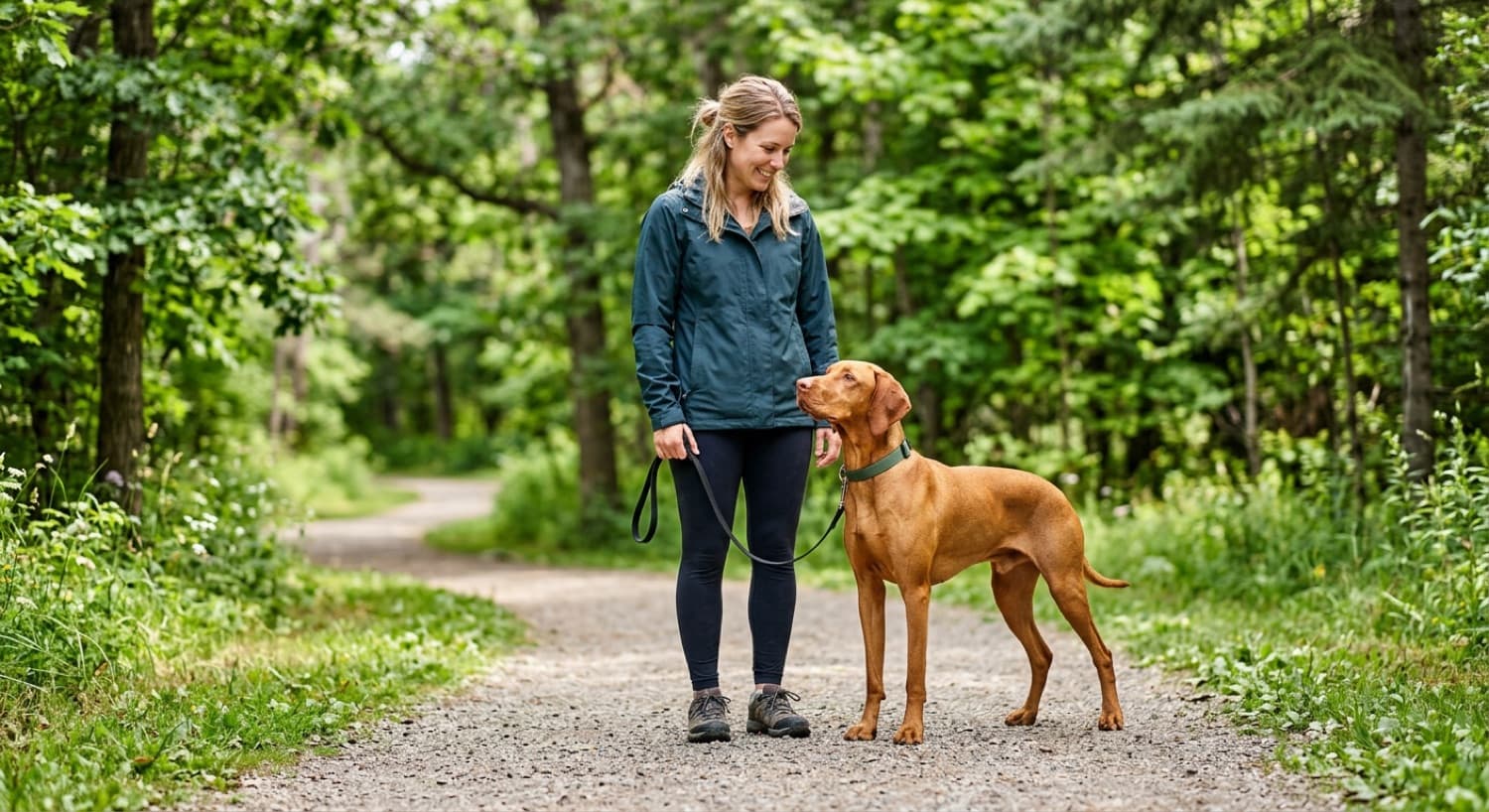
- Pre-departure exercise, 45 to 60 minutes. A real exercise session before the workday: a run, a vigorous off-leash session in summer, an active fetch game in winter. A tired Vizsla handles solitude better than a fresh one.
- Breakfast as enrichment. Frozen Kong, snuffle mat, or food puzzle. Not free-fed from a bowl. Builds calm activity at the post-exercise window.
- Pre-departure cue desensitisation. Pick up keys, put on coat, approach the door, then sit back down. Cues lose predictive value of an extended absence.
- Departure with a high-value chew. The chew predicts the absence and shifts the emotional valence. Low-key departure, no farewell rituals.
- Midday dog walker or daycare drop-off. Breaks the absence. Structured exercise and human contact at the midpoint.
- Quiet afternoon return for the dog. Settling time after midday activity, not a second burst of arousal.
- Low-key arrival. Ignore the dog for the first 2 to 3 minutes on return. No greeting party. Calm tone, normal household routine.
- Late afternoon exercise, 30 to 45 minutes. Second meaningful exercise session of the day.
- Dinner as enrichment. Same pattern as breakfast.
- Evening training session, 5 to 10 minutes. Skill layering, scent work, calm engagement.
- Settle on a mat during human evening time. Reinforced daily. Builds the off-switch.
- Predictable bedtime routine. Vizslas settle into structure quickly when it is consistent across days.
Some of the product links in this section are Amazon affiliate links — we may earn a small commission at no extra cost to you. It never changes which products we recommend.
Total handler time: about 90 to 120 minutes of structured input daily, plus the coverage that fills the workday. Some of this overlaps with normal household routine. The off-switch and the structured solitude work are the underrated pieces; many Vizsla SA cases improve substantially when the off-switch is reinforced even though the SA-specific work continues.
When SA becomes a medical emergency
Most Vizsla SA is a chronic management problem. A smaller subset crosses into medical emergency territory and warrants same-day intervention rather than next-appointment booking.
- Self-injury producing bleeding, broken teeth, or torn nails. Same-day vet visit. The dog has crossed from anxiety into self-harm and the containment setup needs to change immediately.
- Refusal to eat for more than 24 to 48 hours. Vizslas are typically food-driven; sustained refusal signals significant distress. Vet assessment to rule out medical contributors and adjust the medication or coverage plan.
- Chronic vomiting or diarrhea during absences, especially with weight loss. Stress-induced gastrointestinal disease that needs medical management alongside the behaviour work.
- Cardiovascular signs. Sustained tachycardia, collapse, or syncope during or after absences. Rare but documented in severely anxious dogs. Cardiac workup plus urgent behaviour intervention.
- Escape resulting in injury or loss. A Vizsla who jumps a fence or breaks a window during an absence needs both medical attention and an urgent reassessment of the containment and coverage plan.
The threshold question is whether the SA is producing physical harm beyond the chronic stress baseline. If yes, escalate quickly. The American Animal Hospital Association guidelines support primary-care vets initiating behavioural medication and coordinating with specialty referral for entrenched cases.
Frequently asked questions
How do I manage Vizsla separation anxiety in Edmonton?
Start with three foundations. First, rule out pain at the vet because chronic discomfort amplifies SA presentations and gets missed in active breeds (cross-link to the Vizsla health article). Second, find a force-free trainer credentialed through CCPDT or IAABC; aversive tools are contraindicated for any anxious dog by AVSAB position. Third, build a coverage plan that means your Vizsla is not actually alone for the 6 to 12 weeks of desensitisation work: a midday dog walker, doggy daycare two to three days per week, work-from-home days, or a family co-owner. Vizslas cannot be left alone 4 or more hours without significant distress while you train through SA. The plan starts with the coverage, not the dog.
Can a Vizsla be left alone at all?
A trained adult Vizsla with no underlying SA can usually handle 3 to 4 hours alone if exercise is real, mental work is built into the day, and the routine is consistent. Beyond 4 hours becomes a problem for the average Vizsla even without a clinical SA diagnosis. Beyond 6 hours daily is incompatible with the breed for most dogs. The owner who buys a Vizsla and works a standard 8-to-5 commute without daycare or a walker is the most common SA-driven surrender pattern Edmonton rescues see. Some individual Vizslas handle solitude better than others, but the breed-level baseline is high need for human presence.
What are the signs of separation anxiety in a Vizsla?
Destructive chewing of door frames, baseboards, and crates. Inappropriate elimination in a house-trained dog. Sustained vocalisation (barking, howling, whining) that neighbours hear. Self-injury including bloody paw pads from scratching at doors, broken teeth from biting crate bars, and torn nails. Escape attempts including jumping fences or breaking through windows. Refusal to eat while alone. Excessive greeting intensity on return. Anticipatory anxiety as you prepare to leave (pacing, panting, vomiting). A video camera is the diagnostic tool; many owners think their Vizsla is fine until they see the footage of pacing and panting for the entire absence.
Should I get a second dog to help my Vizsla with SA?
Usually no, and rescues will be upfront about this. SA is about the absence of the bonded human, not the absence of another dog. A second dog will not fix the panic, and you may end up with two anxious dogs instead of one. The exception is a dog with mild over-attachment rather than true SA; some of these dogs do settle better with company. True clinical SA needs human-focused treatment: behavioural medication, desensitisation, and coverage. Adding a second dog as an SA solution is a common owner mistake and produces a second surrender about half the time.
What medications are used for Vizsla separation anxiety?
Three commonly prescribed by veterinary behaviourists. Fluoxetine (a daily SSRI, similar to human Prozac) builds a baseline anxiolytic effect over 4 to 8 weeks and is the most-prescribed first-line option. Clomipramine (a tricyclic, Clomicalm is the licensed form for dog SA in Canada) works similarly. Trazodone is often added situationally for shorter-acting calming before departures. Combination therapy is common and adjusted by a board-certified veterinary behaviourist. Costs run $30 to $150 per month depending on the dog's weight and the drug. Medication is not a replacement for desensitisation; it is the platform that makes desensitisation possible.
When should I see a veterinary behaviourist for my Vizsla?
Sooner than you think. The DACVB threshold for SA cases is lower than for most other behaviour presentations because (a) true SA rarely resolves with training alone, (b) medication paired with desensitisation has the strongest evidence base, and (c) Vizsla SA tends to be entrenched. Escalate to a DACVB if your Vizsla cannot be left alone at all without panic, if home-alone destruction includes self-injury, if vocalisation is producing neighbour complaints, if a 4 to 6 week force-free desensitisation plan is not producing visible progress, or if the dog is refusing to eat or drink while alone. The closest DACVB-staffed program for Edmonton is the Western College of Veterinary Medicine at the University of Saskatchewan.
How long does it take to treat Vizsla separation anxiety?
Plan for 6 to 12 weeks of structured desensitisation to see meaningful change, and 6 to 12 months for a stable new baseline. Vizslas tend toward the longer end because the breed-level over-attachment is built in by selection. Medication starts working at the 4 to 8 week mark. Doggy daycare or a dog walker covers the gap during training. Owners who try to compress the timeline by skipping coverage and forcing the dog into long absences typically lose ground; the dog re-enters panic, the protocol resets, and the case becomes harder. Patience and consistent coverage win.
Is crate training good or bad for Vizsla SA?
It depends on the dog. Some Vizslas settle well in a covered crate with a high-value chew and find the small space reassuring. Others escalate panic in a crate to the point of breaking teeth on the bars. Never assume a crate will help an SA Vizsla without testing carefully. Start with the door open, brief intervals, owner present, and food rewards for entering and settling. If the dog escalates panic in the crate, the crate is not the right tool for this individual; a baby-gated room or open-door access to a safe space works better. Forcing a panicking Vizsla into a crate causes injuries and worsens SA.
How does Edmonton winter affect Vizsla SA?
It compounds it. The Vizsla is a short-coated active breed that needs serious daily exercise, and Edmonton winter shortens outdoor sessions significantly. An under-exercised Vizsla is a more anxious Vizsla; chronic under-arousal feeds the over-arousal at separation. Plan winter to include indoor enrichment that approximates the exercise volume: treadmill work, fetch in long hallways, structured nose-work games, food puzzles, indoor obedience drills. Skipping winter mental stimulation and assuming summer-level outdoor exercise will resume in May is a common Edmonton Vizsla mistake; SA presentations often spike in February and March when the cumulative under-exercise catches up.
Can I leave my Vizsla puppy alone?
Puppyhood is when the breed-level SA risk gets locked in or trained out. A Vizsla puppy left alone for long stretches between 8 and 16 weeks learns that absence equals distress, and the pattern often persists into adulthood. The protocol is gradual independence from day one: brief absences the puppy handles without distress, building to longer ones over months, paired with a high-value chew at departure and low-key arrivals. Daycare and dog-walker support during puppyhood are not optional for the typical Edmonton work-commute household; they are the foundation that produces an adult Vizsla who can handle reasonable solitude.
What does a Vizsla-friendly Edmonton work setup look like?
The realistic options are work-from-home most days, a dog-friendly workplace, lunch-hour walk-back coverage, twice-daily dog walkers, doggy daycare two to three days per week, or a family co-owner who shares coverage. A pure 8-to-5 commute with the dog alone all day is not a Vizsla-compatible setup regardless of how much exercise you give before and after. Adopters who recognise this before adoption and build coverage into their plan have successful Vizsla placements; adopters who assume the dog will adapt to their schedule produce the largest share of SA-driven surrenders in Edmonton rescue.
Related Edmonton Vizsla guides
Edmonton Adoptable Dogs
Current Edmonton-area Vizsla and Vizsla-mix listings from SCARS, EHS, AARCS Edmonton fosters, Zoe's, AHHRB, GEARS, and Hope Lives Here.
Vizsla Adoption Edmonton
The rescue-first Vizsla adoption guide: Edmonton intake patterns, surrender reasons, fees, breed-specific rescues, and adopter readiness.
Vizsla Health Issues: Epilepsy, Skin, Muscle
Vizsla health issues to plan for: epilepsy, sebaceous adenitis and allergies, an immune-related muscle disease that affects swallowing, hips and bloat.
Vizsla Exercise Needs Edmonton
90+ minutes of real daily exercise, year-round winter programming, and the river-valley running routes that Vizslas thrive on.
New dog? Start with these care guides
Everything a new adopter needs to set up a safe, happy home.