The short answer
A Vizsla in Edmonton needs 90 to 120 minutes of varied daily exercise plus 30 to 45 minutes of mental enrichment. The sporting pointer-retriever heritage selects for endurance running, scent processing, and constant handler partnership. Summer programming centres on river-valley sniff-and-run sessions, lake swims, and dog-sport class. Winter programming pivots to multiple short outings plus aggressive indoor enrichment because of the breed's thin single coat. Under-exercise compounds the breed's already-elevated separation anxiety baseline (see our Vizsla SA guide). Force-free training only; aversive tools are rejected by every credentialed body in North America.
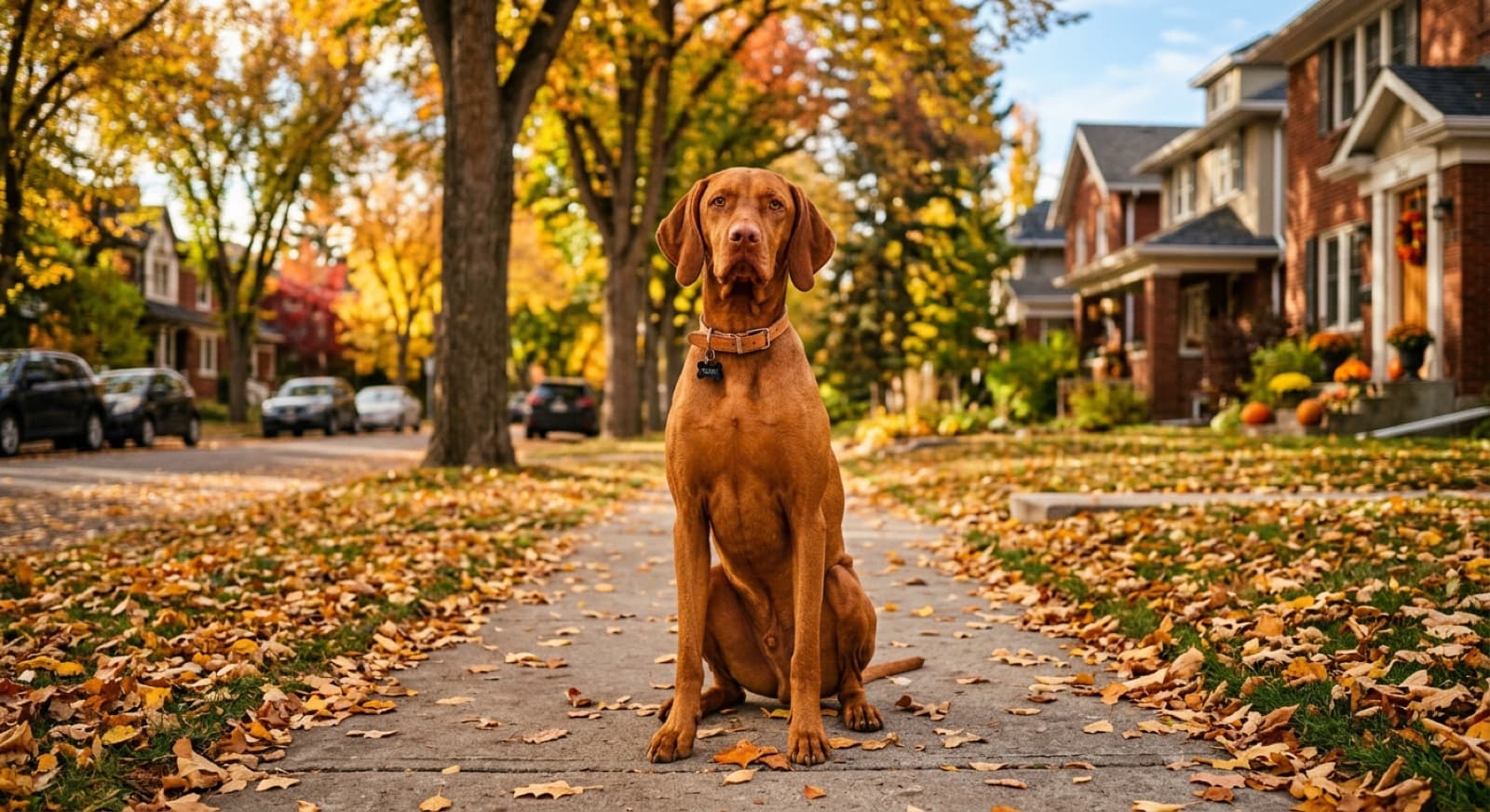
Why a Vizsla needs more than the average pet routine
The Vizsla was developed over centuries by Hungarian Magyar nobility as a pointer-retriever for falconry and upland game across the plains of central Europe. The selection pressure was for a dog that could run all day on varied terrain, find game by scent, point steady, retrieve cleanly to hand, and work in close partnership with the handler. The modern Vizsla still carries every one of those genetic instructions. A pet-home Vizsla being asked to live on two short leashed walks a day is running on a fraction of the fuel their nervous system expects.
Endurance, not sprint. Vizslas are sustained-moderate athletes, not short-burst sprinters. The breed thrives on 60 to 120 minute outings at jogging or fast-walk pace with constant scent processing built in. A 5 minute all-out fetch session leaves them buzzing; a 90 minute river-valley sniff-and-run leaves them satisfied. Programming for endurance is the single biggest shift owners make when they move from a Lab or Golden to a Vizsla.
Scent is the working organ. Pointer heritage selected for olfactory acuity. The nose wants to work as much as the legs do. Sniff work, nose games, scent discrimination, and tracking exercises produce more satisfaction per minute than physical exercise alone for most Vizslas. Twenty minutes of structured nose work tires the breed more than 45 minutes of pavement walking.
Close-handler partnership is non-negotiable. The Vizsla is the breed where separation anxiety is breed-defining. Centuries of Magyar selection for close-handler partnership produced a Velcro dog whose entire behavioural architecture assumes a human is nearby. Exercise that involves the handler (joint runs, training walks, sport class, sniff sessions led by the owner) is exponentially more satisfying than exercise the dog does alone in a yard. Yard time is not exercise for a Vizsla.
The 90 to 120 minute daily floor: what counts
The number adopters hear is 90 to 120 minutes a day of varied exercise. The number is right, but it deserves unpacking because not every minute is equal.
What counts as full Vizsla exercise
| Activity | Counts as exercise? | Notes |
|---|---|---|
| Off-leash river-valley trail run | Yes, fully | The gold standard. 45 minutes off-leash beats 90 minutes leashed. |
| Long-line work on a trail | Yes, mostly | Slightly less aerobic than full off-leash; counts as real exercise. |
| Lake swim in summer | Yes, fully | Excellent low-impact endurance work. Pigeon Lake, Wabamun, Alberta Beach. |
| Sport class (agility, nose work, dock diving) | Yes, fully | Counts as both physical and mental layer. |
| Brisk leashed neighbourhood walk | Partial | A 60 minute leashed walk is closer to 30 minutes of Vizsla exercise. |
| Sniffari (slow scent walk) | Yes, as decompression | Excellent mental work; pair with a vigorous session if it is the day's only outing. |
| Repetitive ball fetch | Partial, with caution | 5 to 10 minutes is fine. 45 minutes builds obsessive chase patterns. |
| Backyard alone time | No | A Vizsla alone in a yard is not exercising. The breed needs a handler. |
| Mental enrichment (sniff games, training) | Counts as the mental layer | 20 minutes of nose work tires a Vizsla as much as a 45 minute walk. |
The realistic Edmonton structure. Most owners who succeed with a Vizsla build the day around two outings plus a midday break. A morning session (45 to 60 minutes) and an evening session (45 to 60 minutes), with one of the two being off-leash or long-line in the river valley several days a week. The other is a structured training-walk hybrid or a sport practice. Add 30 to 45 minutes of mental work spread through the day (a puzzle-fed meal, a short training reps block, an evening scent game). That is the floor for an adult healthy Vizsla.
Adolescence costs more. A Vizsla between 10 and 24 months is at peak energy and peak need for outlets. Plan on the upper end of the range (closer to 120 minutes plus aggressive mental work) through that window. Skipping it produces the behavioural problems that fill rescue surrender forms.
Puppy caveat. If you have a Vizsla puppy under 12 months, do NOT hit the adult floor. The five-minute-per-month-of-age guide is widely cited and useful as an upper limit: a 4 month old puppy gets roughly 20 minutes of structured exercise. Growth plates close between 12 and 18 months; over-exercising during this window predicts hip and elbow problems for life. Sniff walks at the puppy's pace, short positive training sessions, and free play are correct. The full daily floor applies starting around 18 to 24 months.
The senior Vizsla (10 years plus)
Senior Vizslas drop to 45 to 75 minutes of lower-impact work spread across two or three shorter outings. The drive and intelligence stay; the joints and cardiac system slow. Programming shifts accordingly.
Lower-impact surfaces. River-valley dirt and grass trails over hard pavement. Swimming in summer (the breed naturally takes to water and arthritis pain decreases in water). Avoid repetitive jumping, stairs, or high-impact agility courses.
Mental work matters more, not less. A senior Vizsla benefits from increased structured enrichment as physical intensity drops. Daily sniff games, training sessions for new tricks, puzzle feeders, scent-discrimination exercises. The brain stays sharper and the dog stays connected to the household.
Watch for cardiac and orthopaedic decline. Book a senior workup at age 8 to 9 (full bloodwork, cardiac auscultation, joint exam) and repeat annually. The medical side of senior care lives in our Vizsla health guide.
Edmonton summer programming
Edmonton summer is when a Vizsla thrives. The breed was built for plains running, and the river-valley trail network plus lake-day access produces an exercise environment that genuinely matches the genetic design. Most behavioural problems quiet down between May and September simply because the dog gets what they need.
River-valley trail running. Hawrelak, Mill Creek Ravine, Whitemud Ravine, Terwillegar, and Capilano all offer the varied terrain, scent, and movement opportunity Vizslas thrive in. The full Edmonton off-leash parks guide covers each in detail.
Lake swims. Pigeon Lake (90 minutes south), Wabamun Lake (45 minutes west), Alberta Beach (60 minutes northwest), and Astotin Lake at Elk Island National Park (45 minutes east) all offer off-leash beach access on the right days. Swimming is the perfect Vizsla summer activity: low-impact, sustained-moderate, and naturally fits the breed's retrieve drive. Watch for blue-green algae warnings in late summer; the City of Edmonton and Alberta Parks publish current advisories.
Heat caution. Vizslas handle moderate heat well (the Hungarian summer is warmer than the Edmonton one), but heat plus humidity plus pavement is still a danger. Above 25 C with sun, shift exercise to pre-dawn (before 7 AM) or late evening (after 8 PM). The breed's deep chest can over-heat on noon-time pavement runs. Carry water on every summer outing.
Tick prevention is year-round in the river valley. Mild winters have extended tick activity past the old “spring to fall” window. Bravecto, NexGard, or Simparica monthly through the warm season at minimum, with year-round coverage on the rise as AVMA guidance updates. The medical side of tick prevention lives in our Vizsla health guide.
Edmonton winter programming: the hardest part
Edmonton winter exercise is where most Vizsla households struggle. The breed has a short single coat and almost no body fat, comparable to a Whippet in cold tolerance, not a Lab. Owner discipline plus structured indoor programming are the two pillars that hold the routine together.
Cold-weather thresholds for an adult healthy Vizsla
| Temperature | Outdoor programming |
|---|---|
| -5 to -10 C | Insulated coat. Normal sessions. 45 to 60 minutes is fine. |
| -10 to -20 C | Insulated coat plus booties. Sessions 30 to 45 minutes. Watch for shivering. |
| -20 to -25 C | Shorter pulses (20 to 30 minutes). Coat plus booties non-negotiable. Front-load indoor enrichment. |
| Below -25 C | Brief potty breaks only. Indoor enrichment is the whole day. |
The insulated coat is mandatory. Not a thin fleece. A real winter coat with insulation rated for sub-zero work (Ruffwear Powder Hound or Vert, Hurtta Extreme Warmer, Voyagers K9 Apparel). $110 to $210 is the realistic range. The coat needs to cover the chest, belly, and most of the torso; Vizsla body composition leaves no insulation reserve, and the dog shivers within 10 minutes of exposure without one.
Paw protection. Edmonton sidewalks are salted heavily through winter. Salt irritates pads, and a Vizsla's thin pads chafe faster than a thick-pad working breed. Options: dog boots (Muttluks, Ruffwear Polar Trex), paw wax (Musher's Secret, Pawtector), or both. Rinse with warm water after every winter walk regardless. Check between the toes for ice balls.
Sustained sessions vs short pulses. Below -20 C, switch from one long session to multiple shorter ones. Two 25 minute sessions plus 60 minutes of indoor enrichment beats one 50 minute session the dog is reluctant to start. Below -25 C, all real exercise moves indoors.
The river valley stays open all winter. Most river-valley off-leash zones stay snow-packed and walkable. With a properly coated Vizsla, the valley is usable on most winter days, just for shorter sessions. The cold is the limiting factor; the trails are not.
Indoor exercise programming
On the days when outdoor work has to be 5 minute potty breaks, the daily floor moves indoors. A 90 minute indoor enrichment day can be done as five 18 minute blocks spread across the day. The goal is mental load plus structured physical work in whatever space the household has.
Indoor scent searches. Hide 8 to 12 high-value treats around the main floor. Cue the dog to find them. Build up to scent-discrimination work using birch oil (the standard introductory scent in sport nose work). 20 minutes of structured nose work tires a Vizsla as much as a 45 minute walk. This is the single highest-ROI indoor activity for the breed.
Puzzle feeders. Kong Wobbler, Toppl, snuffle mats, lick mats, slow-feed bowls, food-dispensing puzzles (Outward Hound, Trixie). Replace at least one meal a day with one of these. Rotate weekly because Vizslas solve puzzles fast and disengage once they have it figured out.
Indoor flirt pole. A flirt pole (rope on a long pole with a toy on the end) channels prey drive in a confined space. Two or three short 5 minute sessions per day deliver real cardio. Avoid sharp turns on hardwood; use a rug or carpet to prevent slipping injuries.
Treadmill walks. Some Vizslas take to dog treadmills well. Introduce gradually with high-value rewards and short sessions. A 20 minute treadmill walk at moderate pace replaces a fair chunk of the daily floor on -30 C days. Used treadmills run $200 to $600; new dog-specific treadmills $1,000 plus.
Short training sessions throughout the day. Five-minute reps build skills faster than one 30 minute block. A morning sit-stay practice, a midday recall game in the hallway, an evening loose-leash walking drill, a bedtime trick session. Vizslas are biddable and food-motivated; pick a new trick every week.
Basement obstacle course. Household objects (broomstick low jumps, coffee table for the “table” command, blanket folds for weave-pole practice). Combined with stair laps and hallway recall games, an active basement can substitute for a fair bit of the daily floor through the deepest weeks of winter.
Off-leash strategy in the Edmonton river valley
The river-valley off-leash network is Vizsla terrain at its finest. The breed's scent-driven independence makes recall the central training project. Most Vizsla owners spend 4 to 8 months on long-line work before earning off-leash freedom in unfenced zones.
The bylaw. The City of Edmonton Animal Care and Control Bylaw restricts off-leash dog activity to designated zones. Off-leash outside a designated zone carries a fine that can reach the $250 range. A long-line clipped to a back-clip harness keeps you compliant on regular trails and gives a Vizsla real range to move while you build recall.
Coyote and wildlife scent lines. All five river-valley off-leash zones border corridors with established coyote populations. Dawn and dusk are the highest-traffic times. A Vizsla on a coyote scent line follows their nose, not their handler. The long-line is the only reliable management until the recall has been counter-conditioned past full scent arousal.
The 95 percent rule. Off-leash status is earned when the dog recalls reliably (95 percent or better) under moderate distraction. Most Vizslas reach this with 4 to 8 months of structured long-line work. Many do not reach it under full prey or scent arousal, and that is OK. A dog who stays on a long-line for life still has an excellent life.
The long-line is the realistic compromise. A 30 to 50 foot biothane line clipped to a back-clip harness gives the dog real freedom to sniff and range while keeping the option to stop them. Biothane is waterproof, washable, stays grippy when wet, and does not stiffen in Edmonton cold. Pair with a sturdy back-clip harness, not a flat collar.
Never near roads. Off-leash near any road, even a quiet residential street, is not negotiable for a Vizsla. A loose Vizsla who hits a scent line or sees movement can cross a road before recall fires. Off-leash zones only. Transit to and from is on a 6 foot leash.
Browse adoptable Vizslas in Edmonton
Edmonton rescues note daily exercise needs and recall progress on every Vizsla's foster profile. Read the foster notes carefully; some dogs come with reliable recall in low-distraction environments and a clear long-line program for distraction work. Activity baseline and SA history matter more than purebred status with this breed.
See Edmonton Adoptable Dogs →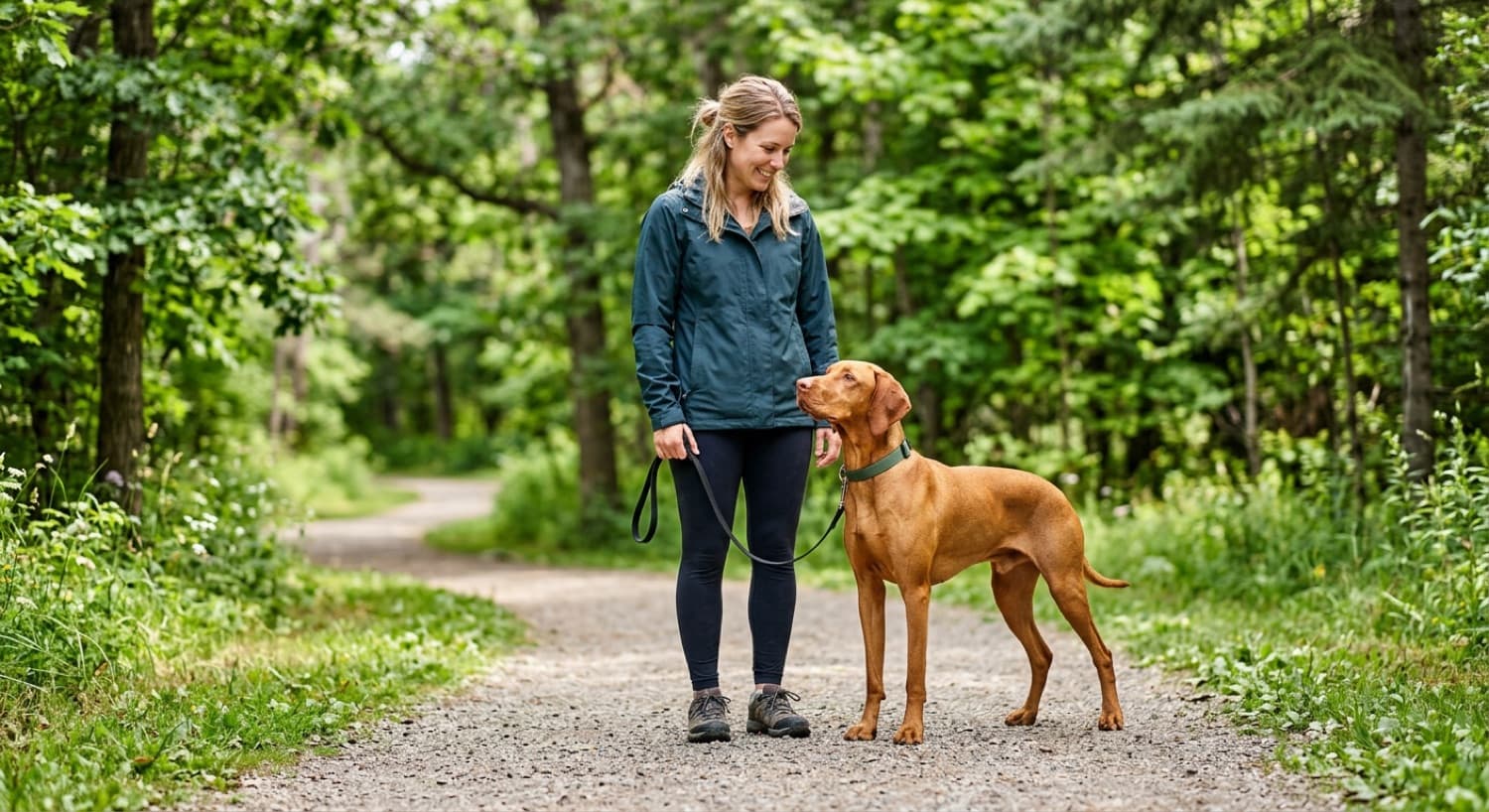
Recall training under scent drive
Vizslas are biddable, which makes recall teachable. They also have a scent-driven independence that can override anything you have built. The goal is to build recall solid enough that a single squirrel does not undo six months of work, and to recognise the situations where even a well-trained recall will fail.
Pick the recall word and never poison it. Choose a word the dog has not heard a thousand times. Avoid the dog's name as the recall cue. Use something distinct: come, here, to me. Whatever you pick, use it only when you can reward heavily and never call when you cannot enforce. A recall word called repeatedly without enforcement becomes a word that means nothing.
The reward hierarchy. Build a treat hierarchy: regular kibble at the bottom, mid-value training treats in the middle, very high-value rewards (real meat, cheese, freeze-dried liver) at the top. The high-value reward is reserved for recall. The Vizsla learns that the recall word predicts the best thing in their day, every single time.
The criterion ladder. Start in zero-distraction environments (your living room, then yard). Cue, reward, repeat. Build to low distraction (quiet residential street at off-peak), then moderate (a quiet park), then higher (a busier park), then the river-valley off-leash zone with the long-line still on. Each step requires the previous step to be solid.
What does not work. Punishing the dog for not coming. Calling repeatedly when the dog is not coming. Calling when you cannot enforce. Calling the dog only to leash up and end the fun. Aversive tools (prong collars, e-collars, alpha rolls) are rejected by every major credentialing body in North America (CCPDT, AVSAB, IAABC) and often make Vizsla recall worse by adding pain association to the recall cue.
Scent arousal is the unicorn. Even well-trained Vizslas can lose recall under full scent or prey arousal. A grouse flushing from cover, a deer crossing the trail, a coyote scent line. The dog's body fires the chase response before the brain processes the recall word. Build the ladder, build it solid, and keep the long-line on in any environment with active wildlife or moving prey-shaped stimuli.
Edmonton sport-dog landscape for Vizslas
Edmonton has an active dog-sport community. Scent work, agility, dock diving, tracking, lure coursing, and hunt tests are all available through community-based clubs. Specific clubs and class schedules change; the Edmonton breed-specific Facebook groups and rescue trainer referral lists are usually the best route to current information. The credentialed bodies (CCPDT, IAABC, AAHA) maintain directories of certified trainers, which is a useful starting point if you want a behaviour consultant alongside sport work. The Canadian Kennel Club sanctions hunt tests, field trials, and tracking events.
Scent work and nose detection. The single strongest fit for the breed. Pointer-bred olfactory drive turns scent work into a near-perfect outlet. The introductory scents in sport nose work are birch, anise, and clove oils. The progression is structured: build the alert behaviour, build the search pattern, add distraction. Scent work suits Vizslas with any reactivity because no other dogs need to be nearby.
Agility. The most accessible Edmonton dog sport. Pairs speed, precision, and handler partnership. Drop-in classes and full programs run year-round at indoor facilities. Vizslas have the athleticism and biddability to do well, though they tend to be more handler-dependent than Border Collies on course (which suits the breed's partnership orientation).
Dock diving. Vizslas naturally take to water, and their build supports strong dock-diving performance. A summer-only sport in Edmonton. Practice facilities open seasonally; backyard pools and lake docks let you practise on your own.
Hunt tests and field trials. The breed's original function. CKC-sanctioned hunt tests and NAVHDA (North American Versatile Hunting Dog Association) testing are increasingly accessible through Alberta clubs. Watch a Vizsla pointing live birds on a real field; the breed comes alive in a way no pet-home activity replicates. Verify any specific club or facility through current contact information before committing.
Lure coursing. Channels prey drive in a controlled fenced setting. The dog chases a mechanical lure on a wire course. Vizslas with high prey drive often do very well and burn enormous amounts of energy in short sessions.
Tracking. Builds on the breed's natural scent drive. A handler-and-dog sport that works year-round including in snow. Tracking suits Vizslas with strong recall and benefits handlers who want to deepen the working partnership.
The exercise and separation anxiety connection
Under-exercise amplifies any anxiety baseline, and the Vizsla baseline is already high. Adopters who shortchange the daily floor see destruction, vocalisation, escape attempts, and self-injury within weeks. The exercise routine is not a separate project from SA management; it is part of the foundation.
The mechanism. Movement metabolises stress hormones (cortisol, adrenaline). A well-exercised Vizsla sleeps deeper, settles faster, recovers from departures more quickly, and tolerates alone time better. An under-exercised Vizsla runs on a higher anxiety baseline all day and is more reactive to every trigger including the handler leaving the house.
But exercise alone does not cure SA. Clinical separation anxiety in a Vizsla rarely resolves with more walking. The full management protocol (force-free desensitisation, behavioural medications, DACVB referral threshold) lives in our Vizsla separation anxiety guide. If your Vizsla is destructive, vocal, or self-injuring when left alone despite hitting the daily exercise floor, that is the playbook to read next.
Mental work tires the Velcro dog faster than physical work. The handler partnership built into 20 minutes of training reps or scent work satisfies the breed's social-emotional needs as well as the cognitive ones. Pair physical and mental work daily and the dog settles into a better baseline state.
Common Vizsla exercise mistakes
Patterns we see across Edmonton Vizsla rescue placements and the surrender notes that come back to the foster network.
Under-exercising the adolescent. The 10 to 24 month window is peak destruction. Owners who cruise through puppyhood at 30 minutes a day hit a wall when the dog needs 120. Skipped exercise in adolescence is the leading cause of Vizsla surrender at the 1 to 2 year mark in Edmonton. Adopters: confirm the daily floor matches the dog's life stage before bringing the dog home.
Over-exercising the puppy. Long forced runs, repetitive jumping, marathon hikes, off-leash mountain biking with a puppy under 12 months. Growth plates close between 12 and 18 months; impact during this window predicts hip and elbow problems for life. Free play and short structured sessions are correct.
Yard time as exercise. A Vizsla alone in a yard is not exercising. The breed is breed-defining for handler partnership; exercise without the handler does not satisfy the social need. Yard alone time often produces fence-running, escape attempts, and barking at neighbours rather than real exercise.
Off-leash without proven recall. A 70 percent recall is not off-leash recall for a Vizsla. A single failure under scent arousal in the river valley can produce a dog kilometres away within minutes. The math on coyote risk, traffic risk, and getting-lost risk does not justify the freedom until the recall is 95 percent reliable under moderate distraction.
Repetitive ball fetch. Sporting breeds are uniquely vulnerable to obsessive ball fixation. A 45 minute ball-launcher session every day reinforces chase patterns that show up as shadow-chasing and OCD-pattern behaviour in the house. Short fetch sessions mixed with other activities are fine; daily marathon fetch is not. Never use laser pointers under any circumstances.
Skipping winter days. The owner who cancels three winter exercise days because of cold ends up with a destructive Vizsla by day four. The dog does not know it is -30 C; the dog knows they did not run today. Indoor enrichment fills the gap. Build a routine that survives -30 C or do not get the breed.
Aversive tools for reactivity. Prong collars and e-collars for reactivity in a Vizsla usually make the reactivity worse. The dog associates the trigger with the pain of the correction. Reactivity escalates. The fix is force-free desensitization and counter-conditioning, run with a credentialed behaviour consultant. It takes longer; it works.
Adding a second dog to fix the first one. “He needs a friend to wear him out” rarely works with Vizslas. An under-stimulated Vizsla plus a second dog usually equals two under-stimulated dogs, and the SA baseline does not resolve because the dog is still bonded to the human. The fix to an under-exercised Vizsla is more exercise and mental work for that Vizsla, not a second dog.
When to scale back exercise
The 90 to 120 minute daily floor assumes a healthy adult Vizsla. Several situations call for reducing intensity and consulting the vet first.
- Lameness or limping. Drop to 30 minutes of leashed walking until the vet has examined the dog. Hip dysplasia, elbow dysplasia, soft-tissue injury, and joint inflammation are all possibilities in the breed.
- Behavioural shutdown. A normally engaged Vizsla who suddenly refuses walks or stops eating may have a medical issue (pain, illness, anxiety spike). Vet first, exercise plan second.
- Cardiac irregularities. Coughing during or after exercise, exercise intolerance, or syncope (fainting) warrants an urgent cardiac workup. Reduce intensity immediately.
- Seizure activity. Idiopathic epilepsy is Vizsla-overrepresented. Recent seizures change the exercise calculus; talk with your vet about safe activity levels and avoid swimming alone or off-leash work near drop-offs during active seizure phases.
- Post-surgical recovery. Spay or neuter, orthopaedic surgery, or any procedure with a recovery window requires strict rest and gradual return per the surgical team. Follow the timeline; do not compress.
- Atopic dermatitis flare. Skin flares can be aggravated by heat, friction, and certain environments (long grass, dusty trails). Adjust the route during active flares and treat the skin first.
- Senior decline. A senior Vizsla who is slowing down is signalling joint pain or cardiac change. Book the vet, then adjust the routine.
Mental enrichment continues even when physical exercise is reduced. A Vizsla on injury rest still benefits from puzzle feeders, scent games at a slow pace, short positive training sessions, and quiet handler partnership.
Frequently asked questions
How much exercise does a Vizsla need in Edmonton?
Plan for 90 to 120 minutes of real daily exercise plus 30 to 45 minutes of mental enrichment for a healthy adult Vizsla. The breed was developed as a Hungarian pointer-retriever for all-day fieldwork on the plains, and that endurance does not disappear in a pet home. A 60 minute leashed walk is closer to 30 minutes of Vizsla exercise. Adolescent Vizslas (10 to 24 months) often need the upper end of the range. Senior Vizslas (10 years plus) drop to 45 to 75 minutes of lower-impact work. Edmonton owners who skip the floor for a bad-weather week see destruction, anxiety, and worsened separation distress within days. Build a routine that survives -30 C, not a routine that only works in July.
What is the difference between Vizsla, Border Collie, and German Shepherd exercise?
All three are high-drive working breeds, but the engine is different. Border Collies need precision, problem-solving, and structured tasks (herding, agility, scent work). German Shepherds want a working partnership with their handler, structured obedience, and protection-adjacent sport (IPO, tracking, search). Vizslas want endurance running plus scent work plus close-handler partnership; the sporting heritage means they thrive on varied terrain and long sustained moderate work rather than short high-arousal bursts. A Vizsla in agility is fine. A Vizsla on a 10 km river-valley sniff-and-run with their person is the breed at its best. Cross all three off the list if you cannot commit to daily structured work.
What do I do with a Vizsla in Edmonton winter?
Vizsla winter exercise is the hardest part of owning the breed here. They have a short single coat and almost no body fat, more comparable to a Whippet than a Lab. An insulated winter coat is non-negotiable below -10 C, booties protect pads from salt, and exercise shifts to multiple shorter outings plus aggressive indoor mental work. Below -20 C, sessions drop to 20 to 30 minutes. Below -25 C, treadmill walks, scent games, indoor flirt-pole sessions, puzzle feeders, and structured training fill the day. The owner who skips three winter days produces a destructive, anxious Vizsla by day four. Cold tolerance is the limiting factor for the dog; owner discipline is the limiting factor for the household.
Can I let my Vizsla off-leash in the Edmonton river valley?
Only inside designated off-leash zones, and only once recall is reliable at roughly 95 percent under moderate distraction. The river-valley off-leash network (Hawrelak, Mill Creek, Whitemud, Terwillegar, Capilano) is Vizsla terrain at its finest. The challenge is the breed's scent-driven independence; a Vizsla who hits a pheasant trail or a coyote scent line can be a long way away before recall lands. The realistic position: 30 to 50 foot biothane long-line clipped to a back-clip harness until recall holds under distraction. Most Vizslas reach reliable recall in 4 to 8 months of structured work. Some do not under full prey arousal, and a lifetime on a long-line is still a full life.
Is fetch good exercise for a Vizsla?
In short bursts, yes. As a daily 45 minute repetitive ball-launcher routine, no. The repetitive high-arousal pattern produces obsessive chase fixation in any sporting breed and can amplify the breed's already-elevated anxiety baseline. Better fetch programming: 5 to 10 minute fetch mixed with sniff work, training, tug, and free running on varied terrain. The Vizsla is built for sustained moderate endurance, not all-out sprint repetition. A swim in summer at Pigeon Lake or Wabamun, a long sniff-and-jog on a river-valley trail, an off-leash zone explore with the handler walking briskly. That is the breed's natural exercise pattern, not fetch.
How much exercise does a Vizsla puppy need?
LESS than an adult, not more. The five-minute-per-month-of-age guide is widely cited and useful as an upper limit: a 4 month old Vizsla puppy gets roughly 20 minutes of structured exercise plus free play. Growth plates close between 12 and 18 months. Over-exercising during this window (long forced runs, repetitive jumping, marathon hikes, off-leash mountain biking) predicts hip and elbow problems for life. Sniff walks at the puppy's pace, short positive training sessions, controlled socialisation, and free play are correct. The full 90 to 120 minute daily floor applies starting around 18 to 24 months once the dog is structurally mature.
How do I exercise a senior Vizsla?
Senior Vizslas (10 years plus) drop to 45 to 75 minutes of lower-impact work spread across two or three shorter outings. Joint integrity, cardiac status, and arthritis pain dictate the pace. Long sniff walks on softer terrain (river-valley trails over hard pavement), swimming in summer for arthritis relief, and structured mental enrichment to replace the physical intensity. Watch for early signs of cognitive decline (disorientation, altered sleep, accidents) and book the vet for a baseline senior workup at age 8 to 9 (full bloodwork, cardiac auscultation, joint exam). Do not retire a senior Vizsla to the couch; they still need engagement, just less intensity. Mental work matters more, not less, as the body slows.
What sports are good for an Edmonton Vizsla?
Scent work and tracking are the strongest fits for the breed's sporting-pointer heritage. Agility is accessible and works well. Dock diving suits the breed's natural swimming drive in summer. Lure coursing channels prey drive in a controlled setting. Hunt tests (CKC Field Trials, NAVHDA testing) honour the breed's original function and are increasingly accessible through Alberta clubs. Edmonton has an active dog-sport community; specific clubs and class schedules change, so the Edmonton breed-specific Facebook groups and rescue trainer referral lists are usually the best route to current information. Pick one or two sports that match your schedule and stick with them for at least 6 months to see real progress.
My Vizsla is destructive when I leave. Is that an exercise problem?
Partly. Under-exercise amplifies any anxiety baseline, and a Vizsla without daily structured work is at high risk for destruction. But Vizslas are the breed where separation anxiety is breed-defining (centuries of Magyar selection for close-handler partnership). If destruction continues alongside vocalisation, drooling, pacing, refusing to eat alone, self-injury, or anticipatory anxiety as you grab your keys, that is clinical separation anxiety and exercise alone will not fix it. The full management protocol (force-free desensitisation, behavioural medications, DACVB referral threshold) lives in our <a href="/alberta/dog-adoption-edmonton/resources/vizsla-separation-anxiety-edmonton">Vizsla separation anxiety guide</a>. Exercise is part of the foundation, but SA needs a parallel behavioural program.
Does sniff work really tire a Vizsla?
Yes, often more than a fast walk. The Vizsla nose is the breed's working organ; pointer heritage selected for olfactory acuity comparable to a Beagle's. A 20 minute structured sniff search (hidden treats around the house or yard, scent-discrimination exercises with birch oil, formal nose-work practice) leaves most Vizslas more settled than a 45 minute brisk walk. The cognitive load of scent processing is metabolically demanding. Edmonton owners who add 20 to 30 minutes of daily sniff work to their routine report less destructive behaviour and better settling within 2 weeks. It is the highest-ROI mental enrichment available for the breed and works year-round indoors when winter limits outdoor time.
What is the daily exercise routine for a working adult Vizsla owner?
A workable Edmonton structure: morning 45 to 60 minute walk or jog (off-leash zone twice a week, long-line in the river valley the other days), midday 20 minute sniff break (dog walker or work-from-home pivot), evening 45 to 60 minute outing (sport class, structured training-walk hybrid, or second river-valley session), plus 30 minutes of mental work spread across the day (puzzle-fed meal, short training reps, scent game). Weekend long sessions (2 to 3 hours on a river-valley trail, lake swim in summer, sport practice) bank exercise credit for the week. Vizsla owners who try to fit 90 minutes into one evening session after work usually fail; spread the work across the day.
More Edmonton Vizsla guides
Edmonton Adoptable Dogs →
Current Vizsla and Vizsla-mix listings from Edmonton rescues, with foster-tested activity and recall notes.
Vizsla Adoption Edmonton →
Edmonton rescue routes for Vizslas, adoption costs, surrender patterns, Vizsla mixes, and the breed-vs-buy reframe.
Vizsla Health Issues: Epilepsy, Skin, Muscle →
Vizsla health issues to plan for: epilepsy, sebaceous adenitis and allergies, an immune-related muscle disease that affects swallowing, hips and bloat.
Vizsla Separation Anxiety Edmonton →
The Velcro-dog playbook: desensitisation, behavioural medications, DACVB referral threshold, Edmonton daycare reality.
New dog? Start with these care guides
Everything a new adopter needs to set up a safe, happy home.