The short answer
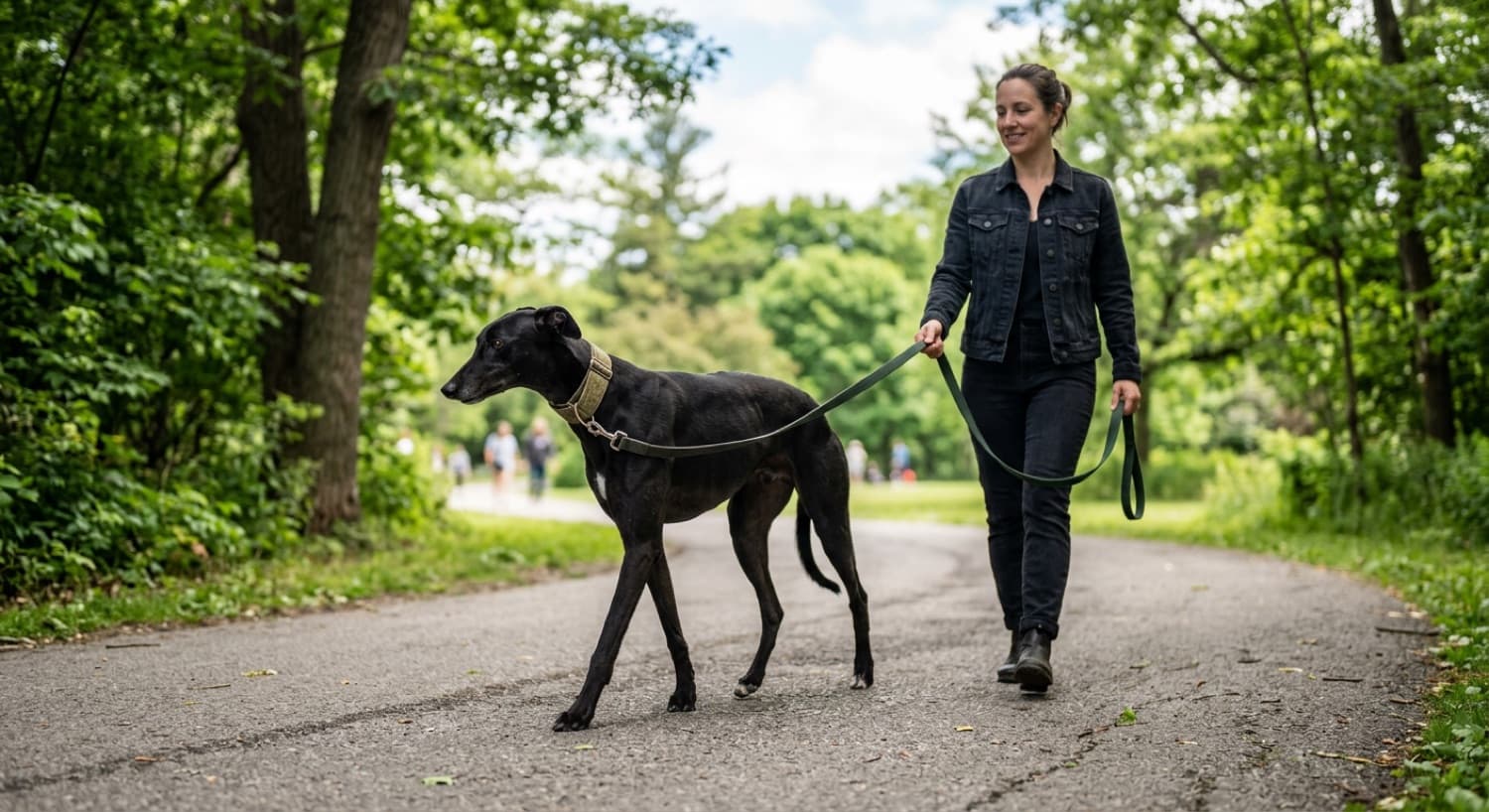
A Greyhound's strong prey drive plus 45-mph speed means a chasing dog is hundreds of metres away in seconds, with recall that effectively vanishes in chase mode, so the firm rule is never off-leash outside a securely fenced area. Always walk on a martingale collar (a regular collar slips off their narrow heads). You can train a recall, but never rely on it as your safety net. Exercise is easy despite the speed: leashed walks plus occasional fenced sprints fully meet the breed's modest needs (lure coursing is a great outlet). If a Greyhound gets loose, never chase, run away and act exciting. Vancouver's seawall, trails, and fenced dog parks suit a leashed Greyhound perfectly.
Why should a Greyhound never be off-leash in an unfenced area?
Because of a hardwired combination that no amount of training reliably overrides: a very strong prey drive and the fastest speed of any dog breed (~45 mph). Greyhounds were bred for centuries to chase, and one that spots something to chase, a squirrel, rabbit, cat, small dog, or even a blowing plastic bag, can switch into chase mode instantly and be hundreds of metres away within seconds, long before you can react or call it back. In that state its recall effectively vanishes; it is not being disobedient, it is being a sighthound. On or near Vancouver roads, trails, and open parks, that is genuinely life-threatening, for the Greyhound and potentially the animal it chases. This is why virtually every Greyhound rescue and experienced owner follows one firm rule: a Greyhound is only ever off-leash inside a securely, fully fenced area.
Our Vancouver off-leash parks guide covers the fully fenced areas where a Greyhound can safely run.
Can I train a reliable recall in a Greyhound?
You can and should train a recall, and many Greyhounds learn a decent one, but you must never rely on it as your safety net in an unfenced area, because when the prey drive kicks in, even a well-trained recall usually loses. Think of recall as useful for everyday situations and as one layer of safety, not as something that makes off-leash freedom safe. Train it as you would for any dog, high-value rewards, positive practice, gradually increasing distraction, but always on a leash or long line so the dog can never rehearse ignoring you and bolting. Practise in secure, fenced areas. The realistic mindset: I will train a good recall, and I will also always manage the environment so a recall failure cannot become a tragedy. Greyhounds are sensitive, trainable dogs that respond well to gentle, positive methods, but their sighthound nature means leashes and fences always come first.
What is a martingale collar and why do Greyhounds need one?
A martingale collar tightens gently and safely when the dog pulls or tries to back out of it, without choking, and it is the standard, recommended collar for Greyhounds. The reason is anatomy: Greyhounds have long, narrow heads that are actually smaller around than their necks, so a regular flat buckle collar can slip right over the head and off, and a frightened or determined Greyhound can back out of an ordinary collar in an instant and escape, exactly the disaster you are trying to prevent with a breed you cannot recall. A martingale prevents this by snugging up just enough when the dog pulls back, while sitting loose and comfortable the rest of the time. Every Greyhound should wear a properly fitted martingale on walks (many owners also use a harness as a backup, clipping the leash to both). It is inexpensive, essential safety gear, and your rescue will advise on fit.
How does a Greyhound get its exercise if it can't go off-leash?
Fortunately, this is easy, because Greyhounds have modest exercise needs despite their speed. A couple of good leashed walks a day (on a martingale) plus the occasional chance to sprint in a securely fenced area is plenty for most, who are otherwise happy to sleep 16 to 18 hours a day. For the sprinting they love, use a fully fenced dog park or yard where the dog can safely run flat-out for a few minutes, genuinely joyful to watch and satisfying to the sprinter's instinct. A long line (15 to 30 feet) lets a Greyhound trot and explore with more freedom while you keep control, useful on Vancouver trails. Some owners pursue sighthound activities like lure coursing (chasing a mechanical lure in a fenced field), a wonderful, safe outlet for the chase drive. A Greyhound does not need off-leash freedom to be well-exercised, leashed walks plus safe, contained sprinting fully meet the breed's needs.
What should I do if my Greyhound gets loose in Vancouver?
Act fast and stay calm, and do not chase, because chasing a loose sighthound turns it into a game and the dog runs further. If the dog is nearby, try crouching, turning side-on, or moving away while sounding happy and excited to draw it toward you, and use a familiar lure like a favourite treat or squeaky toy. Because Greyhounds are so fast, a loose one covers ground quickly, so if it will not come, keep it in sight from a distance without pushing it toward roads. For a truly lost Greyhound, mobilize immediately: post on local lost-pet networks and Vancouver-area Facebook groups, notify the BC SPCA and nearby shelters and vets, use the microchip registry, and if you adopted through a Greyhound-specific rescue, contact them at once, they have experience recovering loose sighthounds. This is exactly why prevention, the martingale collar, the never-off-leash rule, secure fencing, and a current microchip, matters so much every single day.
Does the off-leash restriction make a Greyhound a bad choice for Vancouver?
Not at all, and many owners find it barely limits them, because the breed's low energy means it does not crave the hours of off-leash running a herding or sporting dog does. Vancouver suits a leashed Greyhound very well: the seawall, beaches, and trails are perfect for calm leashed walks and long-line exploring, and the region's fenced dog parks give safe spots for the occasional joyful sprint. A Greyhound is content with a couple of leashed walks and plenty of couch time, so the leash-and-fence rule fits naturally into a relaxed city routine rather than feeling like a constant restriction. The dogs that struggle with the off-leash rule are high-energy breeds that need to run for hours, a Greyhound is not one of them. For a Vancouver owner who wants a large, gentle, low-key companion and is happy to keep walks on-leash, the restriction is a minor, easily-managed part of owning one of the easiest big dogs around.
Browse adoptable Greyhounds in Vancouver
The leash-and-fence rule fits a Greyhound's low-key nature beautifully. Browse Lower Mainland and Greyhound-specific rescues, each with a foster's notes on temperament and prey drive. Refreshed regularly.
See Available Greyhounds →Frequently Asked Questions
Why never off-leash outside fencing?
Strong prey drive plus 45-mph speed means a chasing Greyhound is gone in seconds with unreliable recall, near roads a life-threatening risk. Only ever off-leash inside secure fencing. It is the breed's nature, not bad training.
Can I train a reliable recall?
You can improve it, but never rely on it, prey drive usually beats even a good recall. Train on a leash or long line so the dog cannot rehearse bolting, and always manage the environment. Positive methods suit this sensitive breed.
Why a martingale collar?
Greyhounds have narrow heads smaller than their necks, so a regular collar slips off and a spooked dog can back out and escape. A martingale snugs up just enough to prevent this. Essential Greyhound gear; many add a harness backup.
How do they exercise on-leash only?
Easily, they have modest needs. Leashed walks plus occasional fenced sprints are plenty, and they sleep most of the day. Long lines add freedom; lure coursing is a great safe outlet. No off-leash freedom needed.
What if mine gets loose?
Do not chase. Crouch, run away, act exciting to draw it in; use a lure; keep it in sight from a distance. For a lost dog, post to lost-pet networks, notify the BC SPCA and vets, use the microchip, and call your Greyhound rescue.
Is the restriction a dealbreaker?
No, it barely limits most owners, because the breed's low energy does not crave hours of off-leash running. Vancouver's seawall, trails, and fenced dog parks suit a leashed Greyhound perfectly. It fits a relaxed routine.
Related Vancouver guides
Greyhound Adoption in Vancouver
Where to adopt in BC, why they are gentle couch potatoes, real costs, and who the breed suits.
Greyhound Health Issues
Anaesthesia sensitivity, dental care, bloat, bone cancer, and the breed's unusual bloodwork.
Adoptable Greyhounds in Vancouver
All currently available Greyhounds and mixes with foster notes on temperament and prey drive. Updates regularly.
Vancouver Off-Leash Parks
The fully fenced areas where a sighthound can safely run flat-out across the Lower Mainland.
New dog? Start with these care guides
Everything a new adopter needs to set up a safe, happy home.