The short answer
Huskies are one of the most over-bred and surrendered breeds in BC. Best Vancouver rescues: BC SPCA Vancouver, Loved at Last Dog Rescue, Langley APS, Heart and Soul. Adoption fee: $300 to $700 versus $1,500 to $3,000 or more from a breeder. Many BC rescue Huskies arrive through the northern BC transport pipeline. Skip free Husky listings, which are usually backyard breeders or scams, and verify any breed-specific rescue with the CRA registry, an address, and vet references before paying. Most Vancouver rescue Huskies are 2-to-6-year adults. Huskies are NOT for first-time owners. High energy, escape artist, vocal, prey drive. Senior Huskies (7+) are often the easiest path.
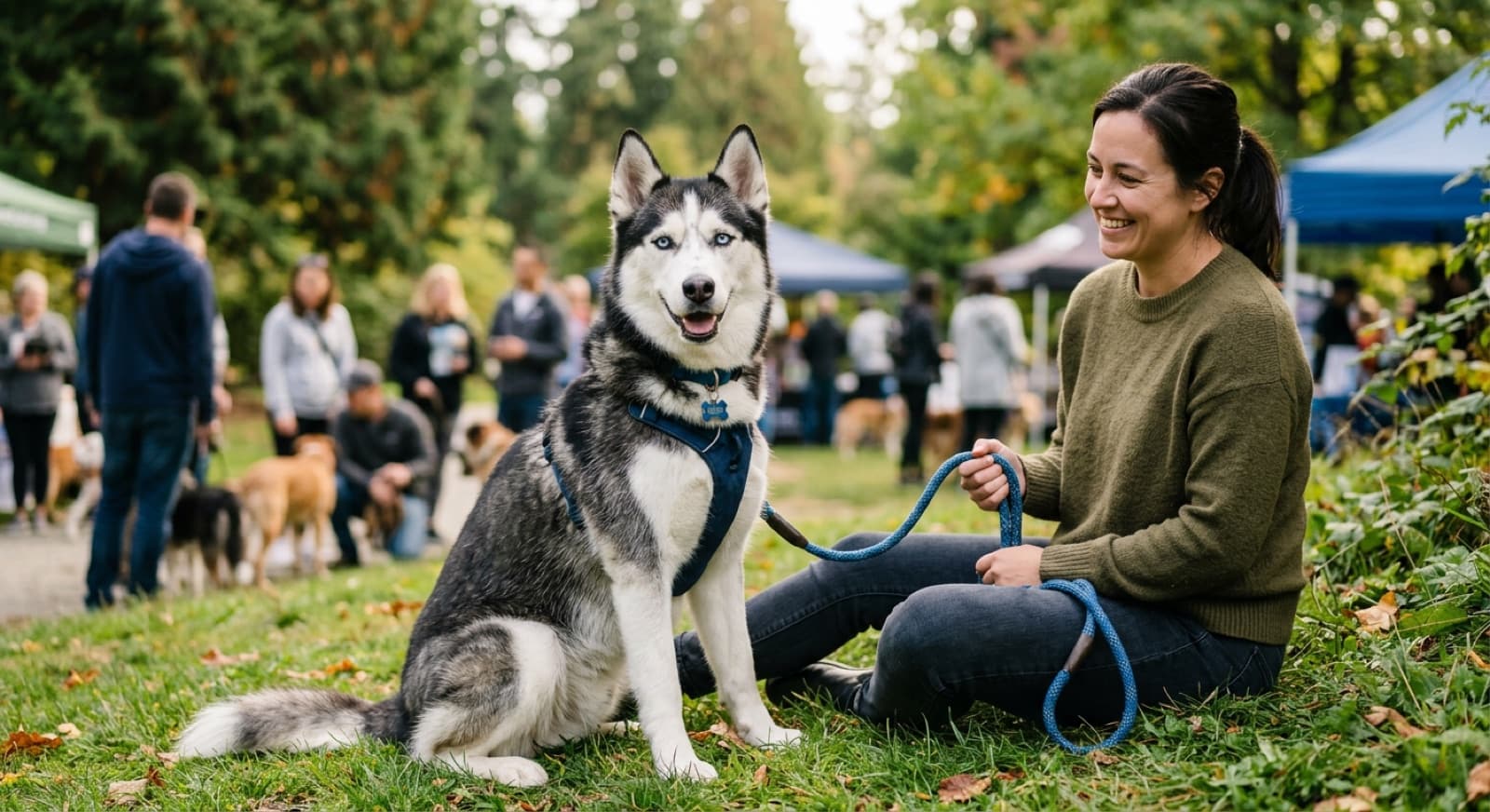
Where can I adopt a Husky in Vancouver?
Huskies appear in Vancouver-area rescues regularly. They are one of the most over-bred and surrendered breeds in BC. Best places to check: BC SPCA Vancouver, Loved at Last Dog Rescue, Langley Animal Protection Society (LAPS), and Heart and Soul Dog and Cat Rescue. Browse all currently available Huskies and Husky mixes (Pomsky, Labsky, Gerberian Shepsky) across Lower Mainland rescues at LocalPetFinder's Husky breed page. Listings update regularly. Many BC rescue Huskies arrive through the northern BC transport pipeline, surrendered from Interior and remote communities where the breed is heavily over-bred. The most common Vancouver Husky surrender reasons: exercise demands underestimated, escape artist behaviour, vocalisation in dense strata buildings, prey drive incidents, and lifestyle changes. Most surrendered Huskies are 2 to 6 year old adults; puppies are rare.
For the full Vancouver rescue landscape and how each organisation works, see our best dog rescues in Vancouver guide. If you are still unsure whether a Husky is the right breed for you, work through our Husky self-assessment first. It can save a surrender 12 months later.
Is there a husky-specific rescue in Vancouver or BC?
Husky-specific rescues exist across Canada, but their reach into the Lower Mainland varies, and some operate as volunteer-only Facebook networks rather than registered charities. We mention this honestly because adopters search for a dedicated husky rescue and then send money to whatever name comes up first. Before applying or paying any breed-specific rescue, run this checklist:
(1) Canada Revenue Agency charitable registry
(2) A physical address or named foster network
(3) Public-facing vet references
(4) Recent adoptable dog listings
Most Vancouver Husky adopters work through the major general rescues, which carry steady Husky inventory and verified governance: BC SPCA Vancouver, Loved at Last Dog Rescue, Langley APS, and Heart and Soul. Many of their Huskies came through the northern BC transport pipeline and have already had a full vet workup and a foster temperament assessment. Verify any Canadian husky-specific rescue claiming Vancouver placements through the same checklist.
How much does it cost to adopt a Husky in Vancouver?
Vancouver Husky rescue adoption fees range $300 to $700. BC SPCA Vancouver: roughly $250 to $500. Foster-based rescues (Loved at Last, Heart and Soul): often $500 to $700 because they cover transport costs from northern BC. Senior Huskies (7+ years): often reduced to $150 to $350. Fees include spay or neuter, vaccinations, microchip, deworming, and a basic vet workup. Buying from a breeder: $1,500 to $3,000 or more for standard pet-quality, $3,500 to $6,000 for show lines. Annual care: roughly $1,500 to $3,000 per year (food is the biggest line because Huskies eat a lot, plus a higher-grooming-cost double coat). BC insurance: commonly $40 to $70 per month for a young healthy Husky.
| Source | Husky Fee Range | What's Included |
|---|---|---|
| BC SPCA Vancouver | $250 to $500 | Spay or neuter, vaccines, microchip, vet check |
| Loved at Last / Heart and Soul (foster-based) | $500 to $700 | Spay or neuter, vaccines, microchip, transport, foster temperament plus medical history |
| Langley APS | $300 to $600 | Spay or neuter, vaccines, microchip, vet check |
| Senior Husky (7+ years) | $150 to $350 | Same as above. Reduced fee. |
| Standard breeder puppy | $1,500 to $3,000 or more | Initial vaccines only |
| Show line / breeding-quality | $3,500 to $6,000 | CKC papers, health-tested parents |
Are there free Huskies for adoption in Vancouver?
Almost never legitimately. Free Husky listings on Craigslist, Kijiji, or Facebook Marketplace are typically:
(1) Backyard breeders using free framing as bait-and-switch (the real cost reveals at $500 or more when you arrive)
(2) Owners trying to bypass rescue surrender screening by giving the dog to anyone (significant behavioural unknowns and no medical workup)
(3) Outright scams demanding shipping or vet-release fees for non-existent dogs
Real Husky adoption is never free. Even the lowest BC SPCA fee covers basic medical care at well below cost. The free Husky search is one of the riskiest dog searches in BC because Huskies are heavily over-bred in Interior and northern communities, and many of those dogs end up in informal Craigslist rehoming with no history. Owner-rehoming with a small fee ($100 to $300) can be legitimate, but it requires verification: vet records, original adoption paperwork, an in-person meeting at the dog's current home, and behavioural transparency.
Should I look at “Husky puppies for sale Vancouver” instead of adoption?
Adoption is the better path for most Vancouver households. The BC Husky surrender rate is high precisely because too many people bought a Husky on looks without understanding the breed. Adopting an adult means the breed reality has already played out and the rescue can tell you what you are getting.
If you do buy from a breeder, only choose breeders who:
- Are CKC-registered (Canadian Kennel Club)
- Health-test both parents (eye CERF/CAER, hip OFA, thyroid panel)
- Allow home visits and meeting both parents
- Take dogs back at any age
- Never sell through pet stores or Craigslist
- Require contracts with spay or neuter clauses
- Run a waitlist
Husky breeder search results in BC are dominated by backyard breeders. Verify carefully. For the broader rescue-first reasoning, see our Vancouver rescue guide and the breed-fit walkthrough in our is a Husky right for you guide.
Siberian Husky vs Alaskan Husky: what is the difference?
Different dogs entirely.
| Trait | Siberian Husky | Alaskan Husky |
|---|---|---|
| Recognised breed? | Yes (CKC/AKC) | No (working type) |
| Adult weight | 35 to 60 lbs | 40 to 65 lbs (varies) |
| Origin | Chukchi people of Siberia | Various working crosses |
| Bred for | Endurance plus appearance | Performance only |
| Distance sled-race dogs | Rare | Common |
| Vancouver rescue prevalence | Common | Rare (more in Interior / northern BC) |
The Alaskan Klee Kai is a third, separate breed: a smaller (10 to 22 lb) Husky-look dog developed in the 1970s, very rare in BC. If you adopt a Husky in Vancouver, it is almost certainly a Siberian Husky or a Siberian/working mix. For the recognised Siberian Husky breed standard, weight ranges, and temperament profile, see the AKC Siberian Husky breed profile.
What is a Pomsky, Labsky, or Gerberian Shepsky?
Common Husky designer mixes:
| Mix | Cross | Weight | Notes |
|---|---|---|---|
| Pomsky | Husky plus Pomeranian | 15 to 30 lbs | Husky personality in a small body. Vocal, escape-prone, stubborn. AI breeding only. |
| Labsky / Huskador | Husky plus Labrador | 40 to 60 lbs | More sociable and trainable than a purebred Husky. Still high energy. |
| Gerberian Shepsky | Husky plus German Shepherd | 45 to 85 lbs | Intelligent and intense. Often the most demanding Husky mix. |
| Aussie Husky | Husky plus Australian Shepherd | 35 to 65 lbs | High drive, herding instincts, very high exercise needs. |
All Husky mixes inherit some combination of high energy, prey drive, vocalisation, and escape tendencies. Vancouver rescues often label dogs as Husky mix on appearance alone. Actual DNA frequently reveals additional breeds (Border Collie, Cattle Dog, German Shepherd ancestry). Read each rescue's temperament notes carefully.
Why are so many Huskies in Vancouver and BC rescues?
Huskies are consistently among the most over-bred and surrendered breeds in BC. Common surrender reasons:
(1) Exercise demands underestimated. 90 or more minutes vigorous daily, which many owners cannot sustain
(2) Escape artists. Jump six-foot fences, dig under, open doors, slip leashes. Lost-Husky reports are frequent across Metro Vancouver
(3) Vocalisation. Howling rather than barking, often extended. A serious problem in dense strata and rental buildings
(4) Prey drive. Many Huskies cannot live with cats, small dogs, or small pets
(5) Recall failure. Bred to run for hours; many never have reliable off-leash recall
(6) Northern BC over-breeding. Huskies are heavily over-bred in Interior and remote communities, then surrendered or transported south to Lower Mainland rescues in large numbers
(7) Pandemic-era impulse buys. Now being surrendered as costs rise and lifestyles shift
Most surrendered Huskies are well-socialised but have specific needs (active home, secure yard, no small pets) that screen out many adopters. For the wet-coast double-coat angle that surprises new owners, see our Husky shedding and grooming guide, and for breed-specific medical patterns see our Husky health issues guide.
Are there Husky puppies in Vancouver rescues?
Rare. Most Vancouver rescue Huskies are 2 to 6 year old adults, surrendered after the puppy phase reveals the full breed reality. Purebred Husky puppies almost never appear in rescues. Be open to a young adult Husky (1 to 3 years). Same temperament as a puppy but past the worst chewing phase, often house-trained, and you can see actual size and coat. Husky mix puppies (especially Husky/Lab and Husky/Shepherd crosses) appear somewhat more often, usually as northern BC litter surrenders.
How long do Huskies live?
12 to 15 years typically. Longer than most large breeds. They are one of the healthier purebreds, with fewer breed-specific genetic diseases than brachycephalic breeds or large guardian breeds. Major health issues to watch for: eye conditions (cataracts, progressive retinal atrophy, glaucoma, corneal dystrophy; Siberian Huskies show a notably elevated prevalence of inherited eye disease), hip dysplasia, hypothyroidism, and zinc-responsive dermatosis (a Husky-specific skin condition where the dog cannot absorb zinc properly). The BC SPCA publishes guidance on responsible-source dog adoption and health screening, and OFA maintains the public parent health-results database (eyes, hips, thyroid). Annual vet visits including eye exams catch most issues. A Vancouver Husky adopted at age 2 will likely be with you for 10 or more years. See our Husky health issues guide.
What is a Husky temperament like?
Huskies are notoriously NOT what most people expect. Despite the wolf-like appearance, they were bred for endurance and team work, not guard work. Most Huskies are friendly with strangers, terrible alarm dogs, and not protective.
Key temperament traits:
- Independent. Bred to make decisions on the trail, not to look to humans for direction
- High energy. 90 or more minutes daily exercise non-negotiable, with mental stimulation just as important
- Vocal. Howling, talking, screaming, wooing. A real problem in Vancouver strata and rental buildings
- Stubborn. Extremely intelligent but uninterested in obedience for its own sake
- Escape artist. Will test every fence, door, leash, and gate
- Pack-oriented. Many do best with another dog companion
- Prey driven. Many cannot safely live with cats or small animals
Excellent companions for the right active home. Challenging or destructive in the wrong fit. The off-leash recall problem matters in particular on the busy Stanley Park seawall, the Pacific Spirit Park trails, and the North Shore mountains, where a bolting Husky can be hard to recover. Work through our is a Husky right for you guide for the Vancouver fit assessment.
Are Huskies good for first-time dog owners in Vancouver?
Generally no. Huskies are one of the most challenging breeds for first-time owners. The BC Husky surrender rate reflects this. The breed disproportionately ends up in rescue because owners chose a Husky on appearance without understanding the temperament.
If you are committed to a Husky as your first dog, five non-negotiables:
- A secure six-foot fenced yard. Minimum, and sometimes still inadequate. In a strata or rental, escape-proofing is even harder.
- A genuine 90-plus-minute daily exercise commitment. Every day, including coastal rain and the summer heat that is the real danger for a double-coated dog here.
- Force-free training from week one. Look for a Vancouver force-free trainer experienced with high-drive northern breeds; verify a current website and recent client references before booking.
- Lifestyle compatibility. A condo plus a 9-to-5 job plus no yard usually means avoid Huskies.
- Acceptance that off-leash recall may never be reliable, which matters on busy seawall and park trails.
Better first-time-friendly breeds with a similar look: Lab or Golden (similar energy, far more trainable), Australian Shepherd (high energy but more biddable). Before you commit, run through our Husky self-assessment.
Should I adopt a senior Husky?
Strongly consider it. Senior Huskies (7+ years) appear in Vancouver rescues regularly. These dogs are typically much calmer than younger Huskies. Exercise needs drop to 45 to 60 minutes daily, escape behaviour decreases, and recall is often more reliable after years of experience. They are usually house-trained, well-socialised, and bond quickly to whoever feeds them. Adoption fees are often reduced ($150 to $350). With good care, many Huskies reach 13 to 15, giving you 5 to 7 more years together. Senior Huskies are often the easiest Husky adoption you can make. The wild edge is gone.
Why do people specifically search for female Siberian Huskies for adoption?
Common reasons adopters search for a female Siberian Husky specifically: (1) household compatibility, since many existing-dog homes have a male resident and want a female to reduce same-sex tension; (2) slightly smaller size, with females typically 35 to 50 lbs versus 45 to 60 lbs for males; and (3) a reputation for slightly less wandering, which varies widely by individual. Reality check: the individual Husky matters far more than gender. Female Huskies can be just as escape-prone, vocal, and prey-driven as males. All Vancouver rescue Huskies are spayed or neutered before adoption, removing intact-female complications. BC rescue Husky surrender ratios are roughly even between males and females. If you have a strong preference, check listings frequently.
Browse adoptable Huskies in Vancouver
Live inventory from Lower Mainland rescues including northern BC transport Huskies, Pomsky and Labsky mixes, and senior dogs at reduced fees. Refreshed regularly.
See Available Huskies →Frequently Asked Questions
Where can I adopt a Husky in Vancouver?
BC SPCA Vancouver, Loved at Last Dog Rescue, Langley APS, and Heart and Soul. Browse current Vancouver Huskies and mixes (Pomsky, Labsky, Gerberian Shepsky) at LocalPetFinder's Husky breed page (updates regularly).
Is there a husky-specific BC rescue?
Some exist as volunteer or Facebook networks with limited Lower Mainland reach. Verify any with the CRA registry, an address, vet references, and recent listings before paying. Most adopters use the major general rescues.
Husky adoption cost in Vancouver?
$300 to $700 from rescues versus $1,500 to $3,000 or more from breeders. Annual care $1,500 to $3,000 per year. BC insurance commonly $40 to $70 per month for a young healthy Husky.
Free Huskies?
Almost never legitimate. Backyard breeders, rehoming that bypasses rescue screening, or scams. Over-bred Interior and northern BC Huskies often end up in informal Craigslist rehoming. Real adoption is never free.
Husky puppies for sale vs adoption?
Adoption is better for most. The BC surrender rate is high, and the rescue can tell you what you are getting. Verify CKC registration plus parent health testing if buying.
Siberian vs Alaskan Husky?
Different. Siberian is a CKC-recognised breed, 35 to 60 lbs. Alaskan is a working-type cross (Husky/Malamute/Pointer/Greyhound), the distance sled-race dogs. Vancouver rescues see Siberians; Alaskan is rare in the urban Lower Mainland.
Pomsky/Labsky/Gerberian Shepsky?
Pomsky (Pom cross, 15 to 30 lbs, AI-bred), Labsky (Lab cross, more trainable), Gerberian Shepsky (Shepherd cross, most demanding). All inherit Husky energy and prey drive.
Why so many Huskies in BC rescues?
Heavily over-bred in northern BC and the Interior, then transported south. Plus exercise underestimated, escape artist, vocal, prey drive, recall failure, and pandemic surrenders. Most are well-socialised but need specific homes.
Husky puppies in rescues?
Rare. Most rescue Huskies are 2 to 6 year adults. Be open to young adults (1 to 3 yr). Husky mix puppies appear more often as northern BC litter surrenders.
How long do Huskies live?
12 to 15 years. Long for a large breed. Watch for eye conditions (elevated inherited prevalence), hip dysplasia, hypothyroidism, and zinc-responsive dermatosis.
Husky temperament?
Friendly with strangers (terrible alarm dog), independent, high-energy, vocal, stubborn, escape artist, pack-oriented, prey-driven. Bred for endurance and team work, not guarding.
Huskies for first-time owners?
Generally no. Need a secure six-foot fence, 90-plus-minute daily exercise, force-free training, no condo plus 9-to-5 job, and acceptance of unreliable recall. Better first-time-friendly: Lab, Golden, Aussie.
Senior Husky adoption?
Strongly consider it. Calmer (45 to 60 min exercise), often house-trained and bonded, $150 to $350 reduced fees. With good care, many have 5 to 7 years left.
Female Husky preference?
Common preferences: same-sex household compatibility and a slightly smaller size (35 to 50 vs 45 to 60 lbs). Individual personality matters more than gender. Roughly even surrender ratio at BC rescues.
The full Husky cluster
Adoptable Huskies in Vancouver
All currently available Huskies and Husky mixes (Pomsky, Labsky, Gerberian Shepsky). Updates regularly.
Is a Husky Right for You?
An honest checklist: exercise, shedding, secure fencing, recall, alone-time and heat.
Husky Health Issues: Eyes, Skin, Thyroid
Siberian Husky health issues to plan for: juvenile cataracts, corneal dystrophy and PRA, zinc-responsive skin disease, hypothyroidism, epilepsy and degenerative myelopathy.
How to Groom a Husky
A Siberian Husky grooming guide: why you never shave the double coat, surviving the coat blow, the self-cleaning coat, why Huskies are low-maintenance, and cost.
All Vancouver Dogs
Browse every adoptable dog from Lower Mainland rescues in one place, with size, energy, and compatibility filters.
Best Dog Rescues in Vancouver
Every Vancouver-area rescue reviewed on cost, wait time, and best fit by adopter type.
New dog? Start with these care guides
Everything a new adopter needs to set up a safe, happy home.