The short answer
Set up one safe room with food, water, a litter box and a hiding spot, and leave your cat in it for the first few days. Expect hiding and very little eating. Keep the shelter's litter and food for a fortnight, then transition slowly. Register with a vet in week one. Follow the 3-3-3 rule: three days to decompress, three weeks to learn the routine, three months to feel at home. Go to an emergency vet for straining in the litter box.
The most common message rescues get in the first week is some version of the same worry. The cat is under the bed. The cat has not eaten. The cat hissed. Did we choose wrong?
Almost always, no. A cat that has just been moved has lost its territory, its smells, its routine and every person it knew, in one car journey. Hiding is not distress at your house specifically. It is a sensible strategy for an animal that does not yet know whether the house is safe.
What follows is what to set up before the cat arrives, what each phase actually looks like, and the small number of things that are genuinely not normal and need a phone call. If you are still choosing, the Saint John cat listings are refreshed regularly, and the rescue guide covers the application-first process at the local shelter.
The 3-3-3 timeline
| Phase | What to expect | What you do |
|---|---|---|
| First 3 days | Hiding, barely eating, no interest in you | Leave them alone in the safe room, sit quietly nearby |
| First 3 weeks | Coming out when the house is quiet, testing routines | Open the safe room, keep feeding times predictable |
| First 3 months | Real personality appears, often a different cat entirely | Normal life, plus play twice a day |
A shape, not a schedule. Shy cats and cats from difficult situations often take considerably longer, and that is still a successful adoption.
Before the cat arrives: the safe room
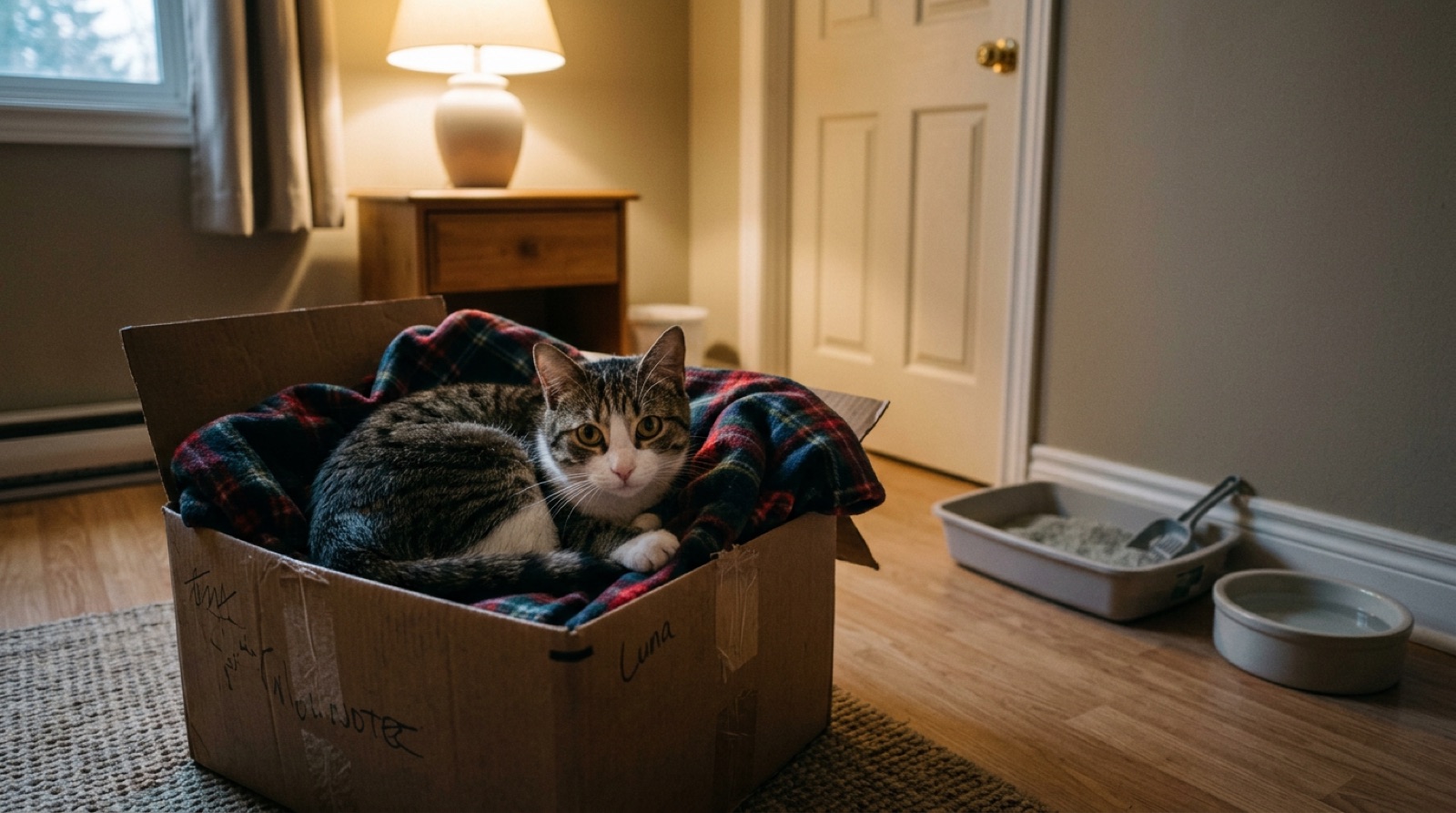
Pick one small quiet room and put everything in it: food, water, litter box, a hiding place, something soft to sleep on. A spare bedroom works, and so does a bathroom. The instinct to give a new cat the run of the house is kind and it backfires, because a whole house is far too much territory to assess at once.
A few things specific to older Saint John housing stock. Check for gaps behind built-in cupboards and around radiators, because a frightened cat will find one within the hour and you will spend an evening with a torch. Avoid the coldest room in a drafty house. If there is a disused chimney flue, block it properly.
You will also need a carrier before adoption day, since Saint John SPCA Animal Rescue requires cats be transported in one. Put the carrier in the safe room with the door open and a blanket inside. It stops being a scary box and becomes another hiding place, which pays off enormously at the first vet visit.
Days one to three: leave them alone
Carry the carrier into the safe room, open the door, and walk away. Do not tip the cat out. Let them choose when to leave it, which may be hours after you have gone to bed.
Then do very little. Go in to change food, water and litter, and otherwise sit on the floor for ten minutes reading something aloud so the cat maps your voice to something harmless. No picking up, no pulling out from under the bed, no visitors, no big introductions to the family. That can all wait a week and it will go far better for waiting.
Eating will be minimal and probably happens overnight when the house is silent. That is fine for a couple of days. A cat that has eaten nothing at all for more than 48 hours needs a veterinary call, since cats can develop liver complications when they go without food.
Litter and food: change nothing yet
For the first fortnight, keep the cat on whatever the shelter was feeding and whatever litter they were using. Ask at adoption. The Saint John SPCA Animal Rescue adoption kit includes a Royal Canin food sample and coupons, which tells you what the cat has been eating.
After two weeks, transition over roughly seven to ten days by shifting the ratio a little each day. The reason to go slowly is diagnostic as much as digestive. If you swap food abruptly and the cat has diarrhea, you have no way to tell whether it is the food, the stress of moving, or a parasite that needs treating.
For litter boxes, the standard is one per cat plus one spare. In a two-storey Saint John house, put a box on each floor at first. A nervous cat will not commit to an unfamiliar staircase to reach a toilet, and you will read the resulting accident as a behaviour problem when it was a layout problem.
Week one: get registered with a vet
Do this before you need it. Phone Fundy Animal Hospital on McLean Street in the city, or Kennebecasis Valley Animal Hospital on Hampton Road in Rothesay if you are out toward Quispamsis, and get your cat onto their books.
The shelter includes one complimentary veterinary visit at a clinic in their partner program as part of the $250 fee, so ask which clinics that covers on adoption day and use it. It is a free health check with someone who will then have a baseline for your cat.
For evening problems that are not emergencies, the Greater Saint John Veterinary Clinic in Quispamsis runs noon to midnight seven days a week. Put all three numbers in your phone this week rather than searching for them at 11 p.m. with a sick cat.
Go straight to an emergency vet for these
Straining in the litter box while producing nothing, especially in a male cat, is a urinary blockage until a vet proves otherwise, and it is life-threatening within hours rather than days. Do not treat it as a litter box behaviour problem. Also go immediately for laboured or open-mouthed breathing, collapse, repeated vomiting, suspected poisoning, or a cat that has eaten nothing for over 48 hours.
Port City Veterinary Emergency Hospital on McAllister Drive is open 24 hours a day, seven days a week. Never give a cat human pain medication, which is toxic to them, and never wait until morning to avoid an after-hours fee.
Browse adoptable Saint John cats
Set the safe room up first, then find the cat who gets to use it. Listings refreshed regularly.
See Available Saint John Cats →Frequently Asked Questions
What is the 3-3-3 rule for a rescue cat?
It is a rough timeline for how a rescue cat settles: three days to stop being terrified, three weeks to start learning your routine, three months to feel genuinely at home. The point of knowing it is that it stops you panicking in week one. A cat wedged behind a dryer refusing food for two days is not a failed adoption, it is a normal Tuesday. Treat the numbers as a shape rather than a schedule, because shy cats and cats from rough situations often run longer than three months.
How do you set up a safe room for a new cat?
Pick one small quiet room, put everything the cat needs in it, and close the door. You want food, water, a litter box, somewhere enclosed to hide, and something soft. A spare bedroom or a bathroom both work. In older Saint John houses, avoid the coldest room and anything with an open chimney flue or a gap behind built-in cupboards, because a frightened cat will find that gap within an hour. Sit in the room reading aloud for ten minutes at a time so the cat learns your voice without pressure.
Why is my new rescue cat hiding and not eating?
Because it has just lost every reference point it had, and hiding is what cats do about that. Expect it for the first few days. What you can do is leave food down, keep the room quiet, and resist pulling the cat out from under the bed, which teaches it that hiding places are not safe either. That said, a cat that has eaten nothing at all for more than 48 hours needs a veterinary call, because cats can develop liver problems when they stop eating for extended periods.
When should you let a new cat out of the safe room?
When the cat starts coming to the door rather than away from it, which is often around day four to seven. Open the door and let them explore on their own terms instead of carrying them out. Keep the safe room set up for another couple of weeks so they always have a bolt-hole they know. If you have stairs, and most Saint John houses do, expect the cat to claim an upstairs corner first and work downward as confidence grows.
How do you switch a rescue cat to new food?
Slowly, over roughly a week to ten days. Start with mostly what the shelter fed and a little of the new food, then shift the ratio a bit each day. The shelter sends home a Royal Canin adoption kit with a food sample and coupons, which makes this easier because you know what they were on. A sudden switch on top of the stress of moving is a reliable way to cause diarrhea, and then you cannot tell whether the upset is the food, the stress, or something that needs a vet.
What about litter, and where should the box go?
Use the same litter type the shelter used for the first fortnight if you can, then transition gradually the same way you would with food. Put the box somewhere quiet with a clear escape route, never in a cupboard where the cat can be cornered, and never right beside the food. The rule of thumb is one box per cat plus one spare. In a two-storey Saint John house, put a box on each floor at first, because a nervous cat will not commit to a staircase to reach a toilet.
When should you register with a vet in Saint John?
In the first week, before you need one. Phone a full-service clinic such as Fundy Animal Hospital on McLean Street or Kennebecasis Valley Animal Hospital in Rothesay, and get your cat on their books. The shelter includes one complimentary veterinary visit at a clinic in their partner program, so ask which clinics that covers when you adopt. Registering early matters because a practice that has never seen your cat has no obligation to fit you in when something goes wrong.
What counts as an emergency in the first week?
Go to an emergency vet immediately for straining in the litter box with nothing produced, especially in a male cat, since a urinary blockage becomes life-threatening within hours. Also for laboured breathing, repeated vomiting, collapse, suspected poisoning, or a cat that has eaten nothing for more than 48 hours. Port City Veterinary Emergency Hospital on McAllister Drive is open 24 hours a day. Do not wait for morning to save an after-hours fee, and never give a cat human pain medication.
How do you introduce a new cat to a resident cat?
Through a closed door first, for longer than you think. The safe room does this work for you. Feed both cats on either side of the door so they associate the other smell with something good, then swap bedding between them so each learns the other scent. Only after that do you allow a brief supervised look, ideally through a cracked door or a baby gate. Rushing this is the most common cause of a resident cat deciding the newcomer is a permanent enemy.
What about introducing a cat to a dog?
Same principle, more caution, and always give the cat a route upward that the dog cannot follow. Keep the dog leashed for early meetings and end the session while it is still going well rather than waiting for it to go wrong. Never leave them together unsupervised until you have weeks of calm behaviour behind you. If your dog has a strong chase drive, be honest with yourself about it and get help from a trainer rather than hoping the cat sorts it out.
Should you let a new cat outside to explore?
No, and not later either if you can help it. A newly adopted cat has no reason yet to think of your house as home, so a cat let out in the first weeks may simply keep going. Beyond that, Saint John is a genuinely rough city for roaming cats between the Fundy fog, the steep streets and the winter storms, and the City does not respond to reports of stray or missing cats. Keep the cat in, and build a catio or try a harness if you want them to have outdoor air.
When will my rescue cat actually seem happy?
Usually somewhere in the second or third month, and it often arrives suddenly rather than gradually. One evening the cat that has been polite and distant jumps onto the sofa, sits on you, and behaves as though it has always lived there. Owners describe it as the cat switching on. If you are past three months and your cat still seems frightened rather than simply shy, talk to your vet, because chronic fear is worth ruling out a medical cause for rather than accepting as personality.
Related Saint John Guides
Find the cat for that safe room
Adoptable cats from Saint John area rescue organisations, in a single list.
Browse Available Saint John Cats →New cat? Start with these care guides
Everything a new adopter needs to set up a safe, happy home.