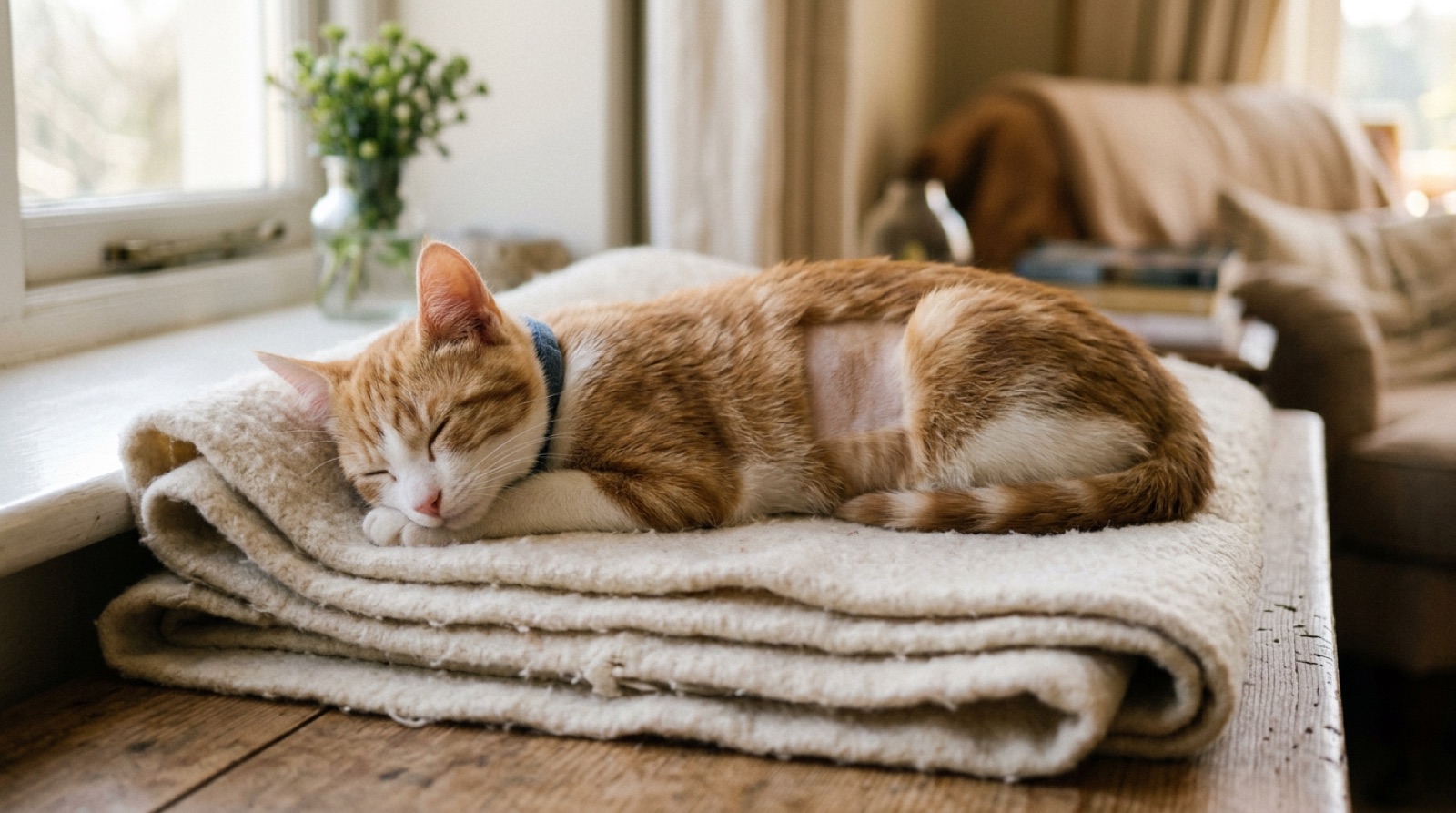
The short answer
Adopt from Saint John SPCA Animal Rescue and the spay or neuter is already included in the $250 fee. Otherwise, book through a full-service clinic such as Fundy Animal Hospital or Kennebecasis Valley Animal Hospital, and ask for a quote that includes bloodwork, pain relief and HST. If money is the barrier, the NBSPCA Happy Tails Fund subsidises the surgery for low-income owners, though its funding is currently constrained. Recovery is roughly ten to fourteen quiet days.
Most people reading this fall into one of two groups, and the advice is completely different for each. If you adopted, the surgery is behind you. It happened before the cat came home, it is inside the fee you already paid, and nobody is going to hand you a bill for it later.
The other group is everybody who ended up with a cat some other way. A kitten from a coworker. A stray who moved in over a Fundy winter and never left. A barn cat somebody could not keep. Those cats need the surgery arranged, and in a city with one shelter and no local low-cost clinic, that takes a bit more legwork than it does elsewhere.
The rest of this covers who does it locally, what help exists if the cost is a genuine barrier, what the recovery fortnight actually involves, and the symptoms that should send you to an emergency hospital rather than to a search engine.
If you adopt, it is already done
Saint John SPCA Animal Rescue lists the spay or neuter surgery among the inclusions in its flat $250 cat fee, alongside vaccines, deworming, flea treatment, microchipping and one complimentary visit at a partner clinic.
That is worth pausing on if you are comparing a shelter cat with a free kitten. The surgery is typically the single largest line item in the first year of veterinary care for a young cat, and here it is folded into a fee that is smaller than the surgery would be on its own. Our cost breakdown runs the comparison properly.
One thing not named in their published inclusions is feline leukemia and FIV testing. Ask about the specific cat rather than assuming, particularly if you already have cats at home.
Where to get it done in the Saint John area
| Clinic | Where | Role | Published hours |
|---|---|---|---|
| Fundy Animal Hospital | 3 McLean St, Saint John | Full-service clinic, surgery and dental | Mon to Fri 8am to 6pm, Sat 9am to 1pm |
| Kennebecasis Valley Animal Hospital | 90 Hampton Rd, Rothesay | Full-service clinic, spay and neuter, imaging | Mon 9am to 7pm, Tue to Fri 9am to 5pm |
| Greater Saint John Veterinary Clinic | 208 Hampton Rd, Quispamsis | Walk-in and urgent care, dogs and cats | Noon to midnight, 7 days |
| Port City Veterinary Emergency Hospital | 212 McAllister Dr, Saint John | Emergency only, not routine surgery | Open 24 hours, 7 days |
Hours as published July 2026. Always phone before travelling, and note that the emergency hospital is for emergencies rather than booked routine surgery.
Local clinics, and what to ask them
Fundy Animal Hospital on McLean Street is a full-service practice in the city itself, offering surgery, dental work with radiology, in-house imaging and lab work, microchipping and parasite control. Kennebecasis Valley Animal Hospital on Hampton Road in Rothesay covers similar ground including spay and neuter, dental, ultrasound and digital radiography, which is the more convenient option if you live out toward Quispamsis or Rothesay.
The Greater Saint John Veterinary Clinic in Quispamsis runs noon to midnight seven days a week and explicitly serves cats, which makes it useful for evening appointments when a nine-to-five practice cannot fit you in.
When you phone, ask for the full quote rather than the surgery price. Bloodwork, pre-anaesthetic screening, pain medication to take home, an e-collar and the post-op check may be separate lines. Ask what is included and what is extra, and ask whether the figure has HST added, because 15% on a surgery quote is a real number.
If cost is the barrier: the Happy Tails Fund
The New Brunswick SPCA Happy Tails Fund exists to give low-income families access to basic veterinary care. It covers subsidised spay and neuter, rabies and core vaccines, parasite prevention, and some emergency and unexpected medical procedures.
You apply by emailing happytails@nbspca.ca with your name, contact number, pet information, location and proof of income. The proof of income is not optional. The fund works through partner clinics across the province, and one of the listed partners is a walk-in and urgent care practice in the Saint John area, which makes this route practical rather than theoretical for local owners.
The honest caveat matters more than the pitch. The NBSPCA has posted that community need for subsidised veterinary care has outstripped its financial resources and that it is actively fundraising. Do not treat the fund as a guaranteed backstop. Email and ask what is currently available before you build a plan around it.
The recovery fortnight
Your clinic sends you home with discharge instructions. Those instructions beat anything written here, including this paragraph. What follows is the general shape so nothing surprises you.
Day one is groggy. Cats coming off anaesthetic are wobbly, sometimes vocal, and often want to be left alone in a dark quiet room. Give them that. Keep other pets and children away, and keep the cat somewhere warm on one level, which is worth thinking about in the older Saint John housing stock where the only quiet room is often up two flights of stairs.
Days two through fourteen are about restraint, mostly yours. No jumping, no climbing, no outdoors at all, and the e-collar stays on. Cats are extremely good at licking a healing incision open the moment you take pity on them. Check the site once a day so you notice a change early.
Appetite usually returns within a day. A cat that is still refusing food after that, or that seems painful, withdrawn beyond the usual, or is breathing oddly, needs a phone call rather than another night of watching.
Straining in the litter box is an emergency in male cats
This is unrelated to surgery but it is the single most important thing on this page. A male cat who is going to the litter box repeatedly and producing nothing may have a blocked urethra. That is life-threatening within hours, not days. Other signs are crying in or near the box, straining that looks like constipation, and persistent licking at the genitals.
Go to a veterinarian immediately. Port City Veterinary Emergency Hospital on McAllister Drive is open 24 hours a day, seven days a week, for exactly this. Do not try a home remedy, do not wait for morning, and do not start reading litter box behaviour guides until a vet has ruled a blockage out. Never give a cat human pain medication, which is toxic to them.
Why it matters in a city with one shelter
Saint John has no cat licence, no cat registration, and a City that states outright that it does not respond to reports of stray or missing cats or provide for their care. Everything routes to the SPCA on Bayside Drive.
That means the unfixed cat population is not managed by anybody in particular, and there is no verified trap neuter return program operating locally that we can point you to. CARMA has done TNR across the Maritimes as a registered charity since 2005 and works through independent chapters, but its website is being rebuilt and no live Saint John chapter page exists right now.
The practical upshot is that one household fixing one cat matters more here than it would in a city with a funded municipal program absorbing the overflow. If you have found a colony rather than a lost pet, phone the shelter and ask what is possible rather than trying to trap alone.
For general background on the reasoning behind the surgery, the American Veterinary Medical Association overview is readable and not trying to sell you anything. Timing decisions still belong to your own veterinarian.
Browse adoptable Saint John cats
Every cat here arrives already spayed or neutered, vaccinated and chipped, so the surgery is one thing you never have to arrange. Listings refreshed regularly.
See Available Saint John Cats →Frequently Asked Questions
Does a rescue cat from Saint John SPCA come already spayed or neutered?
Yes. The spay or neuter surgery is one of the published inclusions in the flat $250 adoption fee at Saint John SPCA Animal Rescue, alongside vaccines, deworming, flea treatment and a microchip. This is the single strongest financial argument for adopting rather than taking a free kitten from a classified listing. The surgery is done, the recovery is behind the cat, and you never see the bill. If you adopt, this whole article becomes background reading rather than a to-do list.
How much does it cost to spay or neuter a cat in New Brunswick?
Prices vary a lot by clinic and by procedure, and we would rather you phoned than trusted a number from the internet that goes stale. What holds true is the shape of it. A neuter on a male cat is a shorter, simpler surgery than a spay on a female, so it costs less. Bloodwork, pain medication, an e-collar and any pre-anaesthetic screening may be quoted separately or bundled. Ask for the full quote including HST rather than the headline surgery price.
Is there low-cost cat spay and neuter in Saint John?
The main route is the New Brunswick SPCA Happy Tails Fund, which subsidises spay and neuter for low-income pet owners along with rabies and core vaccines, parasite prevention and some emergency care. You apply by emailing happytails@nbspca.ca with your name, contact number, pet information, location and proof of income, which is required. There is an important caveat. The fund has posted that demand has outstripped its resources and that it is actively fundraising, so confirm current availability before you count on it.
What age should a cat be spayed or neutered?
This is a conversation for your veterinarian rather than a rule you should take from a website, because the right timing depends on the individual cat. What is broadly agreed is that waiting is riskier than most owners assume. An unspayed female cat can become pregnant far younger than people expect, and an unneutered male will start spraying and roaming. The American Veterinary Medical Association has a plain-language overview of the reasoning worth reading before your appointment. Book the consult and ask.
What does recovery look like after a cat is spayed or neutered?
Most cats are noticeably themselves again within a few days, and males usually bounce back faster than females because a neuter is a smaller procedure. Your job for roughly ten to fourteen days is keeping them quiet and stopping them licking the site. That means no jumping onto the top of the fridge, no going outside at all, and the e-collar stays on even though the cat will make you feel terrible about it. Follow the discharge instructions your clinic gives you over any general advice, including this.
When should you phone the vet after a spay or neuter?
Phone if the incision is swelling, opening, oozing anything other than a little clear fluid, or smells wrong. Phone if your cat is refusing food for more than a day, hiding to an unusual degree, breathing oddly, or seems painful when you approach the belly. Do not wait it out to avoid an after-hours fee. Port City Veterinary Emergency Hospital on McAllister Drive is open 24 hours specifically for this. A quick call that turns out to be nothing is a good outcome, not a wasted call.
Is straining in the litter box an emergency?
For a male cat, yes, treat it as one immediately. A blocked urethra stops a cat passing urine and it becomes life-threatening within hours, not days. The signs are repeated trips to the box with nothing produced, crying in or near the box, straining that looks like constipation, and licking at the genitals. Go to an emergency veterinary hospital straight away rather than trying anything at home or waiting for the morning. This is not a behavioural problem and litter box advice does not apply until a vet has ruled a blockage out.
Does spaying or neutering change a cat behaviourally?
It removes the behaviours driven by hormones, which is usually what people want. Unneutered males spray urine to mark, roam long distances looking for females, and fight over territory, which is how they end up with abscesses and injuries. Unspayed females come into heat repeatedly and vocalise loudly through it. What it does not do is change your cat into a different animal. Playfulness, affection and personality come from the cat, not the reproductive organs.
Will my cat get fat after being fixed?
Metabolism does slow after the surgery, so the honest answer is that it can happen if you keep feeding the same amount. It is manageable rather than inevitable. Ask your clinic to recalculate the portion at the post-op check, and measure food rather than free-pouring into a bowl. Indoor Saint John cats are more prone to it in general, because there is no summer of hunting to burn anything off and roughly five months of the year when nobody opens a door for long.
Are there TNR or feral cat programs in Saint John?
Not one we can send you to with a working website, and we would rather say so than point you at something that has folded. CARMA is a registered Maritime charity that has done trap neuter return since 2005, but it operates by independent local chapter and its site is currently being rebuilt with no live Saint John chapter page. The City of Saint John states plainly that it does not respond to reports of stray cats or provide for their care. If you have a colony rather than a lost pet, phone Saint John SPCA Animal Rescue and ask what is possible.
Does the City of Saint John require cats to be fixed or licensed?
There is no cat licence in Saint John and no cat registration requirement. The City licenses dogs at $10 fixed or $25 unfixed, and its animal pages carry nothing equivalent for cats. One place it does come up indirectly is adoption. Saint John SPCA Animal Rescue requires that pets already in your home are spayed or neutered and licensed before they approve you, so an unfixed resident animal can hold up an application even though no bylaw compels you.
Should you fix an indoor-only cat?
Yes, and the reasoning is not really about accidental litters. Spraying is the practical one. An unneutered male in an apartment will mark walls and furniture with urine that is genuinely hard to remove, and it starts around sexual maturity whether or not he has ever been outside. Repeated heat cycles in an unspayed female are loud and stressful for the cat. There are also health considerations your vet can walk you through. Indoor-only does not make the surgery optional.
Related Saint John Guides
Adopt a cat with the vetting behind it
Adoptable cats from Saint John area rescue organisations, in a single list.
Browse Available Saint John Cats →New cat? Start with these care guides
Everything a new adopter needs to set up a safe, happy home.
Cat & Dog Spay/Neuter Cost in Canada
Standard and subsidised pricing by province, and how to find a low-cost clinic wherever you are.