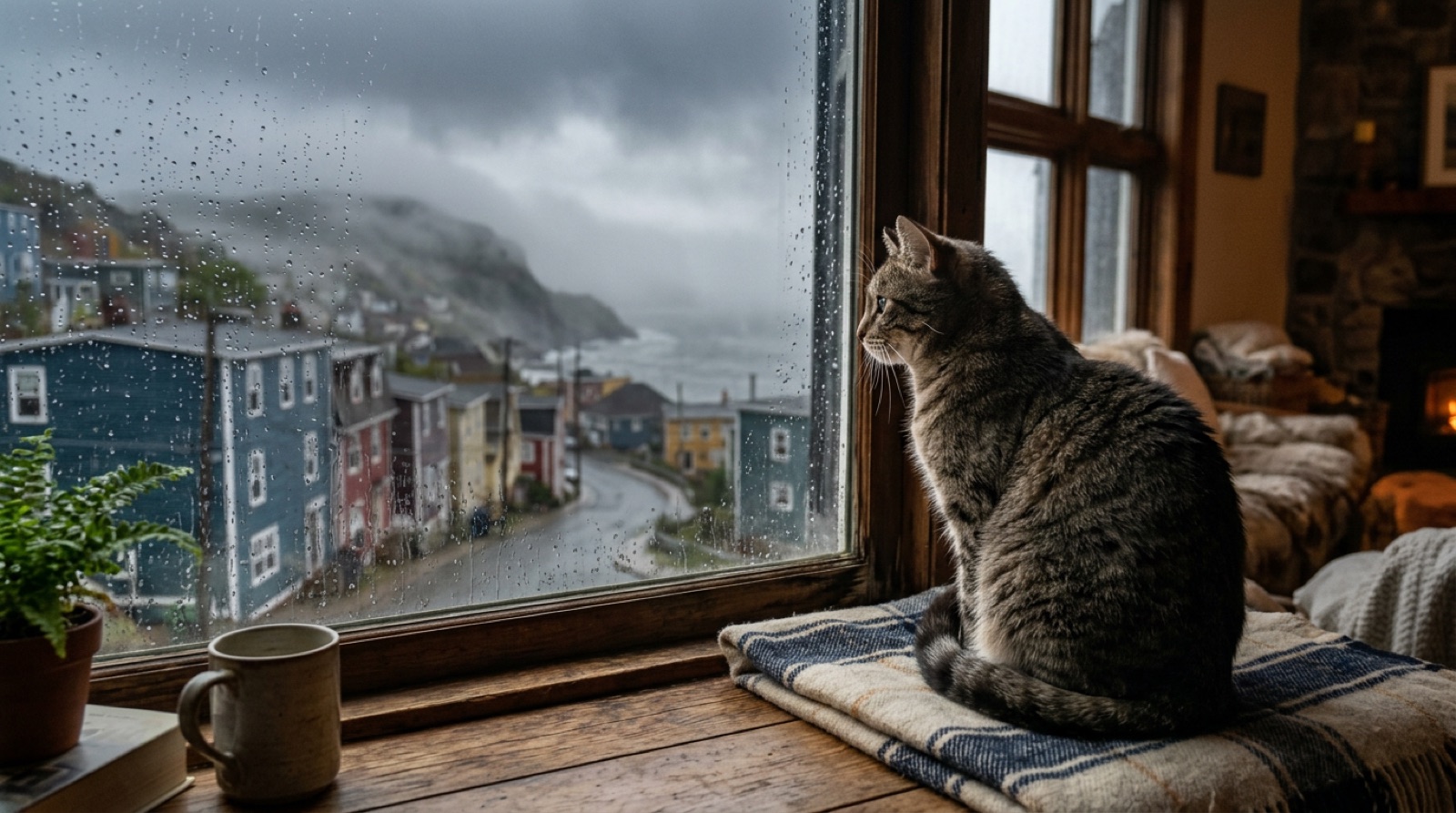
The short answer
Keep cats indoors in Saint John. The specific local risks are heavy Fundy sea fog that hides a cat from drivers, steep streets with short stopping distances, winter storms, road salt, and antifreeze. There is also no municipal safety net, since the City does not respond to stray or missing cat reports. Make indoor life work with height, window perches, puzzle feeders and real daily play. A catio built for wind gives outdoor time safely.
Every city has a version of this argument, and in most of them it comes down to traffic. Saint John has traffic too, but the local case is really about a stack of conditions that each seem manageable alone and become serious together.
Think about a cat crossing a street in the north end on a June evening. The fog has come in off the bay in the last twenty minutes. The street runs downhill, so the driver has less stopping distance than the speed suggests. The light is already going. That is not an unusual night here. It is a fairly ordinary one.
Add a winter where salted pavement is the default surface for months and storms arrive with little warning off the water, and the outdoor life a cat imagines is not the one they actually get. Below is the honest breakdown, and then the more useful half: making indoors genuinely good. If you are still choosing a cat, the Saint John cat listings are refreshed regularly.
What an outdoor cat faces in Saint John
| Risk | Why it matters here | When |
|---|---|---|
| Traffic on steep streets | Saint John hills limit sightlines and stopping distance | Year round, worst in fog and dark |
| Sea fog off the Bay of Fundy | Drivers cannot see a cat at the kerb until very late | Heaviest late spring into summer |
| Nor easters and winter storms | Wind, driving snow and no shelter within reach | November through March |
| Road salt and brine | Irritates paws, and cats ingest it grooming afterwards | Freeze-thaw months |
| Antifreeze and driveway runoff | Sweet tasting, highly toxic, common in winter | Cold months |
| Wildlife and other cats | Fights cause abscesses and spread disease | Year round |
The fog and the hills
Saint John sits on the Bay of Fundy, where warm air meeting very cold water produces some of the densest sea fog on the Atlantic coast. It can arrive in minutes and settle for days. Locals stop noticing it. Drivers still cannot see through it.
Now add the topography. This is a city built on hills, and the streets running down toward the harbour and around the uptown core give drivers short sightlines and less room to stop than the posted speed implies. A dark cat at the kerb in fog, at dusk, on a downhill street is close to invisible until it is too late.
Cats are also crepuscular, meaning they are most active around dawn and dusk. Those are precisely the hours when the fog tends to be thickest and the light is worst. The cat is doing what cats do, at the exact time it is least visible.
Winter, salt and the freeze-thaw
Nor easters come up the coast fast, and a cat that was fine an hour ago can be caught out in driving snow with nowhere to shelter. Cats find garages, sheds and wheel arches, which solves the cold and creates a different problem entirely.
The freeze-thaw cycle here means salt and brine go down repeatedly all winter. That cracks paw pads and irritates the skin between the toes, and because cats groom, whatever is on the paws ends up swallowed. If your cat does go out, wipe the paws every time they come in.
Antifreeze is the one that kills. Ethylene glycol tastes sweet, it pools in driveways and parking areas in cold weather, and a small amount causes kidney failure. If you suspect your cat has had any, that is an immediate trip to Port City Veterinary Emergency Hospital, open 24 hours on McAllister Drive. Do not wait to see whether symptoms develop.
The ASPCA Animal Poison Control resources are worth bookmarking for the wider list of household and seasonal toxins.
The City will not look for your cat
This is the local fact most Saint John cat owners do not know until they need it. The City licenses dogs and runs animal control for them, but its cat page states that it does not respond to reports of stray or missing cats and does not provide for their care. The one exception described is that an officer may seize a stray cat that is diseased or injured to the point where euthanasia is the humane option.
Everything else routes to Saint John SPCA Animal Rescue. There is no municipal pound picking up loose cats and holding them for you to collect. A cat that goes missing here is genuinely on its own, which is the strongest practical argument on this page for keeping them in and keeping the microchip details current.
Making indoors good enough
Go vertical. Cats measure territory in height, not floor area. A tall tree or two wall shelves turns a small uptown flat into somewhere worth patrolling.
Give them a window. A perch with a bird feeder outside it is the single best value enrichment in a Saint John winter. Fog, gulls, snow, the neighbour's dog. It all counts as television.
Make them work for food. Puzzle feeders and scattered portions replace some of the hunting a cat is wired for. A cat that has to solve something before eating is a calmer cat afterwards.
Play properly, twice a day. Wand toy, ten focused minutes, until the cat is actually breathing hard and then let them catch it. Toys left on the floor are furniture, not enrichment.
Build a catio if you have the space. Even a window box enclosure gives real outdoor air and smells. Build for wind here, put a roof on it so it works in rain and snow, and add a sheltered box inside.
Try a harness. Start indoors, let the harness get boring before the lead appears, and take first walks somewhere quiet. The quieter edges of Rockwood Park suit this far better than a pavement uptown.
Browse adoptable Saint John cats
Plenty of cats in our listings are already settled indoor-only, which makes the transition to your home simpler. Listings refreshed regularly.
See Available Saint John Cats →Frequently Asked Questions
Should cats go outside in Saint John?
Indoors is the safer answer here, and the local conditions make the case more strongly than they would in a mild inland city. Saint John combines steep streets with poor sightlines, some of the heaviest sea fog on the Atlantic coast, winter storms that arrive fast off the Bay of Fundy, and a City that does not respond to reports of stray or missing cats. A cat that gets into trouble outdoors in this city has fewer safety nets than in most places. Indoor with proper enrichment is the setup we recommend.
Do indoor cats live longer than outdoor cats?
Substantially, and the reasons are not mysterious. Indoor cats are not hit by cars, do not fight over territory, do not pick up disease from unknown cats, do not ingest antifreeze or road salt, and do not freeze. None of those risks are rare in a coastal city with real winters. The trade-off is that an indoor cat depends entirely on you for stimulation, which is a genuine obligation rather than a footnote. A bored indoor cat is a real welfare problem, just a more fixable one than a road.
What does Fundy fog have to do with cat safety?
Visibility, mainly. Saint John sits where warm air meets cold Bay of Fundy water, which produces thick sea fog that can roll in within minutes and sit for days at a stretch. A driver coming down a steep street in that fog will see a dark cat at the kerb far too late to stop. Cats are also more active at dawn and dusk, which is exactly when the fog tends to be worst and the light is already poor. The two effects stack.
Is road salt dangerous for cats in New Brunswick?
It is an irritant rather than an acute poison, but it causes more trouble than people expect. Salt and brine on Saint John streets and steps get into the pads and between the toes, causing cracking and soreness through the freeze-thaw stretch. The bigger issue is that cats groom, so anything on the paws ends up swallowed. If your cat does go outside in winter, wipe the paws when they come in. If your cat is indoors, this is one more risk you have simply removed.
What should you do about antifreeze in winter?
Treat it as one of the most serious seasonal hazards for a roaming cat. Ethylene glycol antifreeze tastes sweet, cats will drink it from a puddle in a driveway or a parking area, and a very small amount causes kidney failure. Suspected antifreeze ingestion is an immediate emergency, not a wait-and-see. Phone an emergency veterinary hospital straight away. Port City Veterinary Emergency Hospital on McAllister Drive is open 24 hours for exactly these situations.
What is a catio and does it work in this climate?
A catio is an enclosed outdoor space a cat can use safely, from a window box the size of an air conditioner up to a full deck enclosure. They work here, with a couple of local adjustments. Build for wind rather than just for containment, because Fundy gusts and nor easters will find any weak panel. Give it a solid roof so it stays usable in rain and snow. Face it away from the prevailing wind if the yard allows, and put a sheltered box inside so the cat has somewhere warm to sit.
Can you harness train a cat in Saint John?
Many cats take to it, and it gives you supervised outdoor time without the roaming risk. Start indoors with the harness alone, let the cat wear it around the house until it is boring, and only then attach the lead. Go outside somewhere quiet rather than a busy street, and expect the first sessions to involve a lot of sitting still and sniffing rather than walking. Rockwood Park has quiet edges that suit this better than an uptown pavement. Some cats never enjoy it, and that is fine.
How do you keep an indoor cat from getting bored?
Think vertical, and think food. Cats care more about height than floor space, so a tall tree or a couple of shelves near a window turns a small flat into a bigger territory. A window with a bird feeder outside it is the best entertainment in a Saint John winter and costs almost nothing. Feed part of the daily portion through a puzzle feeder rather than a bowl. And play with a wand toy twice a day, properly, until the cat is actually tired. Ten focused minutes beats an hour of toys on the floor.
My cat was outdoors before I adopted it. Can it adjust?
Usually yes, though give it more time and more enrichment than a cat that has always lived inside. Expect some door-watching and some complaining in the first few weeks. The tactics that help are feeding on a routine so the cat learns food comes from indoors, giving it a window perch with something to watch, and adding a catio or harness time if you can. Do not compromise by letting it out once to settle it. That teaches the cat that persistence works, and you start again from zero.
What happens if my cat goes missing in Saint John?
Act fast and do not expect the City to help, because it states plainly that it does not respond to reports of stray or missing cats or provide for their care. Contact Saint John SPCA Animal Rescue on Bayside Drive, since the City routes cat matters to them. Search your own property thoroughly first, including under decks and in sheds, because frightened cats usually hide close to home rather than travelling. This is also the argument for a microchip, which every cat adopted from the shelter already has.
Does Saint John have a cat bylaw or leash rules for cats?
No. The City licenses dogs at $10 for a fixed dog or $25 for an unfixed one, and it has nothing equivalent for cats. There is no cat licence, no registration, and no cat-at-large provision on its animal pages. The only cat-related power described is that an animal control officer may seize a stray cat if it is diseased or injured badly enough that euthanasia is the humane option. Practically, that means a roaming cat here has no municipal safety net at all.
Are coyotes and other wildlife a risk to cats here?
Wildlife is one of several reasons cats disappear in wooded and semi-rural edges of the region, and Saint John has plenty of those between the park land, the ravines and the Kennebecasis Valley. We are not going to quote you a statistic we cannot source. What we can say from how rescue intake works is that cats who roam near woodland go missing at rates that owners find shocking, and there is rarely any way to know afterwards what happened. Fights with other cats are the more routine problem, and they lead to abscesses that need veterinary treatment.
Related Saint John Guides
Find a cat for your indoor home
Adoptable cats from Saint John area rescue organisations, in a single list.
Browse Available Saint John Cats →New cat? Start with these care guides
Everything a new adopter needs to set up a safe, happy home.