The short answer
Labs are the most popular breed in Canada and one of the most surrendered, and the mismatch is nearly always underestimated energy. In Greater Moncton, start with People for Animal Wellbeing (PAW) at 116 Greenock Street, where an adult Lab is $450 and a puppy six months and under is $550, and with Fulfilling Hearts Rescue, a foster-based Moncton rescue with detailed temperament notes. A young Lab needs 60 to 90 minutes of real daily exercise, gains weight easily, and carries a hip and elbow dysplasia risk. Purebred Labs place quickly in a metro of about 160,000, so set alerts, stay open to a Lab mix, and be ready to apply the same day. Save hard exercise for cool mornings in humid Moncton summers, and rinse the paws of road salt in winter.
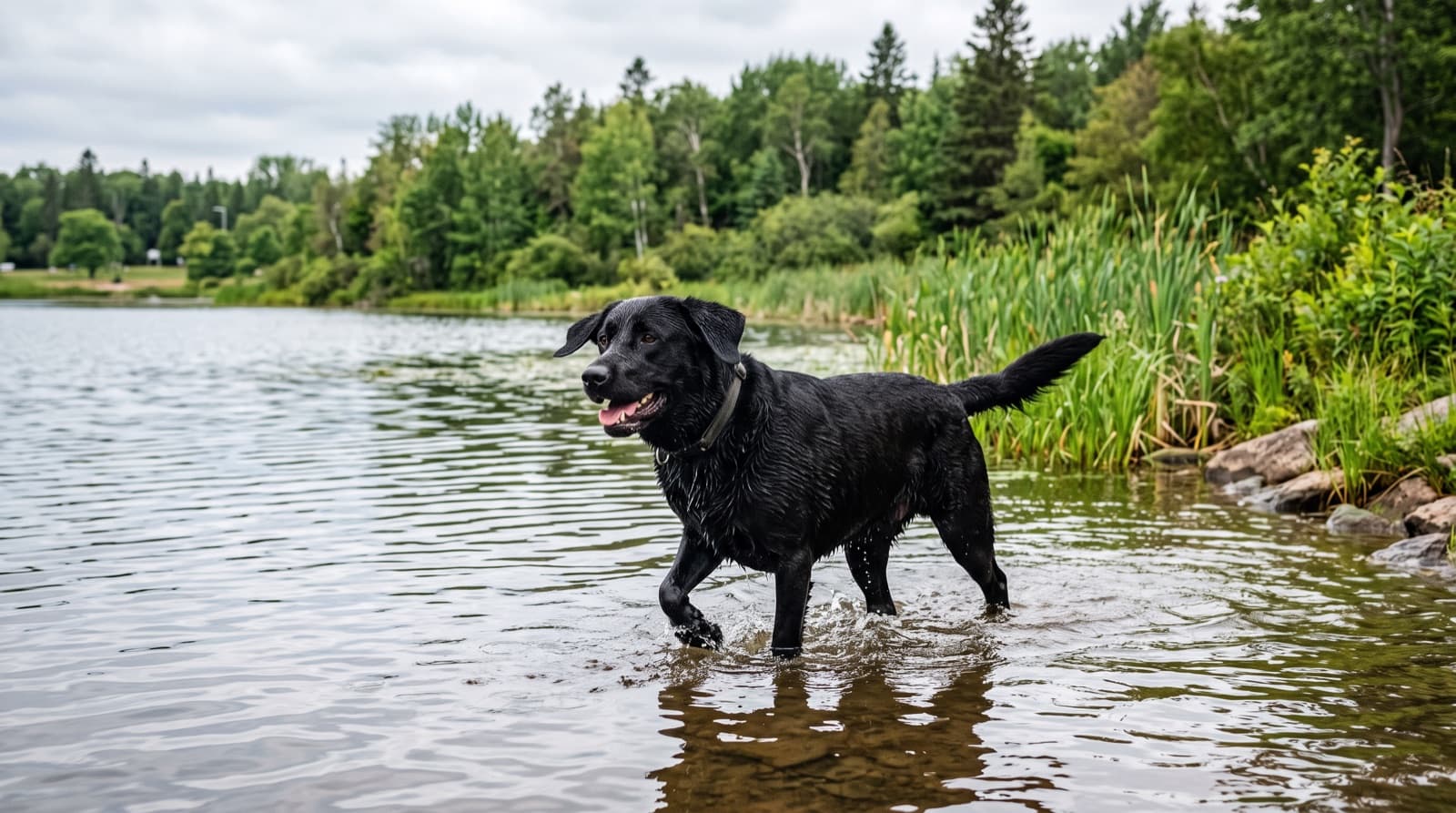
Why Labradors surrender in Moncton
The Labrador is the most popular dog in Canada, and popularity is exactly why the breed shows up so often in rescue. When a dog is everywhere, plenty of people bring one home without a clear picture of what they are taking on. The surrender stories in Greater Moncton are remarkably consistent, and reading them ahead of time helps you decide honestly whether a Lab fits your life.
- Underestimated energy. This is the big one. A young Labrador is a powerful, high-drive retriever that needs real daily exercise, not a placid family pet that will happily lie around. Owners who expected calm get a dog that chews furniture, digs up the yard, counter-surfs, pulls hard on lead, and never seems to tire. That is a normal under-exercised Lab, and it is the version that ends up back at the shelter.
- Life and housing changes. A move into an apartment or a rental that does not suit a large active dog, a new baby, a job change that cuts into the day, or a relationship ending are all common triggers. The dog did nothing wrong; the household simply changed around it.
- Cost and health surprises. Large breeds cost more to feed, board, and medicate, and a Lab that develops hip or elbow problems, an ear infection cycle, or creeping weight-related issues can run up bills an unprepared owner did not budget for. Some of those dogs are surrendered when the vet costs mount.
- Adolescence. The stretch from roughly six months to two or three years is when a Lab is at its most challenging: full-sized, full of energy, and not yet mentally mature. Families who expected the puppy phase to be the hard part get blindsided by the teenager phase and give up right before the dog would have settled.
- Weight and the health spiral. Labs are genetically wired to overeat, and an owner who free-feeds or over-treats ends up with an obese dog whose joints, energy, and lifespan all suffer. When the weight-related problems start, so sometimes do the surrender calls.
Almost none of this is about a bad dog. Labs are friendly, trainable, and devoted, which is why they place so readily once the right household finds them. When you read a Moncton Lab listing that says “needs an active home” or “too much energy for us,” take it at face value and ask the rescue how much exercise the dog actually needs, what its weight and body condition are, and how it does when left alone. The organisations that handle Labs will give you straight answers.
Moncton and NB rescues that list Labradors
Greater Moncton is the tri-community of Moncton, Dieppe, and Riverview, the largest metro in New Brunswick at roughly 160,000 people, which means genuine search demand and steady Lab intake. Because purebred Labs move fast, cast a wide net and set listing alerts on every organisation you would consider. For a fuller directory, see our guide to the best dog rescues in Moncton.
- People for Animal Wellbeing (PAW): formerly the Greater Moncton SPCA, this is New Brunswick's largest shelter, located at 116 Greenock Street in Moncton, and the most consistent general source of Labs and Lab mixes through owner surrender and stray intake. It runs a walk-in adoption route so you can meet the dog in person before deciding, and its published fees are $450 for an adult and $550 for a puppy six months and under. The fee schedule and inclusions are listed on the shelter's adoption fees page.
- Fulfilling Hearts Rescue: a Moncton foster-based rescue with foster homes across the province, and it considers applicants beyond Greater Moncton. Because its dogs live in real homes, the temperament notes on energy level, house manners, and how a dog handles kids, cats, or being alone tend to be more accurate than a kennel setting can provide. That accuracy is worth a lot with a breed whose whole story is about energy and fit. Fulfilling Hearts does not publish a flat adoption fee, but every dog it adopts out is spayed or neutered and vaccinated first, so ask about the fee when you apply.
- Provincial and regional rescues: the New Brunswick SPCA is the provincial animal-welfare body and a good reference point, and various NB and Maritime foster-based rescues pull dogs from within the province and sometimes from farther afield. Foster-rescue timelines vary, so if you widen your search to regional groups, expect the process and the wait to differ from a walk-in shelter.
One warning that applies to popular breeds especially: be wary of online “free Lab to a good home” posts and cheap-purebred-puppy offers. Verify any rescue through a real address, a current adoptable-dog list, and a proper application and conversation before sending any money. A legitimate Moncton rescue will always want to talk with you first. A fully vetted $450 adult Lab from PAW is the cheapest genuinely safe path to the breed in this region.
The energy reality: field lines, bench lines, and the first three years
Everything hard about living with a young Lab traces back to one fact: this breed was built to work. Labradors were developed to retrieve waterfowl in cold conditions for hours at a stretch, and that stamina and drive did not disappear when the breed became a family favourite. Understanding where a particular dog sits on the energy spectrum is the most useful thing you can do before adopting.
The breed splits into two broad types. Field-line Labs, sometimes called working or American Labs, are bred for hunting and field trials. They are typically leaner, more athletic, and much higher energy, with a strong need to work that a leisurely walk will not touch. Bench-line Labs, also called show or English Labs, are bred to a conformation standard and tend to be stockier, blockier in the head, and a shade calmer, though calmer is relative. Most rescue Labs are a blend, a cross, or simply of unknown background, so treat the line label as a hint rather than a guarantee. The individual dog matters far more, and this is exactly where a foster-based rescue earns its keep, because a foster home can tell you how much drive a specific dog shows on an ordinary Tuesday.
Whatever the line, plan on at least 60 to 90 minutes of genuine daily activity for a young adult, and know that the walk-around-the-block standard does not cut it. Labs want to run, swim, fetch, and use their brains. Long outings along the Centennial Park trails, walks on the Riverfront Trail beside the Petitcodiac River, the big trail network at Irishtown Nature Park, fetch, and swimming in warmer months all help burn the physical energy. Just as important is mental work: puzzle feeders, training sessions, and scent games tire a Lab in a way distance alone never will. For off-leash running specifically, use Moncton's designated off-leash areas rather than assuming a given park allows it; our off-leash parks guide covers where that is permitted.
The reassuring part is that this is a phase, not a life sentence. Most Labs settle noticeably after about three years, and a well-exercised adult becomes the calm, trainable, endlessly good-natured dog the breed is famous for. The trick is getting through adolescence with enough structure and exercise that the dog never learns that chewing the couch is how you fill an empty afternoon. An under-stimulated Lab invents its own entertainment, and you will not like the results. A tired Lab is a good Lab.
Labrador health, in brief
Labs are a generally sturdy breed that often lives 10 to 12 years, but a handful of conditions are worth planning around so you adopt with clear eyes. These notes are directional; for the breed screening standards that responsible breeders follow, see the Orthopedic Foundation for Animals and the Canadian Kennel Club.
- Hip and elbow dysplasia. The best-known Lab concerns, both inherited joint conditions. Responsible breeders screen for them through the OFA, but a rescue Lab rarely arrives with records, so watch for stiffness, limping, or a reluctance on stairs and raise anything you notice with your vet.
- Obesity. The single biggest day-to-day health risk. Labs carry a real genetic tendency to overeat and gain weight, and every extra pound loads the joints, saps energy, and shortens life. Measured meals, treats counted into the daily total, and no free-feeding are non-negotiable with this breed.
- Ear infections. The drop ears trap moisture, and Labs are enthusiastic swimmers, which makes recurring ear infections common. Dry the ears after every swim or bath and check them weekly.
- Eye conditions. Progressive retinal atrophy and cataracts appear in the breed. A vet eye check is a sensible part of the first-year workup.
- Exercise-induced collapse. A genetic condition seen in some field-line Labs where intense exercise triggers a temporary collapse. Uncommon, but worth knowing about if you have a high-drive working-type dog.
- Cancer. Like many large breeds, Labs carry a somewhat elevated lifetime cancer risk. Early vet attention to new lumps, weight changes, or lethargy gives the best odds.
The practical takeaway is not to fear a Lab but to prepare. Book a baseline vet visit in your first month to establish records, score body condition, and check the ears and joints, and enrol in pet insurance early before any condition becomes pre-existing. For a Lab, keeping the dog lean is the single most important health decision you will make. If you need after-hours help, know where to go before you need it; our Moncton emergency vet guide lists the options, and our low-cost vet guide covers budget-friendly routine care.
What a Moncton rescue Labrador actually costs
At People for Animal Wellbeing (PAW), the adoption fee is $450 for an adult dog and $550 for a puppy six months and under. That fee is a partial recovery on medical work already done, not a price on the dog. It covers spay or neuter, the first vaccination, the rabies vaccine, deworming, flea treatment, microchip, a nail trim, and one month of 24-hour PetWatch. Stack those services at retail New Brunswick vet pricing and they add up to considerably more than the fee, which is why a fully vetted $450 adult Lab is the cheapest legitimate way to bring a dog home in Greater Moncton. Fulfilling Hearts Rescue does not publish a flat fee, but every dog is spayed or neutered and vaccinated before adoption, so confirm the number when you apply.
Compare that to a Labrador puppy from a breeder, which for a well-bred, health-tested litter runs well into four figures with no medical work yet done, and the rescue path is dramatically cheaper. It also often gives you a dog with a known temperament, which matters more for a breed defined by its energy. Beyond the fee, plan roughly $400 to $900 in one-time first-month setup for a crate, bed, lead and harness, bowls, food, and initial supplies. Note that 15% HST applies to those supplies, though not to the adoption fee itself. For a fuller local breakdown, see our Moncton dog adoption cost guide.
Ongoing, budget roughly $1,500 to $2,500 a year for a medium-to-large dog: quality food measured to keep a Lab lean, routine vet care, pet insurance (genuinely worth it given the breed's joint, ear, and eye risks), and a City of Moncton dog licence, which the municipality administers and renews annually. Our pet licensing guide and Moncton dog bylaws guide cover the local requirements. Most rescue Labs arrive already spayed or neutered, but if yours is not, our spay and neuter guide covers the local options.
Browse adoptable Moncton Labradors and Lab mixes
Current Greater Moncton listings from PAW, Fulfilling Hearts Rescue, and other New Brunswick rescues in one place. Labs are popular and place fast, so alerts and same-day applications win.
See Available Moncton Labradors →The first 30 days with a Moncton Labrador
A rescue Lab settles on the same 3-3-3 arc as any dog: the first three days are raw decompression, the routine clicks into place over about three weeks, and the real bond takes closer to three months. Labs tend to land on the faster end because the breed is so social and eager to attach, but the exercise and weight habits you set in month one are the ones that stick. The general settling plan lives in our first week with a rescue dog guide; below is how that plays out with an energetic young Lab.
- Set the exercise routine from day one. A Lab that starts with a real daily outlet is far easier to live with. Build in walks, fetch, and sniffing time straight away, weighted toward genuine activity, not just a stroll.
- Establish the feeding and weight plan immediately. Measured meals, no free-feeding, treats counted into the daily total, and a firm no-table-scraps rule. Ask the vet to score body condition at the first visit so you know your target.
- Book a baseline vet visit in the first two weeks. Establish records, check ears and joints, confirm the microchip is registered to you, and discuss any breed-specific monitoring.
- Enrol in pet insurance in week one. Before any joint, ear, or eye issue appears in your records. Lab health risks are cheaper to insure against when you enrol early.
- Dog-proof for a chewer. A bored or anxious young Lab chews, so put shoes, cords, and anything precious out of reach and supply plenty of appropriate chew toys during decompression.
- Crate train from night one. Even a house-trained Lab benefits from a crate routine in the first month, and it gives the dog a safe den while it settles.
- Start manners training early. A Lab is strong and enthusiastic; loose-lead walking and a reliable sit save you from a dog that drags you down the Riverfront Trail or bowls over a visitor.
- Licence the dog with the City of Moncton. Required in the city and quick to arrange through the municipality.
- Manage the seasons. In winter, rinse or wipe road salt off the paws after every walk and watch for salt burn. In summer, avoid midday exercise on hot humid days, carry water, and use shade.
- Introduce water safely. If your Lab loves to swim, choose safe, known spots, keep it leashed near the tidal Petitcodiac, and dry the ears afterward.
- Same routes, same routine for the first two weeks. Predictability speeds settling. Save busy off-leash areas and new dog friends for after week three.
By about week three, once the daily exercise has a real outlet, the frantic edge comes off and the dog you actually adopted surfaces. Around the three-month mark the walk, feed, train, and rest rhythm feels automatic and the bond is firmly in place. Try not to judge the dog before those 90 days are up. The Lab households that thrive are the ones that treated the energy as real from the first afternoon and built the whole routine around burning it off.
Is a Labrador the right dog for your Moncton household?
The honest question is not whether Labs are good dogs, because they clearly are. The question is whether your life has room for an active large-breed retriever, especially through the first few years. A Lab suits a household that can commit to real daily exercise, that has the space or the outdoor access for a big dog, and that will keep the feeding disciplined rather than letting a food-obsessed retriever set the pace. Homes with a yard and an active routine tend to do brilliantly. So do busy families who adopt a calmer adult or senior rather than a puppy, because the exercise math is more forgiving with a mature dog.
Apartment and rental living is not automatically off the table, but it raises the bar. A Lab in a Moncton apartment needs a genuinely committed daily exercise plan, because the breed does not self-regulate the way a lower-energy dog might, and a large dog can strain a rental relationship if it is under-exercised and restless. If you rent, confirm the landlord permits a dog of this size, be realistic about the exercise you can deliver year-round including through a Maritime winter, and consider whether a calm adult is a better match than a boisterous young dog. The tri-community of Moncton, Dieppe, and Riverview has trail access along the Petitcodiac and at parks like Mapleton Park and Irishtown Nature Park, which helps, but access still requires you to get the dog out in all weather.
First-time owners can absolutely succeed with a Lab, and many do, precisely because the breed is so trainable and forgiving. The pitfall is not temperament; it is the energy commitment. If you are new to dogs, lean toward an adult from a foster-based rescue that can describe exactly what the dog needs, invest in a basic obedience class early, and treat the exercise routine as non-negotiable from the first week. Do that, and a Labrador rewards you with one of the most affectionate, biddable, and family-oriented companions in the dog world.
Frequently asked questions
Where can I adopt a Labrador near me in Moncton?
Start with the two Greater Moncton organisations that most reliably list Labs and Lab mixes. People for Animal Wellbeing (PAW), formerly the Greater Moncton SPCA, at 116 Greenock Street, is New Brunswick's largest shelter and takes in Labs and Lab crosses through owner surrender and stray intake on a regular basis. Its adult adoption fee is $450 and a puppy six months and under is $550. Fulfilling Hearts Rescue is a Moncton foster-based rescue with foster homes across the province, and it is the better route if you want detailed temperament notes because the dog has been living in a real home rather than a kennel. Purebred Labs move quickly in a metro of roughly 160,000 people, so set alerts on both organisations and stay open to a Lab mix, which widens your options considerably. Also watch general New Brunswick and Maritime rescues, since foster-based groups sometimes pull Labs from within the province and occasionally from farther afield.
Why do so many Labradors end up in rescue in Moncton?
The single biggest reason is underestimated energy. People adopt or buy a Labrador expecting a calm family dog and get a powerful, high-drive working retriever that needs real daily exercise for the first several years of its life. A young Lab that does not get enough physical and mental work chews, digs, counter-surfs, pulls on lead, and bounces off the walls, and that is when the surrender calls start. Other common drivers are a move to housing that does not fit a big active dog, a growing family with less time, the cost of caring for a large breed, and health issues like hip or elbow problems that owners were not prepared for. The dogs themselves are almost always friendly and adoptable. The mismatch is usually about the household's time and energy, not the Lab's temperament.
How much does it cost to adopt a Labrador in Moncton?
At People for Animal Wellbeing (PAW) the fee is $450 for an adult dog and $550 for a puppy six months and under. That fee is not a price tag on the dog; it is a partial recovery on work already done. It covers spay or neuter, the first vaccination, the rabies vaccine, deworming, flea treatment, microchip, a nail trim, and one month of 24-hour PetWatch. Stacked at retail New Brunswick vet pricing those services would cost far more than the fee, which makes a fully vetted $450 adult Lab the cheapest legitimate path to a dog in Greater Moncton. Fulfilling Hearts Rescue does not publish a flat fee, but every dog it adopts out is spayed or neutered and vaccinated first, so ask when you apply. Beyond the fee, budget roughly $400 to $900 in one-time first-month setup and roughly $1,500 to $2,500 a year ongoing for a medium-to-large dog. Note that 15% HST applies to supplies, though not to the adoption fee itself.
What is the difference between a field-line and a bench-line Labrador?
Labradors split into two rough types and the difference matters a great deal for a Moncton adopter. Field-line (also called working or American) Labs are bred for hunting and field trials. They tend to be leaner, more athletic, and considerably higher energy, with a strong drive to work that needs a serious daily outlet. Bench-line (also called show or English) Labs are bred to a conformation standard and tend to be stockier, blockier in the head, and a little calmer, though calmer is relative because any Lab is still an active dog. Most rescue Labs are a mix of both or of unknown background, so do not assume. What matters is the individual dog in front of you. A foster-based rescue like Fulfilling Hearts can tell you how much drive a specific dog actually shows day to day, which is far more useful than a line label. If a listing describes a young Lab as needing an active home, believe it.
Are Labradors good with kids and other dogs?
Generally yes on both counts, which is a big part of why the breed is so popular with families. Labs were developed to work closely with people and most are affectionate, patient, and social with children and with other dogs. The usual caution is size and enthusiasm rather than aggression. A happy young Lab is strong and bouncy and can knock over a toddler or an older adult without meaning any harm, so supervision and some basic manners training matter in the early months. Around food the breed's appetite can show up as pushiness, so teach children not to bother the dog while it eats. Any reputable Moncton rescue does a temperament assessment and flags concerns in the write-up, and a foster home can tell you directly whether a specific dog has lived successfully with kids, cats, or other dogs. For a home with very young children, look for that lived-in confirmation and supervise through the settling period.
What health problems do Labrador Retrievers have?
Labs are a generally sturdy breed but a few conditions are worth planning around. Hip and elbow dysplasia are the best-known, both inherited joint conditions that responsible breeders screen for through the Orthopedic Foundation for Animals. A rescue Lab will not usually come with OFA records, so watch for stiffness, limping, or reluctance on stairs and raise it with your vet. Obesity is the biggest day-to-day risk because Labs are relentless eaters and carry a genuine genetic tendency to gain weight, and every extra pound worsens the joints. Other risks include exercise-induced collapse, progressive retinal atrophy affecting the eyes, and a somewhat elevated rate of certain cancers seen across many large breeds. The breed is also prone to ear infections given the drop ears, especially in swimmers. None of this should scare you off a Lab, but it argues strongly for measured feeding, early pet insurance, and a baseline vet visit in the first month. Health claims here are directional; for breed screening standards see the OFA and the Canadian Kennel Club.
How much exercise does a Labrador actually need?
More than most first-time owners expect, especially in the first few years. Plan on at least 60 to 90 minutes of real activity a day for a young adult Lab, and understand that a leisurely walk around the block does not count for much with this breed. Labs were built to retrieve all day in cold water, so they want to run, swim, fetch, and use their brains. Long walks along the Riverfront Trail by the Petitcodiac River, off-leash time in Moncton's designated off-leash areas, fetch sessions, and swimming in warmer months all help. Mental work matters as much as physical; puzzle feeders, training games, and scent work drain a Lab's energy in a way distance alone does not. An under-exercised Lab is a destructive Lab, and that is the version that gets surrendered. A well-exercised one is the calm, biddable family dog the breed is famous for. Adult Labs settle down noticeably after about three years, but the exercise commitment never fully disappears.
Can Labradors swim in the rivers and lakes around Moncton?
Swimming is one of the best outlets you can give a Lab, and the breed loves water more than almost any other. The lake and trails at Centennial Park and the paths along the Petitcodiac River give Moncton owners good options in the warmer months. A few real cautions apply. The Petitcodiac is a tidal river with strong currents and deep mud flats at low tide, so it is not a casual swimming spot; keep a Lab leashed near the riverbank and let it swim only where you know the water and the footing are safe. At any swimming spot, rinse the coat after a swim, dry the ears thoroughly to head off infections, and watch for blue-green algae warnings on standing water in late summer, which can be dangerous for dogs. And do not confuse a Lab's love of water with heat tolerance; on a hot humid Maritime afternoon a swim is great, but a midday run is not. Save hard exercise for the cool of the morning or evening in summer.
How do Moncton winters and summers affect a Labrador?
A Labrador's double coat is built for cold, so a Moncton winter is well within the breed's comfort zone. The real winter issue is the ground, not the temperature. Road salt and de-icer on Greater Moncton sidewalks and streets irritate paw pads and can cause chemical burns, so rinse or wipe the paws after every winter walk and watch for licking or limping. Some Labs tolerate booties, which solve the problem entirely. Nor'easters, freezing rain, and deep snow are normal here, and most Labs are happy to be out in it as long as you manage the salt afterward. Summer is the direction that actually needs caution. Moncton summers are warm and humid, and a heavy-coated active dog can overheat fast. Avoid midday walks on hot days, carry water, seek shade, never leave a dog in a parked car, and shift hard exercise to the cooler parts of the day. Our Moncton winter dog care guide has the full seasonal routine.
What colours do Labradors come in, and does colour matter?
Labradors come in three standard colours recognised by the Canadian Kennel Club: black, yellow, and chocolate. Yellow ranges from very pale cream to a deep gold, and within the yellow range is the darker reddish shade often called fox-red, which is a colour variation rather than a separate type. Silver and charcoal Labs are marketed by some sellers but are not a recognised standard colour and often signal a breeding operation more interested in a fad than in health. For an adopter, colour should be near the bottom of your list. Temperament, energy level, health, and how well a specific dog fits your household matter enormously; coat colour matters not at all to how good a companion the dog will be. If you have your heart set on a particular colour, be prepared to wait longer and to widen your search, but do not pass over a well-matched dog because of its coat. Rescue Labs of every colour make wonderful family dogs.
Should I adopt a Labrador puppy or an adult?
For most Moncton households an adult Lab is the easier and often wiser choice. A Lab puppy is a delight and also a serious project: eighteen months or more of house-training, chewing, mouthing, jumping, and near-constant exercise needs, all while the dog's adult temperament is still unknown. An adult rescue Lab comes with a settled personality, established house manners in most cases, a known energy level, and a documented history, plus the lower adult fee at PAW of $450 versus $550 for a puppy. A foster-based rescue can tell you exactly what an adult dog is like to live with. Senior Labs, often overlooked, are frequently the calmest and most rewarding companions of all and place beautifully into quieter homes. If you specifically want a puppy and have the time, budget, and energy for the work, that is a valid choice, but do not assume a puppy is the safe default. For a busy family, a calm five-year-old Lab is often the far better fit.
Related Moncton adoption guides
Adoptable Moncton Labradors
Current Greater Moncton Labrador and Lab-mix listings from PAW, Fulfilling Hearts Rescue, and other New Brunswick rescues.
Best Dog Rescues in Moncton
A directory of the Greater Moncton shelters and foster-based rescues worth setting listing alerts on, with what each is known for.
Moncton Dog Adoption Costs
What the PAW fee actually covers, first-month setup costs, and the true ongoing budget for a dog in Greater Moncton.
Winter Dog Care in Moncton
Road-salt paw care, nor'easters, and the seasonal routine that keeps a Maritime dog safe through the cold months.
Find your Moncton rescue Labrador
Browse current Greater Moncton Labrador and Lab-mix listings. Labs are popular and place fast; alerts and same-day applications still win.
Browse All Moncton Dogs →New dog? Start with these care guides
Everything a new adopter needs to set up a safe, happy home.