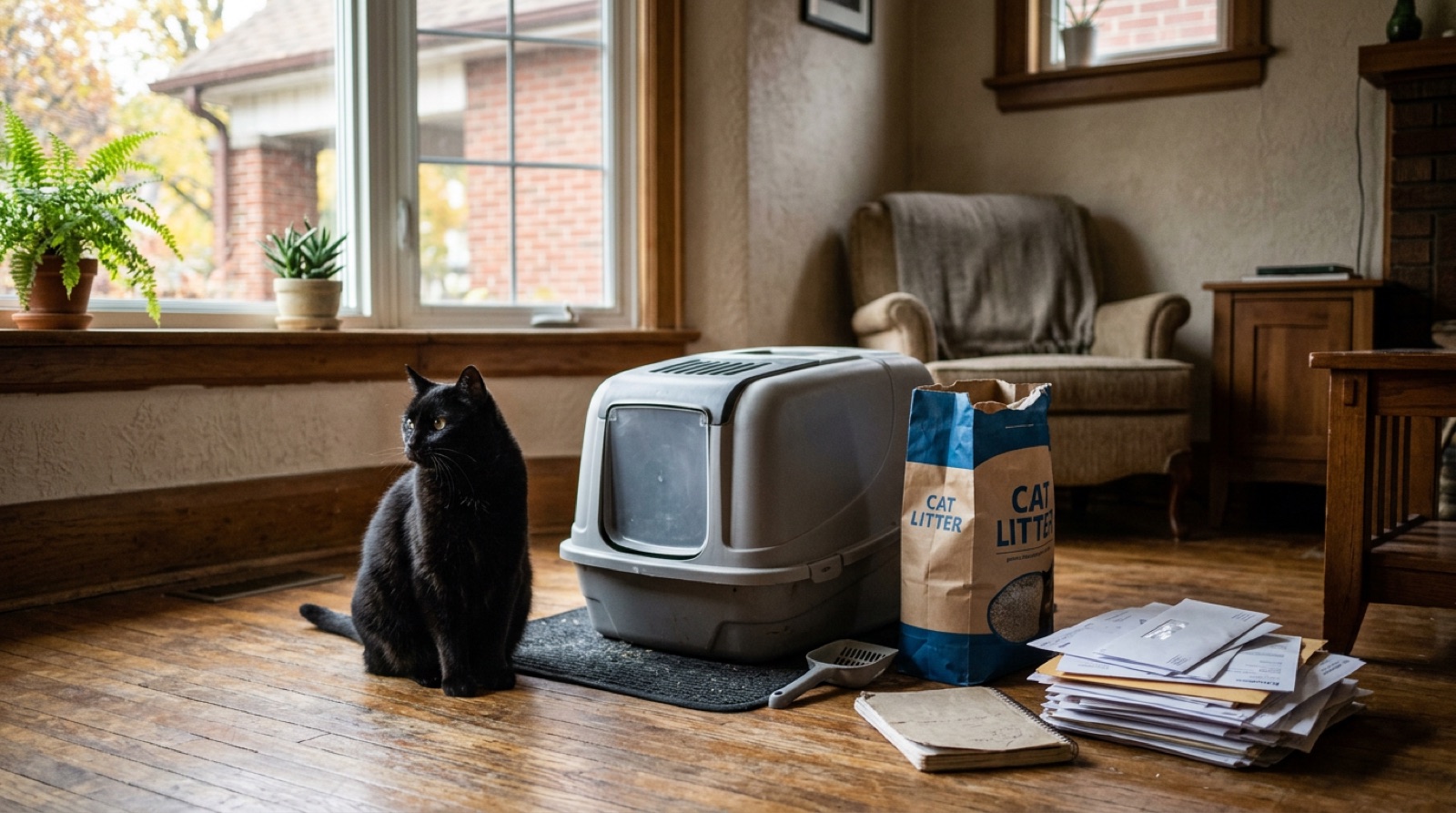
The short answer
Hamilton rescues set adoption fees per cat rather than publishing a schedule, so ask on the listing. That fee already covers the expensive part: the Hamilton/Burlington SPCA puts more than $1,000 of veterinary value into each adoptable cat. Plan for roughly $900 to $1,700 across the rest of year one, mostly food, litter and gear, with 13% HST on top of nearly all of it. Hamilton charges no cat licence. Build a $1,000 emergency fund before you need it.
People budget for the adoption fee and then get surprised by everything else. That is backwards. The fee is the one part of cat ownership that somebody else has already subsidised for you, and it is the smallest line in your first year by a wide margin.
What actually costs money is the twelve months after you drive home from Dartnall Road. Food, litter, the tree you buy after the couch arm loses a fight, the annual exam, and the emergency you did not schedule. None of it is dramatic on its own. Together it adds up to real money, and it helps to see the shape of it before you commit rather than in February.
Below is what to expect, what the adoption fee already bought you, and the two lines Hamilton owners underestimate most. If you want to see who is available first, the live Hamilton cat listings are refreshed regularly.
Year One, Line by Line
| Cost | Budget | Notes |
|---|---|---|
| Adoption fee | Ask on the cat | Hamilton rescues do not publish fixed schedules |
| Litter box, scoop and mat | $40 to $80 | One box per cat plus one spare is the rule |
| Carrier | $40 to $90 | Hard-sided with a removable top makes vet visits easier |
| Scratching post or tree | $50 to $200 | Cheaper than replacing a couch arm |
| Food, first year | $400 to $800 | Wet food and prescription diets sit at the top end |
| Litter, first year | $180 to $350 | Two cats roughly doubles this line |
| Annual vet exam and vaccines | $150 to $300 | Already covered for the first year on most adoptions |
| Parasite prevention | $80 to $200 | Even indoor cats, since fleas ride in on people |
| Emergency fund | $1,000 minimum | The single most useful line on this list |
Supply and food ranges are planning estimates for Hamilton retail, not quoted prices, and most carry 13% HST. Adoption fees and veterinary pricing vary by organisation and by cat, so confirm both directly.
What the adoption fee already paid for
The Hamilton/Burlington SPCA states that its adoptable cats carry more than $1,000 in veterinary value: the exam, spay or neuter, microchipping, preventatives and testing. Adoptions also include five days of post-adoption care through the shelter's onsite Companion Animal Hospital and 30 days of pet insurance.
Foster-based groups cover the same ground. Abandoned Cats Rescue states that every cat is vet examined, flea and worm treated, vaccinated, spayed or neutered, microchipped, and treated for any medical issue identified in foster care.
Here is the number that makes it concrete. The same HBSPCA hospital charges the public $325 to spay a cat and $175 to neuter one, and that is the affordable option in Hamilton rather than the expensive one. An adopted cat has already had that surgery. You are not paying for a cat. You are reimbursing a fraction of work already done.
Our Hamilton spay and neuter guide breaks down what those surgery prices include and who qualifies for the subsidised program.
Hamilton does not licence cats
This is a genuine saving and worth stating plainly, because adopters moving from other Ontario cities assume otherwise. Hamilton licences dogs. It does not licence cats, and city council has examined cat licensing more than once over the years and declined each time.
What the City of Hamilton offers instead is a voluntary cat registration tag. The point of it is recovery. A registered cat picked up by Animal Services can be traced back to you quickly, rather than sitting in the shelter as an unidentified stray while you post on neighbourhood groups. A microchip does the same job more reliably, and your adopted cat already has one.
None of that means a cat can roam. Hamilton's Responsible Animal Ownership By-law includes at-large provisions covering cats, and the city advises owners to keep cats indoors or on their own property. Our indoor versus outdoor guide covers the practical side of that.
The two lines people underestimate
Litter. It is the most boring line and the one that quietly outpaces the budget. A single cat gets through a surprising volume, and a second cat genuinely doubles it. Buy the litter your cat already uses in foster or at the shelter and change it slowly, because a cat that dislikes a new litter stops using the box, and that problem costs far more to solve than the bag you saved money on.
Dental work. Nobody budgets for teeth. Cats hide dental pain almost perfectly, and a cleaning under anaesthetic with extractions is one of the more common four-figure bills a middle-aged cat generates. Ask your vet to grade the teeth at every annual exam so you get warning rather than a surprise.
And the tax. Ontario's 13% HST applies to food, litter, gear and most retail, which is roughly $117 on a $900 year of consumables. Build it into the plan rather than discovering it at the till.
Plan for the emergency before it happens
Hamilton has 24-hour emergency veterinary coverage, which is a good thing and an expensive one. The Hamilton Region Emergency Veterinary Clinic at 50 Dundurn Street South runs around the clock at 905-529-1004, and Burlington Veterinary Emergency & Referral Hospital covers the same hours about twenty minutes away.
Decide now how you would pay a large bill on a Sunday night. A urinary blockage in a male cat is the classic example: it is a genuine emergency measured in hours, it needs immediate veterinary care, and it is not cheap. Savings, a clear credit line or insurance all work. Having no plan is the only option that does not.
Browse adoptable Hamilton cats
Every cat listed here is already fixed, vaccinated and chipped, which is the largest line in this whole budget already handled. Listings refreshed regularly.
See Available Hamilton Cats →Frequently Asked Questions
How much does it cost to adopt a cat in Hamilton?
None of the Hamilton cat rescues publish a fixed fee schedule online, so ask on the specific cat rather than budgeting from a number you found elsewhere. What we can tell you is what the fee represents. The Hamilton/Burlington SPCA states its adoptable cats carry more than $1,000 in veterinary value, covering the exam, spay or neuter, microchip, preventatives and testing. Foster groups like Abandoned Cats Rescue cover the same ground before a cat leaves foster care. A fee far below the going rate usually means part of that work has not happened yet.
Do I have to pay for a cat licence in Hamilton?
No. Hamilton licences dogs but has never required a cat licence, and council has considered cat licensing more than once and declined each time. The city offers a voluntary cat registration tag instead, which exists so a cat picked up by Animal Services can be traced back to you rather than sitting as an unknown stray. That is a genuine saving compared with Ontario cities like London and Kingston, where cat owners pay an annual licence. The at-large rules in the Responsible Animal Ownership By-law still apply to cats, so this is not permission to let a cat roam.
What is the biggest hidden cost of a cat in Hamilton?
Emergency veterinary care, and it is not close. A single after-hours visit to a 24-hour hospital in Hamilton runs into the hundreds before anyone treats anything, and a urinary blockage or a foreign-body surgery moves into four figures fast. The useful move is deciding now how you would pay a $2,000 bill at eleven on a Sunday night. That is either a dedicated savings account, a credit line you keep clear, or a pet insurance policy. Most people find out they had no plan on the night they needed one.
Is pet insurance worth it for a cat in Hamilton?
It depends on whether you can absorb a large bill without borrowing. If you can comfortably cover $3,000 tomorrow, self-insuring into a savings account usually works out better across a cat's life, because you keep whatever you do not spend. If a surprise bill would go on a credit card, insurance is the safer structure. Worth knowing: HBSPCA adoptions include 30 days of pet insurance, which is a free trial window rather than a long-term answer. Read the exclusions before the month is up, because pre-existing conditions found in that window may not be covered later.
How much does 13% HST add to owning a cat?
More than people expect, because it lands on nearly everything except the veterinary surgery itself. Food, litter, toys, the carrier, the scratching post, flea prevention and most retail purchases all carry Ontario's 13% harmonised sales tax. On a $900 year of food and litter that is roughly $117 you did not plan for. It is not a reason to skip anything, but if you build a budget from sticker prices and forget the tax line, you will be off by a month of litter by December.
Is it cheaper to adopt or to take a free kitten?
Adopting, and the gap is large. A free kitten from a classified listing arrives unfixed, unvaccinated, untested and unchipped. You then pay for all of it. For scale, the HBSPCA charges the public $325 to spay a cat and $175 to neuter one, and that is the low-cost option in the city rather than the expensive one. Add vaccines, a microchip, deworming and a feline leukemia test, and a free kitten becomes several hundred dollars of catch-up veterinary work inside its first year, plus HST on the parts that are not surgery.
What does an adopted cat already come with?
The expensive part, done. A cat from the Hamilton/Burlington SPCA goes home spayed or neutered, vaccinated, microchipped, treated for parasites and health-checked, with five days of post-adoption care through the shelter's onsite Companion Animal Hospital and 30 days of pet insurance. Abandoned Cats Rescue states every cat in its care is vet examined, flea and worm treated, vaccinated, fixed, microchipped and treated for any medical issue found along the way. That is why the first-year budget for an adopted cat is mostly food, litter and gear.
Are two cats twice the cost?
No, closer to one and a half. Food and litter genuinely double, and those are the two biggest recurring lines. Everything else mostly does not. Two cats share the tree, the scratching post, the toys and eventually your bed, and a second cat does not double your vet visits so much as add a second exam fee. Bonded pairs are also frequently listed together by Hamilton rescues because they settle faster as a unit, which quietly saves you the cost of a failed single placement.
Do senior cats cost more?
The adoption fee is usually lower and the veterinary spending is usually higher, so it roughly evens out with more variance. Senior cats often carry reduced fees at Hamilton rescues and many arrive with a documented health history, which is more useful than it sounds because you are not guessing. Budget for twice-yearly exams rather than annual ones, and expect bloodwork to become routine. What you get in return is a cat whose personality is fully known on day one, which is the thing kittens cannot offer at any price.
How much should I keep in an emergency fund?
A thousand dollars is a sensible floor, and two thousand is more realistic for a Hamilton cat owner. That range covers most single emergencies: a urinary blockage, a bad dental, a swallowed hair tie, a wound that needs sedation. It will not cover everything, but it means the decision at the emergency clinic is medical rather than financial. Build it before you need it. Start the month you adopt, even at fifty dollars a month, and you will be in reasonable shape by the time a cat is old enough to need it.
Where can I get help if I cannot afford a vet bill?
Ask before the bill exists rather than after. The Hamilton/Burlington SPCA runs a Pet Health Community Outreach Program aimed at low-income-verified pet owners specifically so cost does not block surgical care, and it is worth calling 905-574-7722 to ask what you qualify for. Many Hamilton clinics also offer payment plans or third-party financing if you ask directly, and some will restructure a treatment plan around what you can actually spend. The worst outcome is silently declining care because you assumed the answer was no.
Does an indoor cat cost less than an outdoor cat?
Considerably, and it is one of the clearest financial arguments for keeping a cat in. Outdoor cats in Hamilton pick up abscesses from fights, parasites, injuries from cars on the Main and King corridors, and the occasional encounter with a coyote off the escarpment edge. Each of those is a vet visit. Indoor cats need more enrichment and can gain weight without it, but the recurring cost of an indoor cat is food, litter and one annual exam. The outdoor version adds an unpredictable emergency line that nobody can budget for.
Related Hamilton Guides
One search, every Hamilton rescue
Shelter cats and foster cats from across Hamilton, in a single list.
Browse Available Hamilton Cats →New cat? Start with these care guides
Everything a new adopter needs to set up a safe, happy home.