The short answer
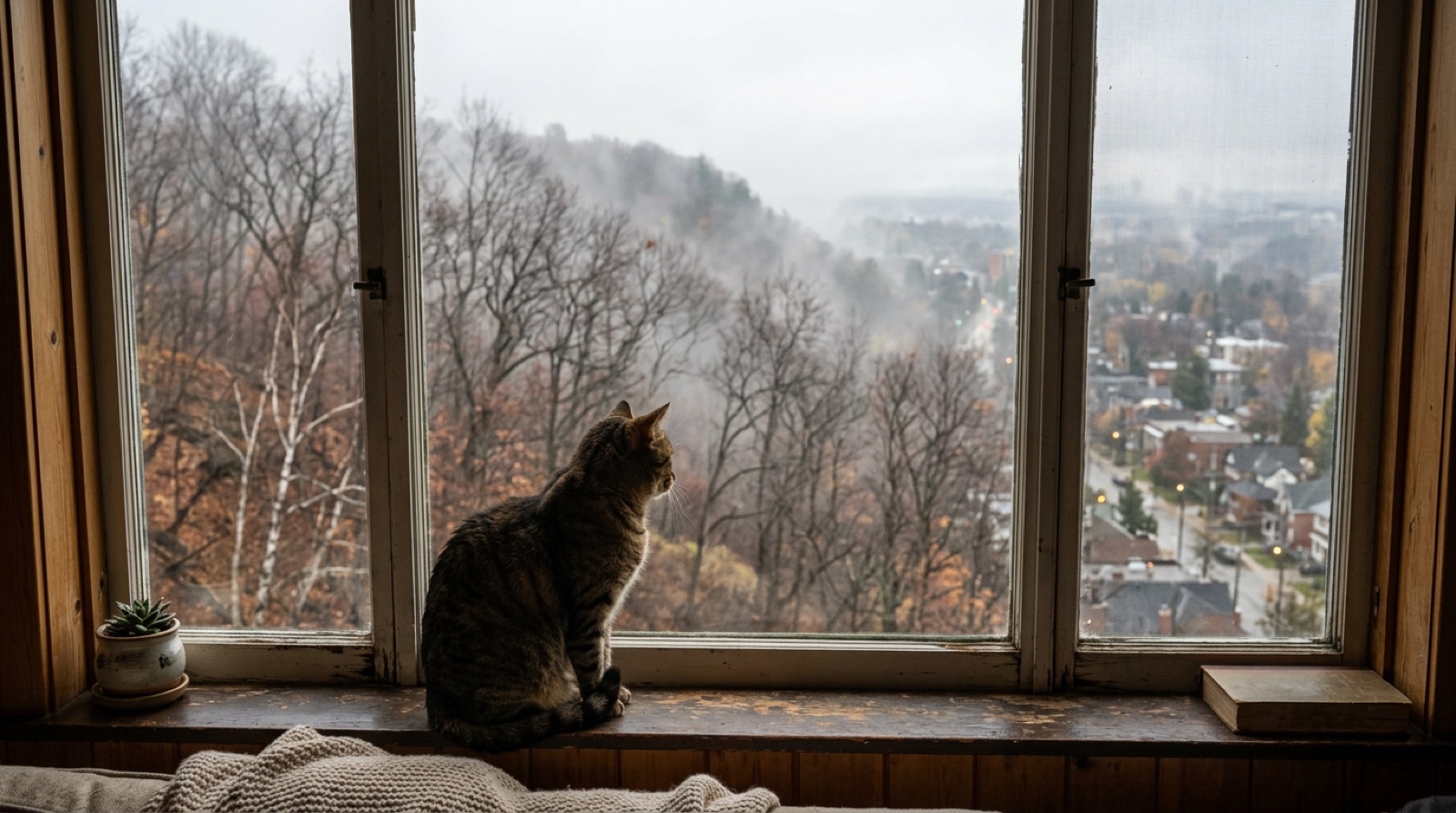
Indoors, in Hamilton specifically. The city advises keeping cats in, and its Responsible Animal Ownership By-law already prohibits cats roaming off your property. The escarpment ravines put coyote habitat inside the city, the Main and King one-ways move traffic a cat cannot judge, and winter salt and humid summers add more. An indoor cat needs height, play and a window with a view. A catio or a harness covers the rest.
Plenty of people grew up with a cat that came and went as it pleased, and the instinct to give a new cat that same freedom is a kind one. It just does not survive contact with Hamilton's actual geography.
This is a city built around an escarpment. The Mountain brow, the ravines below it, the creek corridors running down toward the harbour and Cootes Paradise are not decorative green space. They are functioning wildlife habitat threaded through residential neighbourhoods, and coyotes use them. Meanwhile the lower city runs one-way arterials at a speed no cat has a useful instinct for.
None of that means an indoor cat has a diminished life. It means the outdoor version of that life is shorter here than people assume. Below is what the risk actually looks like, and the alternatives worth setting up. If you are still choosing a cat, the Hamilton cat listings are refreshed regularly.
What an Outdoor Cat Faces in Hamilton
| Risk | Where | When | Why it matters |
|---|---|---|---|
| Coyotes | Escarpment edge, ravines, creek corridors | Year-round, worse in winter | Coyotes prey on cats in urban Hamilton |
| Traffic | Main, King and the lower-city one-ways | Year-round | Fast multi-lane one-way traffic gives a cat no time |
| Road salt | Sidewalks and driveways citywide | November to March | Irritates paws, and cats groom it off and swallow it |
| Heat and humidity | Lower city, sheltered from the lake breeze | July and August | Cats trapped in sheds and garages overheat |
| Fights and abscesses | Anywhere with a resident cat population | Year-round | The most common outdoor vet bill by a distance |
| Disease | Anywhere cats meet cats | Year-round | Feline leukemia and FIV pass between roaming cats |
The escarpment puts coyotes inside the city
This is the part that separates Hamilton from a flatter city. Coyotes shelter along stream banks, ravines and sandy ridges, and the Niagara Escarpment provides all of that in a continuous corridor running through the middle of a city of half a million people. They follow watercourses down into residential streets looking for food and water, which is how a coyote ends up photographed in a neighbourhood like Westdale rather than only out past Ancaster.
The City of Hamilton states plainly that in urban areas coyotes prey on pets such as cats and small dogs, and its guidance to residents is to keep cats indoors and not let dogs roam. Homes backing onto wooded areas, the brow, or newer developments cut into former field edges should expect coyotes nearby.
The Hamilton Conservation Authority publishes similar guidance for people living near the escarpment lands and trail network. Coyotes themselves are shy and avoid people. A cat is a different proposition entirely.
The one-way corridors
Hamilton's lower city runs on a one-way grid, with Main Street and King Street carrying multiple lanes of traffic moving in a single direction. That system is efficient for cars and unforgiving for anything crossing it. A cat that has learned to read a quiet residential street has no equivalent instinct for a four-lane one-way where every vehicle arrives from the same side at speed.
Add the industrial routes toward the harbour, the access roads climbing the escarpment, and the highway corridors around the city edge, and a roaming cat in Hamilton crosses a lot of hostile ground. Cats hit by vehicles are one of the most common serious emergencies veterinary clinics see, and they arrive at any hour, which is why the city has 24-hour coverage at all.
Winter salt and humid summers
November to March. Salt and grit on Hamilton sidewalks and driveways irritate paw pads and cause cracking. The bigger issue is grooming. A cat licks its paws clean and swallows whatever is on them. If your cat does go out in winter, wipe the paws with a damp cloth on the way in and check between the toes for packed ice.
Antifreeze. Winter also means antifreeze on driveways and in garages. It is sweet, cats will drink it, and it is lethal in very small amounts. Any suspicion that a cat has had access to it is an immediate veterinary emergency, not a wait-and-see.
July and August. Lake Ontario holds heat into September, and the lower city sits below the escarpment where the breeze thins out. The classic summer disaster is a cat shut into a shed, garage or vehicle on a humid afternoon. Indoors, keep water in more than one place and know that panting in a cat is never normal and always warrants a call.
What to do instead
Build up, not out. Cats measure territory vertically. A tall tree, a couple of wall shelves, or a cleared bookshelf top transforms a small apartment more than extra floor space would.
Give them a window with content. A perch at a window facing a bird feeder, a busy sidewalk or a back garden is genuine entertainment. A window facing a blank wall is not.
Make them hunt for food. Puzzle feeders and scattered portions turn eating into an activity. This is the single easiest change for a bored indoor cat.
Play twice a day, properly. Fifteen minutes with a wand toy, letting the cat actually catch it at the end, beats a basket of ignored toys. Do one session before bed and you will sleep better.
Consider a catio. Screened outdoor access, from a window box to a full back-door run, gives the air and the smells without the coyotes or the traffic. Check with your landlord first if you rent.
Try a harness. Some cats take to it well. Start indoors, build slowly, and pick quiet residential streets rather than anywhere near the arterials.
If your cat gets out
Search close first. Cats that slip out usually hide within a few properties rather than travelling, so check under decks, sheds, porches and parked cars nearby at dusk and dawn when it is quiet. Put the litter box outside the door. Post in local neighbourhood groups with a clear photo.
Then call. City of Hamilton Animal Services is at 905-574-3433, and it is worth registering your cat for a voluntary city tag in advance so a picked-up cat traces back to you. Your adopted cat already has a microchip, which does the same job better, so confirm the registration details on that chip are current. Ours is the boring advice that works: check the chip registry the week you adopt, not the week the cat goes missing.
Browse adoptable Hamilton cats
Many Hamilton rescue cats are already settled indoor cats, and foster notes will tell you which ones have never wanted to go out. Listings refreshed regularly.
See Available Hamilton Cats →Frequently Asked Questions
Should I let my cat outside in Hamilton?
The City of Hamilton's own advice is to keep cats indoors, and it gives that guidance in the context of coyotes and roaming risk rather than as a general preference. There is also a practical legal point. Hamilton's Responsible Animal Ownership By-law includes at-large provisions covering cats, so a cat off your property unrestrained is not simply a neighbourhood convention being broken. Indoor cats in Hamilton avoid coyotes, traffic on the arterial one-ways, fights, and the diseases that pass between roaming cats. The trade-off is that an indoor cat needs enrichment, which is a solvable problem.
Are coyotes really a risk to cats in Hamilton?
Yes, and it is not a rural-only concern. Coyotes live along stream banks, ravines and ridges, and Hamilton has all three in quantity thanks to the Niagara Escarpment cutting through the middle of the city. The city notes that in urban areas coyotes prey on pets including cats, and that homes near wooded areas, ravines or newer residential developments should expect sightings. Coyotes follow watercourses into residential neighbourhoods looking for food and water, and sightings have turned up in established areas including Westdale. A cat outdoors near the escarpment edge at dusk is genuinely at risk.
Is there a cat at large bylaw in Hamilton?
Yes. Hamilton's Responsible Animal Ownership By-law does not allow cats to roam off the owner's property unrestrained, and a cat observed at large can result in a warning or a fine. This surprises people, partly because Hamilton does not require cat licences and owners assume the two things go together. They do not. The city separately encourages a voluntary cat registration tag so that a cat picked up by Animal Services can be identified and returned quickly rather than sitting as an unknown stray.
Why is Hamilton traffic worse than average for cats?
The one-way arterial system. Main Street and King Street run as fast multi-lane one-ways through the lower city, and traffic on a one-way moves at a different speed and rhythm than on a two-way residential street. A cat that has learned to judge a quiet side street has no useful instinct for that. Add the highway corridors around the city edges and the industrial routes near the harbour, and a roaming lower-city cat crosses genuinely dangerous ground. Cats hit by cars are among the most common outdoor emergencies vets see.
Does road salt hurt cats in Hamilton?
It does, in two ways, and both run from roughly November through March. The salt and grit used on Hamilton sidewalks and driveways irritates paw pads directly, and cracked pads are painful and can get infected. The second problem is worse. Cats groom obsessively, so a cat that walks through salt licks it off and swallows it. If your cat does go out in winter, wipe the paws with a damp cloth when it comes in, and check between the toes for packed ice and grit.
What about humid Hamilton summers?
The heat problem is less about the temperature and more about where cats get stuck. Hamilton summers are humid because the lake holds warmth, and the lower city sits below the escarpment where the breeze does not always reach. Cats seek out sheds, garages and vehicles, and an outdoor cat that gets shut into one on a humid July afternoon is in serious trouble within hours. Indoors, watch for panting, lethargy or drooling in a heatwave, keep water available in more than one spot, and know that panting in a cat is never normal.
How do I keep an indoor cat happy in an apartment?
Go vertical and add hunting. Height matters more to cats than floor space, so a tall tree or a couple of well-placed wall shelves changes a small Hamilton apartment more than another square metre would. Put a perch at a window with something happening outside. Feed part of the daily ration through a puzzle feeder so the cat works for food rather than finding a full bowl. And commit to two short play sessions a day with a wand toy. Fifteen minutes of real chasing is worth more than a basket of toys the cat ignores.
What is a catio and does it work in Hamilton?
A catio is an enclosed outdoor space, anything from a window box the cat can sit in to a full screened run off a back door, and it works well here. It gives a cat the outdoor air, the smells and the bird-watching without the coyotes, the traffic or the disease exposure. Hamilton has plenty of housing stock with usable back yards and balconies, particularly through the older lower-city neighbourhoods and the Mountain suburbs. If you rent, check with your landlord first, since even a freestanding structure may need permission.
Can I train a cat to walk on a harness?
Many cats take to it, and it is the middle path between indoor-only and free roaming. Start indoors with the harness on for short stretches paired with food, then add the lead indoors, then try a quiet space outside. Do not start on a busy street. Some cats never accept it and flatten themselves to the ground, and that is a clear no rather than something to push through. If it does work, the quiet residential streets and park edges suit it better than anywhere near the Main and King corridors.
My cat has always gone outside. Can it adjust to being indoors?
Usually yes, though expect a few noisy weeks. The transition works best when you replace what the outdoors was providing rather than simply closing the door. That means more play, a window perch, vertical space and puzzle feeding, added before you make the change rather than after. Move gradually if you can, shortening outdoor time rather than stopping overnight. Cats that yowl at the door for a fortnight almost always settle. If your cat is spraying, hiding or not eating during the change, talk to your vet.
Do indoor cats still need parasite prevention?
Yes, and this is a common gap. Fleas ride into a house on trouser legs, on a dog, and through shared walls in an apartment building. Mosquitoes get in through a screen door. An indoor cat is at much lower risk than a roaming one, but lower is not zero, and prevention is far cheaper than treating an established flea problem in a carpeted home. Ask your veterinarian what makes sense for your specific cat and living situation rather than picking something off a shelf.
What should I do if I see an ear-tipped cat outside?
Leave it where it is. A straight cut off the tip of one ear is the universal mark of a cat that has been trapped, fixed, vaccinated and returned through a managed programme, and in Hamilton that usually means the Hamilton/Burlington SPCA Community Cat Program. The cat has a caregiver, a territory it knows, and food. Picking it up removes it from all of that and takes a shelter space that a cat with no such arrangement needs. If the cat is visibly injured or in danger, that is different, and Animal Services is at 905-574-3433.
Related Hamilton Guides
One search, every Hamilton rescue
Shelter cats and foster cats from across Hamilton, in a single list.
Browse Available Hamilton Cats →New cat? Start with these care guides
Everything a new adopter needs to set up a safe, happy home.