The short answer
Toronto indoor cats live 12 to 18 years. Outdoor cats live 3 to 5, per the Cornell Feline Health Center and the ASPCA. The Toronto-specific risks are coyotes established in the Don Valley, the Humber, and ravines across the city, very high raccoon density spreading disease, busy traffic from downtown to the suburbs, and cold winters that drop well below freezing. Every Toronto cat rescue requires indoor-only adoption. They are right. The good news is that a well-enriched indoor cat is a content cat.
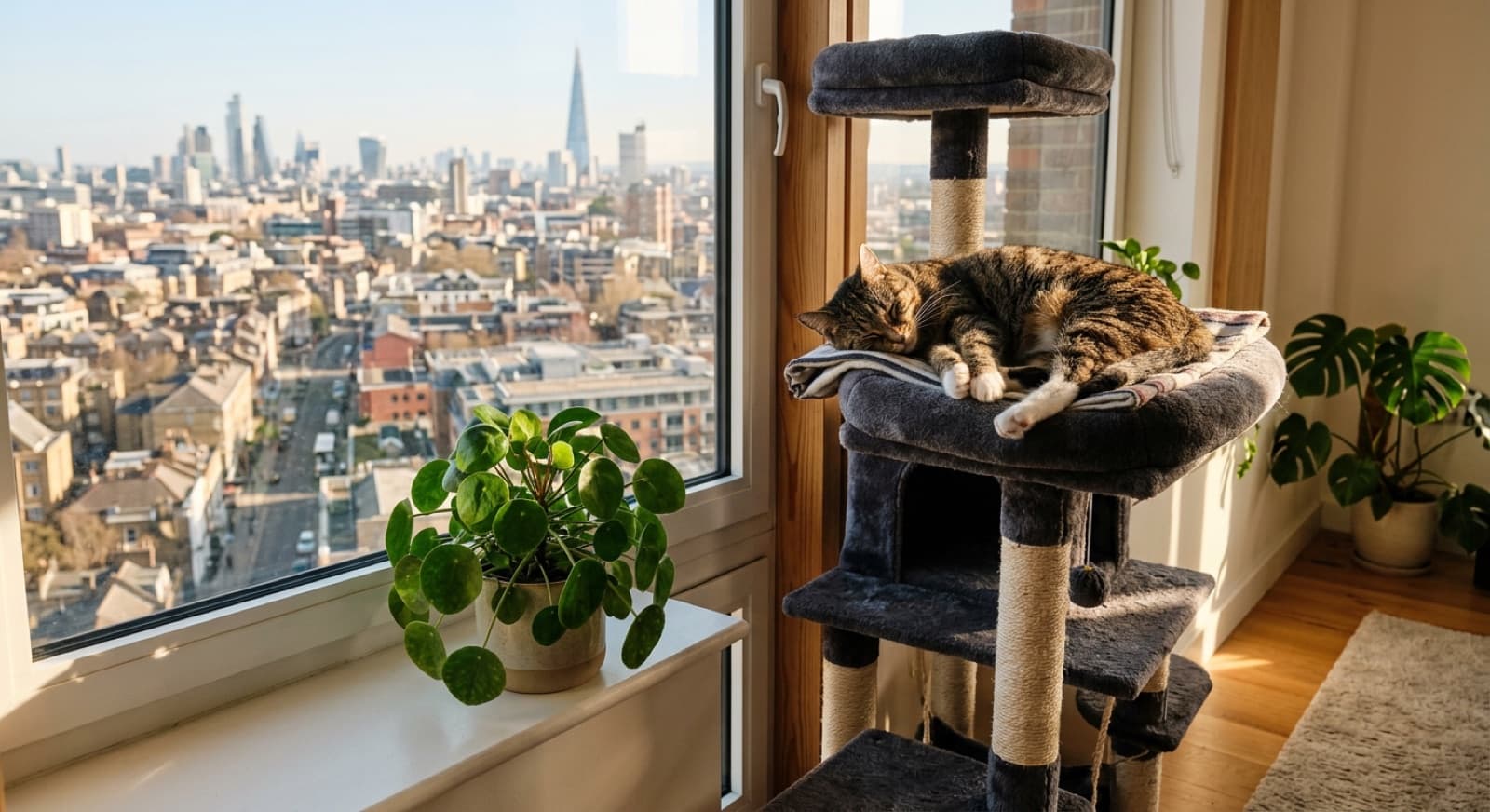
The lifespan gap is dramatic
The feline veterinary literature converges on similar numbers, summarized by the ASPCA and the American Association of Feline Practitioners (AAFP):
- Indoor cats: typically 12 to 18 years, many live to 20 and beyond
- Indoor-outdoor cats: typically 6 to 10 years
- Strictly outdoor cats: typically 3 to 5 years in urban Toronto
That is not a small difference. An outdoor cat in Toronto loses roughly two-thirds of its potential lifespan compared to an indoor sibling. The gap shows up everywhere outdoor cats live. Toronto adds its own pressures on top: a dense, fast-moving city wrapped around a ravine network that funnels predators right into residential neighbourhoods.
What kills outdoor cats in Toronto
Vehicle traffic
Traffic is the single most common cause of outdoor cat death in a dense city like Toronto. Streets from downtown to Scarborough, Etobicoke, and North York carry traffic volumes that make any crossing a coin flip for a cat. Even quiet residential streets in the Annex, Leslieville, or the Beaches kill cats regularly. The cat does not understand vehicles and moves unpredictably. Slow cars still kill cats. A cat that has crossed a street safely a hundred times can lose on the hundred-and-first.
Ravine coyotes
Coyotes are established residents across Toronto. The Don Valley, the Humber River corridor, the Rouge, High Park, the Scarborough Bluffs, and the city's ravine system all support steady coyote activity. Those ravines act as wildlife highways that bring coyotes directly into backyards in neighbourhoods that look fully urban. The City of Toronto's coyote information page tracks urban coyote behaviour and warns residents to keep pets supervised. Cats and small dogs are documented prey. A coyote clears a backyard fence in one motion, so a free-roaming cat anywhere near a ravine corridor is reachable.
Raccoons and disease vectors
Toronto is famous for its raccoons, and for good reason. The city has one of the highest urban raccoon densities in North America. Raccoons carry leptospirosis (spread through urine in standing water around storm drains and gardens), raccoon roundworm (Baylisascaris procyonis, neurologically devastating to cats and people), feline distemper, and rarely rabies. A direct fight often leaves the cat with deep infected bite wounds. Raccoons sometimes kill kittens and small adult cats outright over food or territory. Because raccoons are everywhere pet cats roam, exposure outdoors is nearly unavoidable.
Disease and parasites
Outdoor cats catch FIV (feline immunodeficiency virus, spread by bites in fights), FeLV (feline leukemia, spread by saliva and blood), feline panleukopenia, ringworm, fleas, ticks, and intestinal parasites. Indoor cats are essentially immune to most of these. Toronto has feral and community cat populations, so fight-transmitted diseases are a real risk for any cat that wanders. Toxoplasmosis from soil and prey is also widespread, and outdoor cats are the main source of household exposure.
Hard winters
Toronto winters routinely drop below -10C, and wind chill pushes the effective temperature much lower. A cat outside in those conditions risks frostbite on the ears, paws, and tail, plus hypothermia if it cannot find shelter. Cats also crawl into warm engine bays and get badly hurt when the car starts. Antifreeze tastes sweet and is lethal in tiny amounts. Road salt and ice melt irritate and crack paw pads. Winter alone justifies keeping a cat inside, before you even count the predators and traffic.
Off-leash dogs and theft
Toronto has dozens of off-leash dog areas and a strong dog-walking culture. A loose dog with prey drive can kill a cat in seconds. Friendly outdoor cats also get scooped up by strangers who assume they are lost, and distinctive-looking cats are sometimes taken for resale. Even a microchipped cat may never come home if the finder never checks the chip.
Why Toronto rescues require indoor-only
Every Toronto-area cat rescue makes indoor-only living a condition of adoption:
- Toronto Humane Society: indoor-only commitment is standard for cat adoptions
- Toronto Cat Rescue: foster-based, indoor-only requirement for adopters
- Annex Cat Rescue: indoor-only required, with a focus on community and feral cats moving into homes
- North Toronto Cat Rescue: indoor-only commitment for adopters
- City of Toronto Animal Services: promotes responsible indoor cat ownership
The rescues are not being overly cautious. They have seen too many rescued cats die after going outside. If you sign an indoor-only agreement and then let the cat roam, the rescue can reclaim the cat under the contract. To see who is adopting out near you, browse the Toronto cat shelters and rescues we feature.
The “but my cat loves outside” reframe
The cat does not love outside. The cat loves stimulation. Outside offers movement, scents, sounds, light, prey to watch, and territory to patrol. All of that can be reproduced indoors with a bit of thought. The underlying needs are sensory enrichment, a hunting outlet, vertical territory, and a varied environment. Outdoor access is one way to meet those needs. It is also the way most likely to get the cat killed.
The honest framing for new adopters: your cat's pull toward outside is real and worth respecting. The answer is to meet the underlying need indoors, not to send the cat out to be hunted.
Safe outdoor alternatives
Catio (cat patio)
A catio is an enclosed outdoor structure attached to a window, door, balcony, or wall of your home. The cat gets fresh air, sunlight, bird-watching, and outdoor scents without coyote, raccoon, or traffic risk. House and townhouse owners can build a ground-level or window catio. DIY builds start around $200; custom builders run $1,500 and up. Use hardware cloth, not chicken wire, because raccoons rip through chicken wire. A cedar frame, secure fasteners, a weatherproof door, and a covered top (to block any aerial threat) are the basics.
Balcony enclosures for condos
A lot of Toronto cat adopters live in condos and apartments. A screened or enclosed balcony can give a condo cat safe fresh-air time. The catch is building rules. Many Toronto condo boards restrict balcony alterations, enclosures, and anything visible from outside, so check your declaration and ask the board before you build or install anything. A tension-mounted, removable screen system is often the most board-friendly option, and a few Toronto builders specialize in balcony cat enclosures.
Leash-walking with a harness
Some cats tolerate harness training. Use a properly-fitted cat harness, not a dog harness. Train indoors for at least three to four weeks before going outside. Start somewhere quiet and predator-safe, like a fenced private garden or a townhouse courtyard. Skip the Don Valley, ravine trails, High Park, and any off-leash dog area because of coyote and dog presence. A residential cul-de-sac in daytime works for most cats. The cat sets the pace, and most explore for 15 to 30 minutes before they want to go in.
Supervised yard time
Sit outside with the cat in a fenced yard, within arm's reach the whole time. This works for cats that genuinely want sensory experience. Toronto fenced yards are not coyote-proof, since coyotes climb and jump fences and use ravine corridors to enter residential blocks. Supervision is the entire safety mechanism, not the fence. The moment you stop watching, the safety is gone.
The indoor enrichment toolkit that actually works
Boredom is the fair concern with indoor cats. The fix is enrichment, not outdoor access.
- Vertical space. Cat trees, wall shelves, perches. Indoor cats use vertical territory more than horizontal, so height matters more than floor area. Toronto condo living rewards this, because vertical territory takes almost no floor space.
- Window perches with a bird feeder view. Toronto's bird life (chickadees, cardinals, blue jays, juncos, the odd downy woodpecker) is excellent cat TV. A window-mounted feeder gives the cat months of entertainment.
- Daily interactive play. 10 to 15 minutes with a wand toy. Make the cat chase, pounce, and “kill” the toy. Do it morning and evening if you can.
- Puzzle feeders. Make the cat work for kibble. This slows eating and exercises the hunting circuit.
- Rotating toy supply. Hide half the toys, swap weekly. Old toys feel new again.
- A feline companion. Two cats keep each other entertained while you are at work. Bonded pairs are ideal for this.
- Scent enrichment. Cardboard boxes, paper bags, catnip, silvervine, dried valerian. Cheap and endlessly novel.
A brand-new rescue cat needs more than enrichment for the first few weeks. They need decompression time. See our first week with a rescue cat guide for the settling-in protocol. When you are ready to meet cats already living the indoor life, browse the indoor-only cats for adoption in Toronto.
Browse adoptable Toronto cats
Every cat from a Toronto rescue comes with an indoor-only adoption commitment. It protects the cat and reflects current best practice in feline care.
See Available Cats →The indoor-outdoor middle ground
Some owners want a compromise: a few hours of supervised time, a screened porch, a catio, or harness walks. Those are reasonable. What is not reasonable is unsupervised free-roam time, which is what most people actually mean by “indoor-outdoor.” The AAFP's position is indoor-only or supervised-only, and most Toronto vets and rescues agree.
A screened porch counts as supervised. A catio counts as supervised. A properly enclosed balcony counts as supervised. A backyard with the door propped open does not, because cats scale almost any fence and coyotes use ravine and greenway corridors to slip into residential yards. The honest middle ground is enclosed outdoor access, not free-roam outdoor access.
What about barn cats and working cats?
Some rescues around the Greater Toronto Area place barn cats at acreages and farms. These are semi-feral cats that would be miserable confined to a house. They get shelter, food, vet care, and outdoor life with an understanding rural owner, matched specifically to an outdoor-life situation. This is a different track from pet cat adoption. Do not confuse “barn cat placement” with “outdoor pet cat.”
Transitioning a previously outdoor cat
If you adopt an adult cat that was previously indoor-outdoor (common with surrendered cats and former strays), the transition to indoor-only is hard for the first month or two. The cat will:
- Cry at doors and windows, sometimes for hours
- Sit by exits and try to dart out
- Scratch at door frames
- Act restless and undirected during the day
Stick with it. The protest phase typically runs 4 to 8 weeks. Increase enrichment heavily during this period: two play sessions a day, food puzzles, a tall cat tree by a window, catnip mice, and a feline companion if possible. The cat adjusts. Once they decide the indoors is “home,” the door-darting and crying usually stop. The most common mistake is giving in at week three and letting them out “just once,” which resets the entire timeline.
Frequently asked questions
Should I let my cat outside in Toronto?
No. Ravine coyotes, dense raccoon populations, busy traffic, and cold winters all stack against a free-roaming cat. Toronto rescues universally require indoor-only adoption. Indoor cats live 12 to 18 years; outdoor cats live 3 to 5.
How long do outdoor cats live in Toronto?
3 to 5 years on average, versus 12 to 18 years for indoor cats. The lifespan gap is one of the largest documented in feline veterinary care. Traffic, predators, and disease drive it.
Are there coyotes in Toronto?
Yes. Coyotes are established in the Don Valley, the Humber, the Rouge, High Park, the Scarborough Bluffs, and ravine systems across the city. Those ravines funnel coyotes into urban backyards. Cats are coyote prey.
Is Toronto winter dangerous for outdoor cats?
Yes. Temperatures below -10C with wind chill bring frostbite and hypothermia risk. Cats also crawl into warm engine bays, and antifreeze and road salt add poisoning and paw-injury hazards.
What is a catio?
An enclosed outdoor cat patio that lets the cat experience fresh air and bird-watching without predator or traffic risk. DIY builds start around $200; custom builds run $1,500 and up. Use hardware cloth, not chicken wire.
Can I have a catio or balcony enclosure in a Toronto condo?
Sometimes. Check your condo board and building rules first, because many Toronto buildings restrict balcony alterations and enclosures. A removable, tension-mounted screen is often the most board-friendly option.
Do Toronto rescues require indoor-only adoption?
Yes. Toronto Humane Society, Toronto Cat Rescue, Annex Cat Rescue, North Toronto Cat Rescue, and City of Toronto Animal Services all require or strongly recommend indoor-only living for cat adoptions.
How do I transition a previously outdoor cat to indoor?
Plan for 4 to 8 weeks of protest. Stick with it. Increase enrichment significantly: daily play sessions, window perches, food puzzles, and vertical territory. Most cats adjust within two months.
Are raccoons a problem for outdoor cats in Toronto?
Yes. Toronto has very high urban raccoon density. Raccoons spread leptospirosis, roundworm, and distemper, and occasionally kill kittens or small cats over food or territory.
Can I leash-walk my cat in Toronto?
Some cats tolerate harness training. Use a cat harness, not a dog harness. Train indoors for several weeks first. Avoid the Don Valley, ravine trails, High Park, and off-leash dog areas because of coyote and dog presence.
Are barn cats different from indoor pet cats?
Yes. Working barn cats are semi-feral cats placed at rural acreages with shelter, food, and vet care. They are matched to outdoor-life situations and are not the same as pet cats.
New cat? Start with these care guides
Everything a new adopter needs to set up a safe, happy home.