The short answer
German Shepherds show up in Ontario rescue regularly because they are one of the most-surrendered large breeds. The work is exercise, training, and management, not fixing a broken dog. The Hamilton/Burlington SPCA and Ladybird Animal Sanctuary are the two local starting points. Rescue fees run about $350 to $600 (Ladybird is $350 single, $650 bonded pair), while the HBSPCA does not publish a flat fee and instead includes an adoption package worth more than $1,000 in care. A Shepherd is a working dog: it needs 60 to 90 minutes of real activity a day, mental work, early socialisation, and a household that can manage a large, alert, protective animal. Plan around hip and elbow dysplasia, degenerative myelopathy, and heavy double-coat shedding, and remember Hamilton's salted winters and humid summers both demand coat and paw care.
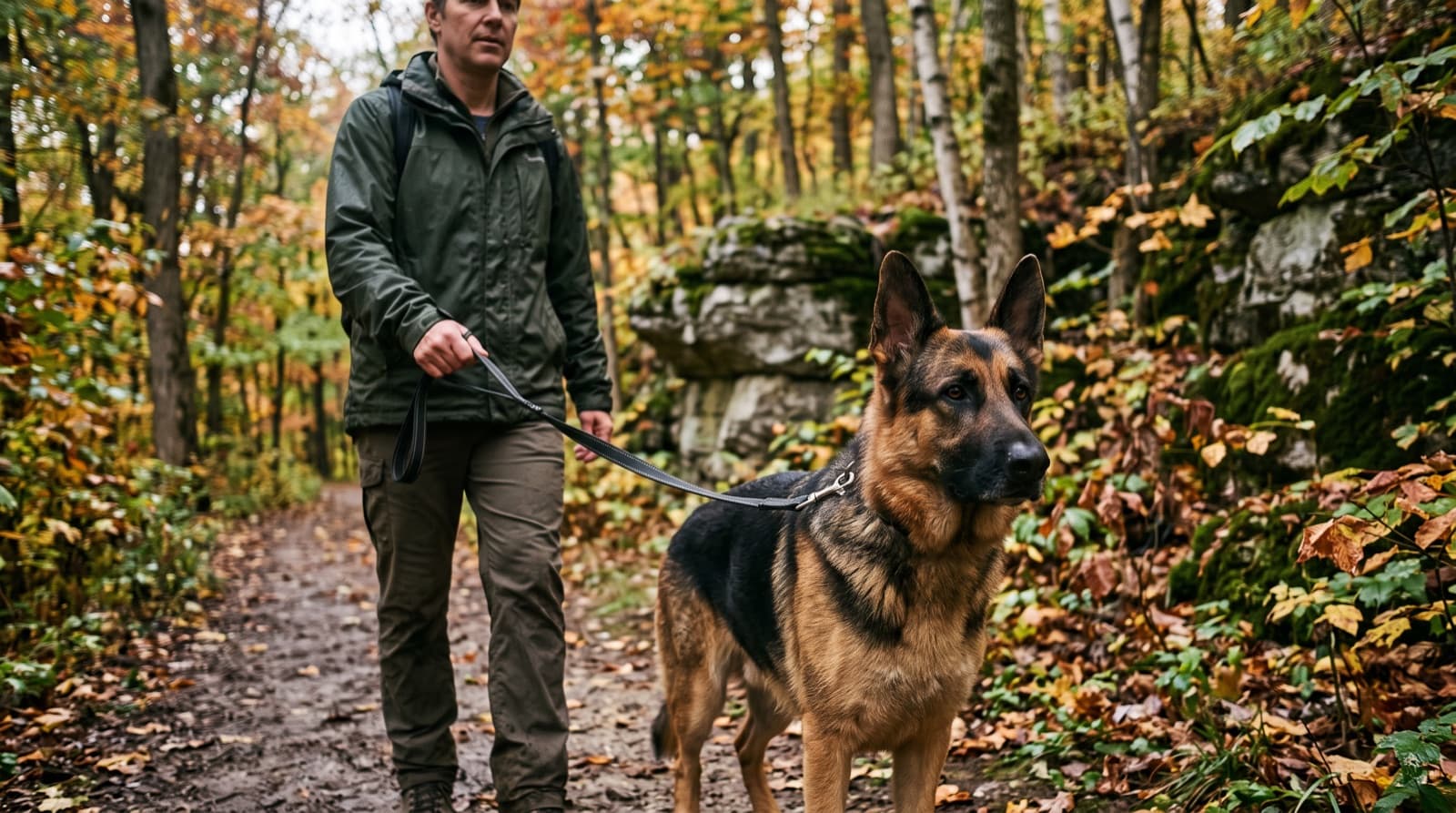
Why German Shepherds surrender in Hamilton
German Shepherds are consistently among the most-surrendered large breeds in Ontario rescue, and the reasons follow a pattern. Understanding those patterns helps adopters read foster write-ups accurately, budget realistically, and decide honestly whether the breed fits their life. Very few Shepherds surrender because they are bad dogs. Most surrender because the household underestimated what a working dog actually requires.
- Underestimated exercise and mental needs. The single biggest driver. Someone brings home a Shepherd expecting a loyal couch companion and instead gets a driven working dog that shreds the house when bored. Physical exercise alone is not enough; a Shepherd needs a job. Training, scent work, and problem-solving drain the mental energy that otherwise becomes destruction, and owners who did not plan for that get overwhelmed within the first year.
- Reactivity and guarding. Shepherds are naturally alert and protective, and without early socialisation and calm management that alertness can tip into barking and lunging at other dogs or strangers on leash. A large, reactive dog is genuinely hard to walk, and families who cannot manage it surrender. The behaviour is usually manageable with the right training, but it frightens unprepared owners.
- Size and strength. A 70 to 90 lb dog that pulls, jumps, or reacts can hurt someone by accident. As the puppy grows into its adult power, households that never taught loose-leash walking or a settle find themselves unable to control the dog physically, especially seniors, small households, or families with young kids.
- Cost of large-breed health issues. Hip and elbow dysplasia, joint disease, bloat risk, and age-related mobility care add up. When a Shepherd develops an expensive condition, some households cannot manage the bills and surrender rather than treat, particularly if they never set up pet insurance.
- Life changes and the double coat. Moves, new babies, relationship breakdowns, and housing that will not allow a large dog all funnel Shepherds into rescue. Add the year-round shedding and twice-yearly coat blow, which surprises owners who did not expect that much fur, and you have a breed that fills Ontario rescue kennels reliably.
Reading these patterns ahead of time matters, because a surrender note that says “too much dog for us” almost always means one of the reasons above. Ask the rescue specifically: how much exercise does this dog need to settle, what is its behaviour like with other dogs and strangers, how does it walk on leash, and is there any history of guarding. A foster-based rescue that has lived with the dog will give you honest answers, and honest answers are how you avoid becoming the next surrender.
Hamilton and Ontario rescues that list German Shepherds
A German Shepherd is a common enough breed in Ontario rescue that a wide alert net catches the right dog within a few weeks. Set up listing alerts on every organisation you would consider, apply the same day a good match appears, and stay open to Shepherd mixes as well as purebreds. For a fuller local directory, see our guide to the best dog rescues in Hamilton.
- Hamilton/Burlington SPCA: the main shelter for the region and the most consistent general source of Shepherd and Shepherd-mix intake, largely through owner surrender. Adopters can meet the dog in person before applying, and the shelter team produces a write-up covering temperament, behaviour, and any flagged medical history. The HBSPCA does not publish a flat adoption fee. Instead, it treats the adoption as a care package worth more than $1,000: a comprehensive vet exam, spay or neuter, up-to-date vaccines and preventatives, microchip, deworming, heartworm testing with continued treatment post-adoption if needed, five days of follow-up care at their onsite hospital, and a 30-day Trupanion pet insurance policy.
- Ladybird Animal Sanctuary: a foster-based Hamilton rescue whose dogs live in real homes, which means the temperament notes on energy, reactivity, and how a Shepherd behaves with kids, cats, and other dogs tend to be far more accurate than a shelter-only setting can offer. That accuracy matters enormously for a breed where individual temperament varies so much. Adoption fees are $350 for a single dog and $650 for a bonded pair, a fee that bundles in a vet health check, spaying or neutering, vaccines, parasite treatment, and a microchip. Reach out early and set up alerts, because foster-based rescues place good Shepherds fast.
- Regional Ontario rescues and breed groups: many foster-based Ontario rescues pull Shepherds from northern and out-of-region intake, and some breed-specific Shepherd rescues operate across the province. These groups often carry higher fees than a local shelter because they cover transport, and a foster-based rescue that has evaluated the dog in a home is worth the difference for a breed this variable. Verify any rescue through a real address, charitable-registry status, and a current adoptable-dog list before sending money, and be wary of free-Shepherd offers online, which are a common scam.
Whichever route you take, be honest with the rescue about your experience level and your home. A good organisation will steer a first-time owner toward a settled, socialised adult and steer a reactive project dog toward an experienced handler, and that matching is the difference between a placement that sticks and one that comes back.
Working line, show line, and the dog in front of you
The German Shepherd has split into distinct types over the decades, and understanding the split helps you set expectations, even though most rescue Shepherds land somewhere in between. Working-line Shepherds are bred for drive, stamina, and task focus, with a straighter back and an athletic build, and they often carry darker sable or bicolour coats. They need a real job: structured training, dog sport, long daily exercise, and consistent mental work. A working-line Shepherd in a quiet, low-activity home is a recipe for a surrender, and it is usually the wrong choice for a first-time owner.
Show-line or bench Shepherds are bred more for conformation and, in many lines, a somewhat calmer household temperament. The North American show line in particular is known for a more angled back, which has drawn criticism on health grounds. Somewhere between these poles sit the countless Shepherd mixes and moderate-line dogs that make up most of Ontario rescue, and for adoption purposes that is good news, because the line label matters far less than the individual dog.
When you read a rescue write-up, look past the coat colour and the back angle. What you actually want to know is the dog's energy level, how quickly it recovers from excitement, whether it settles at home, and how it handles new people and dogs. A foster assessment answers those questions directly, which is exactly why a foster-based rescue is such a strong choice for this breed. The Canadian Kennel Club publishes the breed standard and background at ckc.ca if you want to understand where the type differences come from, but for choosing a rescue dog, the foster notes beat the pedigree every time.
Exercise, the Escarpment, and mental work
An adult German Shepherd needs a solid 60 to 90 minutes of genuine activity a day, and the mental component matters as much as the physical one. A Shepherd walked to exhaustion but never asked to think stays restless; one given training, scent games, and problem-solving alongside its exercise settles into a calm, satisfied dog. Plan for both, every day, and understand that a bored Shepherd is a destructive Shepherd.
Hamilton is well suited to a big active dog. The Niagara Escarpment cuts through the city and the Bruce Trail runs along it, offering hours of varied on-leash hiking with real elevation and endless new smells. The Dundas Valley Conservation Area gives forest trails, the Chedoke Radial Trail and Rail Trail offer long flat routes, and the Bayfront Park and Pier 8 waterfront paths along Lake Ontario are good for distance walks. Cootes Paradise and the trails around it add more variety. All of these are on-leash spaces, and for a large, potentially reactive breed, on-leash is the responsible default anyway.
For off-leash running, check the City of Hamilton's list of designated dog parks and free-running areas rather than assuming any given park allows it, because off-leash rules are specific and enforced under the city's Responsible Animal Ownership By-law. A designated free-running area is the right place to let a Shepherd run once you trust its recall and its dog-to-dog manners. Until then, a long-line in an open space gives freedom safely. Mix the physical and the mental, use Hamilton's trails for the body and training for the mind, and you will have the calm, biddable Shepherd the breed is famous for.
Managing reactivity and guarding
Shepherd alertness is normal breed behaviour, not a defect. The breed was developed to watch, guard, and respond, and that same wiring is why so many Shepherds develop leash reactivity: the barking and lunging at other dogs or people that comes from a mix of genetics, missed socialisation, and stress. The good news is that reactivity is usually manageable, and management starts with the right mindset. A reactive Shepherd is not a dangerous dog by default; it is an over-aroused dog that needs distance, calm, and a plan.
Reward-based training is the approach that works. Give a newly adopted Shepherd a real decompression period before exposing it to busy environments, keep early walks calm and low-traffic, and reward the dog for noticing a trigger and then looking back to you. Managing distance so the dog stays under its threshold is the whole game. Punishing a reacting Shepherd risks teaching it that the trigger predicts something unpleasant, which makes the reactivity worse, not better. Guarding of food, toys, or space is a separate issue that also responds to management and professional guidance rather than confrontation.
For a dog with significant reactivity or guarding, work with a qualified force-free trainer or a veterinary behaviourist. In Ontario, you can confirm a veterinary behaviourist's credentials through the College of Veterinarians of Ontario. Be honest with the rescue about your experience, because the right dog for a first-time home is a settled, well-socialised Shepherd, not a project. There are plenty of both in Ontario rescue, and matching the dog to your skill level is the single best predictor of a placement that lasts.
German Shepherd health, in brief
Shepherds are prone to several breed-associated conditions. None of this should scare you off the breed, but all of it should shape your budget, your insurance decision, and where you keep the number for your nearest emergency vet.
- Hip and elbow dysplasia. Malformations of the joints that can cause pain and arthritis, and among the best-known Shepherd health issues. The Orthopedic Foundation for Animals maintains public screening databases for both.
- Degenerative myelopathy (DM). A progressive spinal-cord disease of older Shepherds that gradually causes hind-end weakness and loss of coordination. A genetic test for the risk gene exists through OFA, though a rescue dog rarely arrives with results.
- Bloat (gastric dilatation-volvulus). A life-threatening emergency where the stomach twists. Know where your after-hours vet is before you need it, and ask your vet about feeding practices that lower the risk.
- Exocrine pancreatic insufficiency (EPI). A digestive-enzyme deficiency over-represented in the breed, manageable with diagnosis and daily enzyme supplementation.
- Allergies and skin issues. Common in the breed and often lifelong to manage, showing up as itching, ear issues, and recurrent skin problems.
- Degenerative joint disease with age. The large frame and active life mean many senior Shepherds need mobility support, so budget for it as the dog ages.
For breed-level health-testing standards, the Orthopedic Foundation for Animals publishes screening databases at ofa.org. A rescue Shepherd will not usually have OFA records, but the resource is useful context for what the breed is screened for. Because bloat is a genuine emergency for this breed, know your after-hours options ahead of time: the Hamilton Emergency Veterinary Clinic offers after-hours and emergency care, and the Burlington Veterinary Emergency and Referral Hospital handles emergencies plus specialty referral. Plan a baseline vet visit in your first month to establish records and score body condition, and enrol in pet insurance early, before any condition is on file.
What a Hamilton rescue German Shepherd actually costs
Adoption fees for a Hamilton-area rescue dog generally sit near $350 to $600. Ladybird Animal Sanctuary charges $350 for a single dog and $650 for a bonded pair, and that fee bundles in a vet health check, spaying or neutering, vaccines, parasite treatment, and a microchip. The HBSPCA does not publish a flat fee; its adoption package instead works out to more than $1,000 in care, taking in a comprehensive vet exam, spay or neuter, vaccines and preventatives, microchip, deworming, heartworm testing, five days of follow-up hospital care, and a month of pet insurance. Foster-based rescues that cover out-of-region transport can run higher. Whatever the fee, it is not a sale price; it is the rescue clawing back part of what it already spent on vet care, and stacked at retail Ontario vet pricing that work would run well past the fee.
Compare that to a Shepherd puppy from a breeder, which runs well into the thousands with no medical work yet done and a temperament you cannot assess, and the rescue path is dramatically cheaper and lower-risk. Budget another $400 to $900 in the first month for your own vet baseline, a properly sized crate, a well-fitted harness for a strong dog, and setup supplies, and remember that Ontario HST of 13 per cent applies to supplies though not to the adoption fee itself. For a fuller local breakdown, see our Hamilton dog adoption cost guide.
Ongoing costs run roughly $1,500 to $2,500 a year for a medium-to-large dog, and a Shepherd sits at the upper end of that thanks to food volume, grooming supplies for the double coat, and the health monitoring the breed needs. Pet insurance is genuinely worth it for a breed with documented hip, joint, and bloat risks. You will also need a City of Hamilton dog licence, which the municipality administers and renews annually; the details are on the City of Hamilton dog licence page, and Ren's Pets offers a $20 credit when you register or renew a Hamilton licence. Our Hamilton dog licensing guide walks through the process. If your Shepherd is not already altered, though most rescue dogs are, our Hamilton spay and neuter guide covers the local options.
Browse adoptable Hamilton German Shepherds and Shepherd mixes
Current Hamilton-area listings from the HBSPCA, Ladybird Animal Sanctuary, and regional Ontario rescues in one place. Well-tempered Shepherds place fast, so alerts and same-day applications win.
See Available German Shepherds →The first 30 days with a Hamilton German Shepherd
Shepherds follow the same 3-3-3 arc as any rescue dog: the first three days are raw decompression, the routine clicks into place over about three weeks, and the real bond takes closer to three months. With a large, alert, potentially reactive breed, the decompression period is not optional, because a Shepherd thrown straight into busy walks and new dogs before it has settled will show you its worst behaviour first. Our first week with a rescue dog guide covers the general plan; here is the Shepherd-specific version.
- Give real decompression. Keep the first week quiet. Short calm walks in low-traffic areas, no dog parks, no meeting the whole neighbourhood. A settled Shepherd is a safer, more trainable Shepherd.
- Set up the crate and a safe space from night one. Even a house-trained Shepherd benefits from a den during the settling window, and a crate helps with the separation and management this breed often needs.
- Establish the exercise-plus-mental-work routine early. Build in training, scent games, and puzzle feeders from the start, not just walks. The mental work is what prevents the boredom that fuels destruction.
- Use a well-fitted harness and practise loose-leash walking. A strong dog that pulls is a management problem waiting to happen. Start the walking skills in week one before habits set.
- Book a baseline vet visit in the first two weeks. Establish records, score body condition, confirm the microchip is registered to you, and discuss breed-specific monitoring for hips, joints, and bloat risk.
- Enrol in pet insurance early. Before any pre-existing conditions appear in your records. For a breed with documented joint and bloat risks, early enrolment saves real money.
- Read the dog before exposing it to triggers. Watch how it responds to other dogs, strangers, and household sounds, and manage distance accordingly. If you see reactivity, start reward-based work early with professional help.
- Winter paw and coat care. Hamilton sidewalks and roads get heavily salted, which cracks and irritates paws, so rinse or wipe the feet after winter walks and watch for salt burn. The double coat handles the cold fine.
- Summer humidex management. The same double coat makes hot, humid Hamilton days dangerous. Shift walks to early morning or evening on high-humidex days, carry water, and never leave a Shepherd in a parked car.
- Licence the dog with the City of Hamilton. Required under the Responsible Animal Ownership By-law and quick to arrange.
- Same routes, same routine for the first two weeks. A predictable rhythm helps a nervous Shepherd relax. Save new environments and dog-to-dog introductions for after week three.
Somewhere around week three the household rhythm settles and the real dog starts to show through. By the three-month mark the bond feels solid and the exercise, training, and coat-care routine is just how your week runs. Hold off on big judgements through those first 90 days, because most early worries about a Shepherd fade with steady structure, real exercise, mental work, and time.
Frequently asked questions
Where can I adopt a German Shepherd near me in Hamilton?
Start with the Hamilton/Burlington SPCA (HBSPCA), the main shelter for the region, and Ladybird Animal Sanctuary, a foster-based Hamilton rescue. Both list German Shepherds and Shepherd mixes through owner surrender and transport intake, and Shepherds are common enough in Ontario rescue that a purebred or near-purebred turns up regularly. Because Shepherds are a popular breed, the well-tempered ones place quickly, so set listing alerts on both organisations rather than waiting for the perfect dog to appear. Widen your net across regional Ontario rescues too, since many foster-based groups pull Shepherds from northern and out-of-region intake. Have your application, references, landlord approval if you rent, and vet contact ready before you find the dog, because same-day applications win most placements in a competitive breed. Most rescue Shepherds in the Hamilton area are adults between one and five years old, which is actually the easier age to bring home than a puppy.
Why are German Shepherds one of the most-surrendered large breeds?
Shepherds surrender for a handful of predictable reasons, and almost none of them are about a bad dog. The breed is a working dog with real exercise and mental-stimulation needs, and owners who pictured a calm family pet get overwhelmed when a bored adolescent starts destroying the house. Reactivity is the second driver: Shepherds are naturally alert and protective, and without early socialisation and management that alertness can tip into leash reactivity or guarding that a family cannot handle. Size and strength matter too, because a 70 to 90 lb dog that pulls, jumps, or reacts is genuinely hard to walk. Add underestimated grooming from the double coat, the cost of large-breed health issues, and life changes like moves or new babies, and you get a breed that fills rescue kennels across Ontario. The dogs themselves are usually loyal, trainable, and deeply bonded once they land in a household that matches their needs.
How much does it cost to adopt a German Shepherd in Hamilton?
In the Hamilton area, adopting a rescue dog usually costs somewhere around $350 to $600. Ladybird Animal Sanctuary charges $350 for a single dog and $650 for a bonded pair, and that fee bundles in a vet health check, spaying or neutering, vaccines, parasite treatment, and a microchip. The HBSPCA sets no flat adoption fee; instead it frames the adoption as a package worth more than $1,000 in care, taking in a comprehensive vet exam, spay or neuter, up-to-date vaccines and preventatives, microchip, deworming, heartworm testing, five days of follow-up care at their onsite hospital, and a 30-day Trupanion pet insurance policy. Foster-based rescues that cover out-of-region transport can run higher than the local range. Budget another $400 to $900 in the first month for your own vet baseline, a crate, a well-fitted harness, and setup supplies, and expect roughly $1,500 to $2,500 a year ongoing for a medium-to-large dog. Ontario HST of 13 per cent applies to supplies, though not to the adoption fee itself.
What is the difference between working-line and show-line German Shepherds?
The breed has split into distinct types, and knowing which you are looking at helps you match a dog to your household. Working-line Shepherds are bred for drive, stamina, and task focus, with a straighter back, athletic build, and often darker sable or bicolour coats. They need a serious job: sport, structured training, long daily exercise, and real mental work, and they are usually the wrong choice for a first-time owner or a low-activity home. Show-line or bench Shepherds are bred more for conformation and a calmer temperament, and the North American show line in particular tends toward a more angled back. Most rescue Shepherds in Ontario are somewhere in the middle or are Shepherd mixes, so the line label matters less than the individual dog's energy level. When you read a rescue write-up, look past the coat and the back angle to the foster notes on drive, recovery from stimulation, and how the dog settles at home. A foster assessment tells you more than any line label ever will.
Do German Shepherds need a lot of exercise, and where can I walk one in Hamilton?
Yes. An adult Shepherd needs a solid 60 to 90 minutes of real activity a day, and the mental side matters as much as the physical. A Shepherd walked hard but never asked to think stays wired; one given training, scent work, and problem-solving settles far better. Hamilton is well set up for it. The Bruce Trail runs along the Niagara Escarpment right through the city and offers hours of varied on-leash hiking, and the Dundas Valley Conservation Area, the Chedoke Radial Trail, and the Bayfront Park and Pier 8 waterfront paths all give a Shepherd distance and new smells to process. For off-leash running, check the City of Hamilton's list of designated free-running areas rather than assuming any given park allows it, since off-leash rules are specific. The Escarpment, the Bruce Trail, and the waterfront are on-leash spaces. Mix physical exercise with structured training and enrichment and you have a calm dog; skip the mental work and even a well-exercised Shepherd finds trouble.
Are German Shepherds good with kids and other pets?
Many are excellent family dogs, but it depends heavily on the individual and on socialisation. Shepherds bond hard to their people and are often patient, gentle, and protective with the children in their household. The cautions are size and herding instinct: a large, high-drive dog can knock over a toddler by accident or nip at running kids out of a herding urge, so supervision and teaching the dog to settle around children matter. With other dogs and cats, outcomes vary. Some Shepherds are social and easygoing, others are same-sex aggressive or have a high prey drive that makes cats a poor match. This is exactly where adopting through a foster-based rescue like Ladybird pays off, because the dog has been living in a real home and the foster can tell you how it behaves with kids, cats, and other dogs. For homes with young children or resident pets, prioritise a dog with a documented history in a similar household and take introductions slowly through the first few months.
What health problems do German Shepherds have?
Shepherds carry several breed-associated risks worth planning around, and none of this is a reason to avoid the breed, only to budget and monitor. Hip and elbow dysplasia are the most well-known, malformations of the joints that can cause pain and arthritis, and the Orthopedic Foundation for Animals maintains public screening databases for both. Degenerative myelopathy (DM) is a progressive spinal-cord disease that appears in older Shepherds and gradually causes hind-end weakness and loss of coordination; there is a genetic test for the risk gene through OFA, though a rescue dog rarely comes with results. The breed is also prone to bloat (gastric dilatation-volvulus), a life-threatening stomach emergency that means you should know where your nearest after-hours vet is before you ever need it. Other concerns include exocrine pancreatic insufficiency, allergies and skin issues, and degenerative joint disease with age. A rescue Shepherd will not usually have health-test records, so plan a baseline vet visit early and consider pet insurance before any condition is on file.
How do I manage reactivity or guarding in a rescue German Shepherd?
Start by understanding that Shepherd alertness is normal breed behaviour, not aggression, and most of it is manageable with the right approach. Reactivity, the barking and lunging at other dogs or strangers on leash, usually comes from a mix of genetics, missed socialisation, and stress, and it responds well to distance management, calm exposure, and reward-based training rather than punishment. The moment you punish a reacting Shepherd you risk teaching it that the trigger predicts something bad, which makes things worse. Work with a qualified force-free trainer or behaviour professional, and in Ontario you can confirm a veterinary behaviourist's credentials through the College of Veterinarians of Ontario. Give a new Shepherd a decompression period before exposing it to busy environments, keep early walks calm and low-traffic, and reward the dog for noticing a trigger and looking back at you. Guarding of food or space is separate and needs management plus professional guidance. Be honest with the rescue about your experience level, because a foster-based group will match an easier dog to a first-time home and steer a project dog toward an experienced handler.
How much does a German Shepherd's double coat shed, and how do I groom it?
A lot. Shepherds shed year-round and blow their coat heavily twice a year in spring and fall, when the undercoat comes out in clumps for several weeks. Weekly brushing keeps it under control most of the year, and during a coat blow you will want to brush several times a week with an undercoat rake to stay ahead of the fur. Never shave a Shepherd's double coat, because it insulates against both cold and heat and does not grow back the same. Bathe only every couple of months or when genuinely dirty, since over-bathing strips the coat. The double coat is also why Hamilton's climate cuts both ways for the breed. A Shepherd handles cold, snowy winters comfortably, but the salt on Hamilton sidewalks and roads irritates paws, so rinse or wipe the feet after winter walks and watch for salt cracking on the pads. In summer, the same coat that keeps the dog warm makes hot, humid days genuinely dangerous, so shift walks to early morning or evening on high-humidex days and never leave a Shepherd in a parked car.
Should I adopt a German Shepherd puppy or an adult?
For most Hamilton households, an adult is the smarter choice. Shepherd puppies are a serious project: they go through a long adolescence, roughly six to eighteen months, that stacks intense energy, mouthing, chewing, and the emergence of drive and reactivity all at once, and they need consistent socialisation and training through that whole window to turn out well. An adult Shepherd has a settled temperament you can actually assess, established house manners, a known size, and often a documented behaviour history from its foster home. You can see what you are getting rather than gambling on how a puppy develops. Senior Shepherds, seven years and up, are frequently the calmest and most grateful companions available and place beautifully into quieter homes, though you should budget for the age-related joint and mobility care the breed tends to need. If you specifically want a puppy and have the time, budget, and training commitment for eighteen months of intensive work, it can be done, but an adult is far more forgiving for a first Shepherd.
How long does it take to adopt a German Shepherd in Hamilton?
Plan on a few weeks to a couple of months from approved application to dog-in-home, though it varies with how specific your needs are. Well-tempered young adult Shepherds place fast, often within days of listing, because the breed is popular, so the adopters who move quickly and have their paperwork ready tend to win those dogs. Shepherds with reactivity, medical needs, or a no-cats requirement wait longer and are exactly the dogs an experienced adopter can do well by. The best strategy is to set alerts on the HBSPCA and Ladybird, stay open to a Shepherd mix rather than holding out for a purebred, and be flexible on age. Because Shepherds are one of the most-surrendered large breeds in Ontario, the supply is steady, so a patient adopter with realistic criteria will find the right dog. Have references, landlord approval, and a vet contact lined up before you start, because the difference between getting a great dog and missing it is often a same-day application.
Related Hamilton adoption guides
Adoptable Hamilton German Shepherds
Current Hamilton-area German Shepherd and Shepherd-mix listings from the HBSPCA, Ladybird, and regional Ontario rescues.
Best Dog Rescues in Hamilton
A directory of the Hamilton shelters and foster-based rescues worth setting listing alerts on, with what each is known for.
Hamilton Dog Adoption Costs
What rescue fees actually cover, first-month vet and setup costs, and the true ongoing budget for a large dog in Hamilton.
First Week With a Rescue Dog
The 3-3-3 decompression plan, settling routines, and what to expect in the first days with a newly adopted Hamilton rescue dog.
Find your Hamilton rescue German Shepherd
Browse current Hamilton-area German Shepherd and Shepherd-mix listings. Well-tempered Shepherds place fast, so alerts and same-day applications win.
Browse All Hamilton Dogs →New dog? Start with these care guides
Everything a new adopter needs to set up a safe, happy home.