The short answer
Huskies are one of the most-surrendered breeds in Ontario, so rescue supply is steady, but the breed demands an experienced, active, fence-secure home. The Hamilton/Burlington SPCA is the main shelter for the region, and Ladybird Animal Sanctuary is a foster-based Hamilton rescue. Rescue fees run about $350 to $600, plus a six-foot dig-proof fence you should have before the dog arrives. A Husky is a hardwired escape artist: never trust one off leash in an unfenced space. It needs one to two hours of hard exercise daily and gets destructive when bored. The heavy double coat handles Hamilton winter beautifully, but the summer humidex is a genuine heat risk, so shade, water, and early-morning walks matter. For most first-time owners, this is the wrong breed.
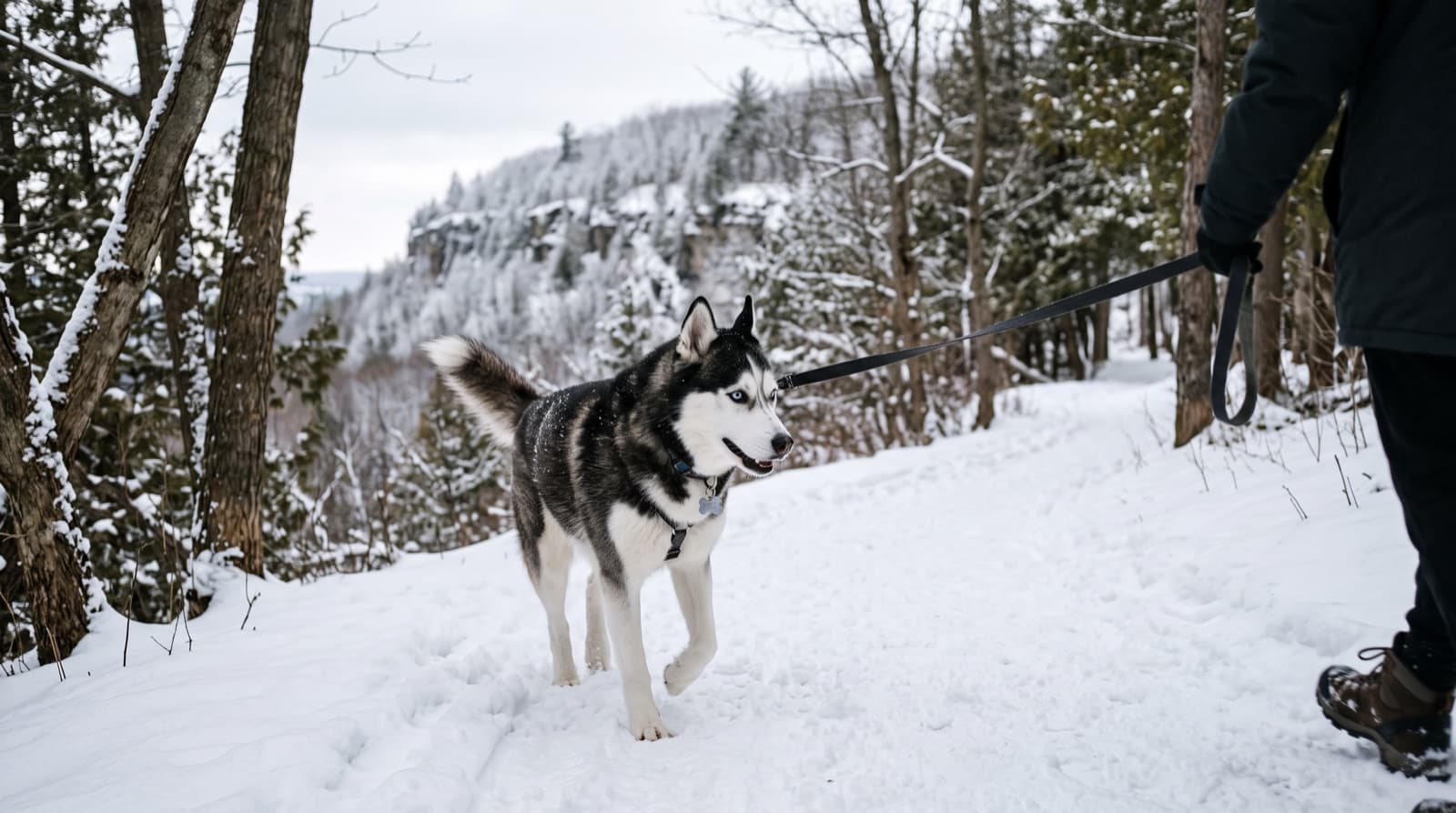
Why Huskies surrender in Hamilton
Huskies are among the most-surrendered breeds in Ontario, and the reasons are strikingly consistent. Almost none of them are about a bad dog. They are about a mismatch between the breed people imagine and the breed they actually get. Reading these patterns ahead of time is the single best thing an adopter can do, because it turns a foster write-up into something you can actually interpret.
- Bought for the looks, not the temperament. The striking blue eyes, the wolfish coat, the dramatic markings: Huskies are one of the most visually arresting breeds, and a lot of people acquire one on impulse or after seeing them in film and on social media. Then reality arrives. The gorgeous dog is also a stubborn, high-drive escape artist that sheds by the bagful, and the owner who wanted a beautiful companion discovers a full-time job. This gap between expectation and reality is the root cause behind most of the patterns below.
- Escaping and roaming. Huskies escape. They dig under fences, climb over them, bolt through open gates and doors, and once loose they run. A Husky that gets out is often found kilometres away, and repeat escapes wear an owner down fast. Many Hamilton-area strays are Huskies for exactly this reason, and a household that could not contain the dog frequently surrenders after the second or third escape.
- Destruction when bored or under-exercised. A Husky needs one to two hours of real exercise a day plus mental work. Denied that, the breed turns its energy on the house: shredded furniture, dug-up yards, chewed drywall, and destroyed doors are common in an under-stimulated Husky. Owners who expected a couple of walks a day to be enough end up with a wrecked home and a dog they see as the problem.
- Howling and vocalising. Huskies are famously vocal. They howl, they “talk,” and they carry. In a detached home this is charming; in a townhouse, an apartment, or a close-set Hamilton Mountain neighbourhood it generates noise complaints, and noise complaints become surrenders in shared or rented housing.
- Shedding overwhelm. The double coat sheds year-round and blows out twice a year in clumps. Owners who did not grasp the scale of it, or who developed or discovered an allergy, sometimes give up. This is a predictable, avoidable surrender that comes down to research not done before adopting.
The dogs that come through this pattern are usually healthy, friendly, and social. A well-matched Husky in an active, experienced, fence-secure home is a wonderful dog. So when you read a Hamilton rescue write-up, ask the direct questions: has this dog escaped before, how much daily exercise is it getting in foster, how vocal is it, and how does it handle being left alone. The honest answers tell you whether the match will work.
Hamilton and Ontario rescues that list Huskies
Hamilton is a large city of roughly 570,000 in a metro area of about 780,000, so there is genuine, steady search demand for Huskies and a real network of sources. Because Huskies surrender at high rates, they turn up more reliably than rarer breeds. Set up listing alerts on every source you would consider. For a fuller directory, see our guide to the best dog rescues in Hamilton.
- Hamilton/Burlington SPCA (HBSPCA): the main open-admission shelter for the region and the most consistent local source of Huskies through owner surrender and stray intake. You can meet the dog in person before applying, and the shelter produces a clear temperament and medical write-up. The HBSPCA does not publish a flat adoption fee; its adoption package is valued north of $1,000 in care, covering a full vet exam, spay or neuter, up-to-date vaccines and preventatives, microchip, deworming, and heartworm testing, plus five days of recovery care at their onsite hospital and a 30-day Trupanion insurance window.
- Ladybird Animal Sanctuary: a foster-based Hamilton rescue whose dogs live in real homes, which makes the notes on escaping, energy, vocalising, and how the dog handles alone time far more accurate than a shelter-only setting can offer. That accuracy is worth a great deal for a breed as demanding as a Husky. Adoption fees are $350 for a single dog and $650 for a bonded pair, a fee that takes care of spay or neuter, vaccines, a microchip, parasite treatment, and a vet health check. Foster space is limited, so apply early when a Husky that fits your home appears.
- Regional and transport-based Ontario rescues: many Ontario foster rescues pull dogs from northern communities, out-of-region shelters, and even out of country, and Huskies feature heavily in these intakes. These rescues can have Huskies available when local sources do not, though their fees can run higher because they cover transport. Verify any rescue through a real address, charitable-registry status, and a current adoptable-dog list before sending money. Free-purebred-Husky offers online are a common scam, and a legitimate Ontario rescue will always want an application and a conversation first.
For veterinary and professional context, the College of Veterinarians of Ontario is the licensing body for Ontario vets and a useful reference when choosing a clinic. Know your emergency options before you need them: the Hamilton Emergency Veterinary Clinic handles after-hours care, and the Burlington Veterinary Emergency & Referral Hospital covers emergencies and specialty referrals for anything beyond a general practice.
The escape-artist reality
Everything about safely living with a Husky comes back to one fact: this breed was built to run, and it will find a way out. The Siberian Husky was developed to pull sleds across enormous distances in a team, and the drive to move and cover ground is written into the dog rather than trained into it. That heritage produces an athletic, tireless, endearing companion, and it also produces the behaviour that surprises unprepared owners most.
The practical rule for Hamilton owners is firm: most Huskies should never be off leash in an unfenced space. When a Husky sees a squirrel, a rabbit, or simply an open horizon, it goes, and recall collapses the instant the chase or the open ground takes over. This is not stubbornness you can fix with enough training; it is what the dog is. A securely fenced yard gives the dog freedom to run at home. Everywhere else, including the City of Hamilton free-running areas, the Bruce Trail along the Niagara Escarpment, the Chedoke Radial Trail, and the Bayfront Park and Pier 8 waterfront, the Husky stays on leash unless the space is fully enclosed. Hamilton's off-leash areas are only safe for this breed where the fencing is complete, so check the City list rather than assuming.
The fence itself deserves real attention. Six feet is the usual recommendation because many Huskies clear a four-foot fence with a running start, and some climb chain-link. Just as critical is the bottom of the fence, because Huskies are champion diggers and will tunnel under a fence line in an afternoon. Secure the base with buried wire, a concrete footing, or paving stones along the perimeter, check for gaps beside gates, and confirm every gate latches. Many Hamilton rescues ask about fencing during the application and some will decline a placement without it. If you do not have a suitable fenced yard, be honest about whether you can commit to leashed exercise for the dog's whole life.
The good news is that the same drive that causes the trouble is also the outlet. A Husky that gets real exercise is a far easier dog. Long leashed hikes on the Bruce Trail and through the Dundas Valley Conservation Area, structured jogging with a mature dog, canicross and skijoring in the snowy months, and secure fenced play all drain the energy that otherwise turns into digging, howling, and escape attempts. Aim for one to two hours of hard activity a day, plus puzzle feeders and scent games at home for the mind. A tired Husky is a manageable Husky. An under-exercised one takes your house apart.
Coat, climate, and the Hamilton humidex
The Husky wears a heavy double coat built for the Arctic, and in Hamilton that coat is both an advantage and a responsibility. Winter is the easy season. Hamilton's cold, snowy winters, with the freezing rain, ice, and lake-effect snow that come off Lake Ontario, are genuinely comfortable for a Husky, and many are visibly happiest in the snow. The one real winter caution is not the cold but the road salt. Hamilton salts its sidewalks and roads heavily, and salt burns paw pads and upsets the stomach when a dog licks it off. Rinse or wipe the paws after every walk, watch for cracked or irritated pads, and use booties for a dog that will tolerate them.
Summer is the season that demands management, and it is the part new Husky owners in southern Ontario most often underestimate. Hamilton sits in a humid continental climate with hot, humid summers, and the humidex can push the felt temperature well past what the thermometer shows. A dog carrying an Arctic double coat can overheat quickly in that heat and humidity, and heat stroke is a genuine emergency. The plan is straightforward: walk in the early morning or after sunset, skip the midday sun entirely on hot days, always carry water, provide constant shade in the yard, and never leave a Husky in a parked car even for a few minutes. Watch for heavy panting, drooling, weakness, or disorientation, and cool the dog and call a vet if you see them. Crucially, do not shave the double coat to cool the dog. The coat insulates against heat as well as cold, and shaving it can make overheating worse and damage the coat's regrowth.
Then there is the shedding, which is relentless and real. Huskies shed year-round, and twice a year they blow coat, a two-to-three-week stretch where the entire undercoat releases in clumps and the dog looks like it is coming apart. During a coat blow you will vacuum daily and fill bags with fur. Routine ownership means brushing several times a week with an undercoat rake, more during a blow. The trade-off is that Huskies are naturally clean, largely odourless, and rarely need bathing. But there is no shortcut here, and it is not a coat you can shave down. If a household member has a serious allergy or cannot live with fur on every surface, this is the wrong breed, full stop.
Husky health, in brief
Huskies are a relatively hardy, athletic breed with a typical lifespan of 12 to 14 years, but a few conditions are worth planning around so adopters apply with realistic expectations. None of this is veterinary advice; always ask a vet before making health decisions.
- Eye conditions. The notable breed concern. Cataracts, progressive retinal atrophy, and corneal dystrophy all appear in the breed, and responsible breeders screen for them. Have any Husky's eyes checked at the baseline vet visit and watch for cloudiness or vision changes.
- Hip dysplasia. Occurs in the breed, though less commonly than in some larger breeds. A malformed hip joint that can lead to arthritis; managed with weight control, appropriate exercise, and sometimes surgery.
- Hypothyroidism. An under-active thyroid that shows up in middle age and can affect coat, weight, and energy. Diagnosed with bloodwork and managed with a daily pill.
- Skin and autoimmune conditions. Certain skin conditions and immune-related issues appear in the breed. Discuss any recurring skin trouble with your vet rather than guessing.
- Heartworm and parasite prevention. Not breed-specific, but essential for any Ontario dog. Southern Ontario has heartworm risk, so a preventative schedule is part of routine care.
For breed-level health-testing standards, the Orthopedic Foundation for Animals maintains public screening databases at ofa.org, and the Canadian Kennel Club describes the breed standard and recommended testing. A rescue Husky will not usually come with screening records, but the databases are useful context for what the breed is screened for. Plan a baseline vet visit in your first month to establish care, check the eyes, confirm the microchip is registered to you, and set a preventative schedule.
What a Hamilton rescue Husky actually costs
A Hamilton-area rescue dog generally costs about $350 to $600 to adopt. Ladybird Animal Sanctuary charges $350 for a single dog and $650 for a bonded pair. The HBSPCA does not publish a flat adoption fee; its adoption package is valued north of $1,000 in care and covers a full vet exam, spay or neuter, vaccines and preventatives, microchip, deworming, heartworm testing, five days of recovery care at their onsite hospital, and a 30-day Trupanion insurance window. Whatever the number, the fee is not a purchase price; it offsets a fraction of the vet work the rescue already funded. A typical adoption fee covers spay or neuter, core vaccinations, microchip, deworming and parasite treatment, and a vet workup. Stacked at retail Ontario vet pricing, those services would run well past the fee, so it is a genuine bargain against the real cost of care already provided.
Compare that to a Husky puppy from a breeder, which is far more expensive with no medical work yet done, and the rescue path is dramatically cheaper while often giving you a dog with a known temperament. Beyond the adoption fee, budget $400 to $900 as a one-time first-month setup: crate, bedding, leash and a well-fitted harness, food, bowls, an undercoat rake and a good vacuum, and initial vet baseline. The single most important line item for this breed is containment, so if your fence is not already six feet and dig-proof, factor in the cost of raising it, dig-proofing the base, or a long-line and training plan. Note that 13% Ontario HST applies to supplies, though not to the adoption fee itself. For a fuller local breakdown, see our Hamilton dog adoption cost guide.
Ongoing costs for a medium dog run roughly $1,500 to $2,500 a year: quality food for a 35 to 60 lb active dog, routine vet care and preventatives, pet insurance (worth it for a breed with documented eye and joint risks), grooming supplies, and a City of Hamilton dog licence, which the municipality administers annually. You can arrange or renew the City of Hamilton dog licence online, and Ren's Pets offers a $20 credit when you register or renew a City of Hamilton dog licence. Licensing is required under the city's Responsible Animal Ownership By-law. If your Husky is not already spayed or neutered, our Hamilton spay and neuter guide covers the local options, though most rescue Huskies arrive already altered.
Browse adoptable Hamilton Huskies and Husky mixes
Current listings from the HBSPCA, Ladybird Animal Sanctuary, and regional Ontario rescues in one place. Huskies are common in rescue but the right-fit dog still moves fast, so alerts and a fence-ready application win.
See Available Hamilton Huskies →The first 30 days with a Hamilton Husky
Huskies follow the same 3-3-3 arc as any rescue dog: the first three days are raw decompression, the routine clicks into place over about three weeks, and the real bond takes closer to three months. What you cannot ease off on, even in the first hour, is containment, because a nose-and-drive-led escape from an unsecured yard can happen the first afternoon. Our first week with a rescue dog guide covers the general decompression plan; here is the Husky-specific version.
- Secure the yard before the dog arrives. Walk the fence line looking for gaps at the bottom, spots low enough to jump, and gates that do not latch. Dig-proof the base with buried wire or paving stones. Assume the dog will test every weak point on day one.
- Leash on for every outing, no exceptions. Until you deeply know this individual dog, treat off-leash freedom outside a fenced area as off the table. A well-fitted harness reduces the risk of a Husky backing out of a collar and bolting.
- Double-door and gate discipline. Huskies dart through open doors. Set a household rule that gates and exterior doors are checked and closed, and consider a baby gate as an airlock at the main entrance during the first weeks.
- Book a baseline vet visit in the first two weeks. Establish records, check the eyes, confirm the microchip is registered to you, and set a heartworm and parasite preventative schedule for an Ontario dog.
- Plan the exercise from day one. One to two hours daily is not optional. Build the walk and hike routine early so the dog learns the outlet exists before boredom turns destructive.
- Set up the grooming kit. Undercoat rake, a good vacuum, and a several-times-a-week brushing habit. Get ahead of the shedding rather than chasing it.
- Manage the heat and cold. If you adopt in summer, walk early and late and watch for overheating in the humidex. In winter, rinse the paws after salted walks and never shave the coat.
- Enrol in pet insurance in week one. Before any pre-existing conditions appear in your records. Eye and joint issues are cheaper to insure against when you enrol early.
- Licence the dog with the City of Hamilton. Required under the Responsible Animal Ownership By-law, and quick to arrange online.
- Build enrichment early. Puzzle feeders, scatter-feeding, and scent games from the start. Mental work prevents the boredom that fuels digging, howling, and escape.
- Crate train from night one. Even a house-trained Husky benefits from a crate routine in the first month, giving the dog a safe den during decompression and a secure spot when you cannot supervise.
- Same routes, same routine for the first two weeks. A predictable routine is what settles a dog into a new home. Save fenced dog parks and new friends for after week three.
By about week three the household finds its rhythm and the dog underneath the early nerves starts to come out. By the three-month mark the bond feels solid and the daily hike, the brushing, and the door-and-gate discipline are just how your week runs. Hold off on big judgements through those first 90 days. Most early worries fade with steady containment, real daily exercise, and time.
Frequently asked questions
Where can I adopt a Husky near me in Hamilton?
Start with the Hamilton/Burlington SPCA (HBSPCA) and Ladybird Animal Sanctuary, the two most consistent local sources. The HBSPCA is the main open-admission shelter for the region and takes in Huskies and Husky mixes through owner surrender and stray intake, which is common for a breed that escapes and roams. Ladybird Animal Sanctuary is a foster-based Hamilton rescue whose dogs live in real homes, so the temperament notes on energy, escaping, and being left alone tend to be accurate. Huskies also reach Ontario through transport-based rescues that pull from northern communities and out-of-region shelters, so widen your alerts across regional Ontario rescues too. Huskies are one of the most-surrendered breeds, so supply is steadier than for something like a Golden Retriever, but the right-fit dog still moves fast once listed. Get your fence, references, and vet contacts sorted before you apply, not after.
Why do Huskies end up in rescue in Hamilton so often?
Huskies are among the most-surrendered breeds in Ontario, and the reasons are almost always about mismatch, not a bad dog. People fall for the striking looks and the wolfish appearance without researching the temperament, then discover a dog with enormous energy that escapes fences, digs, howls, destroys the house when bored, and sheds relentlessly. The breed was developed to run long distances in a team, so a Husky in a quiet home with a couple of short walks a day is deeply under-stimulated and finds its own entertainment, usually destructively. Add the escape drive, the heavy shedding, and the reality that Huskies are stubborn and independent rather than eager to please, and you get a breed that overwhelms first-time and under-prepared owners. The dogs that reach rescue are usually friendly, social, and healthy. They just need an active, experienced, fence-secure home.
How much does it cost to adopt a Husky in Hamilton?
Adoption fees at Hamilton-area rescues usually land in the $350 to $600 window for a dog. Ladybird Animal Sanctuary charges $350 for a single dog and $650 for a bonded pair, and that fee takes care of spay or neuter, vaccines, a microchip, parasite treatment, and a vet health check. The HBSPCA does not publish a flat adoption fee; instead its adoption package is valued north of $1,000 in care, covering a full vet exam, spay or neuter, up-to-date vaccines and preventatives, microchip, deworming, heartworm testing, five days of recovery care at their onsite hospital, and a 30-day Trupanion insurance window. Foster-based rescues that cover out-of-region transport can run higher. Whatever the fee, it is not a purchase price; it offsets a fraction of the vet work the rescue already funded. Budget another $400 to $900 in the first month for setup, and the single most important line item for this breed is a secure, dig-proof fence.
Can a Husky ever be trusted off leash?
For the large majority of Huskies, no, not in an unfenced space. The Husky was bred to run, and the drive to move, chase, and cover ground is hardwired rather than trainable away. A Husky that sees a squirrel, a rabbit, or simply an open horizon will run, and recall collapses the moment prey or open space takes over. Rescues and experienced owners are near-unanimous on this: a Husky stays on leash everywhere except a fully fenced area. That means a securely fenced yard for off-leash freedom at home, a leash on the Bruce Trail and the Chedoke Radial Trail and the Bayfront Park waterfront, and Hamilton's off-leash free-running areas only where the space is properly enclosed. Check the City of Hamilton dog-parks page for enclosed options. Treating an open trail as safe is exactly how Huskies go missing, and a lost Husky can be kilometres away within the hour.
What kind of fence does a Husky need?
A tall, secure, dig-proof fence is the single most important thing you can have before adopting a Husky. Six feet is the usual recommendation because many Huskies clear a four-foot fence with ease, and some climb chain-link like a ladder. Just as important is the bottom: Huskies are prolific diggers and will tunnel under a fence line, so the base needs to be secured with buried wire, a concrete footing, or paving stones along the perimeter. Check for gaps beside gates, loose boards, and anything a determined dog can use as a launch point. Many Hamilton rescues will ask about your fencing during the application, and some will decline a placement without adequate containment. If you do not have a suitable fenced yard, be honest with yourself about whether you can commit to leashed exercise for the dog's entire life, because a Husky without secure containment is a lost-dog poster waiting to happen.
How do Huskies handle Hamilton winters and summers?
Winter is the easy season. The Husky's heavy double coat was built for Arctic conditions, so Hamilton's cold, snowy winters are genuinely comfortable for the breed, and many Huskies are happiest in the snow. The real caution in winter is not the cold but the road salt: Hamilton salts sidewalks and roads heavily, and salt burns paw pads and upsets the stomach if the dog licks it off. Rinse or wipe the paws after every walk, and booties help sensitive dogs. Summer is the season that needs management. Hamilton sits in humid continental southern Ontario, and the summer humidex can climb into dangerous territory. A dog carrying an Arctic coat can overheat fast in that heat and humidity, so walk early morning or after sunset, skip the midday sun, always carry water, provide constant shade, and never leave a Husky in a parked car. Do not shave the double coat to cool the dog; the coat actually insulates against heat, and shaving can make overheating worse.
Do Huskies shed a lot?
Yes, more than almost any breed you will meet. Huskies shed year-round, and twice a year they blow coat, a two-to-three-week period where the entire undercoat comes out in clumps and the dog looks like it is falling apart. During coat blow you will vacuum daily and fill bags with fur. Regular ownership means brushing several times a week, more during a blow, with an undercoat rake and a good vacuum. The upside is that Huskies are naturally clean, largely odourless, and rarely need baths. But if anyone in the home has a serious allergy, or if you cannot tolerate fur on every surface and in the air, a Husky is the wrong breed. This is not a coat you can shave to reduce shedding, and it is a real, non-negotiable part of daily life with the breed.
Are Huskies a good first dog?
For most first-time owners, no. Huskies are stunning and affectionate, but they are one of the more challenging breeds to live with, and they punish inexperience. They are stubborn and independent rather than eager to please, so training takes patience and consistency that a first-time owner often underestimates. They escape, they dig, they howl, they need one to two hours of hard exercise daily, and they get destructive when bored or under-exercised. None of this is unmanageable for an experienced, active, committed owner with a secure yard, but it overwhelms people who expected an easy, biddable dog. If this would be your first dog and you have your heart set on a Husky, be honest about your lifestyle, talk frankly with a Hamilton rescue about what the breed actually demands, and consider whether an adult with a known temperament is a safer bet than a puppy.
How much exercise does a Husky need?
A lot, and it is not optional. Plan on one to two hours of real physical exercise every day for an adult Husky, plus mental enrichment on top. The breed was built to pull a sled for hours, so a leisurely stroll around the block does not touch the energy reserve. Long leashed hikes on the Bruce Trail and the Dundas Valley Conservation Area, structured running or jogging with an adult dog, canicross and skijoring in winter, and secure fenced play are all good outlets. Because a Husky cannot safely run off leash, containment-safe exercise takes real planning. An under-exercised Husky is where the destruction, howling, and escape attempts come from, so the exercise is preventive maintenance, not a nice-to-have. If your week does not have room for daily hard exercise regardless of weather, the breed will make your life difficult and yours will make the dog miserable.
What health problems do Huskies have?
Huskies are a relatively hardy, athletic breed with a typical lifespan of 12 to 14 years, but a few conditions are worth knowing about. Eye conditions are the notable breed concern: cataracts, progressive retinal atrophy, and corneal dystrophy all appear in the breed, and responsible breeders screen for them. Hip dysplasia occurs though less commonly than in some large breeds. Hypothyroidism and certain skin and autoimmune conditions also show up. The Orthopedic Foundation for Animals maintains public health-screening databases, and the Canadian Kennel Club describes the breed standard and recommended health testing. A rescue Husky will not usually come with screening records, so plan a baseline vet visit in your first month to establish care, check the eyes, and set a preventative schedule that includes heartworm testing, which Ontario dogs need. Always ask a vet before making medication or supplement decisions.
How long is the wait to adopt a Husky in Hamilton?
Because Huskies are one of the most-surrendered breeds, supply through Ontario rescues is steadier than for rarer breeds, so the wait is often shorter than the two-to-three-month average for a specific breed. That said, the wait depends on matching the right dog to your household rather than just finding any Husky. A rescue will want to place a high-drive escape artist into a home that genuinely fits, so a home with a six-foot dig-proof fence, an active lifestyle, and dog experience gets approved and matched faster. Set alerts across the HBSPCA, Ladybird Animal Sanctuary, and regional Ontario transport rescues, stay open to a Husky mix rather than a purebred, and have your application materials ready. Being fence-ready and application-ready is what shortens the wait, because rescues move quickly with adopters who are clearly prepared for the breed.
Related Hamilton adoption guides
Adoptable Hamilton Huskies
Current Husky and Husky-mix listings from the HBSPCA, Ladybird Animal Sanctuary, and regional Ontario rescues.
Best Dog Rescues in Hamilton
A directory of the Hamilton shelters and foster-based rescues worth setting listing alerts on, with what each is known for.
Hamilton Dog Adoption Costs
What rescue fees actually cover, first-month setup and containment costs, and the true ongoing budget for a dog in Hamilton.
Dog Licensing in Hamilton
How to licence your dog under the City of Hamilton by-law, what it costs, and the Ren's Pets registration credit.
Find your Hamilton rescue Husky
Browse current Husky and Husky-mix listings across Hamilton and Ontario. Huskies are common in rescue, but the right-fit dog for a fence-secure, active home still moves fast; alerts and a ready application win.
Browse All Hamilton Dogs →New dog? Start with these care guides
Everything a new adopter needs to set up a safe, happy home.