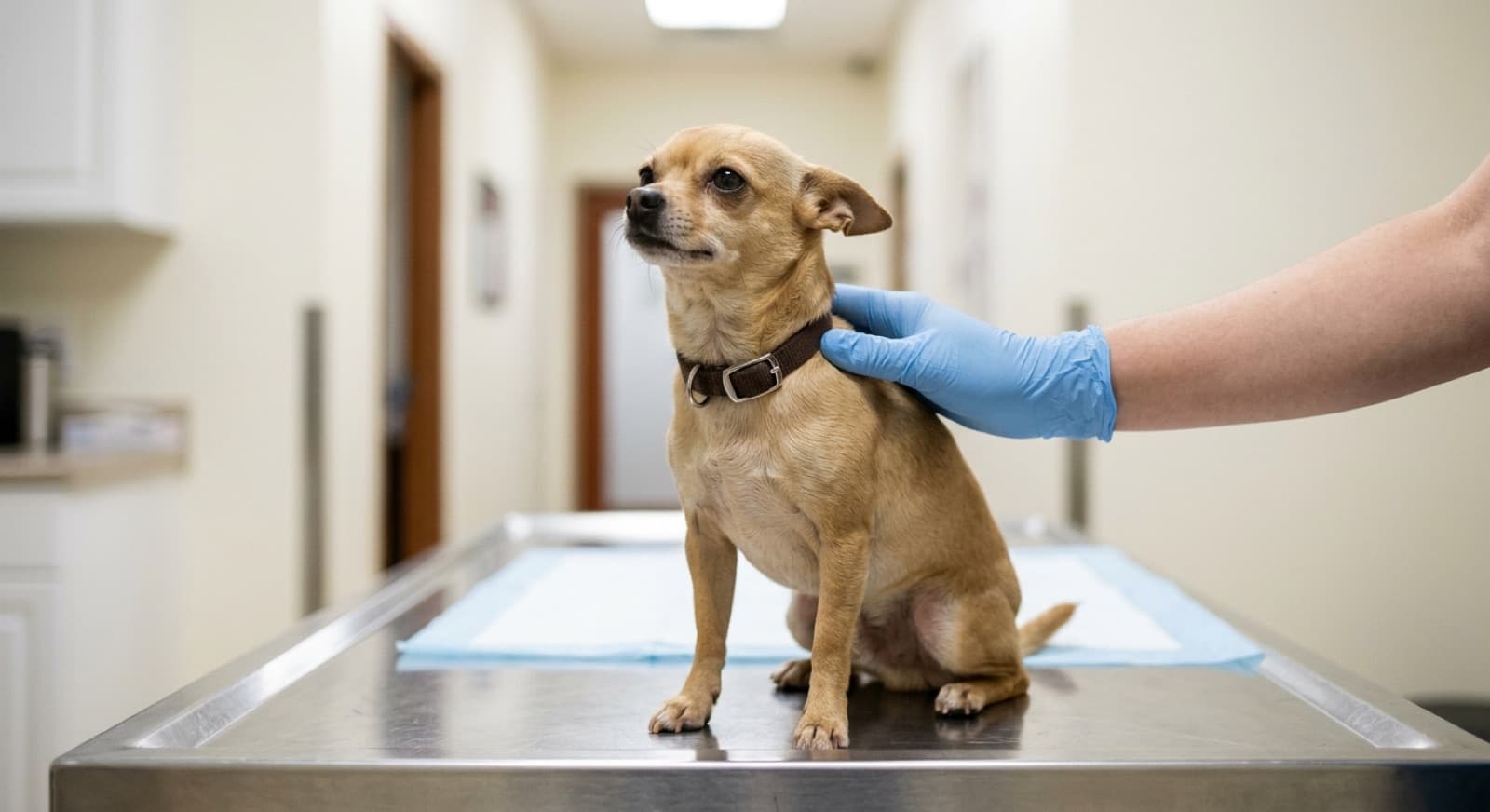
The short answer
Budget for dental care from day one, walk the dog on a harness rather than a collar, and keep it lean. Those three habits address most of what this breed is prone to. Skip anesthesia-free dental cleaning, which cannot treat the disease it appears to treat. This is general information, not veterinary advice; your vet is the one who can assess your dog.
The teeth, which are the real story
A Chihuahua carries a full complement of teeth in a jaw far too small to space them properly. They crowd, they overlap, and the gaps between them trap plaque in places a tongue and a chew toy will never reach. The result is that periodontal disease is close to expected rather than unlucky, and it starts earlier than most owners assume.
This matters beyond bad breath. Dental disease is painful, and dogs are unhelpfully stoic about mouth pain, so the usual presentation is a dog that has quietly stopped enjoying chewing, or become less tolerant of being handled around the head, rather than one that obviously hurts. It is also the single most common reason a Chihuahua owner faces a significant vet bill.
Anesthesia-free dental cleaning does not do what it looks like it does
It is marketed most heavily to owners of small dogs, because a four-pound dog makes people understandably nervous about anesthesia. The American Veterinary Dental College is unambiguous that scraping without anesthesia is not a substitute for a proper procedure and is not effective prevention.
The reason is simple. Periodontal disease happens below the gumline, and an awake dog will not permit anyone to clean or examine below the gumline. So the visible surfaces come away looking cleaner while the disease continues underneath, unseen and untreated. A full cleaning means examination, full-mouth radiographs and scaling beneath the gum, which cannot be done on a conscious animal. If anesthesia worries you, that is a conversation to have with your vet about how they manage risk in small dogs, not a reason to choose something that does not work.
The knees
A luxating patella is a kneecap that slips out of its groove. The Orthopedic Foundation for Animals notes that it can be present from as early as eight weeks of age and that the medial form affects toy and miniature breeds. It is graded from one to four, ranging from a kneecap that pops out and returns by itself to one that is permanently dislocated.
The familiar sign is a dog that skips for a step or two mid-walk, holding a back leg up, then puts it down and carries on as though nothing happened. Mild grades are frequently managed without surgery and plenty of dogs are entirely comfortable for life; higher grades may need surgical correction. The most useful thing an owner controls is weight, because a joint that small feels every extra ounce. Keeping a Chihuahua lean is not cosmetic.
The windpipe, and why the harness is not optional
Tracheal collapse is the reason every good Chihuahua guide tells you to use a harness. The Merck Veterinary Manual describes weakened cartilage rings in the windpipe flattening and restricting airflow, most commonly in toy and miniature breeds, producing a distinctive dry honking cough.
A lead clipped to a collar applies pressure precisely where the weakness is, every time the dog pulls. A harness moves that load to the chest. It is a cheap change that costs nothing to adopt as a default, and it is worth doing whether or not your dog has ever been diagnosed. Merck also lists obesity as a contributing factor and identifies weight loss as critical to management, which is the same lever as the knees. Two of this breed's four main problems get better with the same habit.
The heart, later on
Mitral valve disease is a condition of older small dogs and is common enough across the small breeds to be worth watching for. In practice it is usually found as a murmur at a routine examination well before the dog seems unwell, which is the argument for keeping up annual check-ups into old age rather than easing off once a dog is settled and apparently fine.
Chihuahuas live a long time, commonly into their mid-teens, so a dog adopted at two has a great many years of check-ups ahead. Coughing, tiring on walks it used to manage easily, or any change in breathing in an older Chihuahua is worth booking an appointment for rather than watching for a week.
Getting it paid for in Toronto
The Toronto Humane Society runs Public Veterinary Services that are open to the general public, dental among them. Their stated requirements are that the patient be under 10 years old and in good health, and they decline English Bulldogs, French Bulldogs and Pugs on anesthetic-risk grounds. A Chihuahua is eligible. If you receive ODSP, Ontario Works or the Guaranteed Income Supplement, or hold a Certificate of Indigenous Status, say so when booking so the right rate is applied.
Expect to be given a cost estimate after a consult rather than a number over the phone, and treat that as a sign of a serious clinic rather than evasion. Dental pricing depends almost entirely on how much disease is found and how many teeth need to come out, none of which is visible until a vet has examined the mouth. Ask for the estimate in writing and ask what happens to it if they find more once the dog is under anesthetic.
On insurance: if you want it, arrange it in the first weeks after adoption. Every insurer excludes pre-existing conditions, and the four problems above are exactly what a first examination is likely to flag and then exclude. Waiting until something appears is waiting until it cannot be covered. Read the dental terms specifically, because dental is where policies differ most and it is the expense this breed is most likely to generate. Our Toronto Chihuahua adoption guide covers what rescue fees already include, which is often more veterinary work than people expect.
Browse adoptable Chihuahuas in Toronto
An adult that has already had a veterinary workup is a known quantity. Ask what the examination found.
See Available Chihuahuas →Questions Toronto owners ask
What health problems are Chihuahuas prone to?▼
Four account for most veterinary care over a Chihuahua's life: dental disease, a luxating patella, tracheal collapse and, in older dogs, mitral valve disease. Dental is the one owners consistently underestimate and the one most likely to cause real suffering, because a full set of teeth in a very small jaw crowds badly and traps plaque. None of the four is a reason to avoid the breed. They are reasons to budget for dental care from the start and to use a harness rather than a collar. Your veterinarian is the person to assess any individual dog.
Does anesthesia-free dental cleaning work for small dogs?▼
No, and it is marketed hardest to exactly the owners most likely to be tempted, because a very small dog makes people nervous about anesthesia. The American Veterinary Dental College is direct about it: scraping without anesthesia cannot clean below the gumline, which is where periodontal disease actually happens, and cannot look below the gumline to find problems early. It makes the visible surfaces of the teeth look better while the disease continues underneath. A proper cleaning involves examination, full-mouth dental radiographs and scaling below the gumline, and that requires anesthesia. Discuss anesthetic risk with your vet rather than avoiding the procedure.
What is a luxating patella and how serious is it?▼
The kneecap slips out of its groove, either inward or outward. The Orthopedic Foundation for Animals notes it can be present from as early as eight weeks and that medial luxation affects toy and miniature breeds. It is graded one to four, from a kneecap that pops out but returns on its own to one that stays permanently dislocated. Mild grades are often managed without surgery and many dogs live comfortably for years, doing the characteristic little skip when it slips and then carrying on. Higher grades may need surgical correction. Keeping the dog lean matters more than most owners expect, since every extra ounce loads a very small joint.
Why should a Chihuahua never walk on a collar?▼
Tracheal collapse. The Merck Veterinary Manual describes weakened cartilage rings in the windpipe flattening and restricting airflow, and it is most common in toy and miniature breeds. The classic sign is a dry honking cough. A lead attached at the neck puts pressure exactly where the problem is, so a harness is the standard recommendation for the breed regardless of whether a dog has been diagnosed. Merck also identifies obesity as a contributing factor and weight loss as critical to managing it, which makes keeping the dog lean the other half of the answer.
At what age do Chihuahuas develop heart problems?▼
Mitral valve disease is a disease of older small dogs rather than young ones, and it is common enough in the small breeds that it is worth knowing the pattern. It is usually picked up as a heart murmur during a routine examination long before a dog seems unwell, which is one of the practical arguments for annual check-ups continuing into old age rather than tapering off. Early detection changes what your vet can offer. Coughing, tiring easily or breathing changes in an older Chihuahua are worth an appointment rather than a wait-and-see.
How do I get affordable dental care for a dog in Toronto?▼
The Toronto Humane Society runs Public Veterinary Services open to the general public, including a dental program. Their published requirements are that the patient be under 10 years old and in good health, and they decline English Bulldogs, French Bulldogs and Pugs on anesthetic-risk grounds, so a Chihuahua is eligible. Cost is quoted after a surgical consult rather than in advance, because the price depends almost entirely on how much treatment and how many extractions are needed. If you receive ODSP, Ontario Works, the Guaranteed Income Supplement, or hold a Certificate of Indigenous Status, tell the client service agent when booking so the correct rate is applied.
Why can nobody tell me what a dental will cost before the appointment?▼
Because the number is genuinely unknowable until a vet has looked. A cleaning on a healthy mouth and a procedure involving multiple extractions and radiographs are very different pieces of work, and the extent of disease below the gumline is not visible from the outside. Any quote given confidently over the phone before an examination should be treated with suspicion. Book the consult, get the estimate in writing, and ask what happens to the price if they find more than expected once the dog is under.
Is pet insurance worth it for a Chihuahua?▼
It can be, but only if you arrange it before anything is diagnosed. Insurers exclude pre-existing conditions, and the four issues this breed is prone to are precisely the ones likely to be flagged at a first examination and excluded from cover thereafter. That makes the useful window the first weeks after adoption, not the moment a problem appears. Read what any policy says about dental specifically, since dental cover varies more between insurers than almost anything else and is the expense a Chihuahua owner is most likely to face.
Are rescue Chihuahuas less healthy than ones from a breeder?▼
Not inherently, and adopting has one real advantage: an adult dog's problems are visible rather than hypothetical. A rescue will usually have had a veterinary examination, will often have addressed dental work already, and can tell you what it found. A puppy is a prediction. Ask specifically what dental care the dog has had, whether a luxating patella has been noted, and whether a murmur has ever been heard. A rescue that answers those clearly is telling you something good about how it operates.
This article is general information for Toronto dog owners and is not veterinary advice. It does not describe medications or doses. Any decision about your own dog belongs with your veterinarian, who can examine the animal in front of them.
Chihuahuas in Toronto Condos →
Condo rules, the $25 licence, and the elevator problem.
Chihuahua Adoption in Toronto →
Which rescues have them, real costs, and what to ask.
Adoptable Chihuahuas in Toronto →
Current listings from Toronto-area rescues.
Senior Dogs in Toronto →
Older dogs whose health is known rather than guessed at.
New dog? Start with these care guides
Everything a new adopter needs to set up a safe, happy home.