The short answer
The most important safety fact about Greyhounds: as sighthounds built to chase, with a strong hardwired prey drive and the ability to hit ~45 mph almost instantly, they generally cannot be trusted off-leash in unfenced areas, a prey-triggered Greyhound is gone in seconds, faster than you can call it back, which is how they're tragically lost. So: always leashed in unfenced areas (a martingale collar or secure harness, they back out of flat collars), off-leash running only in fully-fenced spaces. Happily, they need surprisingly little exercise (leashed walks plus occasional safe fenced sprints, sprinters, not marathoners). Cat/small-pet safety is individual (adopt a prey-drive-assessed dog through a Greyhound group). Recall is a supplement, never a substitute for the leashed-and-fenced rule, no recall reliably beats prey drive at 45 mph. In Montreal, add a warm winter coat and microchip/ID.
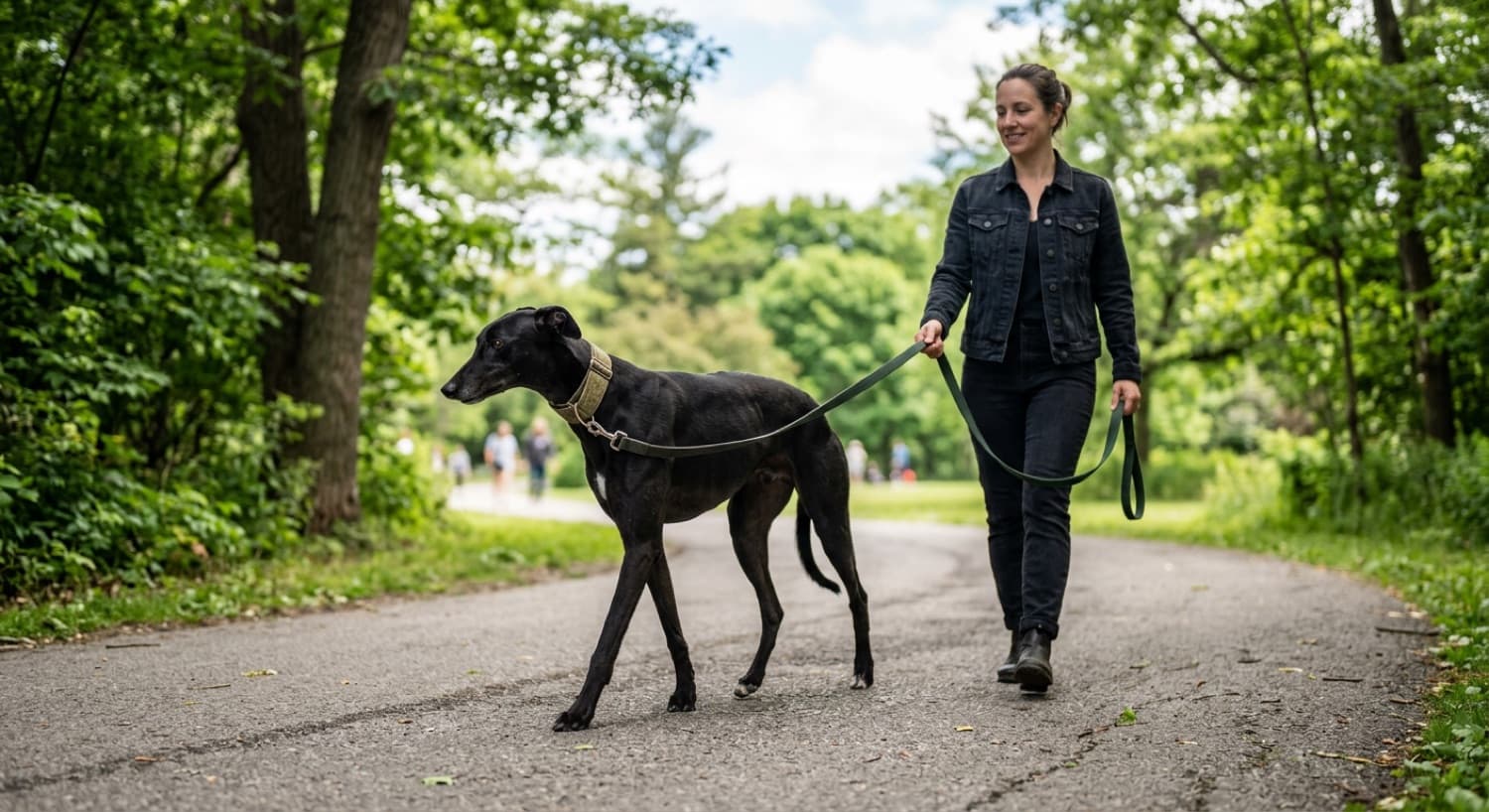
If you take away one thing about owning a Greyhound, make it this: the fastest dog on earth, with a chase instinct bred in over centuries, cannot safely be let off-leash in open spaces. It's not a training gap, it's physics and instinct. Get this right, and the rest of Greyhound ownership is famously easy. Here's the full picture, the breed's most important safety topic.
Why Greyhounds can't be trusted off-leash
As a rule, Greyhounds can't be trusted off-leash in unfenced areas, adoption groups and experienced owners advise this near-universally. Two reasons combine into a genuine danger: the prey drive (sighthounds bred to chase fast prey by sight will bolt after small, fast-moving things, squirrels, cats, even a blowing bag, oblivious to owner, commands, or traffic) and the speed (the fastest breed, ~45 mph reached almost instantly). A prey-triggered off-leash Greyhound can be hundreds of metres away, or into traffic, before you react, which is exactly how they're tragically lost, injured, or killed.
Crucially, this can't be reliably trained away: recall is worth building (below), but the deep prey drive plus extreme speed mean even a Greyhound with decent recall generally shouldn't be trusted off-leash in an unsecured area, because the one time prey drive overrides training, at 45 mph, can be fatal. The near-absolute rule: keep it on-leash in any unfenced area (with a secure martingale collar or harness, they back out of flat collars, see the equipment question), and allow off-leash running only in securely, fully-fenced areas. Owners who dream of off-leash hikes should understand a Greyhound generally can't safely do that (except in secure fenced spaces). This is the most important thing to accept about the breed.
How much exercise a Greyhound actually needs
Here's the delightful surprise: despite being the fastest breed, the Greyhound needs surprisingly little exercise, it's a sprinter, not an endurance athlete, a famous “45 mph couch potato” that's lazy and low-energy at home (sleeping 16 to 18 hours a day). Its needs are moderate and manageable: a couple of daily leashed walks are usually enough, a big part of why the breed suits apartments and less-active owners.
What a Greyhound loves in addition is the occasional chance to do what it was built for, a good sprint in a securely, fully-fenced area (a fenced yard, or fenced dog park/field) where it can safely run flat-out for a few minutes (being sprinters, they typically run hard for a minute or two and are then happily done). So the formula is: regular leashed walks plus occasional safe fenced sprints, which easily meet the breed's moderate needs. In Montreal, plan for year-round leashed walks (with a warm coat in winter, given the cold-sensitivity, see the health guide) and seek out secure fenced spaces for runs. The reframe: a Greyhound needs far less exercise than its speed suggests, and what it needs should be leashed or fully-fenced, never off-leash in the open.
Living with cats and small pets
This depends heavily on the individual dog, one of the most important things to assess if you have cats or small pets, because prey drive varies significantly from Greyhound to Greyhound. Some have a low prey drive and live happily with cats (many do); others have a high prey drive that makes them genuinely unsafe with cats or small animals. You cannot assume any given Greyhound is or isn't “cat-safe”, it must be assessed for the specific dog.
This is a major advantage of adopting through a Greyhound-specific group: they assess each dog's prey drive and behaviour around cats/small animals (often “cat-testing”) and can place a genuinely “cat-friendly” dog with a cat-owning home, so if you have cats or small pets, adopt through such a group and be honest about your household. Even with a cat-assessed dog, use careful, gradual introductions and management (supervision, especially at first; muzzling during early introductions if advised; escape routes and high spaces for the cat; never unsupervised until confident), and note some Greyhounds are fine with their household cats but would still chase an unfamiliar cat outdoors, so outdoor leash control applies regardless. Small pets (rabbits, guinea pigs) warrant extra caution (they strongly trigger prey drive, even a “cat-safe” dog may not be safe with them). Greyhounds are often good with other dogs (especially similar-or-larger size), though very small dogs can trigger a high-drive individual, so introductions matter there too.
Can you train a reliable recall?
Work on recall, yes, but understand the reality: you generally cannot train a recall reliable enough to override the prey drive at full speed, which is exactly why Greyhounds still shouldn't be off-leash in unfenced areas even with recall training. This isn't a training failure, it's the nature of a sighthound: the prey drive is deep and hardwired, and at ~45 mph (reached instantly) the dog is running on instinct, at a speed and focus no recall can reliably interrupt, and the consequences of one failure can be fatal.
So the honest framing: recall is a valuable safety layer and worth building, but a supplement to, never a substitute for, the leashed-and-fenced rule, never rely on it to keep a Greyhound safe in an unfenced area. That said, recall (and general) training is genuinely worthwhile, for use within secure areas (calling the dog back during a fenced-field run, or at home), bonding, communication, and mental engagement. Train it with positive, reward-based, gentle methods (Greyhounds are sensitive), high-value rewards, in safe low-distraction settings first (and only ever practice off-leash recall within a securely fenced area). Retired racers may be new to pet training but are intelligent and learn with patience (groups often provide guidance). Realistic expectation: many Greyhounds learn a decent recall for secure-area use, but even a good recall doesn't make off-leash safe in unfenced spaces for this breed.
Equipment and management for Montreal
Keeping a Greyhound safe outdoors comes down to the right gear and consistent management, built around the leashed-and-fenced rule:
- •A secure collar or harness they can't back out of: Greyhounds have narrow heads and can slip a flat collar, so a martingale collar (a limited-slip sighthound collar) or a well-fitted secure harness is strongly recommended, a plain buckle collar isn't secure enough.
- •Always leashed in unfenced areas, off-leash running only in securely, fully-fenced spaces (check the fencing is truly escape-proof).
- •Microchip and ID tags, given the escape/prey-drive risk, so a loose dog can be recovered.
- •A warm winter coat (and often booties) in Montreal, the Greyhound is very cold-sensitive (thin coat, low body fat), so this is essential, not a luxury.
- •Vigilant leash management (watch for prey triggers, keep a secure hold, anticipate situations), secure yard and exits (no gaps; manage doors/gates against door-dashing), and a muzzle when advised (a normal, humane management tool for some situations, like early cat introductions or some off-leash play; racing Greyhounds are used to them).
For an adopted Greyhound, the adoption group will advise on the right equipment (often providing or recommending a martingale) and management for the individual dog. All of it is built around the essential leashed-and-fenced rule. See the adoption guide.
Browse adoptable dogs in Montreal
A Greyhound adoption group can match you with a dog whose prey drive and cat-safety are assessed, and guide you on safe management. Refreshed regularly across Montreal-area organizations.
See Available Dogs →Frequently Asked Questions
Why can't Greyhounds be trusted off-leash?
Two reasons combine into real danger: a strong hardwired prey drive (sighthounds bred to chase small, fast-moving things, oblivious to owner or traffic) and extreme speed (~45 mph, reached almost instantly). A prey-triggered off-leash Greyhound is gone in seconds. This can't be reliably trained away, so keep them leashed in unfenced areas and allow off-leash running only in fully-fenced spaces. The most important safety fact about the breed.
How much exercise do they actually need?
Surprisingly little, they're sprinters, not marathoners, famous “45 mph couch potatoes” that are lazy at home. A couple of daily leashed walks usually suffice, plus, ideally, occasional safe sprints in a fully-fenced area (they run hard for a minute or two and are done). Far less exercise than their speed suggests, a big reason they suit apartments and less-active owners. In Montreal, add a winter coat for walks.
Can they live safely with cats and small pets?
It depends on the individual dog, prey drive varies significantly. Some Greyhounds live happily with cats; others with high prey drive are genuinely unsafe. You can't assume, so adopt through a Greyhound group that assesses (“cat-tests”) dogs and can place a “cat-friendly” one with a cat home. Use careful introductions and management even then, and note extra caution for small pets and that outdoor leash control applies regardless.
Can I train a reliable recall?
Work on it, but understand you generally can't train a recall reliable enough to override the prey drive at full speed, which is why Greyhounds still shouldn't be off-leash in unfenced areas even with training. Recall is a valuable supplement (for secure-area use, bonding, engagement), never a substitute for the leashed-and-fenced rule. Train positively in safe settings, and only practice off-leash recall within a securely fenced area.
What equipment and management keep one safe in Montreal?
A secure martingale collar or harness (they back out of flat collars), always leashed in unfenced areas with off-leash running only in fully-fenced spaces, microchip and ID, and, in Montreal, an essential warm winter coat (they're very cold-sensitive). Plus vigilant leash management around prey triggers, secure yard and exits (against door-dashing), and a muzzle when advised (a normal, humane tool for some situations). Built around the leashed-and-fenced rule.
Related Montreal guides
Greyhound Adoption in Montreal
Where to adopt (usually a retired racer), the gentle couch-potato temperament, the cold-sensitivity, real costs, and who the breed suits.
Greyhound Health Issues
Dental disease, bloat, osteosarcoma and cancers, the breed's unusual physiology and anesthesia sensitivity, and the pet-insurance case.
Adoptable Dogs in Montreal
All currently available dogs across Montreal-area organizations, including Greyhounds and sighthound mixes. Updates regularly.
Montreal Dog Adoption Resources
All our Montreal dog adoption guides in one place.
New dog? Start with these care guides
Everything a new adopter needs to set up a safe, happy home.