The short answer
Adopt through the Humboldt & District SPCA, the area's shelter for Humboldt and the surrounding central-Saskatchewan region. Adult cats are $150, kittens up to six months are $200, and senior residents are $75. Every fee includes the spay or neuter, age-appropriate vaccines, deworming, a microchip and a health check. The shelter runs cat-heavy most of the year, so adult cats in particular are plentiful, healthy and easy to place.
Humboldt is a city of roughly 6,000 people sitting in the parkland of central Saskatchewan, grain-elevator and canola country, about an hour and a quarter east of Saskatoon on Highway 5. It is a real regional hub for a big spread of surrounding farms and small communities, and that reach shapes how cat adoption works here.
A city this size would normally have a small shelter handling a small number of animals. Instead the Humboldt & District SPCA absorbs cats from a service area far larger than the city itself, including acreages, farms and villages across the region.
The practical effect for an adopter is unusual and genuinely good: real choice. On most days there are more cats and kittens here than you would expect for the population, with variety in age, colour and temperament that a small-town shelter often cannot offer.
The Humboldt & District SPCA
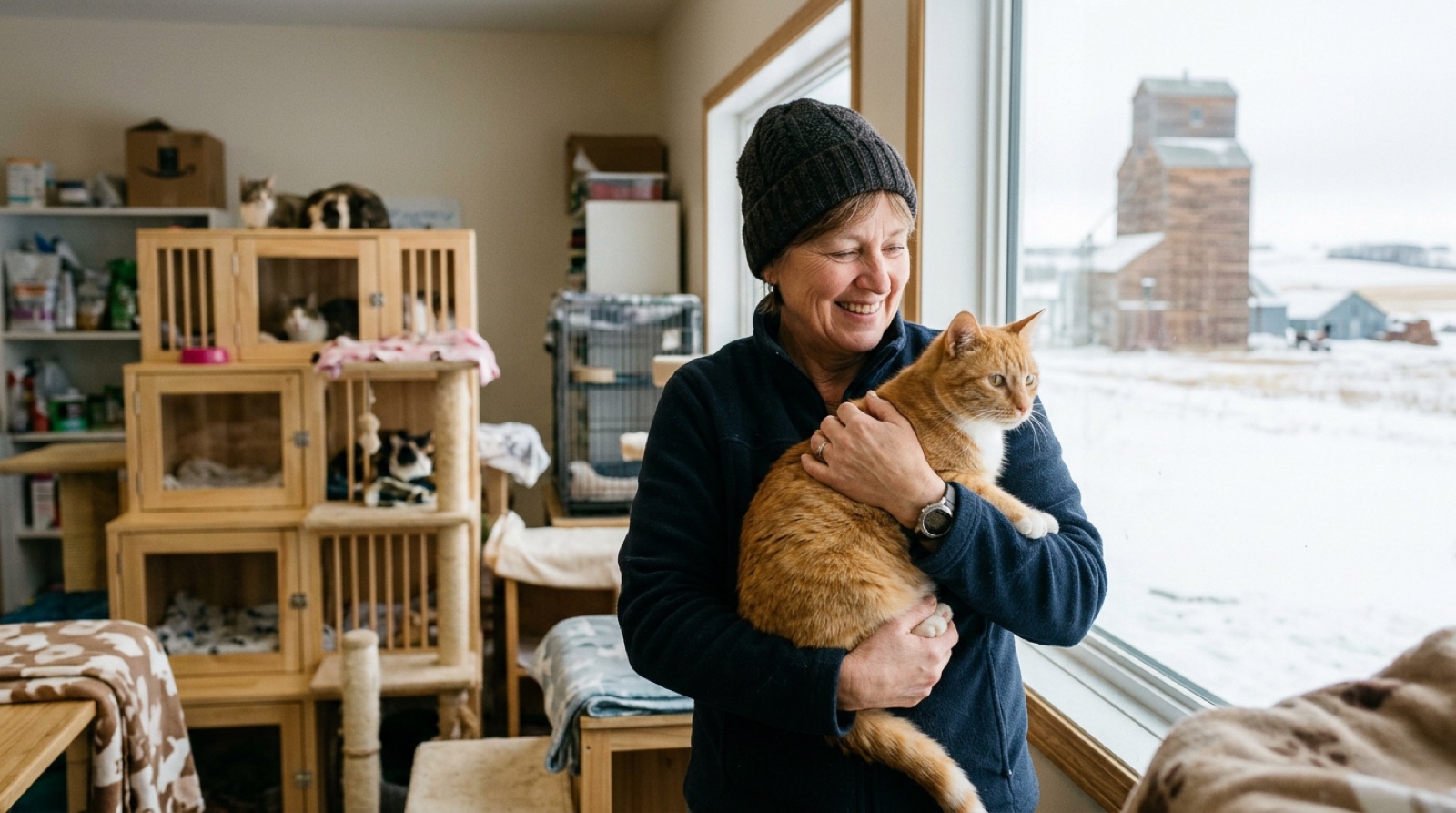
The Humboldt & District SPCA was established in 2007 and takes in surrendered, stray and impounded cats, dogs and small animals from Humboldt and the surrounding communities. It runs on a mix of on-site housing and a network of local foster homes, so some of the cats you see live at the shelter and others are settled into a volunteer's house.
That foster model is a feature, not a hiccup. A cat living in someone's living room shows its true personality in a way a cat in a kennel row often cannot, so the notes you get on a fostered cat tend to be honest and detailed.
Contact is straightforward. The shelter is at 10464 Highway #5 East, Humboldt. Phone 306-682-5550 or email hdspca@sasktel.net. Applications go through their website.
Cat Adoption Fees
| Cat | Fee | Notes |
|---|---|---|
| Adult cat (7 months and up) | $150 | The easiest cats to place into a first-time home |
| Kitten (up to 6 months) | $200 | Moves fastest, especially spring through early autumn |
| Senior / long-term resident | $75 | Older cats the shelter wants to see settled |
Fees verified July 2026 from the Humboldt & District SPCA rates page. Confirm on the individual cat's listing, since medical circumstances can change what applies.
What the fee already covers
- ✓Spay or neuter surgery, done before the cat goes home
- ✓Age-appropriate vaccinations
- ✓Deworming and basic parasite treatment
- ✓A permanent microchip
- ✓A pre-adoption health check
- ✓Medical records so your vet starts with a full picture
Price that stack separately at a clinic and the surgery alone costs more than the adoption fee, before you add vaccines, deworming and a chip. Saskatchewan also charges 6% PST on veterinary services and pet food on top of 5% GST, so the retail catch-up on a free kitten is worse than the sticker comparison suggests. A shelter cat is not a cheap cat that happens to be used. It is a fully vetted cat sold below cost.
Why a small city's shelter runs so full
People assume high shelter numbers mean something is wrong locally. Usually it means the opposite. A shelter that stays full is a shelter that is still saying yes.
Three things drive the cat count around Humboldt. The catchment is rural and wide, so cats arrive from well beyond the city limits. Free-roaming cats are culturally normal on prairie farmyards, and a free-roaming unspayed female produces litters nobody planned. And spay or neuter surgery means a drive and a bill for rural owners who may be a fair distance from a clinic.
None of that makes the cats themselves problem animals. The great majority are healthy domestic shorthairs and longhairs, friendly, adaptable and completely ordinary. The reason they are waiting has to do with arithmetic upstream, not with anything wrong with the cat in front of you.
This is also why getting cats fixed matters more here than in a big city with a dense clinic network. Every unfixed cat on a rural property is a future shelter intake.
How to choose a cat that actually fits
Be honest about your household. A quiet retired couple and a house with three kids under ten need different cats. Tell the shelter the truth and let them steer you, because they and the foster homes have watched these animals live.
Ask about other pets specifically. Some cats are fine with dogs, some are fine with cats, and plenty are fine with neither. That information exists. Ask for it before you fall for a photo.
Meet the cat in person. A relaxed cat in a room with you is data. A cat that flattens itself into a corner may still become a wonderful pet, but it is telling you it needs a slower, quieter home.
Consider a bonded pair. Two cats that already like each other settle faster than one cat alone, and they keep each other company while you are at work. Food and litter double, but most of the gear does not.
Do not overlook the adults. They are the easiest cats to live with and the hardest to place. Kittens will find homes without your help.
Free kittens online are not free
Classified listings for free prairie kittens are common around Humboldt, and the arithmetic never favours them. A free kitten arrives unfixed, unvaccinated, unwormed and unchipped, and you pay retail for all of it plus tax. That routinely exceeds a $200 shelter kitten that already comes with the work done.
Classifieds also carry a real scam risk, including deposits taken for animals that never existed. If cost is the concern, adopt an adult at $150 instead. If you want to help, that is the choice that helps most.
Browse adoptable Humboldt cats
The shelter runs cat-heavy, which means genuine choice in age and temperament. See who is available right now. Listings refreshed regularly.
See Available Humboldt Cats →Where LocalPetFinder fits
We are not a rescue, and we do not place cats. We are an aggregator. We pull adoptable cats from Humboldt area rescues into one place and refresh them regularly, so you are not checking several websites and a handful of Facebook pages to see what changed this week. Coverage varies by rescue, so treat this as a starting point rather than the whole picture, and check the rescues above directly too.
We also carry something the rescues do not. Some cats are listed directly by the families rehoming them, so the history comes from the person who actually lived with the animal rather than from an intake form. There is no waitlist and contacting an owner costs nothing.
Frequently Asked Questions
Where can I adopt a cat in Humboldt?
The Humboldt & District SPCA is the area's main cat adoption source. It serves Humboldt and a wide stretch of the surrounding central-Saskatchewan farming region, taking in surrendered, stray and impounded cats and rehoming them through a mix of on-site kennels and local foster homes. There is no second cat shelter in town, which sounds limiting but works in your favour. The whole local supply of adoptable cats sits in one place rather than scattered across a dozen foster groups you would otherwise have to track yourself. You can browse current listings on LocalPetFinder and apply through the shelter directly.
How much does it cost to adopt a cat in Humboldt?
An adult cat is $150, a kitten up to six months is $200, and senior or long-term residents are $75, based on the Humboldt & District SPCA rates page in July 2026. Every one of those fees already includes the spay or neuter surgery, age-appropriate vaccines, deworming, a microchip and a health check before the cat leaves. The surgery alone would cost more than the whole fee if you booked it yourself, which is the plain economic case for adopting rather than taking a free kitten off a classified ad. Confirm the exact fee on the individual cat's listing, since medical circumstances can change what applies.
Why does the shelter always seem to have so many cats?
Two things stack up. The Humboldt & District SPCA serves a catchment far larger than the city's population suggests, pulling cats from acreages, farms and small communities across a big rural area. And unspayed cats reproduce fast. One unfixed female and her offspring can turn into a large colony in a couple of seasons, and on a prairie farmyard nobody is counting until the numbers are obvious. The result is a shelter that runs cat-heavy nearly year round, with a genuine surplus of healthy adult cats waiting for homes.
Are shelter cats healthy, or is it a gamble?
They are vetted before they are listed, which is more than you get almost anywhere else. Each cat has been examined, vaccinated for its age, dewormed, microchipped and fixed. Foster and shelter staff also know how the cat actually behaves after living with it, so they can tell you whether it hides from strangers, tolerates dogs, or wants to be the only cat in the house. A breeder or an online seller cannot tell you any of that about a kitten. Ask questions and take the answers seriously, because behaviour someone has watched over weeks predicts your next year better than a photo does.
Should I adopt a kitten or an adult cat?
Adopt the adult unless you specifically want the kitten chaos. Adult cats already know what a litter box is, their personality is fully formed so what you meet is what you get, and they settle into a quiet household in days rather than months. Kittens are wonderful and they also climb curtains, wake you at 4am and need more supervision than people expect. Adults are also the harder cats to place, so choosing one frees space for the shelter to take the next animal. If you have young kids or a busy schedule, the adult is nearly always the better match.
Can I adopt if I live on an acreage or farm outside town?
Yes, and rural adopters are common here. The shelter will ask about your setup, and the answer they want to hear is that the cat lives indoors. A cat placed loose on an acreage faces coyotes, owls, farm equipment, highway traffic and prairie winter cold, and those cats live dramatically shorter lives. If you have a heated outbuilding you want kept mouse-free, ask the shelter directly whether they can place a cat suited to that life with proper shelter and warmth provided. Do not assume any cat will thrive outdoors just because the property is rural.
How does the adoption process work?
Find a cat you are interested in, fill out the shelter's application, and give real detail about your household rather than the shortest possible answers. They will get back to you, usually with a conversation about your home, your other pets and your routine. Because the SPCA uses foster homes, some cats live off-site, so a meet-and-greet may take a little arranging rather than a same-day drop-in. You meet the cat before deciding, which matters more with cats than people realise. A cat that relaxes with you in the room is telling you something a photo cannot. If it is a match, you finish the paperwork, pay the fee and take your cat home.
What if the cat does not work out?
Talk to the shelter before you make any decision. Most of what looks like failure in week one is a cat that has not finished decompressing, and it resolves on its own with a quiet room and a predictable routine. Hiding under a bed for several days is normal. Not eating for more than a day is not, and that needs a vet. If there is a genuine mismatch, such as a resident cat that will not tolerate a newcomer, the shelter would far rather hear from you early than have the cat passed along through a classified ad to a stranger nobody screened.
Is there a trap-neuter-return program in Humboldt?
We could not verify an organised trap-neuter-return or community-cat program running in Humboldt, so we are not going to name one. If you are feeding or dealing with unfixed cats on your property, the right first calls are the Humboldt & District SPCA and the City. They can tell you what help exists locally and how the animal control bylaw treats trapping, rather than you setting a trap on your own and creating a problem for yourself. If a program does operate here, those are the people who would know.
Do I need to licence a cat in Humboldt?
Yes. The City of Humboldt licenses cats, not just dogs, which surprises a lot of new adopters who have lived elsewhere. Any dog or cat over three months old needs an annual licence. The fee is $40 a year, dropping to $15 if you show a vet certificate that the animal is spayed or neutered. Licences run the calendar year, January to December, and are paid at City Hall. Because every shelter cat comes home already fixed, adopting puts you in the cheaper tier automatically. Check the City of Humboldt permits and licensing page for the current process.
Where is the nearest emergency vet if something goes wrong overnight?
Start with your own clinic, since the Animal Health Clinic of Humboldt handles day-to-day care and can advise on after-hours options. The nearest full 24-hour hospital is the WCVM Veterinary Medical Centre in Saskatoon, about an hour and a quarter west on Highway 5. Work this route out before you need it, not at 11pm with a sick cat. A male cat straining in the litter box without producing urine is a possible urinary blockage, which is life-threatening and measured in hours rather than days. That is exactly the drive you do not want to be figuring out from scratch in the moment.
Related Humboldt Guides
One search, every Humboldt cat
Adoptable cats and kittens from the Humboldt area, in a single list.
Browse Available Humboldt Cats →New cat? Start with these care guides
Everything a new adopter needs to set up a safe, happy home.