The short answer
A newly adopted Domestic Shorthair hiding, eating little, and seeming “nothing like the shelter said” is doing exactly what a healthy, frightened cat is supposed to do. Use the 3-3-3 rule: ~3 days to feel safe, ~3 weeks to learn the routine, ~3 months to truly bond. Start the cat in one quiet safe room, never force contact, and let it set the pace. Most DSH cats emerge within 3 to 7 days and show clear trust signs within 2 to 6 weeks. Treat it as a vet issue, not adjustment, if the cat will not eat or drink for 24 to 48 hours, will not urinate for 24 hours or strains in the box, or shows vomiting, laboured breathing, or collapse.
Do not judge the cat by week one
The terrified cat under your couch on day two is not the cat you adopted. It is that cat in the middle of losing its entire world. The real personality, the one the foster home described, reappears over weeks, not hours. Patience is not just kindness here; it is the actual technique.
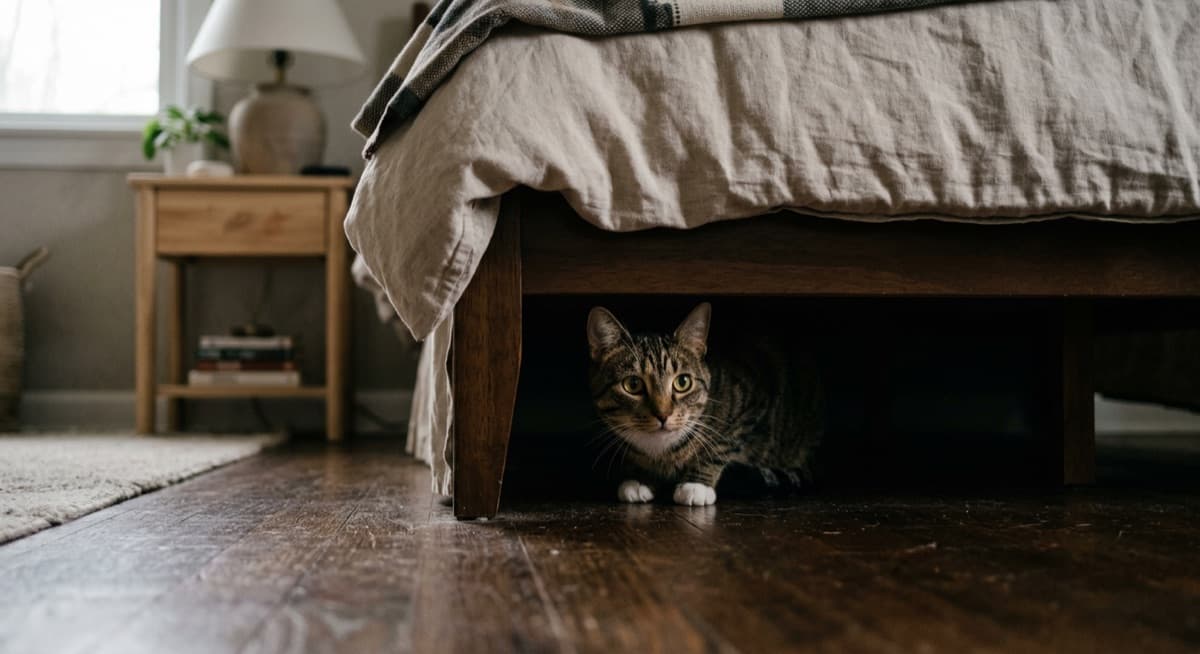
Why is my new cat hiding (and when to worry)?
Hiding is normal, expected, and healthy. Your cat just lost its territory, scent, routine, and people all at once. A hiding spot is how it feels safe enough to assess a strange new world.
A cat that bolts under the bed and stays there is not broken. It is doing precisely what a frightened cat is built to do. International Cat Care describes hiding and withdrawal as the normal feline response to an overwhelming environment, not a sign of a damaged temperament. The wrong response is to pull the cat out, coax it loudly, or “introduce” it to the household. The right response is to make hiding safe and boring: food, water, and a litter box nearby, a calm room, and your quiet, undemanding presence. (For a refresher on what a Domestic Shorthair actually is and why temperament varies so much within the type, see our Calgary guide to the Domestic Shorthair.)
The line between normal and worrying is physical, not behavioural. Hiding, being quiet, and eating cautiously are fine. Call a Calgary vet if the cat will not eat or drink at all for 24 to 48 hours, will not urinate for 24 hours or strains in the box (a possible urinary blockage, an emergency, especially in males), or shows vomiting, diarrhea, laboured breathing, or collapse. The American Association of Feline Practitioners and Cornell Feline Health Center both flag urinary obstruction in male cats as a true emergency that needs same-day veterinary care. Stress can mask illness in a new cat.
The 3-3-3 rule for cats
A rough decompression timeline, not a schedule: ~3 days to feel physically safe, ~3 weeks to learn the routine and show real personality, ~3 months to truly feel at home and bonded.
The numbers are approximate. A confident DSH may skip ahead; a shy cat or former stray may take longer. The value of the rule is that it stops you judging the cat by its worst, most frightened days. Expect the early period to be mostly hiding, minimal eating, and silence. That is the “3 days” phase doing its job.
By the “3 weeks” mark, most Calgary DSH adopters see a recognizable cat: a routine, some play, a personality. By “3 months,” the cat the foster home described is usually the cat you have. Mark progress against this rule, not against your hopes for day one.
Week by week: the first 30 days
Week 1: The safe room. One quiet room, door closed, with food, water, a litter box (away from the food), hiding spots, and a scratching post. Visit calmly, sit on the floor, do not reach for the cat. Success this week is simple: eating, drinking, and using the box, even if only when you are not looking.
Week 2: Presence and play. The cat starts tracking your routine. Sit longer, talk quietly, offer wet food or lickable treats near you. Introduce a wand toy from a distance. Predatory play is the fastest confidence builder. Many cats take food from near your hand and emerge while you are in the room this week.
Week 3: Expanding territory. Once the cat is relaxed in the safe room, open the door and let it explore the rest of the home on its own terms, often at night first. Keep the safe room available as a retreat. Do not carry the cat around the house; let it map the space itself. If you have a resident cat or dog, do not rush the meet. Run a slow, scent-first introduction using our dedicated cat-to-cat or cat-to-dog introduction guides instead.
Week 4: The real cat appears. Routine is established, play is reliable, and contact-seeking often begins: face rubs, following you, lap attempts, sleeping in the open. This is usually when adopters say it finally “clicked.” If your cat is shyer and not here yet, that is still within normal range. Keep going.

Why is my cat nothing like the shelter described?
Almost never because you were misled. The foster saw the cat at baseline, in a known environment. You are seeing the same cat mid-crisis, running entirely on fear.
A “confident, affectionate” foster cat that hisses and hides in week one is not a different animal. It is that animal decompressing after losing everything familiar. Foster assessments remain the best information you have, precisely because they describe the cat when it is settled, which is what your cat will be again in a few weeks.
Give the described personality 3 to 8 weeks to resurface before drawing conclusions. If the cat is fully settled but genuinely, persistently different in a way that worries you, contact the rescue. Good Calgary rescues want that feedback and will help. That is part of what adopting through a rescue buys you.
How to bond with a shy or scared DSH
The formula is repetition plus zero pressure. Every calm, non-threatening interaction is a deposit; trust is the slow sum of them. Practically:
- Sit in the room and ignore the cat. Read or talk quietly so your presence becomes safe and dull.
- Use food: strong-smelling wet food or lickable treats offered near you, then slightly closer over days.
- Play with a wand toy from a distance. Predatory play breaks the fear cycle and builds confidence.
- Slow-blink and look away rather than staring; staring reads as a threat to a cat.
- Never reach into a hiding spot, corner the cat, or pick it up before it is clearly ready.
Most shy Domestic Shorthairs turn a corner between week 2 and week 6. Former strays and cats with a rough history can take months. The technique does not change, only the timeline does.
Signs your rescue cat is starting to trust you
Trust arrives as a sequence of small, escalating signals. Learn them. They are the real milestones, and they come long before lap-sitting.
Early (often week 1 to 2): coming out while you are in the room, eating in front of you, exploring with you present, an upright tail on approach, slow-blinking back at you.
Middle (weeks 2 to 6): leaving the safe room voluntarily, face-rubbing on furniture, playing while you are there, sleeping in the open rather than hidden.
Later (weeks to months): seeking contact, such as head bumps, following you room to room, lap-sitting, and sleeping near or on you. Notice and quietly reward the early signs; they predict the later ones.
Litter box in the first weeks
Most early litter “problems” are logistics, not behaviour. A stressed cat given a whole house often cannot find or get back to the box. Keep the cat in the safe room with the box close, use the same litter the foster used (do not change two things at once), keep it clean and away from food and water, and place it somewhere quiet.
A few days of little litter use while a cat is barely eating can be normal. But straining, no urination for more than ~24 hours (a urinary blockage is life-threatening, especially in males), blood, or ongoing avoidance once the cat is otherwise settled are vet calls. Our Calgary litter box troubleshooting guide has the full decision tree.
Adopting in a Calgary winter
A winter arrival actually helps. A new cat should be strictly indoors regardless, and a long Calgary winter removes any temptation to rush outdoor access. The decompression period and the season line up. Keep the safe room warm and draft-free, offer cozy covered hiding spots (winter-arrival cats love to burrow), and lean into indoor enrichment since you will both be inside for months.
If the cat may have lived partly outdoors, expect some window-watching and vocalizing as it adjusts to indoor life. Calgary’s winter is a natural, low-conflict reset to the fully indoor life that keeps DSH cats safe from cold, traffic, and river-valley coyotes.
When it is a vet issue, not adjustment
Decompression is behavioural. These are medical. Call a Calgary vet promptly, same day for the urgent ones:
- No eating or drinking at all for more than 24 to 48 hours.
- No urination for more than 24 hours, or visible straining in the box (possible urinary blockage, an emergency).
- Repeated vomiting or diarrhea.
- Laboured breathing, or lethargy that looks like collapse rather than hiding.
- Any wound, discharge, or obvious pain.
Stress can mask illness in a newly adopted cat. When physical symptoms appear alongside the behaviour, treat it as medical first. The American Veterinary Medical Association recommends a baseline wellness exam within the first week of bringing home an adopted cat, which doubles as a chance to flag anything the shelter or foster did not catch. Keep our Calgary emergency vet guide saved before you need it.
Frequently Asked Questions
Why is my newly adopted cat hiding?
It is normal and healthy. The cat lost its whole world and a hiding spot rebuilds safety. Do not force it out. Most DSH cats emerge in 3 to 7 days. Worry only if it will not eat, drink, or use the box for 24 to 48 hours.
What is the 3-3-3 rule for cats?
~3 days to feel safe, ~3 weeks to learn the routine and show personality, ~3 months to truly bond. Approximate, not a schedule. Its purpose is to stop you judging the cat by its most frightened days.
How long does a shelter cat take to adjust?
Usually a recognizable, relaxed cat by 3 to 8 weeks and full bonding by ~3 months. Confident DSH cats settle in days; shy cats and former strays take longer. A small starting space speeds it up.
Why is my cat nothing like the shelter said?
The foster saw it at baseline; you see it mid-crisis. A “cuddly” cat hiding in week one is the same cat decompressing. Give the real personality 3 to 8 weeks. If concerns persist, tell the rescue.
How do I bond with a shy rescue cat?
Repetition plus zero pressure: sit and ignore it, feed near you, play with a wand from a distance, slow-blink, never corner or grab it. Most shy DSH cats turn a corner between week 2 and 6.
What are signs of trust?
Early: emerging, eating in front of you, upright tail, slow blinks. Middle: leaving the safe room, face-rubbing, open sleeping. Later: head bumps, following you, lap-sitting. The small early signs are the real milestones.
My new cat will not use the litter box?
Usually logistics. Confine to the safe room with the box close, use the foster’s litter type, keep it clean and quiet. Straining or no urination 24h+ is an emergency (especially males). See the litter troubleshooting guide.
Should it explore the whole house right away?
No. One quiet safe room first, then expand gradually as confidence grows. A whole house overwhelms a cat that lost its world. Skipping this step reliably produces a longer, rockier adjustment.
Does a Calgary winter arrival change anything?
It helps. A new cat is indoor-only anyway, and winter removes the urge to rush outdoor access. Keep the safe room warm, offer covered hiding spots, and lean into indoor enrichment.
When is it a vet issue, not adjustment?
No eating or drinking for 24 to 48 hours, no urination for 24 hours or straining (emergency), vomiting or diarrhea, laboured breathing, collapse, or visible pain. Physical symptoms with the behaviour = medical first.
First Week With a Rescue Cat
The day-by-day version of the safe-room and decompression setup.
Adoption Regret & Kitten Blues
Overwhelmed in the first weeks? Why it is normal and how to get through it.
Cat Litter Box Problems
The vet-first troubleshooting decision tree for litter issues.
Domestic Shorthair Cats in Calgary
Browse adoptable DSH cats from Calgary rescues by age and personality.