The short answer
The Bernedoodle coat is the lower-shedding-but-high-maintenance trade. The Poodle cross means many shed little, but no dog is truly hypoallergenic (people react to dander and saliva, not hair), so treat it as lower-allergen, not allergen-free, and test your reaction to the specific dog. The generation (F1, F1b) hints at coat and shedding but is a tendency, not a promise, and a rescue doodle's generation is often unknown. The dense, often curly coat mats fast without near-daily brushing right down to the skin, the puppy coat change around 9 to 18 months is a notorious matting period, and a big-dog doodle groom every 6 to 8 weeks runs $90 to $150 or more in Edmonton. If allergies are your reason for a doodle, read the pets and allergies guide first.
The coat trade: low-shedding, high-maintenance
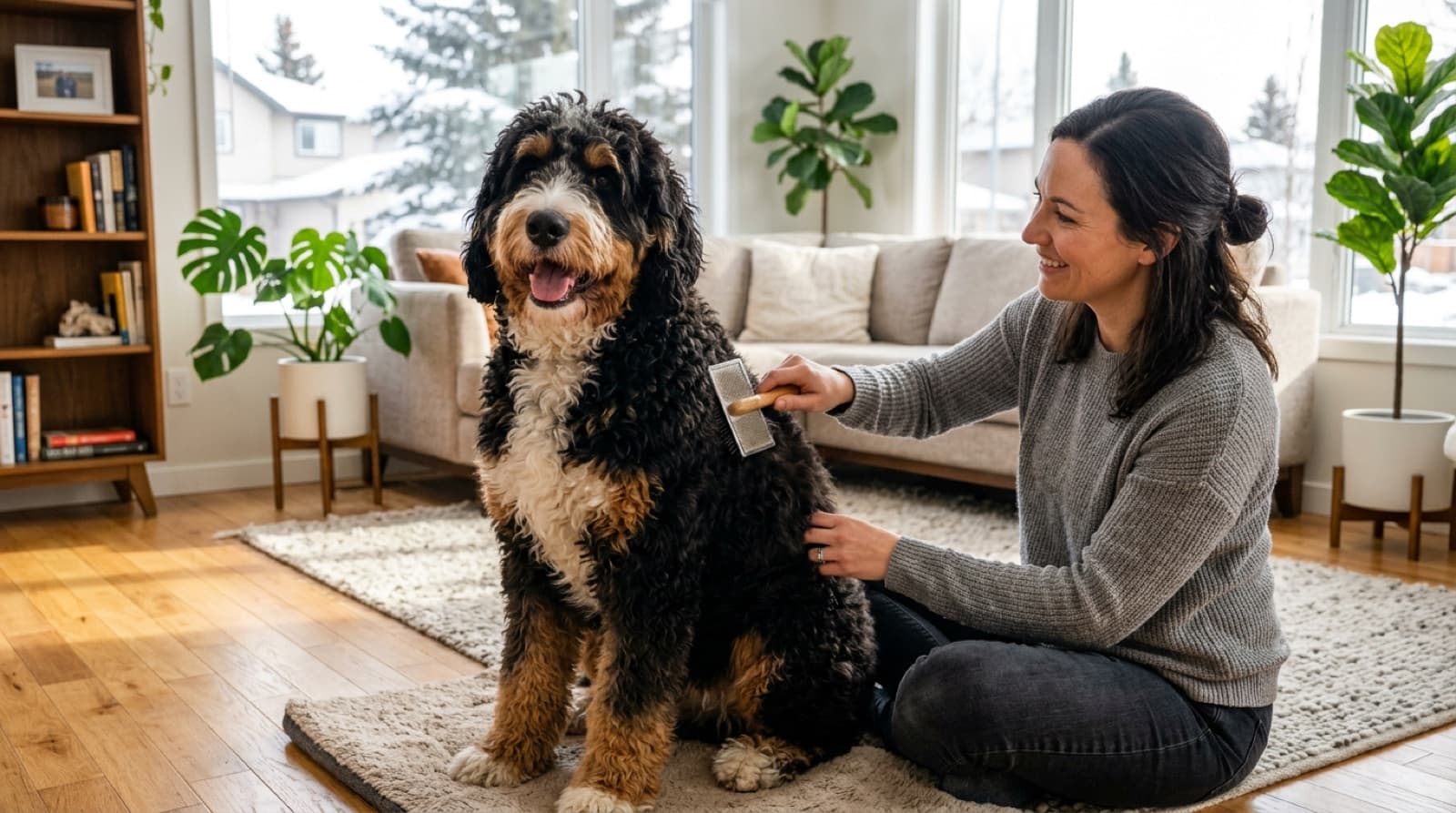
The thing to be clear-eyed about before adopting a Bernedoodle is the coat, because it is the single biggest ongoing commitment of the breed and the most common source of doodle ownership regret. The appeal is real: thanks to the Poodle in the cross, many Bernedoodles shed very little, which is wonderful for keeping a home hair-free. But that low-shedding coat comes with a catch, and it is the opposite of low-maintenance. Hair that does not shed out stays in the coat and tangles, so without thorough regular brushing it mats, and a doodle coat mats fast and tight.
So the honest framing is a trade, not a free lunch: you swap shed hair on your furniture for a daily brushing commitment and a real professional grooming budget. For owners who go in expecting that, a Bernedoodle coat is manageable and the dog is a joy. For owners who picture a fluffy low-effort teddy bear, the coat is a rude surprise. Decide knowing the trade, and the rest of this guide is just the how-to.
Shedding, the hypoallergenic myth, and generations
The hypoallergenic truth
Bernedoodles are widely marketed as hypoallergenic, and it oversells. No dog is truly hypoallergenic, because people react to proteins in dander, saliva, and urine, not to hair, as the American Academy of Allergy, Asthma and Immunology explains, so even a low-shedding dog produces allergens. A lower-shedding doodle spreads less allergen around a home, which genuinely helps many mild allergy sufferers, but it is lower-allergen, not allergen-free. If allergies are the reason you want a doodle, the honest approach is to spend real time with the specific dog before committing and read the broader pets and allergies guide, because reactions are individual.
What the generations mean
Generation labels give a rough hint about the coat. An F1 is a first cross of a purebred Bernese and a purebred Poodle, with coats ranging from wavy to curly and variable shedding. An F1b is an F1 bred back to a Poodle, carrying more Poodle, tending toward a curlier, lower-shedding coat, and often chosen by allergy-sensitive families. Later multigen crosses aim to stabilise the curly, low-shedding coat. But the generation is a tendency, not a promise, individuals vary, and a rescue Bernedoodle often comes with an unknown generation. Rather than fixate on the label, look at and feel the actual coat and ask the rescue or foster what the dog actually sheds and needs. For the deeper generation breakdown, the doodle generations guide applies closely to Bernedoodles too.
Browse adoptable Edmonton Bernedoodles
Current Edmonton Bernedoodle and doodle-mix listings from SCARS, Zoe's, EHS, GEARS, Hope Lives Here, AHHRB, and AARCS Edmonton fosters. Ask the foster what the dog's coat actually sheds and needs, and set up a brush, comb, and a doodle-experienced groomer before the dog comes home.
See Available Bernedoodles →Brushing and preventing mats
Daily or near-daily brushing, done properly, is what keeps a Bernedoodle coat healthy, and the word properly is doing a lot of work. The single most common doodle grooming failure is brushing only the surface, which leaves a tangled layer underneath that mats into a solid sheet at the skin, often discovered weeks later when it is too late to comb out. Brush in sections all the way down to the skin, use a slicker brush to work through the coat, then run a metal comb through to find tangles the brush missed; if the comb snags, a mat is starting.
Pay special attention to the friction points where doodle coats mat fastest: behind and under the ears, the armpits and groin, the collar area, the legs and feathering, and the rear. Mats are not merely cosmetic. They pull painfully, trap moisture and debris against the skin, hide skin problems, and in a neglected coat cause real suffering, which is exactly why a humane groomer will shave out a badly matted coat rather than torture the dog brushing it.
The realistic strategy for most homes is daily brushing plus keeping the coat at a manageable length rather than long. A shorter clip is not a failure; it is a sensible, kind choice that keeps a big dense coat maintainable and the dog comfortable.
The puppy coat change: the matting crisis nobody warns you about
Somewhere around nine months to about a year and a half, many doodles go through a coat change as the soft puppy coat transitions to the denser adult coat, and it catches owners off guard every time. During the change, dead puppy coat sheds out underneath while the adult coat grows in, and the two tangle together into mats with startling speed, sometimes seeming to appear overnight in a dog you thought you were keeping up with.
The counterintuitive fix is to brush more through this stage, not less, staying especially vigilant about the friction points and brushing right to the skin every day. Many owners find it is the moment to keep the coat shorter to make daily maintenance realistic. If you adopt a Bernedoodle in this age range, or have a young one, treat the coat change as a known, temporary high-maintenance window rather than a surprise, and you will get through it without a painful, total shave-down.
Professional grooming, ears, and winter care
The professional schedule and cost
Plan on a professional groom every six to eight weeks: a bath, blow-dry, full brush-out, haircut, face and sanitary trim, nail trim, and ear cleaning. Because a Bernedoodle is a large dog with a dense coat that takes time, an Edmonton doodle groom commonly runs higher than a toy-breed groom, often $90 to $150 or more per visit depending on size, coat condition, and style, with matted coats costing more. Keeping up with home brushing keeps these costs down, since a well-maintained coat grooms faster. This is a meaningful ongoing expense and a real part of the cost of owning the breed.
Ears, bathing, and the Edmonton winter
The floppy, hairy doodle ears trap moisture and are prone to infection, so check and clean them on your vet's advice and have the groomer manage the ear hair. When bathing, always brush out tangles first, since water tightens existing mats, and dry the dense coat thoroughly. In an Edmonton winter the coat takes on snow, ice balls, and road salt and mats faster when wet, so dry the coat and feet after walks, clear ice balls from between the toes and the feathering, and rinse off skin-irritating salt.
Many owners keep the coat a little shorter through winter to cut snow and salt buildup, but do not shave a doodle to the skin, since the coat provides insulation for a dog that is otherwise comfortable in the cold. Booties help on heavily salted paths if the dog tolerates them. Winter is manageable, just more work than summer.
Easing a rescue Bernedoodle into grooming
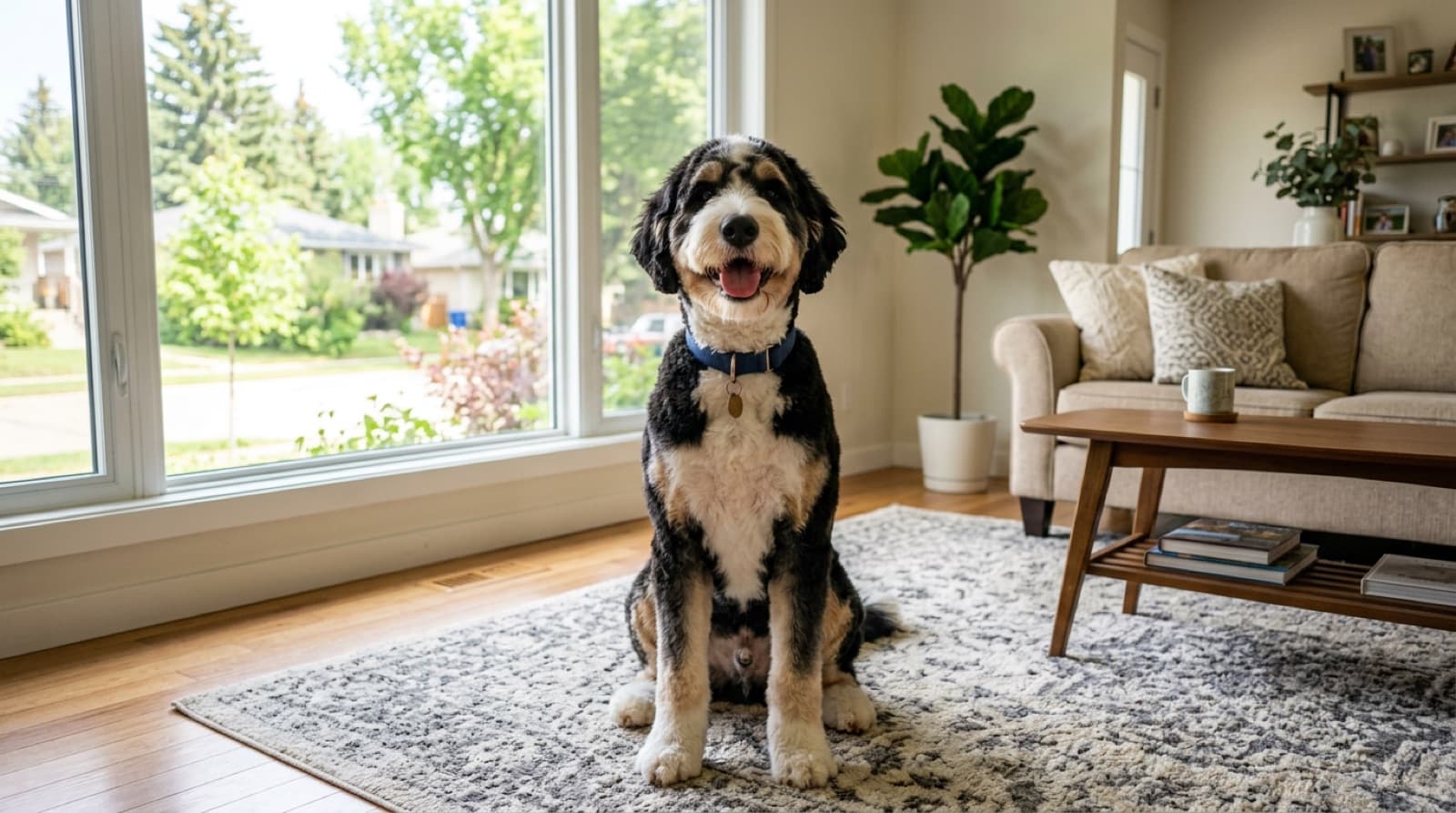
A rescue Bernedoodle may arrive with an unknown history of handling and, not uncommonly, already matted. Go slowly and make grooming positive. Start with short sessions, a few gentle brush strokes paired with treats and praise, and build up over days and weeks rather than forcing a full groom on day one. Handle the paws, ears, and face briefly and reward calm acceptance, since those are the sensitive areas a groomer and vet need to touch on a big dog.
If your new dog comes in badly matted, do not try to brush the mats out at home, which is painful and can damage the skin. Let a doodle-experienced groomer shave them out humanely and reset the coat, then start fresh with good daily maintenance or a manageable clip. The patience you invest early pays off for years, because a Bernedoodle that tolerates grooming calmly is cheaper, easier, and far less stressful to care for, which matters a great deal for a coat this demanding.
Frequently asked questions
How do I find a good groomer for a Bernedoodle near me in Edmonton?
Look for a groomer experienced with doodles and curly-coated breeds specifically, because a thick doodle coat takes skill and time and a poorly handled one ends up shaved to the skin. Ask how they handle matting (a humane groomer shaves out serious mats rather than painfully brushing them and will tell you honestly), what a typical doodle groom costs and how long it takes, and whether they do a sanitary and paw trim. Book on a regular schedule, commonly every six to eight weeks, rather than waiting until the coat is a problem. Between visits, the daily home brushing described here is what actually keeps the coat healthy; the groomer maintains and tidies but cannot undo weeks of skipped brushing on a coat this dense. For a large Bernedoodle, budget more time and money per visit than a small breed, and build a steady relationship with one groomer who knows the dog.
Do Bernedoodles shed, and are they hypoallergenic?
It depends on the individual coat, and the honest answer disappoints people who expect a guarantee. Bernedoodles are marketed as low-shedding and hypoallergenic because of the Poodle in the cross, and many do shed very little, but no dog is truly hypoallergenic. People react to proteins in dander, saliva, and urine, not to hair, so even a low-shedding dog produces allergens. How much a particular Bernedoodle sheds depends largely on its coat type and generation: a curlier, more Poodle-like coat tends to shed less, while a wavier or straighter coat can shed more like the Bernese side. For a rescue Bernedoodle of unknown generation, you cannot predict the coat in advance, so if allergies are the deciding factor, spend real time with the specific dog before committing and treat lower-shedding as lower-allergen, not allergen-free.
What do Bernedoodle generations (F1, F1b) mean for the coat?
The generation describes the cross and gives a rough hint about the coat, though individuals still vary. An F1 is a first cross of a purebred Bernese Mountain Dog and a purebred Poodle, producing a fairly even mix; F1 coats range from wavy to curly and shedding varies. An F1b is an F1 bred back to a Poodle, so it carries more Poodle, tends toward a curlier, lower-shedding coat, and is often chosen by allergy-sensitive families. Later generations and multigen crosses aim to stabilise the curly, low-shedding coat. The practical point for an adopter: the generation is a tendency, not a promise, and a rescue Bernedoodle often comes with an unknown or uncertain generation. Rather than fixate on the label, look at and feel the actual coat, and ask the rescue or foster what shedding and grooming the dog actually needs.
Why do Bernedoodle coats mat so badly?
Because the coat is dense, often curly, and does not shed out the way a typical dog coat does, so loose hair stays in the coat and tangles. Without thorough regular brushing it mats, and a doodle coat mats fast and tight, right down to the skin. Mats are not just a cosmetic problem: they pull painfully, trap moisture and debris against the skin, hide skin problems, and in a neglected coat cause real suffering. The friction points mat first: behind and under the ears, the armpits and groin, the collar area, the legs, and the rear. Daily or near-daily brushing all the way down to the skin (not just over the top, which leaves a matting layer underneath) is what prevents it, along with keeping the coat at a manageable length. The single most common doodle grooming failure is brushing only the surface and discovering a solid mat layer at the skin weeks later.
What is the Bernedoodle puppy coat change, and why does it matter?
Somewhere around nine months to about a year and a half, many doodles go through a coat change as the soft puppy coat transitions to the denser adult coat, and it is a notorious matting period. During the change, dead puppy coat sheds out underneath while the adult coat comes in, and the two tangle together into mats with alarming speed, sometimes seeming to appear overnight even in a dog you thought you were keeping up with. The fix is to brush more often, not less, through this stage, stay vigilant about the friction points, and consider keeping the coat shorter during the change to make maintenance realistic. Many owners are caught off guard when a previously easy puppy coat suddenly mats constantly. Knowing the coat change is coming, and ramping up brushing through it, saves you and the dog a painful shave-down.
How much does Bernedoodle grooming cost in Edmonton?
More than a small breed, because a Bernedoodle is a large dog with a dense coat that takes time. Plan on a professional groom every six to eight weeks, including a bath, blow-dry, full brush-out, haircut, face and sanitary trim, nail trim, and ear cleaning. In the Edmonton area a full doodle groom commonly runs higher than a toy-breed groom, often in the range of $90 to $150 or more per visit depending on the dog's size, coat condition, and the style, with heavily matted coats costing more because of the extra careful time or the need to shave out mats. Keeping up with daily home brushing keeps these costs down, since a well-maintained coat grooms faster, while a matted one takes longer and may have to be clipped short. Budgeting for regular professional grooming is simply part of the real cost of owning the breed, and it is a meaningful ongoing expense.
How do I care for a Bernedoodle coat in an Edmonton winter?
A doodle coat handles cold reasonably well but takes on snow, ice balls, and road salt, and mats faster when wet, so winter is a high-maintenance season. After walks, dry the coat and the feet, clear ice balls from between the toes and the leg feathering, and rinse off salt, which irritates skin and paws. Brush out any tangles while the coat is damp rather than letting it dry matted. Many owners keep the coat a bit shorter through winter to reduce snow and salt buildup, while leaving enough length for warmth on a large dog that is mostly fine in the cold. Do not shave a doodle to the skin for winter, since the coat provides insulation. Booties help on heavily salted paths if the dog tolerates them. With drying, salt removal, and regular brushing, an Edmonton winter is manageable, just more work than summer.
Related Edmonton Bernedoodle guides
Bernedoodle Health Issues Edmonton
Hips and elbows, eye disease, bloat, the Bernese cancer question, Addison's, and the hybrid-vigour reality.
Bernedoodle Adoption Edmonton
Rescue sources, real adoption costs, the doodle reality, generations and sizes, and what to expect.
Pets and Allergies
The truth about hypoallergenic pets, what you actually react to, and how to test before you commit.
Goldendoodle Grooming Edmonton
The same doodle coat-care playbook for the other popular Poodle cross.
Find your Edmonton rescue Bernedoodle
Browse current Edmonton-area Bernedoodle and doodle-mix listings. Ask the foster what the dog's coat actually sheds and needs, set up a doodle-experienced groomer and a daily brushing routine, and you go in ready for the coat rather than surprised by it.
Browse All Edmonton Dogs →New dog? Start with these care guides
Everything a new adopter needs to set up a safe, happy home.