The short answer
A Bernese is a winter breed in a winter city. The seasonal risk in Edmonton is summer, not winter. The non-negotiables: above 20C is meaningful, above 25C is dangerous, above 30C is genuine emergency; never shave the double coat (it insulates in both directions); walk pre-dawn or after dark in summer; AC the indoor space on heat-warning days; and learn heat stroke signs cold (heavy panting that does not slow, bright red gums, drooling, vomiting, staggering means a 24-hour vet now). Cars and hot pavement kill Berners every Alberta summer. The 2021 heat dome killed Bernese across Western Canada and the same conditions return periodically.
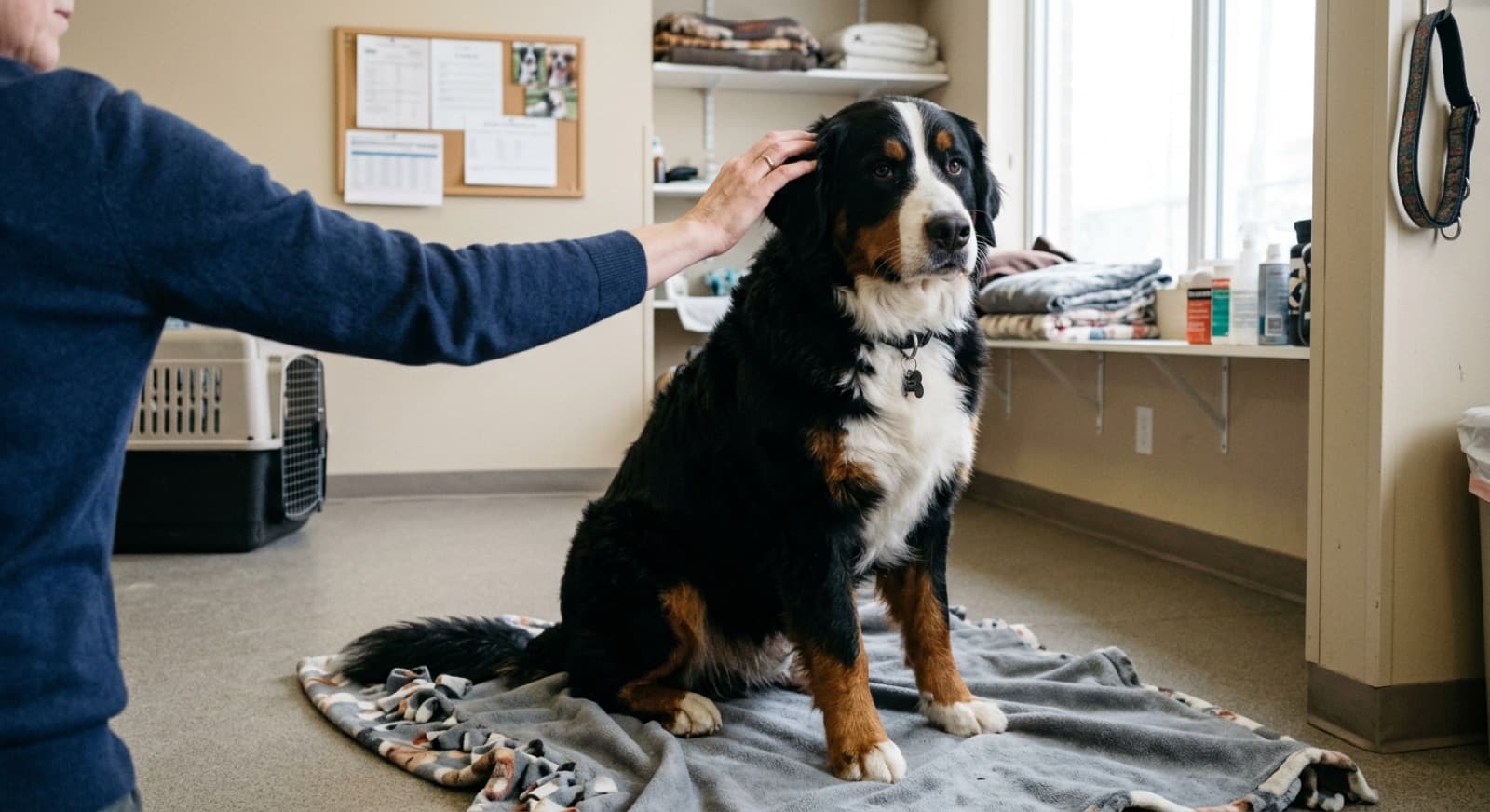
The Bernese seasonal flip: winter is native, summer is the risk
Most Edmonton dog breed guides organize around winter. The cold is the constant, the threshold for shortened walks is somewhere around minus fifteen, the gear conversation is about boots and coats, and the seasonal article is about frostbite. The Bernese inverts almost all of that. The Berner walks happily in minus twenty, will lie in fresh snow for an hour by choice, and the cold is genuinely close to native conditions for a breed that did farm work in the Swiss Alps for centuries. The Edmonton winter, even at its coldest, sits inside the breed's historical comfort zone.
The Edmonton summer does not. Average July highs in Edmonton sit between 22 and 25C, which is already at the upper edge of Berner comfort. Heat waves and heat domes push the city above 30C several times each summer, and the 2021 Western Canada heat event pushed Edmonton above 38C for multiple consecutive days. The breed standard built for Swiss winter snow has no good answer for that kind of heat. Edmonton emergency vets see Bernese heat stroke cases every summer; the 2021 event killed Berners across Western Canada, and clinics in Edmonton, Calgary, Vancouver, and Kamloops all reported breed-specific spikes during the heat dome week.
The owner mindset shift that follows from this: winter is your easy season, summer is your work. Most new Berner owners in Edmonton expect the opposite and get caught out in the first July heat wave. The dog that romped through January is suddenly panting in shade at noon and the owner does not yet know what they are looking at. The rest of this guide is how to recognize the summer risk before it becomes a crisis.
Why a Bernese struggles in summer heat
Four anatomical and physiological factors stack to make the Berner one of the most heat-intolerant non-brachycephalic breeds in common Canadian rescue inventory.
The double coat. The Berner has a dense undercoat layered under a longer guard-hair topcoat. The system was built to trap insulating air against the skin in Swiss winter conditions. It does the job exceptionally well in cold. In heat, the same trapped air layer slows the rate at which the dog can shed body heat through the skin, and the only effective cooling pathway left is panting (evaporative cooling through the respiratory tract). For a healthy lean Berner that works. For a heat-stressed Berner the panting cannot keep up.
The body mass. Adult Berners are 70 to 115 lb. A large body has a smaller surface-area to body-mass ratio than a small body, which means proportionally less skin for heat dissipation per kilogram of body to cool. The same physics that makes giant breeds tolerate cold well makes them cool down slowly once they are overheated. A 100 lb Bernese that overheats takes much longer to bring back to safe core temperature than a 30 lb dog, and the time-to-organ-damage window is the same.
The coat colour. The Bernese is a tricolour breed but the dominant surface colour is black. Black coats absorb significantly more solar radiation than light coats; published thermography work shows surface coat temperature differences of 10 to 20C between dark and light coats in direct sun. A black Berner standing in Edmonton afternoon sun is genuinely hotter on the surface than a yellow Lab in the same conditions, and that surface heat translates into core heat load over time.
The cardiac load. Heat stress increases cardiac workload because the dog dilates peripheral blood vessels to push warm blood to the skin for cooling, which drops central blood pressure and forces the heart to work harder to maintain perfusion. Bernese as a breed are prone to a number of cardiac concerns including dilated cardiomyopathy. A senior Berner or a Berner with subclinical cardiac disease can decompensate in heat well before a healthy younger dog. See our Bernese health guide for the cardiac workup detail.
Together these four factors make Bernese one of the highest-risk breeds for heat stroke in published veterinary literature, second only to brachycephalic breeds (Bulldogs, Pugs, French Bulldogs) for confirmed case rates per breed-population. The AVMA warm-weather pet safety guidance is the canonical reference for owner-facing summer protocols.
Temperature thresholds for an Edmonton Bernese
The thresholds below are conservative because the Berner upside on cooling is much smaller than the downside on heat injury. They assume a healthy adult dog. Senior Berners, overweight Berners, and Berners with cardiac or respiratory concerns should follow tighter thresholds (subtract 3 to 5C from each row).
| Temperature | What it means | Activity plan |
|---|---|---|
| Below 15C | Native conditions | Walk freely, normal duration and intensity |
| 15 to 20C | Routine but watch | Normal walks, watch panting, carry water |
| 20 to 25C | Caution zone | Early morning or late evening only, shaded routes, shorter duration |
| 25 to 30C | Dangerous | Pre-dawn or post-dusk only, minimal duration, cool surfaces, AC indoors |
| 30 to 35C | Emergency zone | Brief potty only, indoor day, AC mandatory, swim if cool clean water available |
| 35C and above | Heat dome / extreme | Fully indoor, active cooling, monitor for symptoms hourly |
Humidity adjusts the picture upward. Edmonton is a dry-climate city most summers, which works in the Berner's favour because evaporative cooling through panting is more effective in dry air. Humid heat (the kind common in southern Ontario, Quebec, and the Maritimes) is significantly worse for the breed than dry heat at the same temperature. When Edmonton catches a humid wave (occasional summer storms, post-rain warm afternoons), drop the threshold by 3 to 5C. The dew point matters; if the morning dew point is above 15C, the day is going to feel heavier than the temperature suggests. Environment and Climate Change Canada publishes Edmonton heat warnings when forecast conditions cross provincial thresholds; subscribe and treat the alerts as Berner-relevant.
Heat stroke: recognition and emergency response
Canine heat stroke is fatal in roughly 50 percent of confirmed cases in published clinical literature. The Bernese sits in the high-risk breed group. Recognition and time-to-treatment are the two variables that decide outcome. Learn the signs cold.
Early signs (act now, do not wait)
- Heavy continuous panting that does not slow when the dog rests in shade for several minutes
- Excessive drooling, often stringing from the mouth
- Bright red gums and tongue (compare to a normal pink baseline)
- Lethargy, slowing on a walk, lying down when usually standing
- Reluctance to move or to follow normal cues
- Wide-eyed anxious expression, restlessness, pacing
Critical signs (24-hour vet immediately)
- Vomiting or diarrhoea, sometimes with blood
- Staggering, unsteady gait, collapse
- Blue or grey gums (cyanosis, indicating low blood oxygen)
- Tremors or seizures
- Unresponsiveness or loss of consciousness
- Rectal temperature above 41C (clinical heat stroke threshold)
The cool-down protocol
Do these steps simultaneously and start driving to the closest 24-hour emergency vet while doing them. Do not wait for the cool-down to finish before leaving for the clinic.
- Move the dog to shade or air conditioning immediately. Indoor AC if possible. A shaded car with AC running second-best.
- Apply cool (not ice-cold) water to the groin, armpits, paw pads, and belly. Wet towels work, a hose at low pressure works. Use cool tap water (15 to 20C); skip the ice water because extreme cold causes vasoconstriction that traps heat in the core and worsens the situation. The ACVECC veterinary emergency consensus is explicit on this; cool not cold.
- Fan the wet dog. Evaporative cooling is the most effective owner intervention. A simple oscillating fan, the car AC vents on full, or even a hand-fan can speed the process.
- Offer small amounts of cool water to drink if the dog is alert and swallowing. Do not force fluid into a dog that is collapsed or seizing.
- Call the emergency vet from the car and tell them you have a suspected heat stroke giant breed inbound. They prepare an IV setup, oxygen, and cooling protocols before you arrive.
- Drive in even if the dog seems to recover. Heat stroke causes internal organ damage (kidney, liver, gut, brain, clotting cascade) that may not be visible for 24 to 72 hours. Edmonton emergency vets routinely admit recovered heat-stroke patients for IV fluids and blood work monitoring; the recovery looks complete but the secondary cascade can be fatal without treatment.
Cost reality: a confirmed canine heat stroke admission in Edmonton runs $2,000 to $6,000 or more depending on length of stay, with the upper end common for giant breeds with multi-organ involvement. The cost is not the question; the dog needs the treatment regardless. The American College of Veterinary Surgeons maintains owner-facing references on emergency presentations including heat stroke.
The summer coat-shaving question (do not do it)
The most common well-meaning summer mistake new Berner owners make is asking a groomer to “shave the dog down” for summer. Some Edmonton groomers will refuse the request and explain why; some will not. The right answer is no, and the reason matters because the same logic applies across the double-coated breed family (Bernese, Golden Retriever, Husky, Australian Shepherd, German Shepherd).
The double coat is not a winter coat. It is a year-round thermoregulation system. The dense undercoat traps a layer of air against the skin. In winter, that trapped air is warmed by body heat and acts as insulation against the cold outside. In summer, the same trapped air sits cooler than the dog's body and acts as insulation against the hot outside, while the longer guard-hair topcoat blocks direct solar radiation from reaching the skin. The system insulates in both directions. Shaving destroys the insulation.
What happens after a shave-down on a Berner:
- The skin is exposed to direct UV. Bernese skin sunburns. Repeated sunburn over years raises skin cancer risk on a breed that already has cancer concerns.
- The dog is hotter, not cooler. The air-buffer cooling system is gone, the skin absorbs solar radiation directly, and the dog has no insulation against ambient heat.
- The coat regrows wrong. Post-Clipping Alopecia is a documented condition in double-coated breeds where the shaved coat regrows patchy, with undercoat dominant and guard hair stunted. Some dogs never grow back a normal coat.
- The dog cannot dissipate water. The undercoat normally traps and slowly releases moisture from cooling routines (post-swim, post-bath, sweat through the paw pads). A shaved Berner gets soaked and stays soaked, which can encourage hot spots and bacterial skin infections.
The veterinary consensus is consistent: do not shave double-coated breeds for summer. The American Kennel Club position mirrors what most reputable Edmonton groomers will tell you in person. If a groomer agrees to shave a Bernese without questioning the request, that is a groomer to avoid.
Strategic summer grooming: thin the undercoat, keep the topcoat
The right summer move is to aggressively de-shed the dead undercoat while leaving the topcoat intact. The goal is to remove the bulk of the dense insulating layer that has accumulated over winter so the cooling air buffer remains thin enough to work efficiently in heat.
The home routine: daily brushing through spring coat blow (April through June for most Edmonton Berners), then twice weekly through summer maintenance. Use an undercoat rake or a deshedding tool (FURminator is the common choice) on the dense undercoat, and a slicker brush or pin brush on the topcoat. The undercoat rake reaches under the guard hair to pull dead undercoat without cutting topcoat; the deshedding blade does similar work faster. Brush from the skin outward in the direction of hair growth. A 20 to 30 minute session twice weekly handles a Berner.
Professional grooming through summer should be every 6 to 10 weeks for a deep de-shed, bath, ear clean, nail trim, and sanitary trim around the rear and paw pads. Edmonton groomer pricing for a Bernese runs $90 to $150 per visit depending on coat condition and the time the deshedding takes. Specify “deshed and bath, no shave” when booking. See our Golden Retriever grooming guide for the broader double-coat grooming pattern that applies similarly to Berners.
One more strategic move: cool-water baths through summer help. A weekly or biweekly bath in cool (not cold) water removes accumulated dirt that traps heat in the coat, washes out loose undercoat the brushing missed, and gives the dog 30 minutes of cooler core temperature during the dry-down. Towel-dry thoroughly; the dense undercoat holds moisture for hours and a damp Berner left in indoor heat can develop hot spots.
Summer exercise programming
The Edmonton Berner summer exercise day looks nothing like the winter day. Winter is two long walks, off-leash time, snow play. Summer is pre-dawn movement, indoor enrichment through the heat of the day, and a brief post-dusk session.
The morning window (5 to 7 am)
The prime Edmonton dog hour from late June through August. The air is still cool, the pavement has had all night to cool off, the sun is low enough that direct radiation is minimal, and the river-valley trails still hold shaded cool air. A 45 to 60 minute walk in this window meets most of an adult Berner's daily exercise need. Set the alarm. Most committed Berner owners convert to this schedule by their second Edmonton summer.
The evening window (9 to 11 pm)
Edmonton has long summer daylight; sunset in late June is after 10 pm. The window between sunset and full dark is comfortable for a shorter 20 to 30 minute walk if the dog needs more movement. Watch the pavement; concrete and asphalt take hours to release stored heat after sunset, so grass routes are still preferable.
Cool-water swimming
One of the best heat-tolerant exercises available to a Berner. The cool water removes heat through direct conduction, the buoyancy reduces joint load (relevant for a breed with hip and elbow dysplasia rates), and the work is aerobic without the surface-temperature exposure of land exercise. Hubbles Lake, Wabamun Lake during clean-water windows, and the cool gravel-bar shallows on the North Saskatchewan all work. Check the blue-green algae advisory list before any lake trip; our Edmonton dog water safety guide covers the algae detail (the toxin kills dogs and Bernese are not exempt).
Indoor enrichment during the heat of the day
The Berner is a moderate-energy breed and does not need 4 hours of exercise per day, but does need mental work to stay settled in the long indoor stretches. Snuffle mats, food puzzles, frozen Kongs (stuffed with wet food and frozen), scent games (hide treats around the house), and short trick-training sessions work. Frozen treats serve a double purpose; the dog gets mental engagement and core cooling at the same time. A frozen Kong stuffed with yogurt or pumpkin can occupy a Berner for 30 minutes while AC handles the ambient heat.
Browse adoptable Bernese Mountain Dogs in Edmonton
Bernese show up in Edmonton rescue inventory periodically, often Berner mixes from Alberta and BC surrenders. Foster temperament notes flag dogs that handle heat better or worse, dogs that swim, and dogs with cardiac history that needs tighter summer thresholds. Browse current adoptable Berners and Berner crosses.
See Edmonton Adoptable Dogs →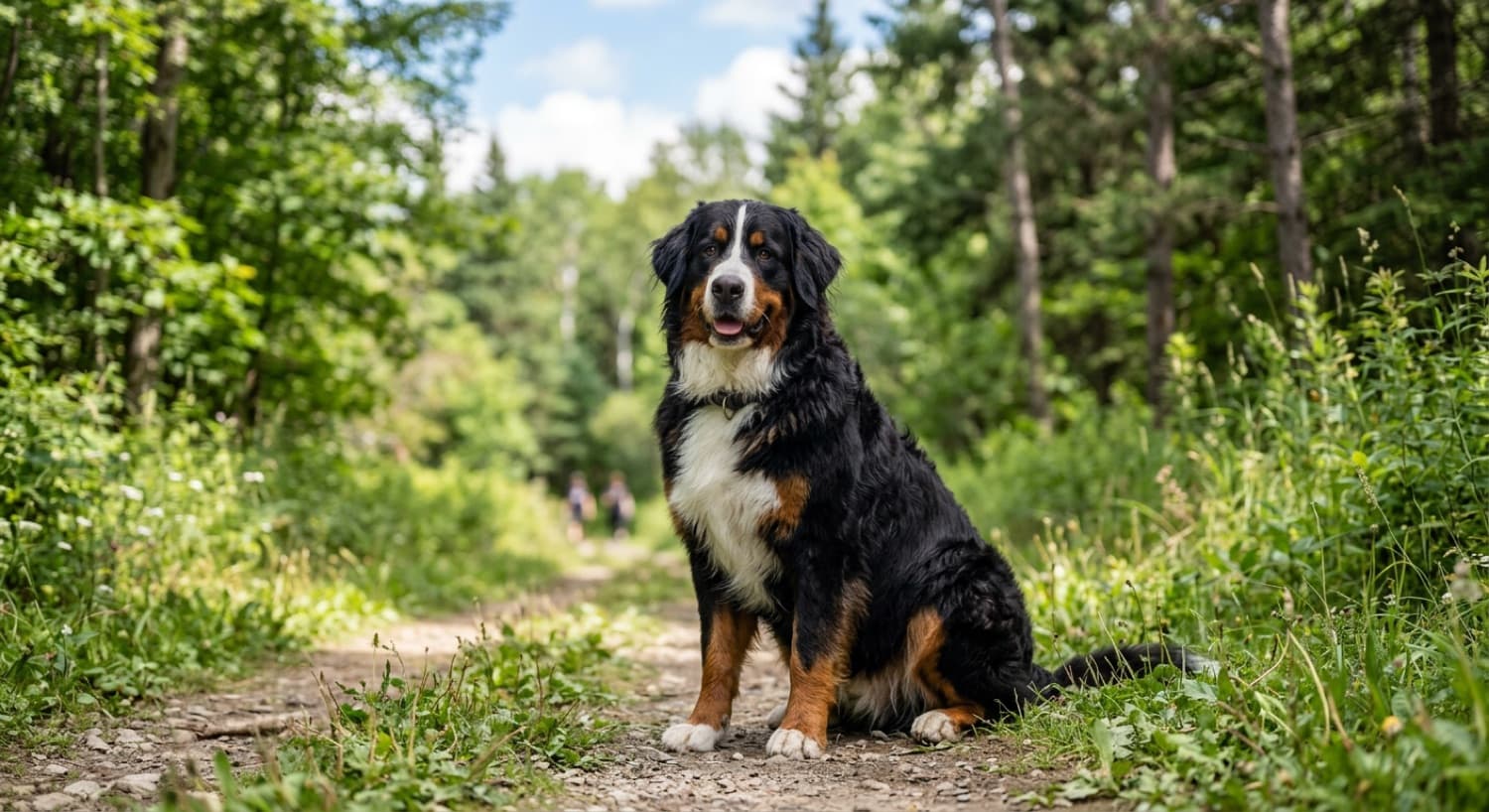
Indoor cooling for an Edmonton Berner
Air conditioning is not optional for a Bernese household in Edmonton. The cost of running central AC or window units through July and August is genuinely low compared to the cost of a heat stroke admission or a dead dog. Most Edmonton Berner owners who have done the math run AC continuously through heat events.
Target indoor temperature for a Berner is 22C or below during heat events. If full-house AC is not available, prioritize one cool room (basement is best in Edmonton because grade-level construction keeps it cool naturally), make that the Berner's daytime base, and run a window unit or portable AC in that room. Tile or hardwood floors are cooler than carpet; the dog will choose the cool floor over a bed during heat. Cooling mats (gel-based, sold at most pet supply stores in Edmonton for $30 to $60) help; place one on the dog's favourite resting spot and refresh by flipping or placing it briefly in the freezer.
Fans help with circulation but do not cool the air; they accelerate evaporation from the dog's panting and from any damp coat after a cool-water rinse. A box fan on the floor pointed at the Berner's lying area improves indoor heat tolerance noticeably. Close blinds and curtains on south and west-facing windows during the heat of the day to block solar gain.
Summer hydration for a Bernese
Water intake for an adult Bernese in Edmonton summer climbs to 4 to 6 litres per day depending on activity and ambient temperature, roughly double the cool-weather baseline of 2 to 3 litres. The breed will drink what it needs if water is available, fresh, and cool; the owner's job is to make that easy.
- Multiple water bowls around the house and yard. A Berner will not always walk far for water; the closer the bowl the more the dog drinks.
- Refresh water through the day. Warm stagnant water gets refused; cool fresh water gets consumed.
- Ice cubes in the bowl encourage drinking and add a small cooling effect.
- Pet-fountain water dispensers (small circulating filtered units) increase water intake for some dogs.
- On walks, carry a collapsible bowl and water bottle. Offer water every 15 to 20 minutes in 20C-plus conditions.
Watch the urine colour. Pale yellow is well-hydrated. Dark amber is dehydrated and means more water and indoor rest. If the dog is not urinating for 6 to 8 hours during summer heat, that is a vet call.
For dogs working harder than usual in heat (longer walks, hikes, swim sessions, off-leash play in the morning window), modest electrolyte support is reasonable. Coconut water (unsweetened, no additives), bone broth (unsalted), or a vet-approved canine electrolyte solution covers the sodium and potassium loss from panting. Skip human sports drinks; the sugar load is wrong for dogs and some contain xylitol, which is fatal to dogs at small doses.
Senior Bernese summer (tighter thresholds)
Bernese typically live 7 to 9 years and the senior window opens around 6. Many adult Berners in rescue inventory are already in or near senior territory, and the senior heat-tolerance picture is significantly worse than the young-adult picture. Senior thresholds shift down 3 to 5C from the table above: routine activity below 18C, brief outdoor only between 18 and 25C, minimal outdoor above 25C, fully indoor with AC above 28C.
The reasons stack. Senior cardiac function declines with age; the heart's ability to compensate for heat-induced peripheral vasodilation drops. Cardiac comorbidities (early dilated cardiomyopathy, valve disease) are common in senior Berners and reduce reserve further. Orthopaedic issues (hip and elbow dysplasia, arthritis) reduce the dog's willingness to move to shade or water bowls; the senior Berner may overheat in place rather than self-relocate. Renal function declines with age, which reduces the body's ability to handle the fluid shifts of heat stress.
Monitor resting respiratory rate through summer for any Berner over 6. The normal sleeping respiratory rate is under 30 breaths per minute; any sustained increase above 30 is a vet call. Cardiac decompensation in heat looks like increased panting at rest, coughing (especially at night or after lying down), exercise intolerance, restlessness or inability to settle, and pale or grey gums. Same-day vet visit for any of those signs in a senior Berner during summer.
Cars, pavement, and the avoidable summer deaths
Most Alberta dog summer deaths fall into two categories: hot cars and hot pavement. Both are entirely preventable and both kill Bernese.
The car
Never leave a Berner in a parked car in summer, not for “a few minutes,” not with the windows cracked, not in the shade. On a 22C day the interior of a parked car reaches 38C in 10 minutes and 47C in 30 minutes, even with windows partly down. On a 27C day the interior passes 40C in 5 minutes. Those temperatures kill a Bernese fast. The Alberta SPCA receives hundreds of locked-dog-in-car calls every summer; many require emergency intervention to break a window and some dogs are already dead when help arrives.
The rule is simple: if the destination does not allow the dog inside the building, leave the dog at home. Drive-throughs are fine in a moving car with AC running; parking lots are not. Driving with the dog in the car requires AC; never drive a Berner in summer with the AC off, even for short trips. The same logic applies to garages with closed doors, sun-exposed outdoor crates, and any enclosed space that traps heat.
The pavement
Pavement temperature in Edmonton on a sunny 28C afternoon can reach 50 to 60C on dark asphalt, which is hot enough to cause second-degree burns to paw pads within 60 seconds of contact. Sidewalks in afternoon sun are the most common burn surface; black asphalt and dark concrete the worst.
The standard test: press the back of your hand flat to the pavement for seven seconds. If you cannot hold it comfortably, the dog cannot walk on it. Use grass routes, shaded river-valley trails, or wait until after sunset when the pavement has cooled. Paw pad burns are common in Edmonton July and August; the injury is painful, requires veterinary treatment ($200 to $600 depending on severity), and takes weeks to heal. A Berner with burned pads may resist walking for a week, which then compounds the summer activity problem.
Edmonton dog parks in summer: shade, water, timing
Edmonton off-leash parks split into two categories for Berner summer use: shaded river-valley trails (good) and open prairie parks (avoid in heat).
Shaded river-valley options stay cool longer into the morning and offer water access. Mill Creek Ravine, the Capilano area, sections of Whitemud Creek, and the tree-canopied sections of the river-valley off-leash mesh all work. The shade keeps surface temperatures lower, the cool river air sinks into the valley overnight and persists into the morning hours, and water access lets the dog cool down mid-walk. These are the right Berner summer destinations and they work right into mid-summer with morning timing.
Open prairie parks heat up fast in summer and offer minimal shade or water. Hawrelak Park's open lawn sections, Terwillegar Park's open fields, the larger off-leash areas south of the city without mature tree cover; these are fine in May and September, dangerous for an adult Berner in July afternoon sun, and acceptable only in the pre-dawn window during heat events. Treat any sustained open-grass park time above 22C as a risk.
Timing matters more than location in summer. The right Berner park session is 6 to 7 am in any park; the wrong one is 2 to 4 pm in any park. Carry water on every summer park visit and use it; do not assume the dog will find a water source. Set a hard 45-minute session limit and watch the dog for early heat signs (heavy panting, slowing, seeking shade). When the dog asks to leave, leave.
Heat-wave exercise alternatives
When Edmonton catches a heat wave (multiple consecutive 30C-plus days) or a heat dome (35C-plus), the outdoor exercise plan collapses to brief potty breaks and indoor enrichment. The dog still needs activity for mental health; the options shift to lower-intensity, lower-heat alternatives.
- Kiddie pool in the shaded backyard. A 6-foot diameter plastic pool with 4 to 6 inches of cool water. Refresh through the day. The Berner can lie in the cool water and self-regulate temperature. One of the most effective heat-tolerant activities available.
- Sprinkler play in early morning. Set up a sprinkler on the lawn for 20 minutes around 6 am. The dog gets cool-water exposure, light movement, and the routine is over before the surface heats up.
- Indoor scent games. Hide treats around the house in increasing difficulty. 15 to 30 minutes of focused work tires a Berner mentally and substitutes for some physical work.
- Frozen food puzzles. Stuff a Kong or West Paw Toppl with wet food, yogurt, or pumpkin and freeze overnight. Gives the dog 20 to 40 minutes of focused work and core cooling at the same time.
- Indoor trick training. Short focused sessions teaching new tricks (spin, bow, paw, place, settle). Builds the bond and burns mental energy.
- Cool-water swims at clean lakes. If a lake within driving range is in the clean-water window (no algae advisory), an early morning lake trip can replace several days of land exercise. The drive is in AC, the swim is cool, the dog gets aerobic work without surface heat exposure.
Cooling vests (Ruffwear Swamp Cooler is the common choice, $80 to $110 at MEC or Atmosphere) work by evaporation. Soak in cool water before the walk; the slow evaporation cools the dog underneath. Effective at 20 to 25C ambient; loses effectiveness above 28C when evaporation slows. Use as a small margin during marginal conditions, not as a license to walk in dangerous heat.
Summer travel and car AC
Any summer car trip with a Berner requires functioning AC. The dog cannot ride in a car without AC in temperatures above 20C; the rear cargo area heats faster than the front cabin and can reach dangerous temperatures within minutes of starting a drive. Test the rear AC vents (if your vehicle has them) before any trip; if rear airflow is weak, run the front vents on full and consider a rear-cargo fan.
Long road trips (lake destinations, weekend cabin trips) work for a Berner with planning: AC on full from departure, water available in the cargo area, planned stops every 90 minutes for water and brief shade time, no left-in-car stops for human meals or shopping. The right pattern is one person stays with the dog in the running AC car while the other person goes inside.
Camping with a Berner in Alberta summer is workable in shaded sites near water (Pembina River, parts of Wabamun Lake Provincial Park, Sundance Provincial Park) and dangerous in open prairie sites. Plan for tent temperatures that exceed ambient temperature by 5 to 10C; a Berner in a sun-exposed tent can overheat within hours. RV travel with functioning AC is the Berner-safe option for summer camping.
Multi-Bernese household summer logistics
Households with two Berners face the same summer rules at double scale. Cooling needs double, water intake doubles, the indoor cool space needs to accommodate both dogs without competition, and exercise timing becomes harder when both dogs need pre-dawn walks. Most two-Berner Edmonton households settle into a rhythm by their second summer.
Practical adjustments: two cooling mats, two water sources per room, separate quiet rest areas if the dogs prefer space, and tandem walks at the same pre-dawn window rather than back-to-back single walks. Heat stroke risk in one dog can be missed if the owner is watching the second dog; watch both carefully on warm-weather walks. Two Berners off-leash on a hot afternoon at a prairie park is a multi-dog emergency waiting to happen; the timing rules apply more, not less, with multiple dogs.
Frequently asked questions
How hot is too hot for a Bernese Mountain Dog in Edmonton?
Anything above 20C is meaningful for a Bernese and anything above 25C is genuinely dangerous. The breed was built for Swiss alpine farm work in cold conditions, and the dense double coat plus the 70 to 115 lb body mass plus the black-and-tan coat colour add up to slow heat dissipation. Practical thresholds for Edmonton owners: below 15C the dog is in native conditions and can walk freely, 15 to 20C is routine but watch for early panting, 20 to 25C means early morning and late evening walks only, 25 to 30C means pre-dawn or post-dusk only with short duration and cool surfaces, 30C and above means minimal outdoor time and AC indoors is mandatory, and 35C and above means a fully indoor day with active cooling. The 2021 Western Canada heat dome that pushed Edmonton above 38C killed Bernese across the region; treat those events as emergencies, not inconveniences.
What are the signs of heat stroke in a Bernese?
Early signs are heavy panting that does not slow when the dog rests, excessive drooling that strings from the mouth, bright red gums and tongue, lethargy or slowing on walks, and reluctance to move. Critical signs that mean go to a 24-hour vet immediately: vomiting, diarrhoea, staggering or collapse, blue or grey gums (cyanosis), tremors or seizures, and unresponsiveness. Heat stroke can become fatal within 30 minutes once core temperature passes 41C, and the death rate for confirmed canine heat stroke is roughly 50 percent in published clinical literature. The window between early signs and critical signs can be short on a black-coated giant breed. Cool the dog and drive to the vet at the same time; do not wait for symptoms to escalate before acting.
Should I shave my Bernese for summer?
No. The double coat is not a winter coat that gets removed for summer; it is a year-round thermoregulation system that insulates in both directions. The dense undercoat traps a layer of cooler air against the skin in heat and a layer of warmer air in cold, and the longer guard hairs of the topcoat block direct UV and solar absorption. Shaving destroys both functions: the dog loses the air-buffer cooling system, the skin is exposed to direct sun (Bernese skin sunburns and can develop solar dermatitis and, over time, skin cancer), and the coat often grows back patchy or with a coarser undercoat-only texture (Post-Clipping Alopecia). The correct summer strategy is aggressive de-shedding of the dead undercoat to thin the dense insulating layer while keeping the topcoat intact. A professional groom every 8 to 10 weeks through summer accomplishes this.
What should I do if my Bernese overheats in Edmonton?
Get the dog into shade or air conditioning immediately. Apply cool (not ice-cold) water to the groin, armpits, paw pads, and belly using wet towels or a hose. The cool-water targets matter: those areas have the largest superficial blood vessels and dissipate heat fastest. Do not use ice or ice-water; the extreme cold causes reflex vasoconstriction that traps heat in the core and can make the situation worse. Run a fan over the wet dog to accelerate evaporative cooling. Offer small amounts of cool water to drink but do not force it. Call a 24-hour emergency vet from the car and drive in even if the dog seems to recover; heat stroke causes internal organ damage that may not be visible for 24 to 72 hours, and Edmonton emergency vets routinely admit recovered heat stroke patients for IV fluids and blood work monitoring.
Can my Bernese walk on hot pavement in Edmonton?
No, not on summer afternoons. Pavement temperature in Edmonton on a sunny 28C afternoon can reach 50 to 60C on dark asphalt, which is hot enough to cause second-degree burns to paw pads within 60 seconds of contact. The standard test: press the back of your hand to the pavement for seven seconds. If you cannot hold it comfortably, the dog cannot walk on it. Use grass routes, shaded river-valley trails, or wait until after sunset when the pavement has cooled. Bernese paw pad burns are common in Edmonton July and August; the injury is painful, requires veterinary treatment, and takes weeks to heal. Sidewalks in afternoon sun are the most common burn surface.
How much water does a Bernese need in summer?
An adult Bernese in Edmonton summer needs 4 to 6 litres of water per day depending on activity and ambient temperature, roughly double the cool-weather baseline. Provide multiple water sources around the house and yard, refresh them through the day (warm stagnant water gets refused), and consider adding a few ice cubes to encourage drinking. Watch the urine colour; pale yellow is well-hydrated, dark amber is dehydrated and means more water. For dogs working hard in heat (long walks, hikes, swim sessions), electrolyte support is reasonable; coconut water or a vet-approved canine electrolyte solution covers the sodium loss from panting. Avoid human sports drinks; the sugar load is wrong for dogs and some contain xylitol which is fatal.
Are senior Bernese at higher heat risk?
Yes, significantly. Bernese typically live 7 to 9 years and the senior window opens around 6, which means many adult Berners are already in the higher-risk category. Senior heat tolerance drops due to reduced cardiac output, decreased thermoregulation efficiency, common cardiac and orthopaedic comorbidities, and slower recovery from heat events. The senior Bernese should follow tighter thresholds: routine activity below 18C, brief outdoor only between 20 and 25C, minimal outdoor above 25C, fully indoor with AC above 28C. Senior Berners are also more prone to heat-related cardiac decompensation; resting respiratory rate should be monitored through summer and any change above 30 breaths per minute at rest is a vet call.
Can I leave my Bernese in the car for a few minutes in summer?
No. Never. The car is the single most common cause of canine heat stroke death and the Bernese is one of the worst breeds to risk it with. On a 22C day the car interior reaches 38C in 10 minutes and 47C in 30 minutes, even with windows cracked. On a 27C day the car interior passes 40C in 5 minutes. The Bernese cannot dissipate heat fast enough to survive those temperatures. The Alberta SPCA receives hundreds of calls every summer about dogs locked in cars; many require emergency intervention and some die before help arrives. The same applies to garages with closed doors, sun-exposed dog crates outdoors, and any enclosed space that traps heat. If the destination does not allow the dog inside the building with you, leave the dog at home.
What summer exercise schedule works for an Edmonton Bernese?
Pre-dawn and post-dusk are the real Edmonton summer dog hours from late June through August. The 5 to 7 am window is cool, the air is still, and the pavement has had all night to cool off; this is the prime walk window. The 9 to 11 pm window after the long Edmonton summer sunset works for shorter sessions. Midday and afternoon are off-limits for any sustained activity above 20C. River-valley trails (Mill Creek Ravine, the Capilano area, sections of the North Saskatchewan with mature tree cover) hold cooler shaded air through morning longer than open prairie parks. Swimming in cool clean water (Hubbles Lake, Wabamun in clean-water windows) is one of the best heat-tolerant exercises for a Berner; the cool water and the buoyancy reduce joint load while providing aerobic work.
How does Edmonton heat compare to Calgary for a Bernese?
Edmonton runs slightly hotter than Calgary in summer on average. Edmonton sits in the prairie heat sink with less chinook moderation, and summer afternoons in the high 20s and low 30s are routine through July and August. Calgary at the same time tends to run 2 to 4 degrees cooler with more afternoon cloud and occasional summer chinook cooling. The other Edmonton-specific factor is the 17-hour summer daylight in June; cumulative UV and surface heat build through the long day. Practically, an Edmonton Berner needs tighter exercise windows and more aggressive indoor cooling than a Calgary Berner. Both cities saw confirmed Bernese heat deaths during the 2021 heat dome; the breed is borderline in any Alberta summer and dangerous in heat-dome conditions.
Do cooling mats and cooling vests actually work for Bernese?
Cooling mats work reasonably well as passive indoor cooling; the gel-based mats absorb body heat through conduction and can extend the comfortable indoor zone by a few degrees. They are not a substitute for AC in serious heat. Cooling vests work through evaporation (the vest is soaked in cool water and the slow evaporation cools the dog underneath); they help for short walks in 20 to 25C conditions, but lose effectiveness above 28C when evaporation slows. Neither tool turns a heat-intolerant breed into a heat-tolerant breed; they buy a small margin. The reliable summer cooling tools for an Edmonton Berner are AC, fans, cool flooring (tile or concrete), shade, cool clean swim water, and timing exercise around the temperature curve. Treat cooling gear as supplementary, not primary.
Related Edmonton Bernese guides
Adoptable Bernese in Edmonton
Browse current Bernese Mountain Dogs and Berner crosses listed with Edmonton-area rescues. Updated regularly.
Bernese Adoption Edmonton
Edmonton Berner rescue sources, the short-lifespan reality, adoption costs, and the breed-vs-buy honesty.
Bernese Mountain Dog Health Issues: Cancer, Joints
Bernese Mountain Dog health issues to plan for: histiocytic sarcoma and other cancers, hip and elbow dysplasia, degenerative myelopathy, bloat and epilepsy.
Bernese Grooming Edmonton
The full Berner double-coat grooming routine, twice-yearly coat blow, professional groomer pricing, and seasonal coat care.
Find your Edmonton Bernese
Browse adoptable Bernese Mountain Dogs and Berner mixes from Edmonton-area rescues. Foster temperament notes flag heat tolerance and cardiac history that matters for Alberta summers.
Browse All Edmonton Dogs →New dog? Start with these care guides
Everything a new adopter needs to set up a safe, happy home.