The short answer
Dilated cardiomyopathy (DCM) is the Doberman's defining health risk, a heart-muscle disease the breed is more predisposed to than almost any other, and it can be silent early and even cause sudden death. That is why the three most important moves are: adopt from sources that value screening, talk to your vet about cardiac monitoring (a Holter monitor and echocardiogram) as your dog reaches middle age, and enrol pet insurance while your dog is young and healthy. The other breed concerns: von Willebrand disease (a DNA-testable bleeding disorder), wobbler syndrome, bloat (GDV), hypothyroidism, hip dysplasia, and skin issues in dilute-coloured dogs. None of this is a reason to avoid a wonderful breed. It is a reason to plan, monitor, and budget, and to lead with the heart. Ontario insurance runs roughly $60 to $110 per month for a young healthy Doberman, and pre-existing conditions are excluded, so enrol early. This is general information, not veterinary advice; your vet is the right guide for your specific dog.
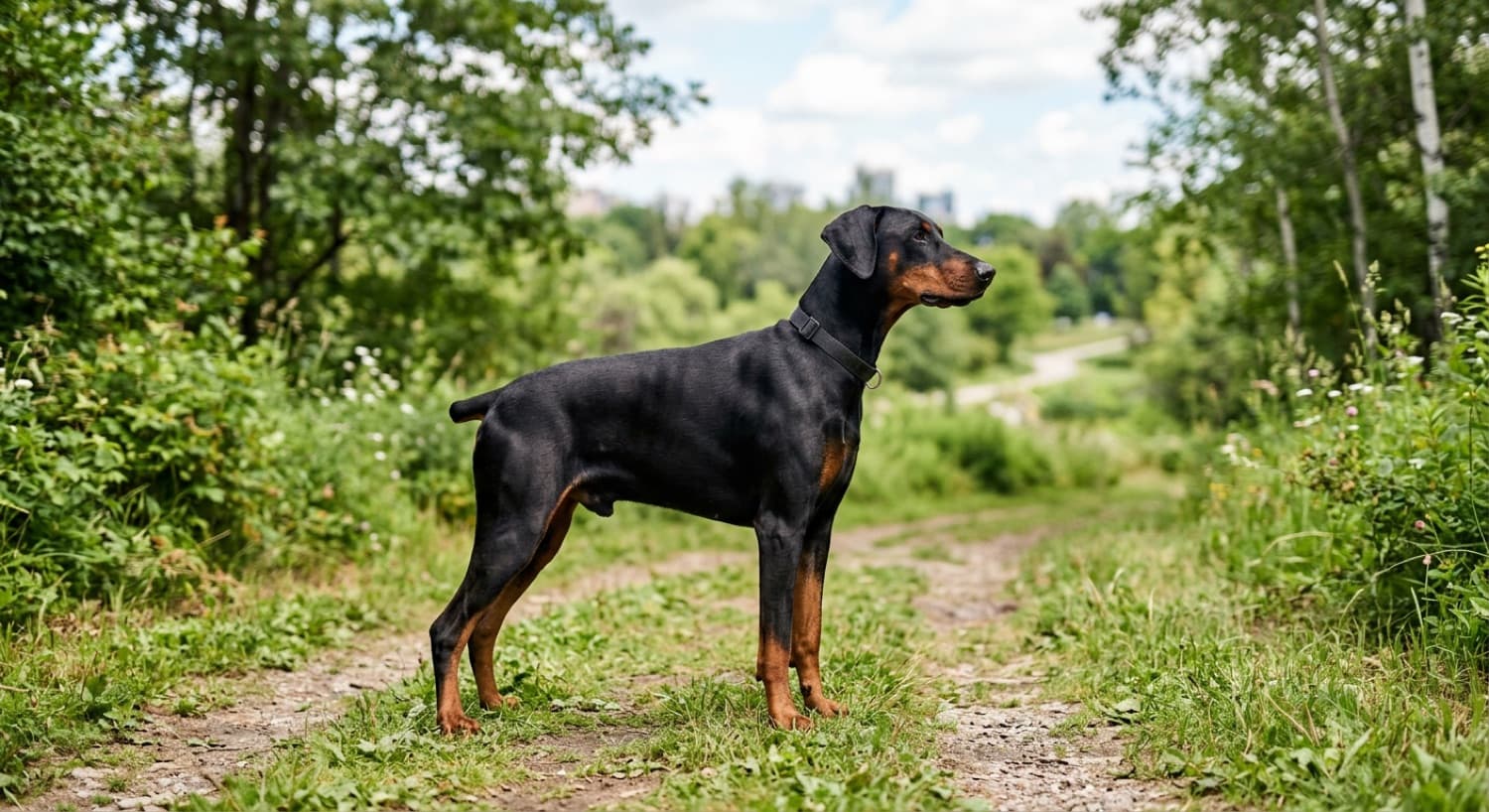
Dilated cardiomyopathy: the breed-defining concern
Dobermans have one of the highest breed predispositions to dilated cardiomyopathy of any dog. DCM is a disease in which the heart muscle weakens and the heart enlarges, which leads to arrhythmias and, over time, heart failure. It can also cause sudden death, sometimes before obvious symptoms appear, which is what makes it so serious. Be accurate about what this means: it is a very high breed risk, not a certainty, and not every Doberman develops it.
The reason DCM leads this guide is that it is often silent in its early stages. A dog can be developing the disease with no outward signs, which is exactly why screening exists. When symptoms do appear, they include coughing, exercise intolerance, laboured or fast breathing, fainting or collapse, and a swollen abdomen. Any of those in a Doberman should be seen by a vet promptly rather than waited out.
What to actually do with this information: (1) adopt from sources that value cardiac screening and ask what is known about the dog's heart; (2) talk to your vet about a cardiac monitoring plan, since many owners of at-risk breeds begin annual screening in middle age; and (3) enrol pet insurance while your Doberman is young and healthy, because cardiac care runs into the thousands and a pre-existing condition is excluded once it appears. The Merck Veterinary Manual explains how dilated cardiomyopathy develops and names the Doberman among the most at-risk breeds, and the AKC Canine Health Foundation funds ongoing research into the disease. The point of leading with the heart is not to scare you off a brilliant breed, but to make sure the decisions that matter most, screening and insuring early, happen before it is too late.
How Doberman heart disease is screened
Because DCM is often silent early, screening aims to catch it before symptoms start. Two tools are commonly used, on a schedule your vet recommends: a Holter monitor and an echocardiogram. Together they look at the heart's rhythm and its structure and pumping, the two things DCM affects.
A Holter monitor is a portable ECG the dog wears at home for 24 hours in a small vest. It records every heartbeat over a normal day, so the vet can spot arrhythmias that a brief in-clinic exam would miss. An echocardiogram is a heart ultrasound, usually done by a veterinary cardiologist, that measures the heart chambers and how well the muscle is pumping. Many owners of at-risk breeds combine the two, often beginning annual screening in middle age.
Screening is a genuine ongoing cost, so build it into your budget alongside insurance rather than treating it as a surprise. Let your vet set the right schedule for your individual dog, since it depends on age, family history where known, and anything found on exam. The value is real: catching DCM early, while a dog still feels well, gives the most options for medication and management and is the whole reason the monitoring plan exists.
Von Willebrand disease
Von Willebrand disease (vWD) is the most common inherited bleeding disorder in dogs, and Dobermans are one of the breeds most strongly associated with it. It is caused by a shortage of a protein needed for normal blood clotting, so an affected dog can bleed more than expected from an injury or surgery. The key point: it is DNA-testable, and it matters most before any planned surgery.
In practice, most dogs with vWD live entirely normal lives, and the disorder is manageable with awareness. The risk shows up around bleeding events: a spay or neuter, a dental extraction, or an injury. Because a DNA test can tell you a dog's status, it is worth knowing before any procedure so your vet can take precautions if needed, such as having clotting support on hand.
If you are adopting a Doberman, ask the rescue whether the dog has been tested for vWD, and either way mention the breed association to your vet before any surgical or dental procedure. It is a simple heads-up that lets the veterinary team plan, and it is exactly the kind of breed-specific detail that pays off when it counts.
Wobbler syndrome
Wobbler syndrome, also called cervical vertebral instability, is a condition of the neck in which the vertebrae and discs compress the spinal cord. Dobermans are one of the breeds most over-represented for it. The classic sign is in the name: a wobbly, unsteady gait, usually starting in the hind legs, often with neck pain or reluctance to move the neck.
The signs can come on gradually and overlap with other neurological and orthopedic problems, so they are easy to misread at first. Watch for wobbliness or swaying in the back end, weakness, scuffing or dragging of the nails, a short or stilted stride in the front legs, and any sign of neck stiffness or pain. Because those signs are not specific, the right move is a veterinary exam rather than guessing.
Your vet may refer to a veterinary neurologist for imaging to confirm what is happening. Treatment ranges from medical management, rest, and a harness instead of a neck collar in milder cases, up to surgery in more serious ones. As with the breed's other conditions, the message is awareness and early assessment, not alarm, and catching it early tends to give the best outcome.
Bloat, hips, thyroid, liver, and coat
Bloat (GDV). As a deep-chested breed, the Doberman is at higher risk of gastric dilatation-volvulus, where the stomach fills with gas and can twist. It is a fast, life-threatening emergency: a swollen abdomen, unproductive retching, restlessness, and drooling mean an emergency vet immediately. Know these signs cold, since bloat progresses fast; the AVMA pet care resources are a good general reference. Some owners discuss a preventive gastropexy with their vet, and feeding smaller meals with no hard exercise right after eating is a common precaution.
Hip dysplasia. This developmental joint condition, which can lead to arthritis, is seen in the breed as in most large dogs. Reputable breeders clear the parents through the OFA, and with a rescue Doberman you usually will not have those results, so watch for limping, stiffness after rest, or reluctance on stairs. The single most powerful thing you control is weight: keeping a Doberman lean dramatically reduces the load on the joints.
Hypothyroidism. An underactive thyroid is common in the breed and shows up as weight gain, low energy, or coat and skin changes. It is diagnosed with a simple blood test and managed well with an inexpensive daily medication, so it is very much a manageable condition rather than a crisis.
Chronic active hepatitis (copper-associated liver disease). This liver condition, in which copper accumulates and damages the liver, is associated with the breed. Signs can be vague early (reduced appetite, weight loss, lethargy), so routine bloodwork at vet check-ups helps catch changes; mention anything unusual to your vet.
Colour-dilution alopecia (blue and fawn Dobermans). Dilute-coloured Dobermans can develop colour-dilution alopecia, a genetic condition causing thinning hair and skin problems over the dilute-coloured areas. It is a coat and skin issue rather than a life-threatening one, but affected dogs may need ongoing skin care, so ask your vet about a management routine if your dog is a dilute colour.
The Doberman health profile at a glance
| Concern | What it is | What helps |
|---|---|---|
| Dilated cardiomyopathy | Heart muscle weakens and enlarges, can be silent | Cardiac screening (Holter, echo), insure early, watch for coughing or fainting |
| Von Willebrand disease | Inherited bleeding disorder, matters before surgery | DNA test, tell your vet before any procedure |
| Wobbler syndrome | Neck spinal-cord compression, wobbly gait | Vet exam, neurology referral, harness not collar |
| Bloat (GDV) | Deep chest, stomach can twist. Emergency | Know the signs, emergency vet, discuss gastropexy |
| Hips / thyroid / liver | Hip dysplasia, hypothyroidism, copper hepatitis | Keep lean, blood tests, routine check-ups |
| Colour-dilution alopecia | Coat and skin condition in blue and fawn dogs | Skin care routine as your vet advises |
Should I get pet insurance for my Doberman?
For a Doberman, yes, and the timing is everything. Between the elevated risk of dilated cardiomyopathy, plus von Willebrand disease, wobbler syndrome, bloat, thyroid, and joint conditions, the lifetime odds of a big vet bill are higher than for many breeds, and cardiac care, neurology, and emergency surgery all run into the thousands. Ontario pet insurance for a young, healthy Doberman commonly runs roughly $60 to $110 per month, often at the higher end because insurers factor in the cardiac risk, and that risk is exactly what makes insurance genuinely worthwhile here.
The rule that catches everyone: anything already present becomes a pre-existing condition and is excluded, so a policy taken out the week you adopt a healthy young Doberman covers vastly more than one bought after the first cough, faint, or wobble. Compare a few Ontario providers on annual and per-condition limits, deductibles, reimbursement percentage, and whether they cover the things a Doberman is prone to, and enrol while your dog is healthy. Separately, budget for cardiac screening (Holter and echocardiogram) as a real ongoing cost that most insurers treat as routine or preventive rather than covered, so plan for it directly.
Between insurance premiums, cardiac monitoring, and routine care, budget roughly $2,500 to $4,500 per year for a Doberman in Toronto. To keep the routine costs down so your budget is free for the heart and the emergencies, see our guides to low-cost vet options in Toronto, affordable spay and neuter, and the full cost of adopting in Toronto.
Ready to meet a Doberman?
Browse adoptable Dobermans and Dobie mixes from Toronto rescues. A rescue can tell you what a specific dog's health has looked like in foster, including anything a vet has flagged about the heart. Refreshed regularly.
See Available Dobermans →Frequently Asked Questions
What is the most common health problem in Dobermans?
Dilated cardiomyopathy (DCM) is the breed-defining health concern, and the single most important thing to understand about the breed. DCM is a disease in which the heart muscle weakens and the heart enlarges, which leads to irregular heartbeats (arrhythmias) and, over time, heart failure. It can also cause sudden death, sometimes before any obvious symptoms appear, which is what makes it so serious. Dobermans have one of the highest breed predispositions to DCM of any dog. This is not a reason to avoid the breed, but it is the reason to adopt from sources that value screening, to talk to your vet about cardiac monitoring as your dog reaches middle age, and to enrol pet insurance early. Beyond the heart, the breed also sees von Willebrand disease (a bleeding disorder), wobbler syndrome, hip dysplasia, hypothyroidism, and bloat. Your vet is the right person to build a monitoring plan for your specific dog.
Do all Dobermans get heart disease?
No. It is important to be accurate here: Dobermans have an elevated breed risk of dilated cardiomyopathy compared with most other breeds, but not every Doberman develops it, and plenty live full lives without heart failure. The elevated risk is exactly why cardiac screening and early insurance matter so much for this breed. DCM is often silent in its early stages, so the goal is not to panic but to monitor: talk to your vet about when screening makes sense, watch for signs like coughing, exercise intolerance, fainting, or laboured breathing, and act quickly if you see them. Treat the risk as a reason to plan and monitor, not as a certainty or a reason to pass over a wonderful breed.
How is Doberman heart disease screened, and what is a Holter monitor?
Because dilated cardiomyopathy is often silent early, screening aims to catch it before symptoms appear. Two tools are commonly used, on a schedule your vet recommends. A Holter monitor is a portable ECG the dog wears at home for 24 hours, recording every heartbeat so the vet can spot arrhythmias that a brief in-clinic exam would miss. An echocardiogram is a heart ultrasound that a veterinary cardiologist uses to measure the heart chambers and how well the muscle is pumping. Many owners of at-risk breeds begin annual cardiac screening in middle age, often combining a Holter with periodic echocardiograms. Screening is a real ongoing cost, so budget for it, and let your vet set the right schedule for your individual dog. Catching DCM early gives the most options for medication and management.
What is von Willebrand disease in Dobermans?
Von Willebrand disease (vWD) is the most common inherited bleeding disorder in dogs, and Dobermans are one of the breeds most strongly associated with it. It is caused by a shortage of a protein needed for normal blood clotting, so an affected dog can bleed more than expected from an injury, a spay or neuter, or other surgery. The important practical points: vWD is DNA-testable, so a dog can be tested to know its status, and it matters most before any planned surgery, because your vet can take precautions if your dog is affected. Many dogs with vWD live normal lives and the disorder is manageable with awareness. If you are adopting a Doberman, ask whether the dog has been tested, and mention the breed association to your vet before any surgical procedure.
What is wobbler syndrome in Dobermans?
Wobbler syndrome, also called cervical vertebral instability or cervical spondylomyelopathy, is a condition of the neck in which the vertebrae and discs compress the spinal cord. Dobermans are one of the breeds most over-represented for it. The name comes from the classic sign: a wobbly, unsteady, drunken-looking gait, usually starting in the hind legs, along with neck pain or a reluctance to move the neck. It can come on gradually. Because the signs overlap with other neurological and orthopedic problems, any wobbliness, weakness, dragging of the nails, or neck stiffness should be assessed by your vet, who may refer to a veterinary neurologist for imaging. Treatment ranges from medical management and rest to surgery in more serious cases. Early assessment gives the best outcome.
Are Dobermans prone to bloat?
Yes. Bloat, or gastric dilatation-volvulus (GDV), is a life-threatening emergency in which the stomach fills with gas and can twist, and deep-chested breeds like the Doberman are at higher risk. Signs include a swollen or distended abdomen, unproductive retching (trying to vomit with nothing coming up), restlessness, drooling, and obvious distress. It comes on fast and needs an emergency vet immediately, not in the morning. Some owners of at-risk breeds discuss a preventive gastropexy, a surgery that tacks the stomach to prevent twisting and is sometimes done at the same time as spay or neuter, with their vet. Feeding smaller meals and avoiding hard exercise right after eating are commonly suggested precautions. Ask your vet what is right for your dog.
Do Dobermans have thyroid or other health issues?
Yes, a few others round out the picture. Hypothyroidism, an underactive thyroid, is common in the breed and shows up as weight gain, low energy, or coat and skin changes; it is diagnosed with a simple blood test and managed well with an inexpensive daily medication, so it is very much a manageable condition. Hip dysplasia, a developmental joint condition, is also seen and is best protected against by keeping your dog lean. Blue and fawn (dilute-coloured) Dobermans can develop colour-dilution alopecia, a genetic coat and skin condition that causes thinning hair and skin problems over the dilute-coloured areas. Chronic active hepatitis, a copper-associated liver disease, is also associated with the breed. Routine vet exams and prompt attention to anything unusual are the throughline for all of them.
How long do Dobermans live?
Dobermans commonly live around 10 to 12 years. Lifespan is influenced by genetics, especially the breed heart risk, but also strongly by things you control: keeping your dog lean, regular sensible exercise, good dental care, staying current on vet check-ups and any recommended cardiac screening, and catching problems early. Because dilated cardiomyopathy is the biggest factor in the breed, a monitoring plan built with your vet is one of the most valuable things you can do. If you are adopting an adult or senior Doberman, go in clear-eyed about the heart risk and possible medical costs, but know that a well-cared-for Doberman with attentive owners and prompt veterinary care has the best odds of a full life.
Is pet insurance worth it for a Doberman?
For a Doberman, it is one of the best decisions you can make, and enrolling early is everything. The breed carries an elevated risk of dilated cardiomyopathy, plus von Willebrand disease, wobbler syndrome, bloat, thyroid, and joint conditions, so the lifetime odds of a significant vet bill are higher than for many breeds, and cardiac care, neurology, and emergency surgery all run into the thousands. Ontario pet insurance for a young, healthy Doberman commonly runs roughly $60 to $110 per month, often at the higher end because insurers factor in the cardiac risk. The catch that catches everyone: anything already present becomes a pre-existing condition and is excluded, so a policy taken out while your Doberman is young and healthy covers vastly more than one bought after the first symptom appears. On top of insurance, budget for cardiac screening (Holter and echocardiogram) as a real ongoing cost, and enrol while your dog is healthy.
What should I ask about a rescue Doberman's health?
Ask the foster or rescue what they have observed day to day: any coughing, fainting, or exercise intolerance (which can hint at a heart issue), any wobbliness or weakness in the legs, unusual bleeding or bruising, weight and appetite, coat or skin problems, and whether a vet has flagged anything. Ask for the vet records from the rescue intake exam, including whether a heart murmur was heard, whether the dog has been tested for von Willebrand disease, and what vaccinations and bloodwork were done. Then book your own vet visit soon after adoption to establish a baseline, and ask about a sensible cardiac monitoring plan given the breed. Reputable Toronto rescues are upfront about known issues, and a foster who has lived with the dog is a valuable source of honest information.
The full Doberman cluster
Doberman Adoption in Toronto
Where to adopt, real costs, the guardian-breed reality, and the housing and insurance considerations.
Doberman Temperament & Training
The velcro-dog temperament, socialisation, life with kids and pets, and training a smart, sensitive breed.
Adoptable Dobermans in Toronto
All currently available Dobermans and Dobie mixes. Updates regularly.
Low-Cost Vet Options in Toronto
Keep routine care affordable so your budget is free for cardiac screening and emergencies.
New dog? Start with these care guides
Everything a new adopter needs to set up a safe, happy home.