The short answer
A well-bred, well-socialised, well-trained Doberman is brilliant, loyal, affectionate, and profoundly bonded to its people, the classic “velcro dobe” that wants to be part of everything. The breed is alert and naturally protective, which is not the same as aggressive; a stable Doberman is discerning, not reactive. That intelligence and sensitivity is exactly why early and ongoing socialisation plus consistent, force-free training are non-negotiable, and why this breed needs real exercise and company, never isolation. Temperament depends far more on genetics, socialisation, and training than on the breed label. One Toronto step: Dobermans are fully legal in Ontario, but some landlords, condo boards, and insurers restrict the breed privately, so confirm your housing and insurance before you commit. This is a committed owner's dog, and it rewards that commitment enormously.
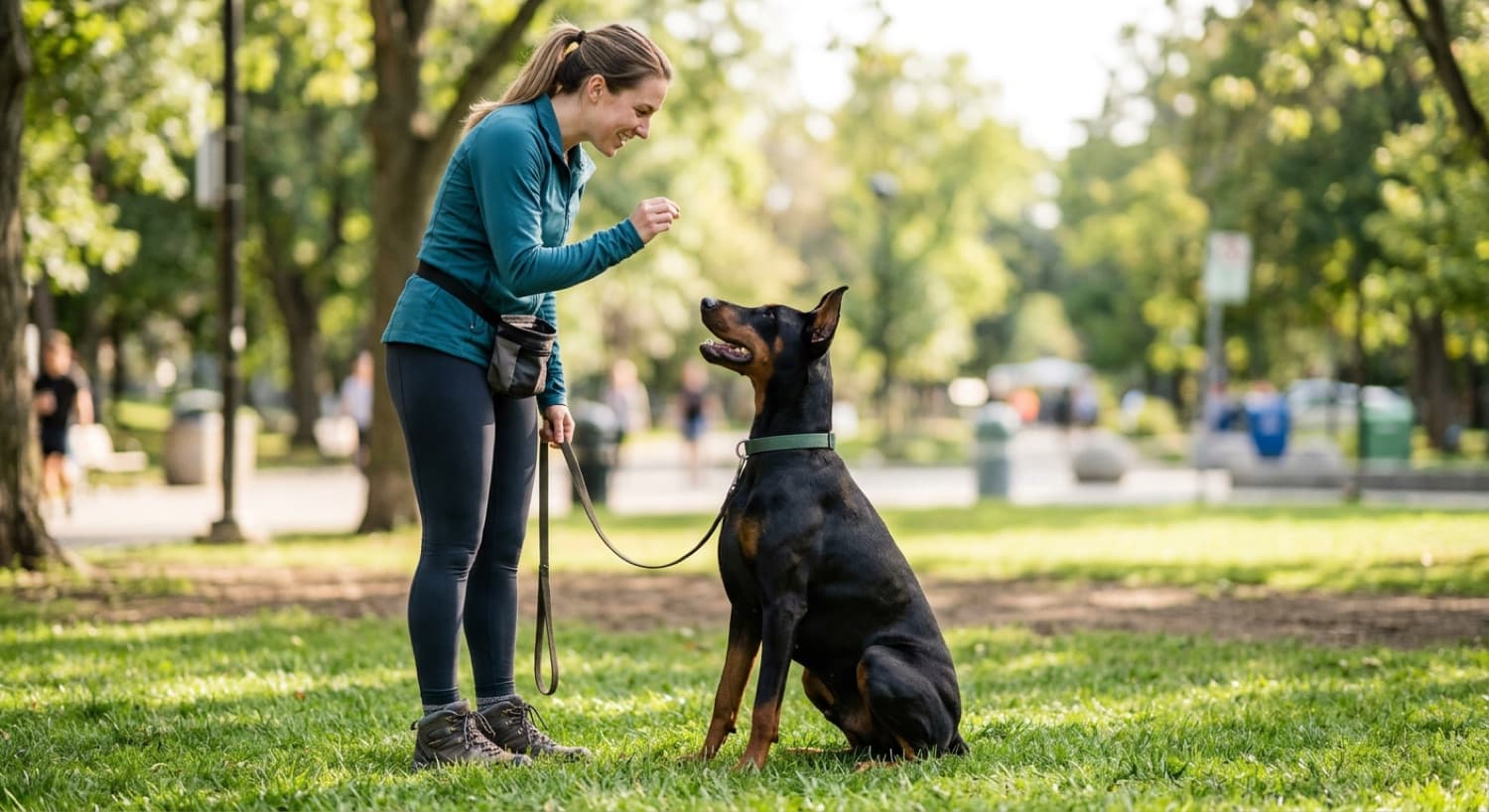
The real Doberman temperament
The Doberman is a highly intelligent, energetic, deeply people-bonded dog, loyal and affectionate with its family and naturally alert and watchful, not fearful, not needlessly aggressive, but protective. A well-raised Doberman is steady and discerning, and often surprisingly goofy and velcro-close with its own people.
That people-bonded, protective nature is why how a Doberman is raised matters so much. A confident, well-socialised Doberman is discerning and settled; an under-socialised, poorly bred, or isolated one can become fearful, anxious, or reactive, which is where problems begin. It helps to draw a clear line: natural watchfulness and alertness are normal breed traits, while unstable, reactive aggression is not, and it usually traces back to fear, poor breeding, or missing socialisation rather than to the breed itself. The old image of the Doberman as a snarling attack dog owes far more to decades of movie casting than to the temperament of a properly raised modern Doberman. The Canadian Kennel Club breed profile describes exactly this loyal, alert, intelligent companion. The temperament you end up with depends heavily on genetics, socialisation, and training, far more than on the breed name, which means a committed owner has enormous influence over how their Doberman turns out.
One trait worth naming: the Doberman is a sensitive breed that genuinely needs to be with its people. This is not a dog that thrives alone in a yard or crated all day. A Doberman left isolated or under-stimulated commonly develops separation anxiety and problem behaviours, so companionship is not a nice-to-have, it is a core need of the breed.
Socialisation is non-negotiable
For an alert, protective breed, a stable temperament is largely built, not just born. Early and ongoing positive socialisation, meaning exposure to many people, dogs, places, sounds, and situations, teaches a Doberman that the world is normal, producing a discerning, settled adult rather than a fearful or reactive one.
Crucially, socialisation does not end at puppyhood; keep up positive experiences throughout the dog's life. A busy city like Toronto is full of useful exposure, sidewalks, streetcars, elevators, other dogs, and crowds, but only if you introduce it gradually and pair it with good things, never by flooding a nervous dog. Early socialisation is what keeps a Doberman's natural watchfulness stable, so it stays a discerning guardian rather than tipping into reactivity toward strangers or other dogs. For an adopted adult Doberman of unknown history, work at the dog's pace, build positive associations gradually, and get professional help early if you see fear or reactivity rather than hoping it fades. Good socialisation, alongside training, is the single biggest factor in whether a Doberman lives up to its best reputation or its worst. If your Doberman is newly adopted, our first-week guide covers the decompression period.
Training a brilliant, sensitive breed, force-free
The Doberman is one of the most intelligent and trainable breeds there is, which is a gift and a responsibility: a brilliant, sensitive dog with no training is a genuinely poor combination. The good news is that Dobermans are eager to work with their people, and they respond beautifully to positive, reward-based training and badly to harsh or heavy-handed methods, which damage the trust this sensitive breed depends on.
Skip the old “dominance” and aversive-tool advice entirely. It backfires hardest with a sensitive, thinking breed like the Doberman, where a dog trained through intimidation learns to distrust the very people it should feel safe with. Modern behaviour science favours force-free, reward-based methods, and organisations like the Fear Free movement have shifted professional training toward building trust rather than suppressing behaviour through fear.
Focus on solid foundations: a reliable recall, loose-leash walking (genuinely important for a strong dog on a busy Toronto street), impulse control, and a calm, mannerly response to visitors. This is a highly intelligent breed, so mental work is as important as physical exercise: training games, puzzle work, and jobs for the mind keep a Doberman balanced and out of trouble. Be ready for an intense adolescence: the teenage months test everyone's consistency, and staying calm and steady through them is what produces a settled adult. Keep sessions engaging and consistent across the whole household, and build the manners early while the dog is easier to manage. A trained, well-mannered Doberman is a joy and an ambassador for the breed. A Toronto force-free trainer experienced with working breeds is a worthwhile investment, especially for a first-time large-breed owner.
Family life, kids, and other pets
With children. Well-raised Dobermans are often gentle, patient, and protective with their own family's kids, and the breed's deep bond to its people usually extends to the children in the home. But their size and enthusiasm mean you always supervise interactions with small children and teach kids to respect the dog, exactly as with any large breed, since even a friendly dog can knock over a toddler. A calm adult Doberman with a known temperament is often a better fit for a home with very young children than a boisterous adolescent.
With other pets. It varies by individual dog and socialisation. Many Dobermans live happily with other dogs and cats, especially when raised together, though some show same-sex tension with other dogs, and a strong, energetic dog's play can overwhelm a small one. Gradual, positive introductions matter, and so does managing shared off-leash time carefully while a new dog settles (our off-leash parks guide covers Toronto's options). This is a great question to ask a foster-based rescue, which has seen a specific Doberman around kids and animals, so tell them about your household and resident pets and let them help you match.
Legal in Ontario, but confirm your housing and insurance
Dobermans are fully legal to own and adopt in Toronto and across Ontario. The province's Dog Owners' Liability Act restricts pit-bull-type dogs, not Dobermans. The catch is private, not legal: some Toronto condo boards, landlords, and insurers restrict the breed on their own, so this is the one step to handle before you adopt.
In practice, three things can trip up a Toronto Doberman adopter, especially a renter or condo owner. Some condo corporations and landlords name large or guardian breeds in their pet rules or leases. Some home and tenant insurance policies exclude or surcharge Dobermans, which commonly appear on insurer restricted-breed lists. And in a rented or condo home, a lease violation over a dog can put both your housing and your adoption at risk. None of this is a bylaw or a ban; it is private policy, fine print that varies building by building and insurer by insurer.
So confirm it first. Read your lease or your condo's pet rules, ask your property manager in writing if you are unsure, and check with your insurer whether the breed is covered or surcharged before you fall in love with a specific dog. Beyond breed rules, Toronto has standard municipal requirements every dog owner meets (licensing, leash rules, and the like), which our Toronto dog bylaws guide walks through. A responsible rescue will usually ask about your housing situation as part of matching, precisely because they want a placement that lasts. If you rent or live in a condo, our apartment adoption guide covers making a larger breed work in shared housing.
Exercise, company, and is a Doberman right for you?
Dobermans need real daily exercise and, just as importantly, company, around an hour or more of walks, off-leash running where allowed, and active play, plus training and mental engagement for a very sharp mind. But the piece owners underestimate is companionship: this is a people-bonded breed that does poorly when isolated, and an under-exercised, under-stimulated, or lonely Doberman commonly develops anxiety and problem behaviours. If you work long hours, plan for a dog walker, daycare, or another arrangement so the dog has an outlet and company. One practical Toronto note: the Doberman's thin single coat means it feels the cold, so it is an indoor dog that needs a coat for winter walks, never a dog to leave outside.
Be honest about the match. A Doberman suits a committed, active owner or family who will invest in socialisation and positive training, provide daily exercise and mental work, keep the dog as a genuine part of the household rather than isolating it, and has confirmed their housing and insurance allow the breed. It is a poor fit for someone wanting a hands-off pet or who is away from home for very long hours. First-time owners can absolutely succeed if they go in fully committed and get guidance, and an adult Doberman from a rescue, whose temperament is a known quantity, is a much safer starting point than a puppy. Responsible ownership, socialisation, and training are what make the Doberman the stable, devoted companion it is bred to be. Meet the commitment, and few breeds are more loyal. If you are still weighing the decision, our Toronto adoption guide walks through the whole process.
Ready to meet a Doberman?
Browse adoptable Dobermans and Dobie mixes from Toronto rescues. A foster-based rescue can tell you a specific dog's temperament, training, and how it does with kids and other pets, which is exactly what makes a great match for this breed. Refreshed regularly.
See Available Dobermans →Frequently Asked Questions
Are Dobermans good family dogs?
Yes, for the right family. A well-bred, well-socialised, well-trained Doberman is typically loyal, affectionate, and profoundly bonded to its people, and many are gentle and patient with the children in their own home. The nickname "velcro dobe" is earned: this is a dog that wants to be with its family, in the house, part of everything. The honest caveats are commitment and needs: this is an intelligent, energetic, people-oriented breed that does badly when isolated or under-stimulated, so it needs an owner who will invest in socialisation, positive training, exercise, and companionship. Match the breed to an active, involved household and a Doberman is a devoted family companion. It is not a dog you can leave in the yard and ignore, and understanding that before you adopt is the whole point.
Are Dobermans aggressive?
A well-bred, well-socialised Doberman is not naturally aggressive. The breed is alert, watchful, and naturally protective of its family, which is different from aggression: a stable Doberman is discerning rather than reactive, and its reputation as a fierce attack dog is largely a legacy of old media portrayals rather than the temperament of a properly raised modern Doberman. What produces problems is the same as with any powerful breed: poor breeding, missing socialisation, fear, or an isolated, under-stimulated dog left to develop anxiety and reactivity. A Doberman raised with good socialisation and positive training is typically a steady, deeply loyal companion. Its behaviour comes down to genetics, socialisation, training, and responsible ownership far more than the breed label. Note that Dobermans are fully legal in Ontario; only pit-bull-type dogs are restricted under the Dog Owners' Liability Act.
Are Dobermans banned in Ontario?
No. Dobermans are completely legal to own and adopt in Toronto and across Ontario. The province's Dog Owners' Liability Act restricts pit-bull-type dogs, not Dobermans, so there is no breed ban or legal restriction on the Doberman itself. The catch is private, not legal. Some Ontario landlords and Toronto condo corporations restrict large or guardian breeds in their leases or building rules, and some home and tenant insurance policies exclude or surcharge certain breeds, and Dobermans commonly appear on those restricted-breed lists. None of that is a law or a ban, but it can determine where you can live and what you pay for insurance, so it is worth confirming before you adopt. On the municipal side, Toronto's standard dog rules (licensing, leashing, responsible ownership) apply to every dog regardless of breed.
Can I rent with a Doberman in Toronto?
Often yes, but confirm the specifics before you commit to a dog. Dobermans are legal everywhere in Ontario, so the question is not the law but your building and your insurance. Some Toronto landlords and condo boards name large or guardian breeds in their leases or pet rules, and some home and tenant insurance policies exclude or surcharge Dobermans, which appear on many insurer restricted-breed lists. So do this first: read your lease or your condo's pet rules, ask your property manager in writing if you are unsure, and check with your insurer whether the breed is covered or surcharged. A lease or insurance surprise after you have fallen in love with a specific dog is exactly the situation to avoid. A responsible rescue will usually ask about your housing as part of matching, precisely because they want a placement that lasts.
How do you train a Doberman?
With positive, reward-based methods, early socialisation, consistency, and plenty of mental work, because a brilliant, sensitive breed responds beautifully to good training and badly to harsh handling. Dobermans are among the most intelligent and trainable of all breeds, genuinely eager to learn and work with their people, so force-free, reward-based training suits them far better than aversive or heavy-handed "dominance" approaches, which can damage the trust this sensitive breed depends on. Start socialisation early and keep it up, so natural watchfulness stays stable rather than tipping into reactivity. Build solid foundations: reliable recall, loose-leash walking (important for a strong dog on busy Toronto sidewalks), impulse control, and a calm response to visitors. Adolescence is intense with this breed, so stay consistent through it. A Toronto force-free trainer experienced with working breeds is a worthwhile investment, especially for a first-time large-breed owner.
Do Dobermans do okay in a condo or apartment?
They can, with the right commitment, though it takes more work than a low-energy breed. A Doberman does not need acreage, but it does need real daily exercise, mental engagement, and above all company, since this is a people-bonded breed that struggles when left alone for long stretches. In a Toronto condo or apartment that means committing to a real exercise routine (long walks, off-leash time where allowed, training games), managing barking and building manners for shared hallways and elevators, and arranging company or a dog walker if you work long hours. The thin single coat also means a Doberman feels the cold, so it is an indoor dog that needs a coat for Toronto winter walks. Confirm your building allows the breed first. Done right, a well-exercised, well-trained Doberman settles calmly indoors and makes a good apartment companion.
Are Dobermans good with kids?
Well-raised Dobermans are often gentle, patient, and protective with their own family's children, and the breed's deep bond to its people usually extends to the kids in the home. As with any large, powerful dog, you always supervise interactions with small children and teach kids to respect the dog, since size and enthusiasm alone can overwhelm a toddler even from a friendly dog. Early socialisation matters: a Doberman raised around children, with positive experiences and clear house manners, generally does very well in a family. A calm adult Doberman from a rescue, whose temperament around kids is a known quantity, is often a better fit for a home with very young children than a boisterous adolescent. Ask a foster-based rescue what they have seen of a specific dog around children, and let them help you match to your household.
How much exercise and company does a Doberman need?
A lot of both, and the company matters as much as the exercise. Plan for around an hour or more of real daily exercise, walks, off-leash running where allowed, and active play, plus training and mental work to satisfy a very intelligent mind. But the piece owners underestimate is companionship: the Doberman is a deeply people-bonded breed that does poorly when isolated, and an under-exercised, under-stimulated, or lonely Doberman commonly develops anxiety and problem behaviours. This is not a dog to leave alone in a yard or crated all day. It wants to be with its family and involved in daily life. If you work long hours, plan for a dog walker, daycare, or another arrangement so your Doberman has company and an outlet. Meet those needs and you get a calm, balanced, devoted companion.
Is a Doberman the right dog for me?
Be honest with yourself, because this is a breed where the match really matters. A Doberman suits a committed, active owner or family who will invest in socialisation and positive training, provide real daily exercise and mental work, keep the dog as a genuine part of the household rather than isolating it, and has confirmed their housing and insurance allow the breed. It is a poor fit for someone wanting a low-effort, hands-off pet, someone away from home for very long hours, or anyone who cannot commit to the training and company the breed needs. First-time owners can succeed with a Doberman if they go in fully committed and get professional guidance, and an adult Doberman from a rescue, whose temperament is a known quantity, is a much safer starting point than a puppy. Meet the commitment and few breeds are more devoted.
The full Doberman cluster
Doberman Adoption in Toronto
Where to adopt, real costs, the working-breed reality, and where to find a rescue Dobie.
Doberman Health Issues
Heart disease (DCM), von Willebrand's, joints, bloat, and why insuring early matters for the breed.
Adoptable Dobermans in Toronto
All currently available Dobermans and Dobie mixes. Updates regularly.
Apartment Dog Adoption in Toronto
Making a larger breed work in a Toronto condo or rental: exercise, manners, and building rules.
New dog? Start with these care guides
Everything a new adopter needs to set up a safe, happy home.