The honest version
Most online guides promise potty training in 2 weeks. For a Chihuahua in Calgary, that is fantasy. Tiny bladders mean 8 to 12 pee trips a day. Anxious temperaments shorten hold time. Cold and rain refusal is normal, not defiance. Owners regularly miss the small “I need to go” signal until it is too late. A realistic Chihuahua housetraining timeline is 6 to 12 months for reliable success, with weather and stress setbacks along the way. The good news is that a clear plan (indoor pad always available, outdoor practice in mild months, force-free rewards, enzyme cleanup, no punishment ever) gets nearly every Chihuahua there eventually. This guide is the patient version.
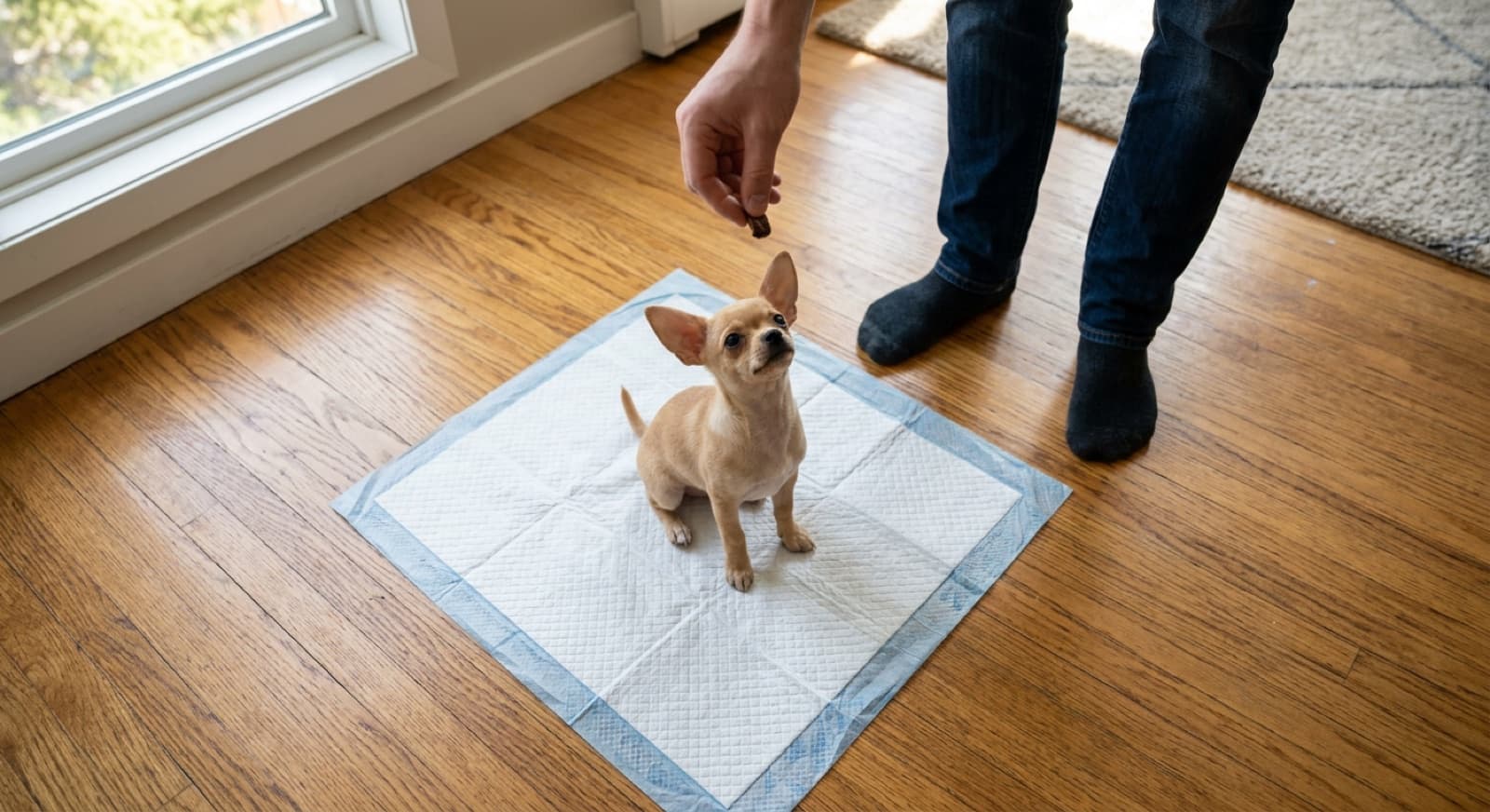
Why Chihuahuas are SO hard to housetrain
Reputation is not personality, it is biology. Five real reasons stack against this breed.
1. Tiny bladder, 8 to 12 pee trips a day
A 4 to 6 lb Chihuahua physically holds a fraction of what a 25 lb dog holds. Most Chihuahuas need to pee every 2 to 4 hours during the day, plus on cue after eating, drinking, sleeping, and playing. A puppy under 16 weeks needs a break every 60 to 90 minutes. Compared to a Lab that can hold 6 to 8 hours, the Chihuahua schedule is roughly double the trips. Miss one window and you have an accident, not a training failure.
2. Anxiety bladder
Chihuahuas are a high-strung breed. Stress, noise, visitors, vacuum cleaners, and big dogs all spike cortisol, which shortens hold time. A Chihuahua that normally lasts 4 hours may need to pee in 90 minutes after a stressful event. Submissive and excitement urination are also common. A shy Chihuahua may dribble urine when greeted, picked up, or scolded. This is involuntary, not a housetraining failure.
3. Cold and rain refusal
Chihuahuas have almost no body fat and thin coats. Cold genuinely hurts them. Most Calgary Chihuahuas turn around at the door when snow, ice, salt, or rain is on the ground. Forcing the issue does not teach them, it teaches them that the door means pain. From November through March, the outdoor option often disappears entirely. An indoor pad is not a backup, it is the primary plan during Calgary winter.
4. Subtle pre-potty signals
Big breeds pace, circle dramatically, or scratch at the door. Chihuahuas glance at the door for half a second, take two small steps, or give a brief soft whine. Owners miss it because they are not watching closely enough. By the time the owner notices, the dog has already chosen a corner. Learning the specific signals your Chihuahua uses is the most underrated housetraining skill, and it takes weeks of observation.
5. Owners punish, which makes it worse
Punishment is the single biggest reason a Chihuahua never fully housetrains. Yelling, rubbing the nose in the mess, and scolding all teach the same lesson: peeing near a human is dangerous. The dog learns to hide behind furniture, in a closet, or under the bed instead. Now the human cannot catch and redirect, and the cycle worsens. Force-free training with rewards on the pad or outside is the only method that works on this breed.
The realistic timeline: 6 to 12 months
Most breeds reach reliable housetraining in 4 to 8 weeks. Chihuahuas need 6 to 12 months. Here is what each phase looks like.
Weeks 1 to 4: Foundation
Strict schedule, pee pad always available, outdoor trips every 1 to 2 hours (weather permitting), reward heavily on success. Expect 1 to 3 accidents a day. Enzyme cleaner ready at all times. No punishment. Goal: dog uses pad or outdoors 60 to 70% of the time.
Months 2 to 4: Habit forming
Accidents drop to a few a week if the schedule holds. Dog starts giving clearer pre-potty signals. Outdoor success rate rises in mild weather. Indoor pad still required for winter weeks, evenings, and missed cues. Goal: 80 to 90% success.
Months 5 to 8: Reliability building
Accidents become rare (1 to 2 a month, often weather or stress related). Dog may start asking to go out by sitting at the door or nudging you. Indoor pad still recommended as a backup. Many owners stop here and call it good enough. Goal: 95% success outside extreme weather.
Months 9 to 12: Reliable
30 consecutive days without an accident is the true milestone. Many Chihuahuas hit this between months 9 and 12. Some never fully drop the indoor pad for winter, and that is fine. A Chihuahua that uses an indoor pad reliably is a successfully housetrained dog, not a failure.
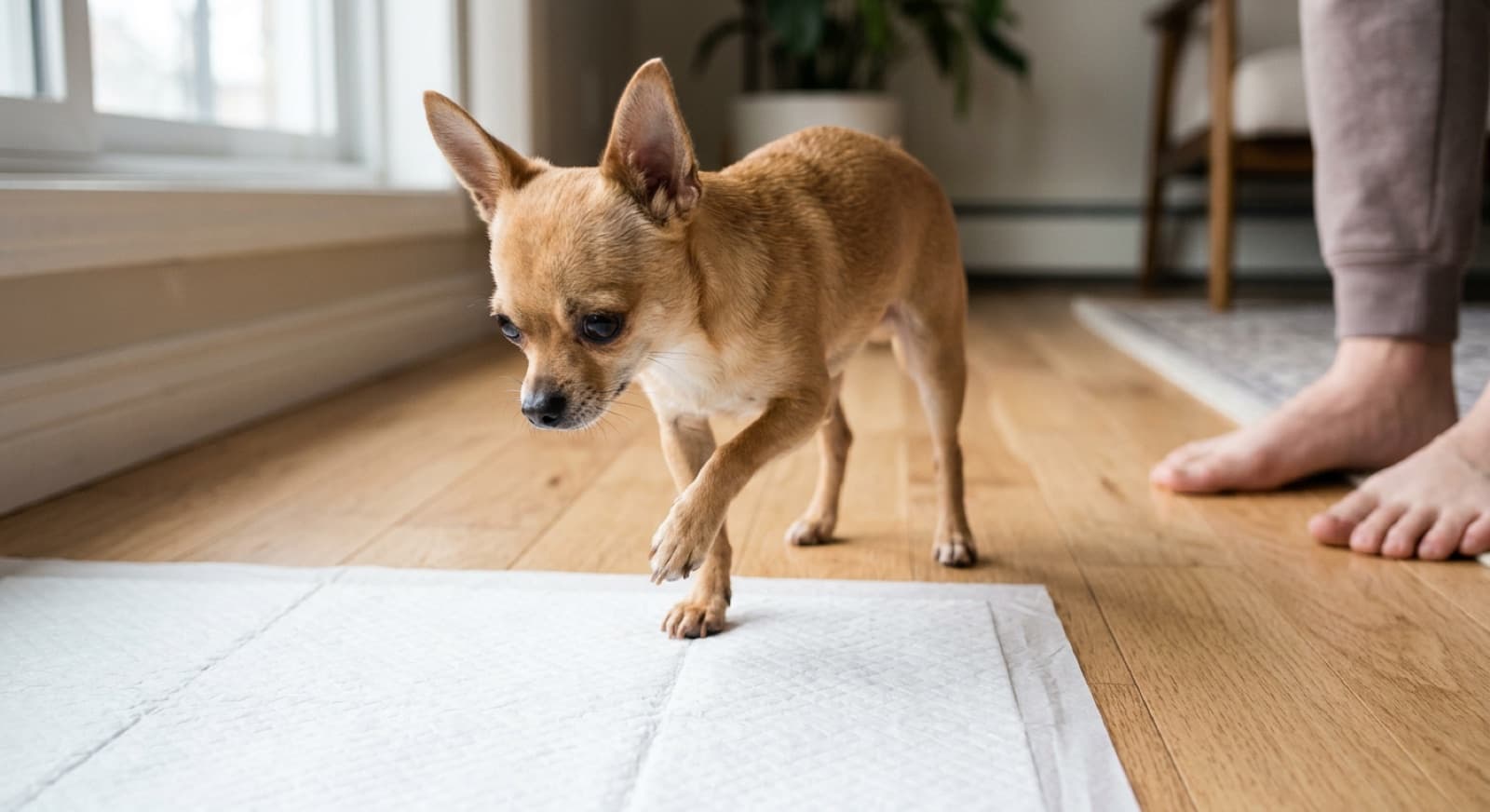
Indoor pee pad protocol
Pee pads are not a fallback, they are a real training tool for this breed. Done properly, they work all year and bridge the winter gap.
Introduce on day one
Place the pad in a low-traffic, easy-access corner near where the dog naturally rests. Avoid the food and water area. If you have a puppy or new rescue, use an exercise pen with the pad on one side and bedding on the other. The dog learns the pad is the bathroom because no other floor surface is accessible.
Reward immediately and heavily
The instant the dog finishes peeing on the pad, deliver a high-value treat (small piece of cooked chicken, cheese, or freeze-dried liver) within 2 seconds. Praise warmly but quietly. Timing matters more than the treat itself. A reward 30 seconds late teaches nothing.
Never punish accidents
If you catch the dog mid-accident, a calm “ah-ah” and immediate carry to the pad is the maximum response. No yelling, no rubbing the nose in it, no scolding after the fact. The dog cannot connect punishment to an act that happened 30 seconds ago. All the dog learns is that you are scary and unpredictable.
Move the pad toward the door slowly
Once the dog reliably uses the pad in its current spot, move it 6 to 12 inches toward the door once a week. If accidents increase, move it back and slow down. Over 2 to 3 months the pad reaches the door, and you can offer outdoor trips first with the pad as a backup. Some Chihuahuas eventually drop the pad entirely. Some keep it forever in winter.
Pad brand matters less than consistency
Most Calgary pet stores carry adequate pads (PetSmart, Pet Valu, Costco, Amazon). Look for a leak-proof backing and an attractant scent. Reusable washable pads are an option if you do a lot of laundry. Replace disposable pads at least daily, or sooner if soiled. A wet old pad smells like a no-go zone to the dog, and they will pick a fresh floor spot instead.
Some of the product links in this section are Amazon affiliate links — we may earn a small commission at no extra cost to you. It never changes which products we recommend.
Outdoor potty in Calgary (April through October)
Outdoor training is realistic for roughly 6 to 7 months of the Calgary year. Here is how to use those months well.
Same spot, every trip
Pick one grass or gravel patch close to your door and use it every single time. The scent builds up and triggers the dog to go faster. Constantly trying new spots resets the learning each time.
Use a verbal cue
As the dog starts to pee, say a consistent word (“go potty,” “bathroom,” whatever you pick). Reward on finish. Over weeks the dog associates the word with the act, which lets you cue them on a rainy walk or before bed.
Carry, do not walk, to the spot
For puppies and new rescues, carry the dog from the door to the potty spot. Walking gives them time to start peeing on the way. Set them down on the grass and wait. If they do not go in 5 to 10 minutes, carry them back inside and try again in 20 minutes.
Stay outside until they go
Bringing the dog back in before they pee teaches them that the trip outside ends in coming inside, which loses the connection. Wait 10 to 15 minutes if needed. If nothing happens, return inside, watch closely, and try again in 15 to 20 minutes.
Calgary winter strategy (November through March)
For four to five months of the year, outdoor potty is unreliable or impossible for most Calgary Chihuahuas. Lean on the indoor option without guilt.
Indoor pad is primary, not backup
Set up two pads in winter. One near the door (for dogs that may still go out occasionally) and one in their main living area. Refresh both daily. A Chihuahua that uses pads reliably all winter and switches to outdoor in spring is a successfully housetrained dog.
Offer outdoor on warm days
When Calgary hits -5C or warmer and the sidewalks are not freshly salted, offer an outdoor trip with a coat and booties. Some Chihuahuas will go. Reward heavily. Do not force on cold days, you will just teach door avoidance.
Watch for salt and ice burns
Calgary sidewalks use calcium chloride and salt. Both crack and burn small paw pads within minutes. Booties or paw wax are essential below freezing. Rinse paws with warm water on return to prevent licking the salt off, which causes vomiting.
A heated indoor potty area helps
Some owners build a small indoor potty zone with washable artificial grass over a tray. It mimics the outdoor feel and transitions back to outdoor easier in spring. PetSmart Calgary and Amazon carry small indoor grass potties for $30 to $60.
Schedule: every 1 to 4 hours plus trigger moments
The schedule is the foundation. Miss it and the dog has no chance.
- Puppies (8 to 16 weeks): potty trip every 60 to 90 minutes, plus all four trigger moments below.
- Puppies (4 to 6 months): every 2 to 3 hours, plus trigger moments.
- Adults (6+ months): every 3 to 4 hours, plus trigger moments.
- Overnight adults: 6 to 8 hours is the maximum healthy stretch. Adjust water cutoff to 2 hours before bed.
The four trigger moments (always offer a potty trip):
- Immediately after eating (within 5 to 15 minutes)
- Immediately after drinking water (within 10 to 20 minutes)
- Immediately after waking from a nap
- Immediately after active play
Missing these four moments causes about 70% of accidents. A timer on your phone for 2 hour potty checks plus reflexive trips after meals and naps is the single highest-leverage tool in housetraining.
Crate training as a housetraining aid
Used properly, a crate accelerates Chihuahua housetraining because most dogs will not soil their sleeping area.
Size the crate correctly
The crate should be just big enough for the dog to stand, turn around, and lie down. Too much extra space lets them pee in one corner and sleep in another. For most adult Chihuahuas a small or extra-small crate (18 to 22 inches long) is correct.
Build positive association
Feed meals in the crate, toss treats in throughout the day, leave the door open so the dog can choose to enter. Never use the crate as punishment. The crate should be a den, not a jail.
Crate time limits
A Chihuahua puppy under 4 months should not be crated more than 2 to 3 hours at a stretch. Adults should not exceed 4 to 5 hours during the day. Overnight 6 to 8 hours is fine once mature. A dog crated longer than they can hold will be forced to soil the crate, which breaks the housetraining benefit.
Pair crate with pad nearby
When you let the dog out of the crate, carry them directly to the pad or outdoors. Do not let them walk through the home first. The bladder is full after crate rest and will empty within 60 seconds. That first post-crate trip is the highest-reward training moment of the day.
Marking, submissive urination, and other special cases
Marking (mostly intact males)
Intact male Chihuahuas mark furniture, walls, and corners with small territorial pees. Neutered males do this far less, females rarely. Belly bands (washable wraps) reduce indoor damage while you address it. If marking starts in a previously trained dog, look for a trigger: a new pet, new visitor, smell of another dog on shoes, or a stressful event.
Submissive and excitement urination
A shy or anxious Chihuahua may dribble urine when greeted, picked up, scolded, or excited. This is involuntary and not a training issue. Punishment makes it worse. The fix is calm low-key greetings (no looming, no high-pitched voices), greet outside or on the pad if possible, and let the dog approach you. Most submissive urination fades by 12 to 18 months as the dog gains confidence.
Adult-rescue regression
Adult-rescue Chihuahuas often regress for 2 to 4 weeks after arrival, even if they were housetrained in their previous home. New environment, new smells, new schedule, separation from familiar humans. Restart from week 1 of the protocol, do not assume previous training carries over. Most adult rescues return to reliable housetraining within 4 to 8 weeks if the schedule and rewards are consistent.
Enzyme cleaners: the most underrated tool
Once a spot smells like urine to a dog, it becomes a permanent bathroom in their mind. Vinegar, soap, and standard carpet cleaners do not remove the uric acid crystals that hold the smell. Only enzymatic cleaners break those down.
What to buy in Calgary:
- Nature's Miracle Advanced Stain and Odor Eliminator (PetSmart, Pet Valu, Tail Blazers, Amazon, $15 to $25)
- Anti-Icky-Poo (Amazon Canada, $30 to $50, stronger for chronic spots)
- Rocco and Roxie Professional Strength Stain and Odor Eliminator (Amazon, $25 to $35)
How to use: blot the spot dry, soak with enzyme cleaner (not spot-treat, soak), let air-dry for 24 to 48 hours, do not vacuum or rub. The enzymes need time to work. Use a UV black light at night to find every old urine spot in your home, and treat all of them. Until odour is fully gone from every spot, those spots remain re-pee targets.
When to see a vet (sudden accidents in trained dogs)
A previously housetrained adult Chihuahua that suddenly starts having accidents needs a vet visit, not more training.
The top medical causes:
- Urinary tract infection (UTI): the most common cause, especially in small female dogs. Symptoms include frequent small accidents, straining, blood in urine, and licking the genital area.
- Bladder stones: Chihuahuas are prone to calcium oxalate stones. Symptoms include painful urination, blood, and small frequent accidents.
- Kidney disease: common in seniors. Symptoms include increased water intake, larger urine volumes, and weight loss.
- Diabetes: increased thirst plus increased urination is a red flag.
- Cushing's disease: older Chihuahuas. Causes excessive thirst and urination.
Behavioural causes (only after medical is ruled out): household stress (new pet, baby, move), schedule disruption, fear of a specific area, or marking after a new dog moves into the home.
Vet timeline: book within 1 to 2 weeks of the first sudden accident. Bring a fresh urine sample if possible (collect in a clean container). A urinalysis runs $50 to $100 at Calgary vets. Do not assume the issue is behavioural until UTI and stones are ruled out.
Looking for a Chihuahua to adopt in Calgary?
Live listings from 15+ Calgary rescues, refreshed regularly. Adult rescue Chihuahuas often arrive partly housetrained and respond well to a consistent restart of the protocol above. Foster notes usually include current housetraining status, indoor pad use, and any known triggers.
See Available Chihuahuas →Frequently Asked Questions
Why are Chihuahuas so hard to potty train?
Tiny bladder, anxious temperament, cold and rain refusal, subtle pre-potty signals, and owner punishment that backfires. A 4 to 6 lb dog physically holds far less than a Lab and needs to pee 8 to 12 times a day. Stress shortens that further. Most Chihuahuas refuse to step into snow, ice, or rain, which in Calgary covers November through March. The signal that they need to go is subtle, often a single glance at the door. And when owners punish accidents, the dog learns to hide to pee instead of going on the pad or outdoors. Each piece is fixable. Stacked together they explain the reputation.
How long does Chihuahua potty training take?
Plan for 6 to 12 months of consistent work. Most breeds reach reliable housetraining in 4 to 8 weeks. Chihuahuas need significantly longer because of bladder size, temperament, and Calgary weather. Some pick it up in 3 to 4 months with strict scheduling. Others, especially shy adult rescues, take a full year. Reliable means 30 consecutive days without an accident, not “mostly good.” Setbacks during weather changes, stress, or schedule disruption are normal.
My Chihuahua refuses to pee outside in Calgary winter. Help.
Completely normal for the breed. Chihuahuas have thin coats, no body fat, and tiny paws that lose heat fast. Calgary sidewalk salt cracks paw pads in minutes. The fix is not to force outdoor trips. Use indoor pee pads as the primary winter option, layer two pads (one near the door, one in the main living area), refresh daily, reward heavily on use. Offer outdoor trips on warmer days (-5C or above) with a coat and booties, and resume outdoor-primary in April when sidewalks dry out. A Chihuahua that uses pads in winter and grass in summer is a successfully housetrained dog.
Are pee pads or outdoor training better?
A combined approach is most realistic for Calgary. Indoor pad always available, outdoor practice in mild months (April through October), pad gradually moved toward the door over weeks. Pure outdoor-only fails because of winter. Pure indoor-only means cleaning pads forever, which many owners are fine with. Decide what works for your household and commit to one plan rather than switching back and forth.
How often do Chihuahuas need to pee?
Puppies under 16 weeks need a break every 60 to 90 minutes. Older puppies (4 to 6 months) every 2 to 3 hours. Adults every 3 to 4 hours during the day, 6 to 8 hours overnight. Always offer a potty trip after eating, drinking, waking from a nap, and active play. Those four trigger moments cause about 70% of missed accidents. A Chihuahua holding 6+ hours during the day is either dehydrated or has a urinary issue.
Why does punishment fail for housetraining?
Punishment teaches the dog to fear peeing near a human, not to hold it. The dog hides behind furniture, in closets, or under beds to pee. The dog refuses to pee on the pad or outdoors while you watch, because peeing near you is now scary. Submissive urination gets worse because anxiety shortens hold time. Force-free training with high-value rewards on the pad or outdoors is the only method that works on this breed. Accidents are cleaned silently with enzyme cleaner, with no reaction toward the dog.
My adult Chihuahua suddenly has accidents. What now?
Sudden accidents in a previously trained adult are a medical signal, not a training failure. Top causes are urinary tract infection, bladder stones, early kidney disease, diabetes, and Cushing's disease. Behavioural causes (household stress, schedule change, marking) only apply after medical is ruled out. Book a vet visit within 1 to 2 weeks of the first sudden accident with a urine sample. Urinalysis runs $50 to $100 at Calgary vets. Do not assume the issue is behavioural until medical causes are cleared.
What enzyme cleaner should I use?
A true enzymatic cleaner, not vinegar or general carpet cleaner. Enzymes break down uric acid crystals that hold the smell. If smell remains, the dog re-pees in the same spot. Calgary options include Nature's Miracle Advanced (PetSmart, Pet Valu, Tail Blazers, $15 to $25), Anti-Icky-Poo (Amazon, $30 to $50, stronger), and Rocco and Roxie (Amazon, $25 to $35). Soak the spot, do not just spot-treat, and let it air-dry for 24 to 48 hours. Use a UV black light at night to find every old spot and treat all of them.
More Chihuahua guides
Chihuahua Adoption Calgary →
Where to find a rescue Chihuahua in Calgary, adoption fees, screening, and the most common surrender reasons.
Is a Chihuahua Right for You? →
Honest 10 truths and 12-question self-assessment built from Calgary rescue patterns. Lifestyle, climate, and budget fit.
Chihuahua Behaviour and Temperament →
What the breed is really like day to day. Velcro tendencies, big-dog attitude, reactivity, and what to expect at home.
Chihuahua Separation Anxiety →
Why Chihuahuas are prone to separation anxiety and the alone-time conditioning plan that actually works.
Chihuahua Biting and Aggression →
Why small dogs bite, the fear-based root cause, and force-free retraining that works without making it worse.
Chihuahua Health Issues →
Patellar luxation, dental disease, heart issues, hypoglycemia, and the breed-specific health profile every adopter should know.
Bringing Home Your Chihuahua →
The first 7 days for a new Chihuahua. Decompression, setup, the 3-3-3 rule, and avoiding common early mistakes.
Senior Chihuahua Adoption →
Why senior Chihuahuas are an underrated adoption choice. Health, costs, lifespan, and what to expect.
Buy or Adopt a Chihuahua? →
Honest cost and ethics comparison between Calgary rescues and Alberta breeders. Backyard breeder red flags included.
Chihuahua Winter Survival →
Coats, booties, indoor exercise, and the full Calgary winter playbook for a breed that hates the cold.
New dog? Start with these care guides
Everything a new adopter needs to set up a safe, happy home.