The compassionate framing
Chihuahuas have one of the highest rates of separation anxiety of any small breed. Three forces stack up: centuries of breeding for constant companionship, a small-dog lifestyle that means they are almost always with their person, and a Calgary rescue population that often carries trauma from hoarding, surrender, or repeated rehoming. None of this is the dog's fault. None of it is your fault as an adopter. It is breed history, lifestyle reality, and personal history meeting in one tiny body. The honest recovery timeline is 6 to 18 months of patient gradual work, not a 4-week fix. This guide is the prevention plan, the rehabilitation plan, and the budget reality.
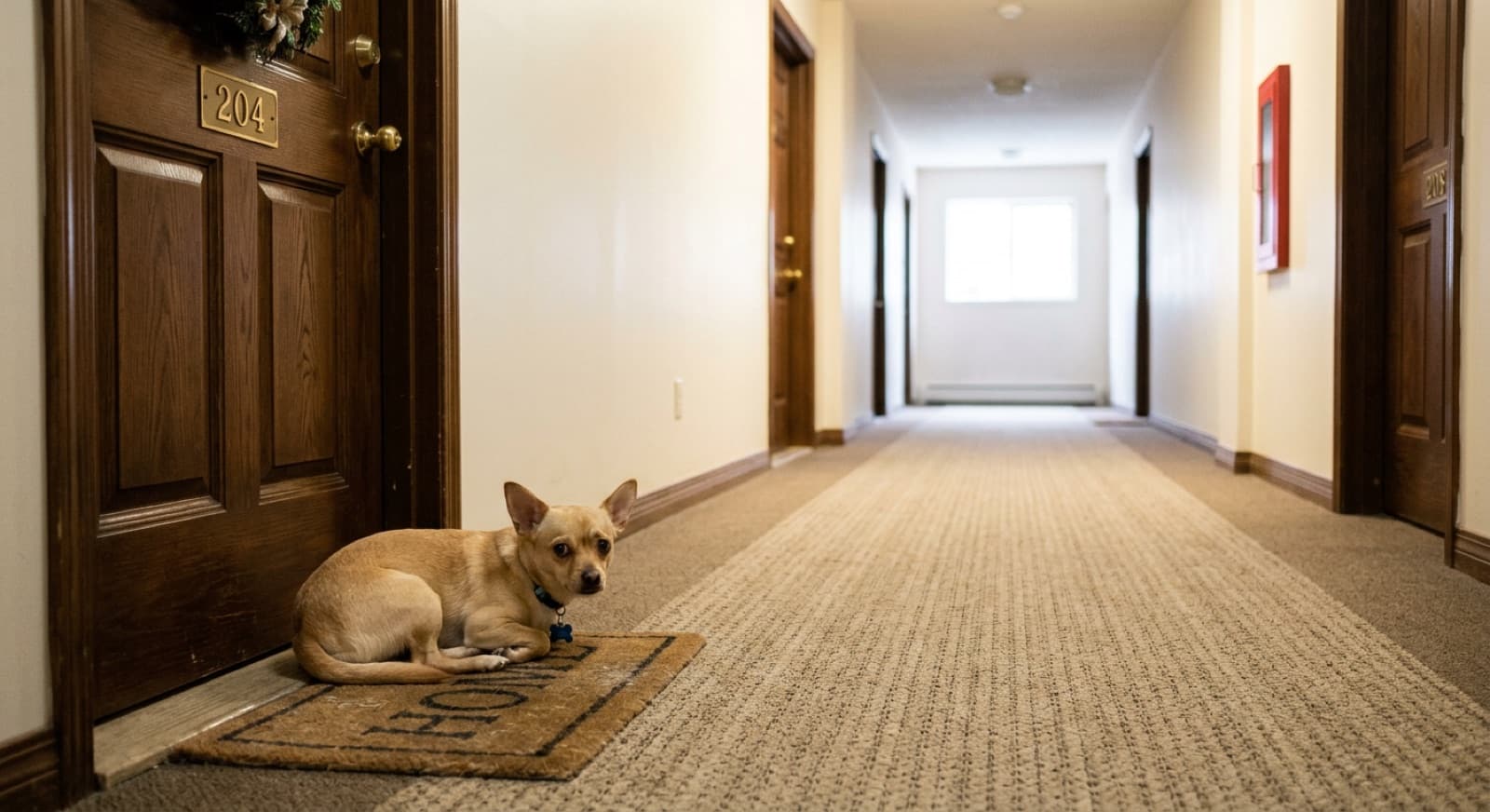
Why Chihuahuas are prone to separation anxiety
Velcro attachment is breed design. Constant companionship is small-dog lifestyle. Trauma is often a personal history. Three forces, one tiny dog.
Velcro by breed design. Chihuahuas were bred for centuries as constant companions. They were not bred to work apart from their person. The attachment trait is hardwired, not a behaviour problem.
Constant contact is the small-dog default. Most Chihuahuas spend the bulk of their early life being carried, held, sleeping under blankets, or perched on a lap. They rarely practice the skill of being alone. By the time a typical owner needs them to be alone, they have never built that muscle.
Many rescue Chihuahuas carry trauma. Calgary rescues regularly intake Chihuahuas from hoarding situations, breeder surrenders, repeated rehoming, or owner-death cases. Each transition is a loss. Some Chihuahuas have lost three or four homes by the time they reach adoption. A dog who has lost everyone tends to attach intensely to the next person and panic at the thought of losing them too.
Excessive shaking complicates diagnosis. Chihuahuas tremble for many reasons. Cold, excitement, low blood sugar, and breed-typical body composition all cause shaking. Anxiety also causes shaking. That overlap makes early-stage SA harder to spot in this breed than in larger dogs. A camera record of alone-time behaviour matters more than a tremor check.
True SA vs normal Chihuahua velcro behaviour
These are different problems with different responses. Misreading them leads to wasted time on the wrong plan.
Normal velcro (manageable)
- • Follows you to the bathroom and bedroom
- • Sits pressed against your leg on the couch
- • Picks the closest nap spot to family activity
- • Mild fussing or whining when you leave
- • Settles within 5 to 15 minutes of departure
- • Eats food and treats when alone
- • No house-soiling during alone time
- • Greets you happily on return without panic
True SA (escalate)
- • Drooling visible on chest or floor on your arrival
- • Self-injury: bloody paws, broken nails, scraped nose
- • Urination or defecation despite being housetrained
- • Persistent vocalizing heard by neighbours
- • Destruction focused on doors, window frames, blinds
- • Escape attempts (scratching, chewing through barriers)
- • Refuses food and high-value treats during alone time
- • Panic-level shaking (above breed baseline) when you leave
Set up a phone or camera recording the first 30 minutes after departure. Anxiety produces visible distress; velcro produces brief fussing that settles. Calgary force-free trainers can review the footage and confirm which pattern you are seeing.
The gradual desensitization plan
Build alone-time tolerance in tiny incremental steps. Most Chihuahuas need months of work, not weeks. Move at the dog's pace, not yours.
5 to 60 second departures
Start absurdly small. Step out the front door for 5 seconds. Come back calmly. Repeat dozens of times per day. Build up to 60 seconds over 4 weeks. The dog learns that departures are routine and you always return. Pair every absence with a frozen Kong or lick mat. Calm exits. Calm returns.
2 to 15 minute departures
Run to the mailbox. Take a short walk. Sit on the patio with the door closed. Mix routine and non-routine departures so keys, shoes, and coats do not become anxiety cues. Some owners pick up keys without leaving 100 times per day to break the cue. Record on camera. If the dog panics, shorten the next session.
30 minutes to 2 hours
Build to short outings. Coffee run, gym session, grocery trip. Confirm the dog settles within 10 to 15 minutes of departure on camera. If you see escalating signs, pause and repeat phase 2 for several more weeks. Setbacks are normal. Progress is non-linear.
3 to 5 hour tolerance
Reach functional working-day tolerance with daycare or walker support filling the gaps. Many Chihuahuas top out around 4 to 5 hours of comfortable alone time even after a year of work. That is not failure. That is the breed. Build the schedule around the dog you have, not the dog you wished for.
Never punish distress. Punishment raises cortisol and worsens anxiety. If a session goes badly, the next one shrinks back down. This is not about willpower; it is about teaching a nervous system to feel safe.
Make leaving routines boring
Dramatic goodbyes feel kind, but they signal danger. A tearful five-minute farewell teaches a Chihuahua that departures are emotionally enormous. The dog rides that emotional spike straight into panic the moment the door closes.
The fix is dull. Drop your goodbyes entirely. Put on your coat in calm silence. Walk past the dog without a glance. Step out the door. On return, ignore the dog for 60 to 90 seconds, even if they are leaping and squeaking. Greet them after they settle.
This feels rude. It works. Departures become a non-event. The nervous system stops bracing for the door.
Pre-departure cue desensitization. Pick up your keys 50 times today without leaving. Put on your shoes and sit back down. Open and close the front door. Each cue, repeated outside of an actual departure, loses its anxiety charge over a few weeks.
Crate use: helpful for some, traumatic for others
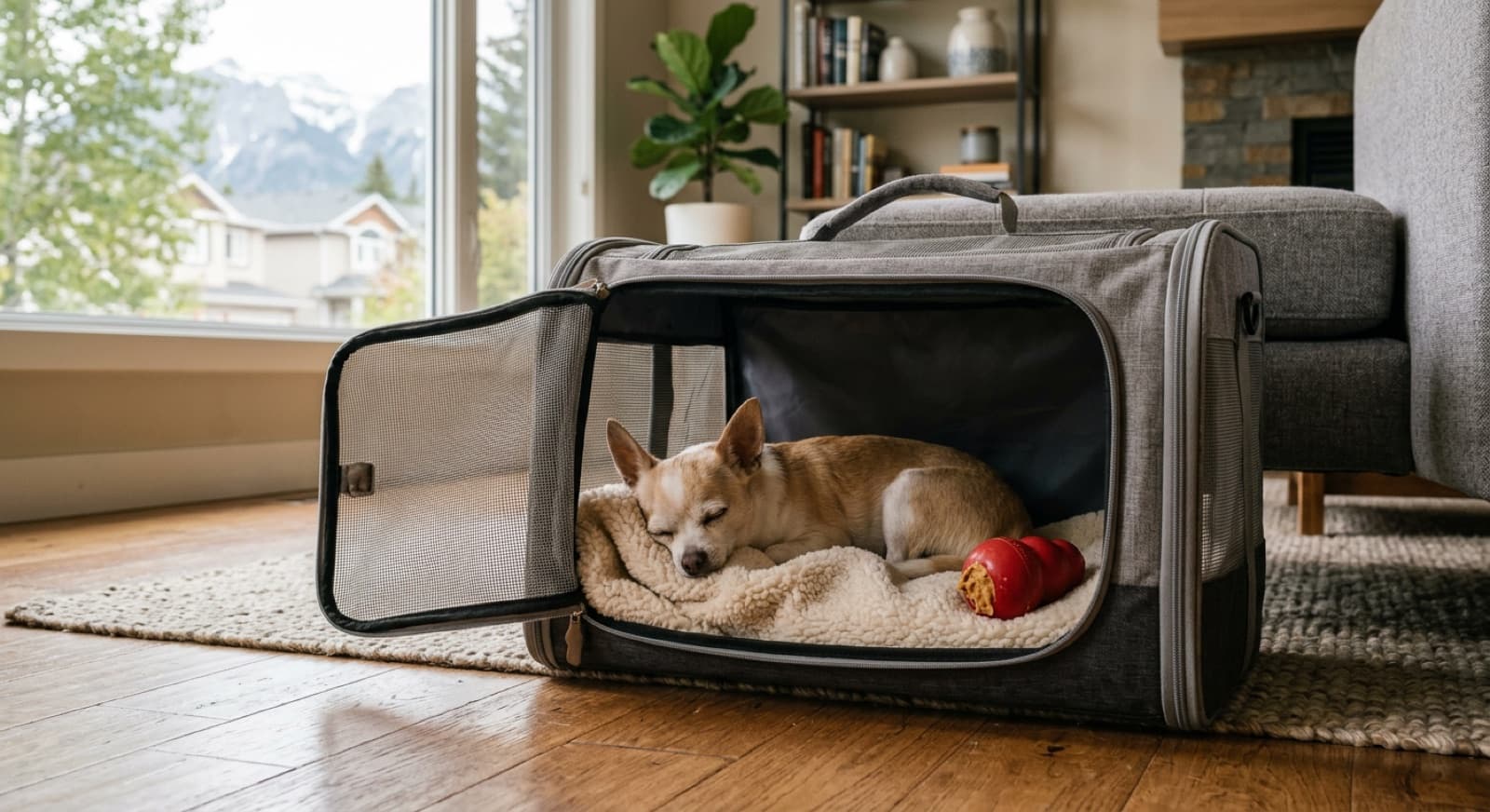
Some Chihuahuas love crates. They are bred to seek small den-like spots, and a positively conditioned crate becomes a chosen retreat. Meals fed inside, chews offered inside, naps taken voluntarily.
How to build a positive crate association:
- Feed every meal inside the crate with the door open for the first week
- Toss treats and tiny chews inside throughout the day
- Use a soft blanket and a piece of clothing that smells like you
- Cover the crate with a light blanket to make it a true den
- Place the crate near family activity, not isolated in a basement
- Build duration in small steps: 1 min door closed, then 3, then 5, then 10
- Never use the crate as a punishment, since that ruins the association
When NOT to crate. If your Chihuahua panics inside (frantic scratching, soiling, broken teeth on the bars, screaming), do not force it. Force-crating a panicking small dog creates lasting crate aversion and worsens separation anxiety. Use a small exercise pen or a baby-gated room instead. Keep building crate love slowly with food and chews, with no expectation that the dog will ever spend alone time inside.
The breed is not uniform. Two Chihuahuas can respond opposite to the same setup. Read your dog, not the rule book.
Browse adoptable Chihuahuas in Calgary
Foster reports often include alone-time tolerance and crate compatibility notes. Critical info if you are choosing between candidates.
Calming aids that actually help
None of these replace gradual desensitization. They reduce baseline anxiety enough that the dog can learn during sessions. Stack two or three for moderate cases.
- Adaptil (DAP) diffuser or collar. Synthetic copy of the calming pheromone mothers produce. Plug-in $40 to $60 per refill, collar $30 to $50. Takes 1 to 2 weeks to show effect.
- Thundershirt. Pressure wrap sized XS or XXS for Chihuahuas. $40 to $50. Works for some dogs, neutral for others. Worth a try.
- Calming music or white noise. Through a Dog's Ear playlists and classical music have measurable calming effects in shelter studies. Free.
- Frozen Kongs sized for tiny mouths. XS or S Kong stuffed with wet food, plain yogurt, or pumpkin and frozen. 20 to 40 minutes of focused work.
- Lick mats. Silicone mats with grooves, smeared with wet food. 10 to 20 minutes of soothing low-stress activity. The licking action itself is calming.
- Snuffle mats sized small. Fabric mats with hidden kibble for nose-driven foraging. 15 to 30 minutes of mental enrichment.
- Food-dispensing puzzle toys (small breed). Outward Hound, Nina Ottosson, and other brands make tiny-mouth options. Rotate two or three to keep novelty.
Watch for choking hazards with tiny dogs. Choose toys sized for the breed, not generic dog toys.
Some of the product links in this section are Amazon affiliate links — we may earn a small commission at no extra cost to you. It never changes which products we recommend.
Calgary force-free trainers experienced with SA
Reward-based trainers fit the sensitive Chihuahua temperament. Harsh handling makes anxiety worse, not better. Calgary options with separation anxiety experience:
- Dogma Training. Multiple Calgary locations, force-free group and private sessions, behaviour consults.
- ImPAWSible Possible (Linda Skoreyko). Strong separation anxiety focus, Karen Overell relaxation protocol experience.
- Calgary K-9. Force-free private training, behaviour consults, in-home work.
A typical Calgary behaviour consult runs $150 to $300 for the initial session and $80 to $150 per follow-up. A full SA package usually runs $400 to $1,200 across 6 to 12 sessions. Cheaper and faster than a vet behaviourist for mild to moderate cases.
When to involve a veterinary behaviourist or medication
Escalate to a vet behaviourist if any of the following are present:
- Self-injury attempting to escape (bloody paws, broken nails, scraped nose, broken teeth)
- Persistent vocalizing for 30+ minutes despite enrichment
- Urination or defecation during alone time despite being housetrained
- Refusing all food and high-value treats during alone time
- No improvement after 8 to 12 weeks of consistent protocol work
- Panic-level shaking above the breed baseline at every departure
Calgary referral: Dr. Jennifer Pelster at Calgary Veterinary Behaviour Services. Referral from your regular vet is required. Initial consult $300 to $600, follow-ups $200 to $400. For after-hours emergencies, Western Veterinary Specialist & Emergency Centre.
Medications commonly used for moderate to severe Chihuahua SA:
- Fluoxetine (Prozac, Reconcile). Daily SSRI. 4 to 6 weeks to full effect. $20 to $50 per month at tiny-dog doses. Long-term medication, usually 6 to 18 months.
- Trazodone. Situational anti-anxiety. Useful for predictable triggers like departures or vet visits. $20 to $40 per month.
- Clomipramine (Clomicalm). TCA antidepressant labelled for separation anxiety. $25 to $60 per month.
Lower body weight means lower dose, which means lower cost than mid-size or large breeds. Most Chihuahuas stay on medication for 6 to 18 months while desensitization builds new responses, then wean slowly under vet supervision. Medication is not a moral failure. It is often the difference between a recoverable case and a dog who deteriorates over years.
The cost reality
Honest first-year budget for a Calgary Chihuahua with moderate separation anxiety:
| Item | Calgary cost | Notes |
|---|---|---|
| Vet behaviour initial consult | $300 to $600 | Referral required from regular vet |
| Vet behaviour follow-ups (2 to 4 visits) | $400 to $1,600 | Most cases need 2 to 4 in year one |
| Medication (fluoxetine, trazodone) | $240 to $720/yr | Lower dose for tiny dogs lowers cost |
| Force-free trainer SA package | $400 to $1,200 | 6 to 12 session program |
| Calming aids (Adaptil, Thundershirt, Kongs) | $150 to $300 | Mostly one-time spend |
| Daycare or midday walker support | $300 to $700/mo | While building tolerance, year one |
Total first-year investment for a moderate case: roughly $2,500 to $5,000. Severe cases run higher. Mild cases run less. This is real money. Knowing the number before adoption protects both you and the dog from a mid-year crisis.
The honest timeline
Chihuahua separation anxiety recovery is 6 to 18 months of consistent work. Anyone selling a 4-week fix is overselling.
Mild cases: 8 to 12 weeks of the prevention protocol resolves most velcro fussing. The dog learns the leave-and-return pattern and settles within 10 to 15 minutes of departure.
Moderate cases: 6 to 12 months. Vocalizing, panting, and refusing food during alone time take longer to resolve. Most owners add medication, calming aids, and a force-free trainer in this range.
Severe cases: 12 to 18 months or longer. Self-injury, urination, and escape attempts almost always need a vet behaviourist, medication, and a long patient program. Some Chihuahuas in this range never reach more than 3 to 4 hours of comfortable alone time. That is still a successful outcome.
Progress is non-linear. Expect plateaus and setbacks. A bad week does not erase three good months. The owners who succeed measure progress in months and zoom out when discouraged.
“I work full time. Can I adopt a Chihuahua?”
Short answer: yes, if you set up gradual alone-time conditioning before crisis hits. Long answer: most failed Chihuahua adoptions in Calgary look like this. Family adopts on a Saturday. Owner takes 2 days off. By the following Friday, the dog is alone for 9 hours and panicking. SA crystallizes. The dog gets surrendered at week 6 with a behaviour record.
The avoidable version looks like this. Family adopts on a Saturday. Owner takes 2 to 3 weeks off, partial WFH, or arranges family help for the first 3 weeks. The 5 to 60 second departure phase starts on day 1 even though the dog seems fine. A midday dog walker is booked starting week 2. Daycare 2 to 3 days a week starts week 4. By month 3, the dog tolerates a partial workday with walker support filling the gap.
The infrastructure has to exist before the dog needs it. That is the difference between a successful working-household Chihuahua adoption and a surrender at week 6.
Frequently asked questions
Why are Chihuahuas so prone to separation anxiety?
Three forces stack: bred for centuries as constant companions, small-dog lifestyle means rarely practicing alone time, and many rescue Chis carry trauma from hoarding, surrender, or repeated rehoming.
What is the difference between true SA and normal velcro?
Velcro: follows you everywhere, fusses briefly when you leave, settles in 5 to 15 minutes, eats food alone, no soiling. True SA: drooling on arrival, self-injury, urination despite training, persistent vocalizing, escape attempts, refuses food. Use a camera to confirm.
How long does treatment take?
Mild cases 8 to 12 weeks. Moderate cases 6 to 12 months. Severe cases 12 to 18 months. Anyone promising a 4-week fix is overselling.
Can I adopt a Chihuahua if I work full time?
Yes with infrastructure: midday walker or 2 to 3 daycare days per week, 2 to 3 weeks WFH at adoption, start gradual alone-time conditioning day 1, calm exits, frozen Kongs on every departure.
Should I crate my Chihuahua?
It depends on the dog. Many Chihuahuas love positively conditioned crates as den retreats. Some panic inside and need an exercise pen instead. Never force crate a panicking dog; it makes SA worse.
What calming aids work?
Adaptil diffuser or collar, Thundershirt, calming music, frozen Kongs sized XS, lick mats, snuffle mats sized small, food-dispensing puzzle toys for small breeds. Stack two or three for moderate cases.
When should I see a vet behaviourist?
Self-injury, 30+ minute persistent vocalizing, urination despite training, refusing food, no improvement after 8 to 12 weeks. Calgary referral: Dr. Jennifer Pelster, Calgary Veterinary Behaviour Services. Medications: fluoxetine, trazodone, clomipramine.
How much does treatment cost?
Moderate case first year: roughly $2,500 to $5,000. Vet behaviour consult $300 to $600, follow-ups $200 to $400, medication $20 to $60/mo for tiny dogs, trainer package $400 to $1,200, daycare/walker support $300 to $700/mo.
More Chihuahua guides
Chihuahua Adoption Calgary →
The full Calgary Chihuahua playbook covering rescues, fees, what to expect, and red flags.
Is a Chihuahua Right for You? →
Honest self-assessment built from Calgary surrender patterns. Time, budget, lifestyle fit.
Chihuahua Behaviour and Temperament →
What Chihuahua personality is really like. Velcro nature, boldness, sensitivity, common quirks.
Chihuahua Biting and Aggression →
Why small dogs bite, fear-based aggression, force-free retraining, when to call a behaviourist.
Chihuahua Health Issues →
Dental disease, luxating patella, hypoglycemia, tracheal collapse. Calgary vet costs and prevention.
Bringing Home a Chihuahua: First Week →
The 3-3-3 rule applied to tiny dogs. Decompression, bonding, and the first week roadmap.
Chihuahua Potty Training →
Why small bladders and Calgary winters complicate training. Schedules, indoor options, force-free methods.
Senior Chihuahua Adoption Calgary →
Why senior Chis are some of the best adoptions. Health, costs, and what to expect.
Buy or Adopt a Chihuahua in Calgary →
Honest comparison of breeder vs rescue Chihuahuas. Costs, health, ethics, and Calgary options.
Chihuahua Winter Survival Calgary →
Coats, boots, indoor potty options, hypothermia signs. Surviving minus-30 with a 4 lb dog.
New dog? Start with these care guides
Everything a new adopter needs to set up a safe, happy home.