The short answer
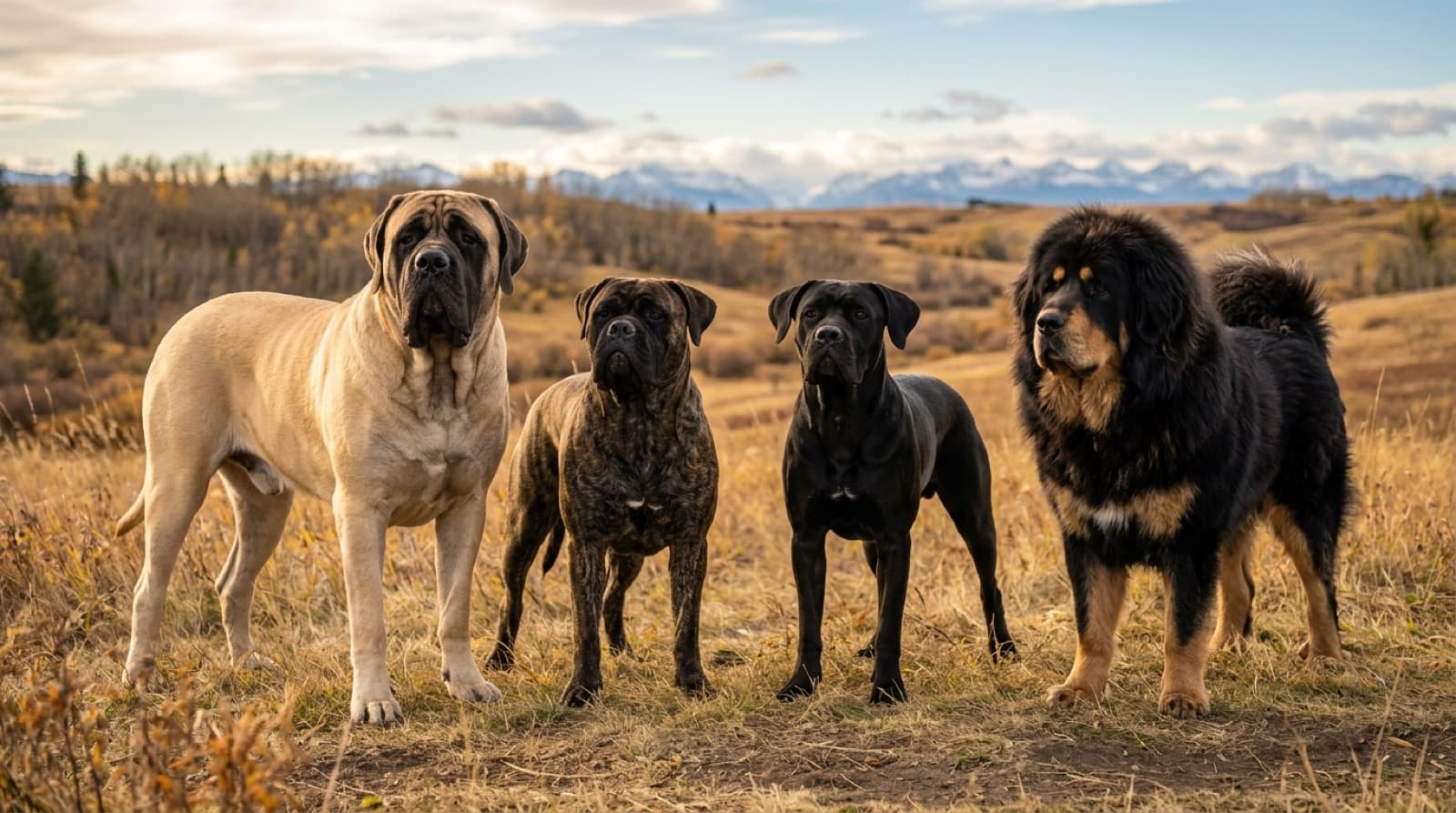
“Mastiff” is not one breed. It is a family of 8 large-to-giant guardian breeds that share Molossus ancestry but were bred for different jobs in different countries. The four most common Calgary candidates are English Mastiff (gentle giant, 150 to 230 lbs, 6 to 10 yr lifespan), Bullmastiff (family guardian, 100 to 130 lbs, 8 to 10 yr), Cane Corso (Italian working dog, 88 to 110 lbs, 9 to 12 yr), and Tibetan Mastiff (independent guardian, 70 to 150 lbs, 10 to 14 yr). Coat type drives Calgary winter fit. All face elevated bloat, cardiac, and joint risk. Insurance and condo restrictions affect all 8 equally.
Why “Mastiff” is confusing
The word “mastiff” comes from the Molossus, an ancient guardian dog mentioned in Greek and Roman texts. Every breed in the modern mastiff family traces some ancestry to that root, but the breeds were shaped over centuries in different countries for different jobs. The English Mastiff was a war and estate-guard dog. The Bullmastiff was bred in 1860s England to catch poachers without killing them. The Cane Corso was an Italian farm worker. The Tibetan Mastiff guarded livestock and monasteries in the Himalayas for thousands of years.
The result is that an English Mastiff and a Cane Corso share an ancestor but have almost nothing in common in daily life. One is 200 lbs and sleeps 18 hours a day. The other is 100 lbs and needs a job. Calgary adopters who shortlist “a mastiff” without picking a specific breed often end up with the wrong dog for their lifestyle.
The Canadian Kennel Club recognizes Mastiff, Bullmastiff, Cane Corso, Neapolitan Mastiff, Tibetan Mastiff, and Dogue de Bordeaux as distinct breeds within the Working Group. The Spanish Mastiff and Pyrenean Mastiff are recognized by the American Kennel Club Foundation Stock Service and various international registries. All 8 are genuinely distinct breeds with separate breed standards.
The 8 mastiff-type breeds compared
Adult weight, lifespan, energy, coat, origin, and best-fit profile for each of the 8 mastiff breeds.
| Breed | Weight | Lifespan | Energy | Coat | Origin | Best for |
|---|---|---|---|---|---|---|
| English Mastiff | 150 to 230 lbs | 6 to 10 yr | Low | Short | England | Experienced owners with space and budget |
| Bullmastiff | 100 to 130 lbs | 8 to 10 yr | Moderate | Short | England (1860s) | Family guardian, most beginner-friendly mastiff |
| Cane Corso | 88 to 110 lbs | 9 to 12 yr | Med-high | Short | Italy | Experienced working-guardian homes |
| Tibetan Mastiff | 70 to 150 lbs | 10 to 14 yr | Low-med | Double, long | Tibet (ancient) | Experienced owners, independent guardian |
| Neapolitan Mastiff | 110 to 150 lbs | 7 to 9 yr | Low | Short, wrinkled | Italy | Experienced owners, dramatic appearance, health-burdened |
| Spanish Mastiff | 140 to 200 lbs | 10 to 12 yr | Low | Double | Spain | Rural livestock guardian, rare in Calgary |
| Pyrenean Mastiff | 130 to 220 lbs | 10 to 13 yr | Low-med | Double | Spain | Rural livestock guardian, rare in Calgary |
| Dogue de Bordeaux | 99 to 150 lbs | 5 to 8 yr | Low-med | Short | France | Family guardian, very short lifespan |
Weight and lifespan ranges reflect breed standard data from the Canadian Kennel Club, American Kennel Club, and breed parent clubs. Calgary-specific factors covered in later sections.
Breed-by-breed profiles
English Mastiff (Old English Mastiff, OEM)
The largest of the group and the namesake of the family. Adult males commonly reach 200 lbs and the breed standard tops out around 230. Temperament is famously gentle, patient, and slow-moving. They are quiet in the home, sleep heavily, and rarely show aggression without provocation. The catch is the size, the financial reality, and the short lifespan. Food alone runs $2,000-plus per year. The 6 to 10 year lifespan (often closer to 7 to 8 in practice) is hard for families with young children who will bond deeply. Calgary availability through the Mastiff Club of America referral network is rare but not impossible.
Bullmastiff
Created in 1860s England as a gamekeeper's night-dog by crossing English Mastiffs (about 60%) with the Old English Bulldog (about 40%). The goal was a dog athletic enough to catch a poacher in the dark but steady enough not to bite. The modern Bullmastiff inherits that breeding: confident family guardian, moderate energy, calm in the home. The most beginner-friendly mastiff and the one Calgary adopters are most likely to find in rescue. Read our full Bullmastiff adoption guide, Bullmastiff as a first dog, and temperament vs reputation articles for the deep dive.
Cane Corso (Italian Mastiff)
The Cane Corso is an Italian working breed traditionally used as a farm guardian, cattle drover, and hunting dog. Smaller and more athletic than the English Mastiff at 88 to 110 lbs. Higher prey drive, higher exercise demand, and a more confident temperament that requires experienced handling. Not a beginner breed. Calgary Cane Corso owners commit to daily structured exercise, force-free training with a working-breed-experienced trainer, and careful socialisation through the critical 8 to 18 week window. Read our Cane Corso adoption guide, is a Cane Corso right for you, and temperament and aggression articles for the full picture.
Tibetan Mastiff
Ancient livestock-guardian breed from the Himalayan plateau, used for thousands of years to protect sheep, yak, and Tibetan monasteries from predators including wolves and snow leopards. Independent decision-makers, not eager-to-please working dogs. Heavy double coat that handles Calgary winter down to -30 degrees Celsius. The independence makes them difficult for traditional obedience training. They were bred to make their own decisions about threats, not to follow instructions. Often vocal at night (a guardian-breed trait that condos and close neighbours rarely tolerate). Very rare in Calgary rescue.
Neapolitan Mastiff (Mastino Napoletano)
Italian breed with the most dramatic appearance in the mastiff family. Heavy loose skin, deep wrinkles, pendulous flews. Originally bred for Roman war and arena combat, modernised as a family guardian. The breed is famously affectionate with family but the health burden is substantial: skin-fold infections, entropion and ectropion eye conditions, severe drooling, heat intolerance, hip and elbow dysplasia, and one of the shortest lifespans in the group at 7 to 9 years. Very rare in Canadian rescue.
Spanish Mastiff (Mastín Español)
Massive Spanish livestock-guardian breed used to protect sheep flocks on the Iberian peninsula. Adult males reach 200 lbs. Double-coated and adapted to long outdoor work in mountain weather. The Spanish Mastiff is calm, deeply loyal to the flock or family, and an autonomous decision-maker. Like the Tibetan Mastiff, they were bred to think independently. Not common in Calgary or anywhere in Canada. Adopters who want a Spanish Mastiff typically work with European rescue networks or specialty breed clubs.
Pyrenean Mastiff (Mastín del Pirineo)
Closely related to the Spanish Mastiff and used for the same livestock-guardian work in the Pyrenees mountains between Spain and France. Slightly different breed standard, similar daily reality. Heavy double coat handles extreme cold. Family-tolerant when raised in a home setting but retains strong guardian instincts. One of the longest lifespans in the mastiff family at 10 to 13 years, the trade-off for retaining functional working structure. Very rare in Calgary rescue.
Dogue de Bordeaux (French Mastiff)
French breed sometimes called the “Bordeaux Mastiff” or simply “Dogue.” Stocky, muscular, with a distinctive large head. Affectionate with family and traditionally a working guardian and hauler. The breed has the shortest typical lifespan in the mastiff family at 5 to 8 years, driven by cardiac issues, cancer rates, and orthopaedic problems. Adopters need to budget for significant veterinary care and prepare emotionally for a short life with a dog they will love deeply. Rare in Calgary rescue. The Dogue de Bordeaux Society of America runs the closest breed-specific rescue network.
Calgary-specific considerations across all mastiff breeds
Some realities apply to all 8 mastiff-type breeds regardless of which one you pick.
Home insurance restrictions
Most Canadian home insurers restrict or surcharge mastiff-type breeds equally because of bite-force statistics and size-related liability. The restriction usually applies to all 8 variants without distinguishing between them. Confirm with your insurance broker before adopting any mastiff. Some insurers refuse coverage outright; others raise premiums by $300 to $800 annually; others require a behaviour evaluation. The Insurance Bureau of Canada does not maintain a national restricted-breed list, so policy varies by company and by Alberta broker.
Calgary condo and rental restrictions
Calgary condo boards commonly enforce 75 lb weight limits in their bylaws. That excludes every adult mastiff in this guide, including the smaller Cane Corso. Rental properties in neighbourhoods like Beltline, Inglewood, Bridgeland, and Bowness frequently exclude mastiff breeds in the same restricted-breed clauses that apply to Pit Bulls, Rottweilers, and Dobermans. Verify the condo bylaw or the lease language before adopting. Calgary has no breed-specific legislation at the municipal level under the Responsible Pet Ownership Bylaw, so the restrictions are private rather than legal.
Coat type and Calgary climate
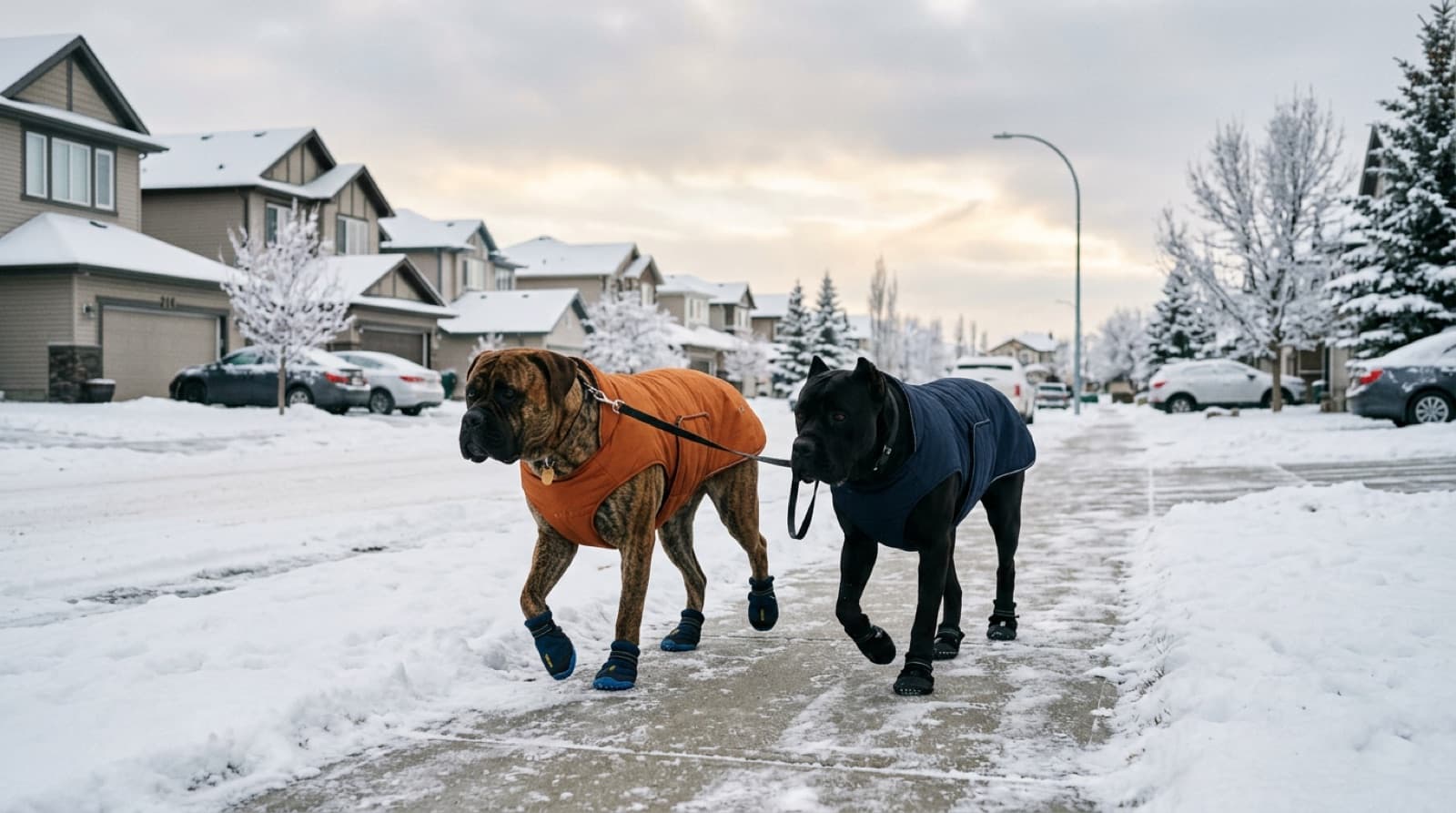
The short-coated mastiffs (English Mastiff, Bullmastiff, Cane Corso, Neapolitan, Dogue de Bordeaux) need a winter coat below -10 degrees Celsius and booties or paw balm on salted sidewalks. Calgary cold snaps below -25 degrees are emergency conditions for these breeds with outdoor exposure limited to brief bathroom breaks. The double-coated mastiffs (Tibetan, Spanish, Pyrenean) handle Calgary winter down to -30 degrees with no coat needed because they were bred to live outdoors with livestock in alpine and mountain conditions.
Summer heat is harder than winter cold
All mastiff-type breeds overheat above 25 degrees Celsius. The brachycephalic short-coated breeds (English Mastiff, Bullmastiff) are highest risk because the shortened face structure reduces panting efficiency. Calgary summer days above 28 degrees mean morning and evening walks only, with midday confined to air-conditioned indoor space. Heat stroke at 200 lbs of body mass moves fast. Never leave any mastiff in a parked car, even in the shade with windows cracked, even for five minutes.
Bloat (GDV) preventive surgery
Every deep-chested giant breed faces elevated lifetime GDV risk. All 8 mastiff variants qualify. Discuss prophylactic gastropexy with your vet, ideally combined with spay or neuter to limit anesthesia events. The surgery tacks the stomach to the body wall and dramatically reduces mortality if GDV occurs. Veterinary Partner and the American Kennel Club Canine Health Foundation both rank gastropexy as the strongest preventive intervention for at-risk breeds.
Cardiac and orthopaedic monitoring
Dilated cardiomyopathy (DCM) affects all the giant mastiff breeds at elevated rates compared to typical dogs. Annual cardiac auscultation starting at age 4, and echocardiography starting at 5 or 6, is the standard recommendation. Hip and elbow dysplasia rates are also elevated. Adult dogs from rescues with documented OFA hip and elbow clearances (or PennHIP scores) start with a known baseline. Specialty referrals to Western Veterinary Specialist Centre or VCA Canada West handle cardiac and orthopaedic workups for any mastiff Calgary adopter.
Anesthesia and surgical complications
Giant-breed anesthesia carries higher risk than typical dogs. Body mass affects drug metabolism, ventilation, and recovery. Calgary specialty practices use giant-breed-adjusted anesthesia protocols. Discuss anesthesia plans with your vet before any procedure including dental work.
Browse adoptable Bullmastiffs in Calgary
Bullmastiff is the most beginner-friendly mastiff and the most common variant available in Calgary rescue. Start your search with current available dogs.
See Available Bullmastiffs →Which mastiff is right for you? A decision framework
The right mastiff depends on five honest answers about your daily life.
1. Experience. First-time large-breed owners should start with a Bullmastiff. Experienced large-breed owners (previously raised a Rottweiler, Doberman, German Shepherd, or large guardian breed) can consider any of the 8. Cane Corso and Tibetan Mastiff are explicitly experienced-owner breeds.
2. Activity level. Sedentary households (less than 60 min of daily exercise) should pick the English Mastiff or Neapolitan. They thrive on moderate walks and house-rest. Active households (90-plus min of daily exercise, off-leash hiking, structured training) match better with Cane Corso, Bullmastiff, or Pyrenean Mastiff.
3. Housing. Apartment and condo dwellers face the 75 lb bylaw barrier. None of the 8 mastiff breeds adult-out under 75 lbs. House with fenced yard is the realistic minimum. A rural acreage suits the livestock-guardian breeds (Tibetan, Spanish, Pyrenean) best.
4. Climate tolerance. If you do most of your dog activity in Calgary winter (skiing, snowshoeing, winter hiking), pick a double-coated breed (Tibetan, Spanish, Pyrenean). If your dog mostly accompanies indoor and summer activity, the short-coated breeds work fine with the winter-coat-and-bootie routine.
5. Budget. Annual ownership cost runs $3,000 to $6,000 per year. The English Mastiff and Pyrenean Mastiff are at the high end because of food volume. Plan for a $5,000-plus emergency fund or comprehensive pet insurance for cardiac, orthopaedic, and GDV risk. Calgary specialty vet visits average $500 to $1,500 per workup at Western Veterinary Specialist Centre or VCA Canada West.
If your honest answer to any of these does not align with the mastiff family, consider a Boxer (smaller, similar guardian temperament, more apartment-friendly), a Greater Swiss Mountain Dog (large, gentle, double-coated, less guardian intensity), or a Bernese Mountain Dog (similar size to Bullmastiff, family-oriented, short lifespan but well-suited to Calgary climate).
Calgary rescue reality across the variants
Availability varies enormously across the 8 breeds.
Bullmastiff is the most realistic Calgary rescue target. Occasional intake at Calgary Humane Society, AARCS, BARCS, and ARF Alberta. Bullmastiff Rescue Inc. (US-based, ships to Alberta with adoption coordination) is the dedicated breed-specific rescue. Read our buy or adopt a Bullmastiff guide for the full decision tree.
Cane Corso shows up occasionally in Calgary general rescue (Calgary Humane Society, AARCS, BARCS). Surrender reasons typically involve under-prepared first-time owners overwhelmed by exercise demand and prey drive. Working with foster-based rescue helps because temperament evaluation is critical for this breed.
English Mastiff is rare in Calgary rescue. The Mastiff Club of America referral network occasionally connects Canadian adopters with English Mastiff rescues. Wait time is typically 6 to 12 months.
Tibetan Mastiff is very rare in Calgary rescue. The Tibetan Mastiff Club of America runs a US-only rescue network. Canadian adopters typically work through breeders who occasionally take back retired adults or rehome dogs from broken homes.
Neapolitan, Spanish, Pyrenean, and Dogue de Bordeaux are nearly never available in Calgary rescue. Adopters who specifically want one of these breeds typically work through European rescue networks (Spanish and Pyrenean) or US breed-specific rescues (Dogue de Bordeaux Society of America for the Dogue, Neapolitan Mastiff Club of America for the Neo).
General Calgary aggregators are the starting point for any mastiff search. Browse current available dogs on LocalPetFinder Calgary, Calgary Humane Society, AARCS, BARCS, ARF Alberta, and Cochrane Humane Society. Set up email alerts so you are notified when a matching mastiff appears. Expected wait time for a specific variant is 3 to 12 months. Adoption fees range $400 to $900 depending on rescue.
Health concerns shared across mastiff types
The giant-breed reality applies to every mastiff variant. Shorter lifespans, elevated risk for several conditions, and higher veterinary costs are constants regardless of which specific breed you pick.
- Lifespan. 5 to 14 years across the family, with most breeds clustering at 7 to 11. The Dogue de Bordeaux has the shortest typical lifespan. Tibetan and Pyrenean Mastiff have the longest.
- Hip and elbow dysplasia. Elevated rates across all giant breeds. OFA or PennHIP screening of breeding parents is the only reliable risk reducer. Rescue dogs benefit from a baseline x-ray at adoption.
- Gastric Dilatation-Volvulus (GDV). Bloat is the most preventable cause of mastiff death. Gastropexy preventive surgery is the strongest intervention. Feed 2 to 3 smaller meals daily and avoid exercise within an hour of eating.
- Dilated cardiomyopathy (DCM). Elevated in all the giant mastiff breeds. Annual cardiac auscultation starting at age 4, echocardiography starting at 5 or 6.
- Joint disease and osteoarthritis. Universal in aging giant breeds. Joint supplements, weight management, low-impact exercise, and Adequan injections all help slow progression.
- Anesthesia complications. Giant-breed-adjusted protocols are essential. Discuss with your vet before any procedure including dental work.
- Entropion and ectropion. Eye conditions where the eyelid rolls inward or outward. Common in Bullmastiff, English Mastiff, Neapolitan, and Dogue de Bordeaux. Surgical correction is straightforward but adds cost.
- Skin fold dermatitis. Wrinkled breeds (Neapolitan, English Mastiff, Bullmastiff, Dogue) need daily fold cleaning to prevent yeast and bacterial infection.
- Heat stroke risk. Brachycephalic short-coated mastiffs (English Mastiff, Bullmastiff) are highest risk above 25 degrees Celsius.
The Bullmastiff health issues and Cane Corso health issues articles cover breed-specific medical detail for the two most common Calgary candidates.
Calgary pet insurance for mastiff-type breeds runs $90 to $200 monthly. ROI is strong because of the elevated risk profile. Read the policy carefully for breed-specific exclusions before signing.
Frequently asked questions
What's the difference between an English Mastiff and a Bullmastiff?
English Mastiff and Bullmastiff are two distinct breeds with shared ancestry. The English Mastiff (also called Old English Mastiff or OEM) is the larger of the two at 150 to 230 lbs, with a lifespan of 6 to 10 years. The Bullmastiff is 100 to 130 lbs with an 8 to 10 year lifespan. The Bullmastiff was created in 1860s England by crossing English Mastiffs (about 60%) with Old English Bulldogs (about 40%) to produce a gamekeeper's night-dog with more athleticism and drive than the English Mastiff. Temperament reflects that breeding history. The English Mastiff is famously gentle, slow-moving, and laid-back. The Bullmastiff is more active, more protective by default, and was specifically selected for guardian work. For Calgary adopters: the Bullmastiff is the better first guardian breed and the more available variant in Alberta rescue. The English Mastiff is rare in Canadian rescue and demands significant space, financial capacity, and tolerance for a short lifespan.
Which mastiff breed is best for first-time owners?
No mastiff-type breed is ideal for a first-time large-breed owner, but the Bullmastiff is the most forgiving entry point. Bullmastiffs were bred for steady temperament and family compatibility, mature into calm adults, and the breed has more available Alberta rescue support than other variants. The English Mastiff is also relatively calm but the 150 to 230 lb size, mobility limitations, and shorter lifespan make first-time ownership harder. Cane Corso and Tibetan Mastiff are explicitly experienced-owner breeds because of high prey drive (Corso) or independent guardian behaviour (Tibetan) that requires confident handling. Neapolitan, Spanish, Pyrenean, and Dogue de Bordeaux are too rare in Calgary to use as a first-time choice. Read our full Bullmastiff first dog guide before committing.
Do all mastiff breeds drool?
Yes, every mastiff-type breed drools, but the volume varies dramatically by face structure. Heavy droolers include the English Mastiff, Neapolitan Mastiff, Dogue de Bordeaux, and Bullmastiff. These breeds have loose lower lips (called flews) that hold saliva and fling it during head shakes. Owners report drool on ceilings, walls, and clothing as routine. Moderate droolers include the Cane Corso, Spanish Mastiff, and Pyrenean Mastiff. Their flews are less pendulous so saliva collects but flings less. The Tibetan Mastiff has the tightest face structure of the group and drools the least, mostly after drinking or during heat. Keep slobber rags in every room if you adopt any mastiff. The drool is a permanent feature of life with these breeds, not a training problem.
Are mastiffs banned in Calgary?
No mastiff-type breed is banned under the City of Calgary Responsible Pet Ownership Bylaw. Calgary has no breed-specific legislation, only owner-accountability rules. Every mastiff-type breed is legal to own, walk, and license in Calgary. The restrictions Calgary mastiff owners face are private rather than municipal. Most Canadian home insurance policies restrict or surcharge all mastiff-type breeds equally because of bite-force statistics and the size-related liability risk. Calgary condo boards commonly enforce 75 lb weight limits in their bylaws, which excludes all 8 mastiff variants. Rental properties in Calgary frequently exclude all mastiff breeds in the same restricted-breed clauses that affect Pit Bulls, Rottweilers, and Dobermans. Confirm with your home insurer and your condo board or landlord before adopting any mastiff variant.
Which mastiff breed lives the longest?
The Tibetan Mastiff and Pyrenean Mastiff have the longest typical lifespans in the mastiff family at 10 to 14 years and 10 to 13 years respectively. Both are working livestock-guardian breeds that retained more functional structure than the heavier show-bred mastiffs. Spanish Mastiff lifespan runs 10 to 12 years for similar reasons. Cane Corso falls in the middle at 9 to 12 years. Bullmastiff and Neapolitan Mastiff are 8 to 10 years and 7 to 9 years. The English Mastiff is 6 to 10 years (often closer to 7 to 8 in practice). The Dogue de Bordeaux has the shortest typical lifespan of the group at 5 to 8 years. Heavier mastiffs simply do not live as long as moderate-sized ones. The cardiovascular and skeletal demands of supporting 150 lb-plus body weight shorten the lifespan compared to a 70 to 100 lb working mastiff.
How do Calgary winters affect mastiff-type breeds?
Coat type is the single biggest factor. The double-coated mastiffs (Tibetan, Spanish, Pyrenean) handle Calgary winter down to -30 degrees Celsius with no coat needed, because they were bred to live outdoors with livestock through alpine and mountain winters. The short-coated mastiffs (English Mastiff, Bullmastiff, Cane Corso, Neapolitan, Dogue de Bordeaux) need a winter coat below -10 degrees Celsius and booties or paw balm on salted sidewalks. Calgary cold snaps below -25 degrees Celsius are emergency conditions for short-coated mastiffs, with outdoor exposure limited to bathroom breaks. The brachycephalic short-coated breeds (English Mastiff, Bullmastiff) also face dry-air respiratory irritation in heated indoor environments, which can worsen any existing breathing issues. Use a humidifier in winter.
How much does a mastiff cost to own in Calgary per year?
Annual cost runs $3,000 to $6,000 for any mastiff-type breed at adult weight, with peaks of $8,000-plus in years with major medical events. Food alone runs $1,500 to $2,800 for a 100 to 200 lb adult on a quality kibble (giant breeds eat 6 to 10 cups daily). Pet insurance for mastiff breeds runs $90 to $200 monthly in Calgary, with most insurers excluding breed-specific conditions like GDV, cardiomyopathy, hip dysplasia, and entropion unless covered before symptoms appear. Annual vet care including senior bloodwork, dental, and screening averages $800 to $1,500. Medications for older mastiffs (joint support, cardiac monitoring, sometimes Adequan injections) add $600 to $1,800 per year. Specialty vet care at Western Veterinary Specialist Centre or VCA Canada West for a single GDV emergency, cardiac workup, or orthopaedic surgery can run $5,000 to $15,000.
What is GDV and why does it matter for every mastiff?
GDV is Gastric Dilatation-Volvulus, commonly called bloat. The stomach fills with gas and rotates on its axis, cutting off blood supply to the stomach wall and major vessels. Without emergency surgery within 1 to 2 hours, GDV is fatal. Every deep-chested giant breed is at elevated lifetime risk, and all 8 mastiff-type breeds qualify. Bullmastiff, English Mastiff, Cane Corso, and Neapolitan are among the highest-risk breeds tracked by veterinary research. Calgary emergency surgery for GDV runs $5,000 to $12,000 at Western Veterinary Specialist Centre or VCA Canada West, with no guarantee of survival if too much stomach tissue has necrosed. Prevention strategies include feeding 2 to 3 smaller meals per day rather than one large meal, avoiding strenuous exercise within an hour of eating, and discussing prophylactic gastropexy with your vet (a surgical procedure that tacks the stomach to the body wall, often combined with spay or neuter). Gastropexy reduces GDV mortality dramatically and is the strongest preventive intervention available.
Are mastiffs good with kids?
Most mastiff-type breeds are excellent with children when raised together and socialized properly, but size and supervision matter more than temperament. English Mastiff, Bullmastiff, Spanish Mastiff, and Pyrenean Mastiff are traditionally family-tolerant. They are slow-moving, patient, and rarely reactive to typical kid behaviour. The Cane Corso is family-bonded but its higher prey drive and confident temperament require experienced handling around children, particularly visiting friends. The Tibetan Mastiff is loyal to the family but independent and sometimes wary of unfamiliar children entering the home. The Neapolitan Mastiff is generally calm but the heavy build, drool, and snoring make it harder to fit into typical family routines. Dogue de Bordeaux is affectionate but the short lifespan and high health burden are hard for kids who form deep bonds. Universal rule for any mastiff with kids: a 150 lb dog turning quickly can knock down a toddler unintentionally. Train both the dog and the children. Never leave any large dog unsupervised with small children.
Where can I find a mastiff to adopt in Calgary?
Calgary mastiff adoption requires patience because the breeds are rare in local rescue. Bullmastiff is the most realistic target. Mastiff Club of Canada referrals (mastiff.org for the American parent club, with cross-border Canadian referrals) help with English Mastiff. Bullmastiff Rescue Inc. (US-based but ships to Alberta with adoption coordination) is the main breed-specific rescue. Cane Corso shows up occasionally at Calgary Humane Society, AARCS, and BARCS. Tibetan Mastiff is very rare in Calgary rescue (the Tibetan Mastiff Club of America runs a US-only rescue network). Neapolitan, Spanish, Pyrenean, and Dogue de Bordeaux are nearly never available in Calgary rescue. General Calgary aggregators (LocalPetFinder, Calgary Humane Society, AARCS, BARCS, ARF Alberta, Cochrane Humane Society) are the right starting point. Set up email alerts on LocalPetFinder so you are notified when an available mastiff appears. Expected wait time for a specific mastiff variant is 3 to 12 months. Adoption fees range $400 to $900 depending on rescue.
Related guides
Bullmastiff Adoption Calgary
Calgary rescue sources, real adoption costs, surrender patterns, and named-rescue verification for the most beginner-friendly mastiff.
Cane Corso Adoption Calgary
Italian mastiff adoption hub. Rescue sources, breeder vs adopt decision, working-breed temperament reality.
Bullmastiff Health Issues Calgary
Breed-specific medical reality, Calgary specialty vet contacts, pet insurance ROI, and screening protocols.
Is a Cane Corso Right for You?
10-question self-assessment for the working-breed Italian mastiff. Honest fit framework for experienced and first-time owners.
New dog? Start with these care guides
Everything a new adopter needs to set up a safe, happy home.