The short answer
Bassets are NEVER reliably off-leash. Scent-hound recall failure is genetic and was deliberately selection-bred for 5,000 years to make the dog work independently of the handler. When the nose locks onto a trail, the recall word does not register. The Basset trap is the slow pace, which makes owners assume the dog will get tired and come back. Bassets do not give up; they stop when the scent stops. Edmonton fenced yards, 15 to 30 foot biothane long-lines on every unfenced trail, and the lost-Basset protocol on the fridge before you need it. Off-leash time happens in fenced spaces only.
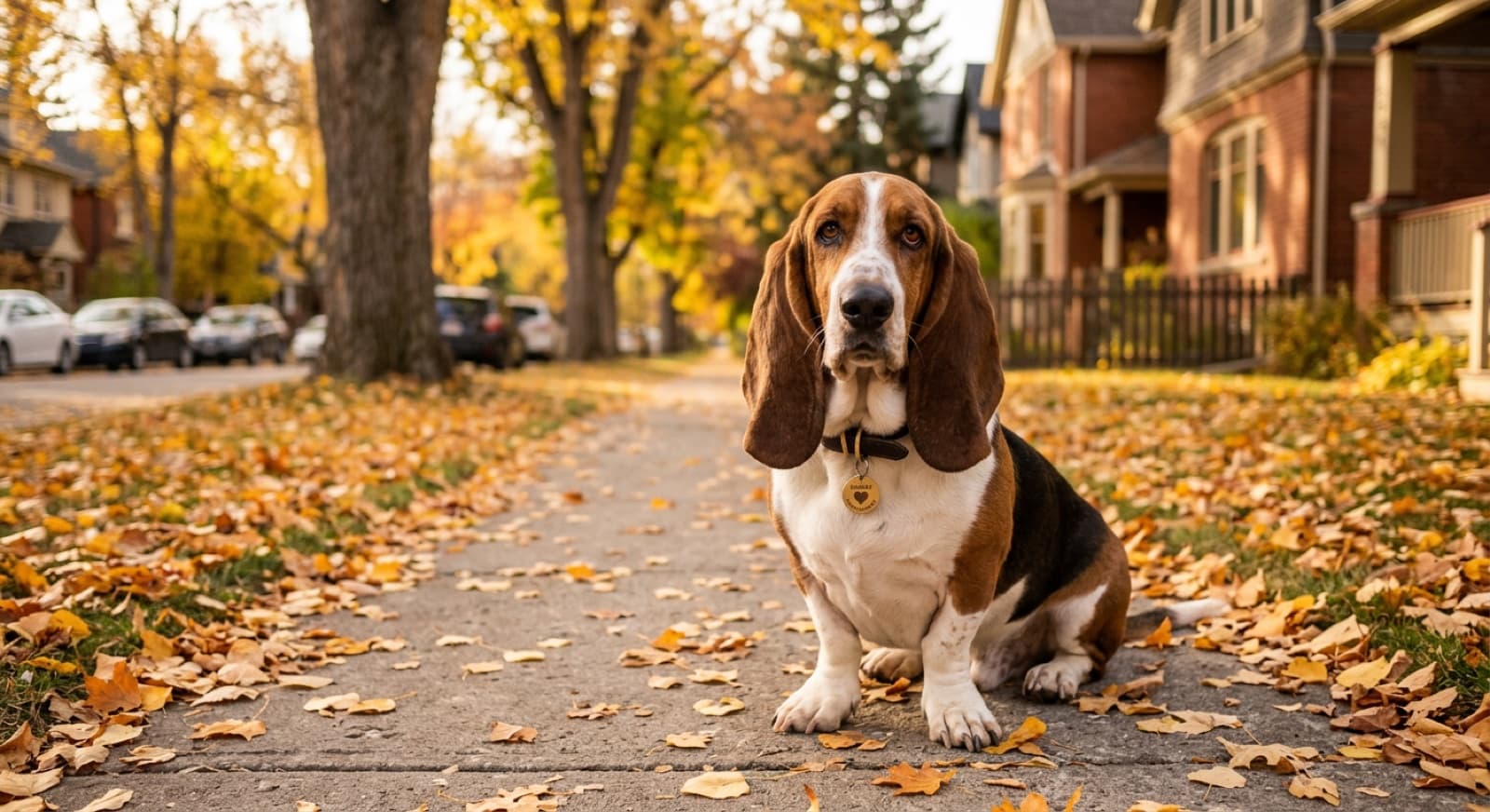
The Basset scent drive: 5,000 years of selection
The Basset Hound is older than most people realise. Scent hounds of the Basset type were depicted in French manuscripts at least 800 years ago and the underlying scent-hound type traces back through 5,000 plus years of selective breeding for one job: track a scent trail independently of a handler over long distances and dense terrain. The breed was developed to be SHORT (so the handler could keep up on foot), DOGGED (so a thicket or a stream did not break off the trail), and DEAF to recall (so the pack stayed on scent when the handler shouted from the field edge).
The genetic load matters because it is not a behaviour problem you can train out of the dog. Bassets carry roughly 220 million olfactory receptors (humans have 5 million, most non-scent-hound dogs 100 to 200 million), and the part of the brain that processes scent is dramatically larger than in non-scent-hound breeds. When a Basset commits to a fresh trail, dopamine reward pathways prioritise pursuit. The recall word does not register against the scent reward. The dog is not choosing to ignore you. According to the Certification Council for Professional Dog Trainers (CCPDT), the more recent and the more rewarding the trail, the lower recall reliability sits under arousal.
The fix is mechanical first, behavioural second. Build the infrastructure that does not depend on the recall holding when the nose locks on.
Basset vs Beagle vs Greyhound: three recall failures
Owners moving from another hound or sighthound sometimes assume the Basset version is similar enough to recycle the same playbook. It is not. Three different mechanisms, three different escape profiles, three different recovery patterns.
| Breed | Drive type | Escape profile |
|---|---|---|
| Greyhound | Sight-driven, explosive | 45 mph sprint; 400 metres in 30 seconds; ends fast |
| Beagle | Scent-driven, fast | Persistent pack runner; covers kilometres in an hour |
| Basset Hound | Scent-driven, sustained | Slow pace, hours-long tracking; will not give up |
The Greyhound chase is over in a minute and ends with the dog far away but stopped. The Beagle chase covers ground fast and ends when the dog or the trail runs out. The Basset chase is the most deceptive of the three because the dog moves at a walk or a slow trot, not a run, and owners assume the dog will tire and turn around. The slow pace is the trap.
A Basset can leave a Mill Creek trailhead at noon, work a rabbit scent at 3 km per hour, cross several streets, follow the trail through a residential neighbourhood, and be 5 kilometres away four hours later still working the same line. The dog does not look distressed and does not bay constantly; it just keeps moving. By the time the owner has finished circling the trailhead, the dog has crossed Whitemud Drive. This is why the recovery search radius for a Basset needs to start wider than the gut says.
Nose-to-ground mode: the dog literally cannot hear you
The Basset posture during scent work is unmistakable. Nose down to the ground or low foliage, head working side to side, ears swinging forward (the long ears help waft scent up toward the nose, which is why they exist), body in a slow methodical trot. Once a Basset enters this state, the dog is not in the same conversation you are. Verbal commands do not register. Body cues do not register. The dog will sometimes look up briefly and then return to the trail; that look up is not engagement with you, it is the dog checking direction.
Owners try to interrupt nose-to-ground mode with treats, with squeaky toys, with calls. None of these work reliably once the trail is hot. The reward the dog is chasing (scent dopamine plus the prey reward at the end of the trail) is more valuable than any treat in your pouch. You cannot out-bid the rabbit. This is why the long-line is the mechanical answer: you do not need to interrupt the state, you just need to control where the dog can physically go while in that state.
The exception is your own dig-proof fenced yard. Inside a 6 foot solid wood fence with proper dig-proofing, the dog can enter nose-to-ground mode safely. The dog will quarter the yard endlessly, find old squirrel paths, work scent trails along the fence line, and burn mental energy in a way no other activity replicates. Two 30 minute scent sessions in the yard daily reduce escape pressure dramatically. Bassets in nose-to-ground mode are happy Bassets, just not approachable ones.
What triggers nose-to-ground mode in Edmonton
Edmonton-specific scent loads make some triggers far more frequent than others. Owners who anticipate the triggers can avoid the worst exposure windows.
- Rabbits. The dominant trigger across the Edmonton metro. Cottontail rabbit populations are dense across suburban yards, river-valley corridors, and the wooded edges of every off-leash zone. A rabbit corridor at the fence line is the single most common escape trigger.
- Squirrels. Backyard squirrel paths from tree to tree to bird feeder leave scent trails that a Basset will work all afternoon. Bird feeders are a Basset magnet.
- Deer. Mule deer use the river-valley parks as travel corridors and cross suburban streets nightly. A Basset on a deer trail can travel kilometres without losing the line.
- Coyotes. Coyote scent triggers a complex response: tracking interest, sometimes territorial response, sometimes wary avoidance. Either way the dog leaves the trail it was on for the new scent.
- Food smells. Backyard barbecues, open compost bins, dropped pizza on a sidewalk, neighbour bird feeders. A scent-driven Basset will follow food smells across several blocks.
- Other dogs in the distance. Bassets are pack hounds and will follow scent trails left by other dogs. A dog that walked through the alley yesterday is a hot trail today.
- Garbage trucks. Wednesday and Thursday garbage routes leave a layered scent trail along the curb that occupies a Basset for hours.
Knowing the triggers does not let you train them away. It lets you plan the management: which yard visits are higher risk, when to bring the dog inside, when to walk the fence line, which trails to skip during dawn deer movement.
The off-leash truth: never unfenced, long-line for life
The position we hold across our Edmonton scent-hound guides: full off-leash for Bassets belongs in fully fenced spaces only. Your own dig-proofed yard with the setup below. A verified fenced indoor or outdoor facility you have walked the perimeter of. Nowhere else. Edmonton off-leash parks are all unfenced and all border wildlife corridors. The Basset community consensus is consistent across rescue networks, breed clubs, and behaviour consultants.
The long-line is the realistic compromise. A 15 to 30 foot biothane line clipped to a back-clip harness gives the Basset real freedom to range, sniff, and quarter while keeping the option to stop the dog at any moment. Biothane is waterproof, washable, does not stiffen in Edmonton cold, and stays grippy when wet or snowy. Pair with a sturdy back-clip Y-shape harness, not a flat collar. Bassets back out of flat collars during scent pursuit (the head shape is wider than the neck, which is the textbook condition for collar slip) and the long ears can catch in a poorly fitted harness.
Some of the product links in this section are Amazon affiliate links — we may earn a small commission at no extra cost to you. It never changes which products we recommend.
Line-length matrix for Edmonton. 15 feet works on paved river-valley pathways and busier off-leash zones where shorter range matters. 20 feet is the versatile default for most trails. 30 feet works on open prairie sections and quiet trails where the Basset can really range. Skip retractable leashes entirely: they break under hard pulling, the spring mechanism fails in cold, the thin cord can wrap around legs at speed and burn handler hands. A standard 6 foot leash for streets and a biothane long-line for trails covers the full Edmonton picture.
Most adult rescue Bassets never reach reliable off-leash status under fresh scent. That is OK. Long-line work plus secure-yard time can give a Basset a full life. The owners who get into trouble are the ones who decide a year of training has earned trust, take the line off, and discover the recall does not hold when a rabbit crosses 30 feet ahead. That single failure can be fatal in coyote country.
The slow but sustained escape
Owners who have lost a Basset describe a particular shock: the dog moved slowly, looked unhurried, and ended up several kilometres from the escape point. The Basset gait at trail work is roughly 3 to 5 km per hour, which is human walking pace. Over four hours that is 12 to 20 km from the start. In suburban Edmonton, 12 km crosses multiple major roads and several neighbourhoods.
The slow pace also fools the dog is internal sense of distance. Bassets often do not return home because the trail led them somewhere else, not because they are stuck. The dog is not lost in the human sense; the dog is working. When the scent runs out, the Basset stops, looks around, and is suddenly in unfamiliar terrain. Some Bassets at this point sit and wait. Others begin a new search pattern. Either way the dog will not retrace the trail back to your yard; the trail does not lead back.
This is why the Edmonton search radius for a lost Basset needs to start at 3 km and expand outward, not at the immediate neighbourhood. A door-knock at the corner of your street is appropriate for the first 30 minutes. After an hour the dog has reached the next neighbourhood. After three hours the dog could be on the other side of an arterial road.
Edmonton fence specs that hold a Basset
Most suburban Edmonton homes (Mill Woods, Castle Downs, Riverbend, Terwillegar South, Summerside, Windermere) come with 6 foot wood privacy fences. For a Basset, height is rarely the failure point because the frame physically cannot clear a 6 foot fence. The bottom edge is everything. Bassets dig under fences more often than other scent hounds because the low body puts the nose at ground level and the front feet are powerful diggers.
| Fence detail | Holds a Basset in Edmonton? |
|---|---|
| 4 foot fence, no dig-proofing | No. Most Bassets dig under within months. Upgrade before adoption. |
| 6 foot solid wood, no dig-proofing | Height is fine. Bottom edge is the failure point. Add dig-proofing. |
| 6 foot solid wood, L-footer chicken wire | Standard Edmonton secure setup. Holds the vast majority. |
| 6 foot solid wood, concrete trench footer | Most permanent. Worth it for known diggers. |
Dig-proofing the bottom edge. Three options that work in Edmonton soil. L-footer chicken wire is the cheapest (around CAD 40 to 80 in materials): 18 inches of chicken wire bent at 90 degrees, buried 6 inches into the soil and extending 12 inches out from the fence base into the yard. The dog tries to dig, hits wire, gives up. Paving stones along the fence line (CAD 80 to 200) are heavy enough that a Basset cannot move them. A poured concrete trench (CAD 200 to 500) is the most permanent option. Pick one and install before your Basset discovers the gap, not after.
Gap inspection matters more than height. Bassets squeeze through 8 inch openings because the body is low and flexible. Walk the fence line monthly looking for loose pickets, rotted boards, gaps under decks and sheds, and any new opening between fence and ground. Edmonton frost heave shifts soil season to season; a gap-free fence in October can have a new opening by March. Corners and gate posts are the most common failure points.
Double-gate the entry. A single backyard gate is one human error away from an escape. The double-gate setup (a small enclosed vestibule between two latched gates) is standard at boarding facilities for good reason. If a contractor opens the outer gate, the inner one still catches the dog. For a Basset specifically, this matters because the dog moves to any opening within seconds of detecting it; a gate that swings on a hinge for 10 seconds while a delivery happens is enough time.
The long ear catch. The Basset is unusual fence-physics: a long ear caught on a fence picket or a gate hinge can stop the dog mid-escape but also injure the ear. Inspect ears after any yard time and trim back any sharp picket edges. The long ears are also a leash-pull risk if a flat collar slips and the leash catches an ear.
Edmonton fenced off-leash options
Edmonton has limited fully fenced off-leash infrastructure. The river-valley off-leash zones (Terwillegar, Mill Creek Ravine, Hawrelak, Whitemud, Capilano, Buena Vista) are all unfenced and all border wildlife corridors. For a Basset, none of them are usable off-leash.
The realistic fenced options in Edmonton are your own dig-proofed yard, the small fenced sub-sections within some off-leash parks (these vary by location and condition; walk the perimeter before trusting them, and assume a Basset will find any gap), and private fenced rental yards through platforms like Sniffspot. Private rental yards offer secure half-acre to acre spaces by the hour and have grown in availability across the Edmonton metro. The hourly cost (CAD 8 to 20 per hour typically) is reasonable for the security premium over an unfenced park.
For most Edmonton Basset owners, the daily routine is on-leash neighbourhood walks plus on-line trail walks plus secure-yard scent work. Off-leash time happens at home or at a verified fenced facility. This is not a deprivation; Bassets get more value from a long-line sniff walk than from off-leash running, because the brain works the scent and the body moves at the breed is preferred pace.
Edmonton wildlife: river-valley reality
Edmonton has the most extensive urban park system in North America, and the entire river-valley network is a wildlife corridor. Terwillegar, Mill Creek Ravine, Hawrelak, Whitemud Ravine, and Capilano all carry fresh rabbit, squirrel, deer, and coyote scent every day of the year. None of them are fenced.
For a Basset on a long-line, these parks are useful sniff destinations. For a Basset off-leash, they are recovery situations waiting to happen. The dog will pick up a deer trail at the trailhead and start working. The handler will be 30 metres behind within two minutes. Within five minutes the handler is not in the dog is consideration set at all.
Coyote presence is the safety concern. Edmonton has established urban coyote populations that travel through Whitemud Ravine, Mill Creek, the Hawrelak south slope, and the Terwillegar perimeter daily, especially at dawn and dusk. Spring through early summer (April through July) is the pup-rearing season when territorial defence is highest. A 40 to 65 lb Basset is size-vulnerable in coyote encounters, and the low slow frame limits escape ability. The City of Edmonton urban coyote resource details the seasonal patterns owners should plan around.
The baying alert: a Basset escape is audible
One thing works in the Basset owner is favour during a loose-dog event. The Basset trail call is a deep sustained bay developed to signal pack position over long distances in dense terrain. The sound carries 500 metres or more on still air, and neighbours unfamiliar with the breed often phone in the sound as a complaint or a concern. A lost Basset who picks up a scent in a suburban neighbourhood will bay, and that bay is your single best directional signal.
How to use the bay during recovery. Drive in widening circles from the last sighting at low speed with the windows down. Stop at intersections, turn off the engine, listen for at least 30 seconds. The bay is unmistakable once you have heard it (deep, drawn-out, repeating every 10 to 20 seconds). Move toward the sound. Bassets do not bay continuously; they bay when on scent and quiet when the trail goes cold, so windows of silence are normal.
The bay also helps strangers identify a found Basset as missing. A quiet found dog is less obviously someone is dog. A baying Basset on a sidewalk gets phone calls fast. Bassets are also distinctive enough visually that strangers usually correctly identify the breed when posting found-dog reports. Use this advantage: include the word Basset prominently in your lost-dog posts, and the Lost Pet Edmonton community will recognise sightings faster than for a generic mixed-breed dog.
Edmonton Bylaw 21244 and Community Standards Bylaw 14600
The City of Edmonton Animal Care and Control Bylaw 21244 restricts off-leash dog activity to designated zones, requires effective control of all dogs at all times, and carries fines that can reach the 250 CAD range for off-leash outside a designated zone. The bylaw is breed-neutral; Bassets are treated the same as every other dog. Community Standards Bylaw 14600 covers nuisance issues including dog-at-large situations and persistent barking complaints (which apply to Basset baying when it crosses into prolonged neighbourhood disturbance).
A Basset on a 15 to 30 foot biothane long-line clipped to a harness is bylaw-compliant on regular trails. A Basset off-leash in a designated unfenced off-leash zone is technically compliant with the bylaw but creates the scent-drive escape risk this article exists to address. Bylaw-compliant and Basset-safe are not the same thing.
Licensing is required for dogs over six months under Bylaw 21244. The licence tag on the collar is one of the fastest paths back to you if a stranger finds a loose Basset. The licence pairs with the microchip (required by most rescues and many vets at the time of intake or first visit) to create a two-layer identification system. Keep both current at all times.
Browse adoptable Basset Hounds in Edmonton
Edmonton rescues that intake Bassets note escape history and fence requirements on every dog's profile. Read the foster notes carefully if your fence is anything less than 6 foot solid wood with dig-proofing. Some Bassets are surrendered specifically because the previous yard could not contain them.
See Edmonton Adoptable Dogs →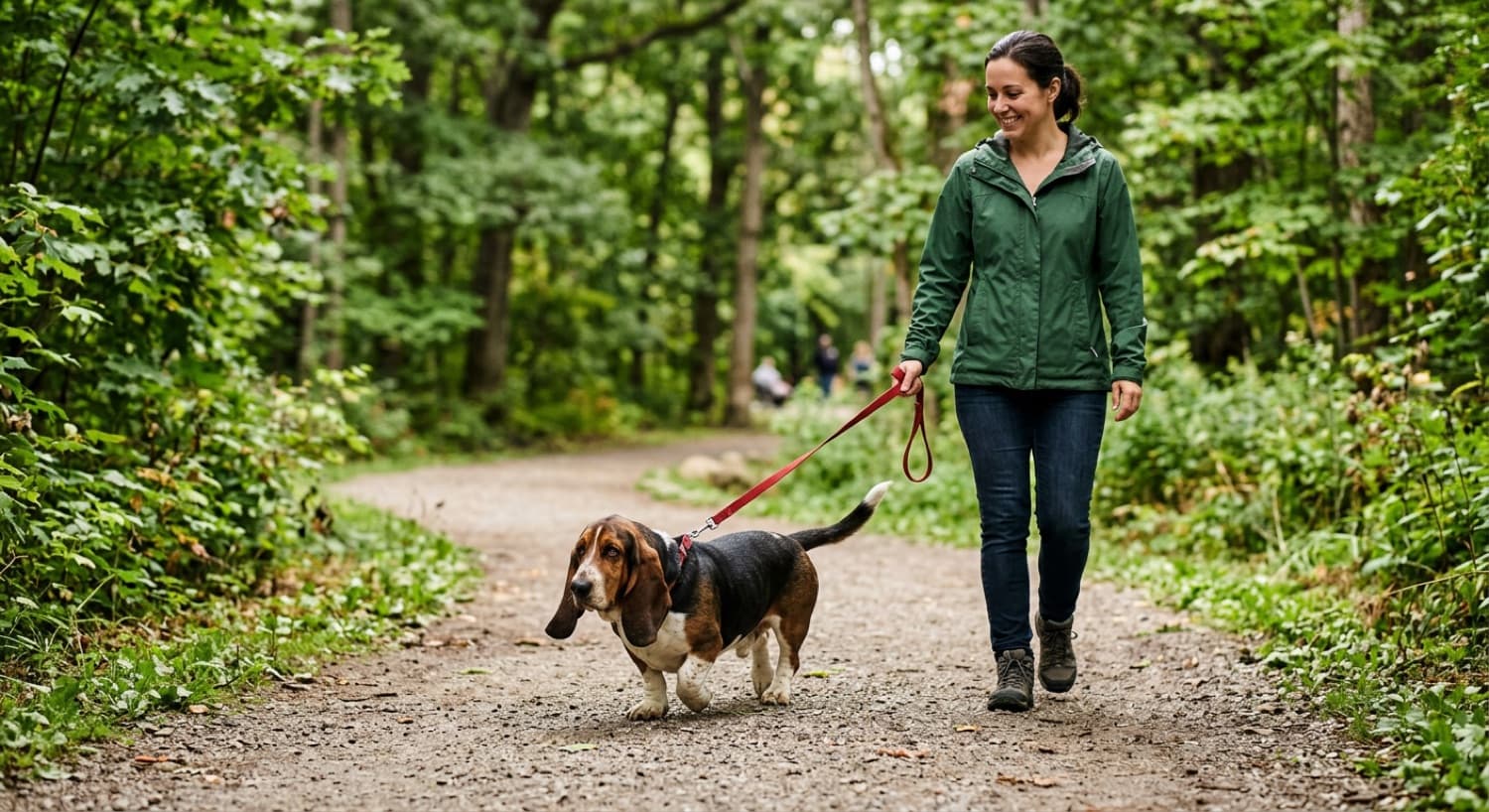
Realistic recall training for a Basset Hound
Recall is trainable. Reliable off-leash recall under fresh scent is not. The training goal for a Basset is to build a solid recall in low-distraction environments and to keep the long-line on for life on trails. Many Edmonton Basset owners reach a good recall in the backyard and an unreliable recall on trails, and that is the realistic outcome. Plan for it.
The basic protocol. Start in zero-distraction environments (indoor room first, then quiet fenced yard). Use a 15 to 30 foot biothane line, a back-clip harness, and very high-value food rewards: real meat, cheese, freeze-dried liver, hot dog cut small. Bassets are food-driven, which is the training lever. Call your dog is name and the recall word once; reward the moment they turn toward you and again when they reach you. Many short reps beat long sessions. Recall should be the most-rewarded behaviour in the dog is daily life.
Graduate distraction levels carefully. Quiet yard, then quiet residential street at off-peak hours, then quiet park, then busier park, then off-leash zone with the long-line still attached. Most Bassets plateau at moderate distraction. Reliable recall under fresh scent arousal is rare; the long-line is doing the safety work that recall cannot. The International Association of Animal Behaviour Consultants (IAABC) publishes evidence-based recall protocols and certifies behaviour consultants who work with scent hounds; for serious recall trouble, an IAABC-certified consultant is the right call.
What does not work. Punishing the dog for not coming. Calling repeatedly when the dog is not coming (this teaches the dog the recall word means nothing). Calling when you cannot enforce on a free Basset. Calling the dog only to leash up and end the fun. Aversive tools (prong collars, e-collars, leash pops) work worse than positive reinforcement with Bassets because the breed is soft-tempered and food-motivated; aversives produce avoidance and shutdown, not better recall. The American Veterinary Society of Animal Behavior (AVSAB) position statements on humane training methodology apply directly here.
Scent work as the productive outlet. Bassets channel scent drive happily into formal nose work, scent detection sport, and home-based hide-and-seek games. A Basset who gets 20 to 30 minutes of structured scent enrichment daily plus 45 to 60 minutes of physical exercise is dramatically less interested in escaping than a bored Basset. Scent work also gives the dog the same dopamine reward as escape tracking, in a controlled setting where the handler holds the reward.
The “I’ve never had a problem” myth
Some Basset owners take the long-line off after a year and report no problems. The dog comes back, the dog stays close, the owner concludes the breed is exaggerated. This pattern holds until it does not. One chase, one rabbit at the wrong moment, one unfamiliar trailhead, and the Basset is in nose-to-ground mode and gone.
The lost-Basset cases that show up in the Lost Pet Edmonton Facebook group are not Bassets with bad owners. They are Bassets with experienced owners who had several off-leash years before the failure event. The genetic load does not weaken with positive history; it is dormant until the right scent triggers it. The failure can come at year one or at year six.
Edmonton makes the consequences worse. A Basset who chases into a residential street risks a vehicle collision. A Basset who chases into a river-valley ravine risks coyote contact. A Basset who crosses an arterial road on a scent trail is at risk for hours until someone catches the dog. The long-line removes the variable. Keep it on.
Multi-Basset and multi-hound households
Pack drive amplifies scent drive. Two Bassets together work scent harder and persist longer than either dog alone. A multi-Basset household needs the same fence specs, the same long-line discipline, and an awareness that one Basset starting to bay or work a trail will pull the other into the same behaviour.
Walks. Two long-lines on two harnesses get tangled. The cleaner setup is a coupler that connects both harnesses to a single double-leash, with each handler-side leash kept separate. Some owners walk multi-Basset households one dog at a time; the time cost is real but the control gain is significant. Inside an off-leash zone the long-lines double the failure surface.
Fences. Two Bassets digging at a fence base is faster than one. Re-inspect the dig-proofing monthly in a multi-Basset household and consider upgrading from chicken wire to paving stones or a concrete trench. The cost difference is small relative to a multi-dog escape recovery.
Lost Basset Edmonton protocol: the first 72 hours
Most Edmonton Basset recoveries happen inside the first 24 to 72 hours when 311, social media, and shelter contacts are activated fast. The cases that drag for weeks are the ones where the owner chased on foot, did not post anywhere, and assumed the dog would come home. Print this list and put it on the fridge before you need it.
First hour
- Do not chase on foot. Bassets read chase as part of the game and continue moving. Stop, breathe, plan.
- Drive in widening circles. Windows down, low speed. Stop at intersections and listen for the bay. The deep sustained bay carries 500 metres or more.
- Call City of Edmonton 311. File a loose-dog report with Edmonton Animal Care and Control.
- Post on Lost Pet Edmonton. The Lost Pet Edmonton Facebook group is highly active. Photo, last sighting location, your phone number, scent direction. Cross-post to neighbourhood Facebook groups and Nextdoor.
- Contact Edmonton Humane Society. Photo, description, microchip number, your phone number.
- If you spot the dog, do not approach fast. Get low, turn sideways, no eye contact, happy voice. Carry high-value food. Bassets will often come close out of curiosity if you do not look threatening.
Hours 2 to 24
- Contact veterinary clinics within 5 km. Strangers often take a found dog to the nearest vet for chip scanning.
- Notify the microchip company. Flag the chip as actively lost and confirm contact details are current.
- Leave scented items at the escape point. Your worn clothes (unwashed) and the dog bed. Some Bassets work scent loops; familiar scent helps.
- Walk likely scent paths. Squirrel and rabbit corridors, river-valley trails, neighbour bird feeders, anywhere with food smells.
- Door-knock the streets near last sighting. A neighbour is back-yard food bowl can stall the dog long enough for you to arrive.
- Carry a slip lead. Many first captures happen because a stranger calls the dog over with food. You need to be able to secure the dog instantly.
Day 2 to 7
- Daily Edmonton Animal Care and Control check. In person or by phone, every day.
- Cross-post posters. Photo, contact info, last sighting, scent direction. Pin to streetlights and notice boards near the likely path.
- Re-walk the area at different times of day. A Basset that hid during daylight may move at dawn.
- Expect the dog to travel farther than your gut says. Start the search radius at 3 km and expand.
In our experience tracking loose-dog cases through the Edmonton rescue and bylaw networks, recoveries happen fastest when 311, social media, and Edmonton Animal Care and Control are all activated within the first hour. The cases that drag past a week are usually the ones with an outdated microchip and an owner who chased on foot for two hours before posting anywhere.
House escapes: front doors, gates, screens, learned latches
Many Edmonton Basset escapes do not start with the fence. They start with the front door during a delivery, the gate left open by a contractor, the screen door bumped open by a kid in summer, or a backyard gate latch that the dog learned to nose open. Bassets learn slower than Beagles at this kind of task but they do learn it.
Front-door management. Install a pressure-mount baby gate or child-safe gate inside the entry so the dog cannot reach the door when it opens. The gate also gives a structure for a place command (a mat or bed near the entry) where the dog learns to wait when guests arrive.
Gate latches. Standard wooden gate hooks can be nosed open by a determined Basset. Upgrade to a key-locked latch, a carabiner-clipped chain, or a coded keypad gate. Add a child-lock or padlock to every backyard gate. Inspect monthly.
Screen doors. Standard screen doors are not Basset-proof. The dog leans the low body weight against the bottom of the screen, the screen pops, and the dog is gone. If you use a screen door in summer, install a heavy-duty pet-resistant screen or keep the inner door closed when the dog is alone in the front room.
Multi-layer thinking. Every escape route deserves two layers: a primary (the latch, the door, the fence) and a backup (the carabiner, the baby gate, the dig-proofing). When the primary fails, the backup catches it. Edmonton Basset owners who have not had an escape are usually owners who have built two layers into every exit point.
Frequently asked questions
Can I let my Basset Hound off-leash in Edmonton?
Almost never in unfenced spaces. Bassets were bred for 5,000 plus years to follow scent independently of a handler, and when the nose locks onto a trail the dog effectively cannot hear you. Edmonton off-leash zones like Terwillegar, Mill Creek Ravine, Hawrelak, Whitemud, and Capilano are all unfenced and all border river-valley corridors that carry fresh rabbit, squirrel, deer, and coyote scent every day of the year. The realistic position: full off-leash for Bassets belongs in fully fenced spaces only (your own dig-proofed yard or a verified fenced facility). On unfenced trails, a 15 to 30 foot biothane long-line clipped to a back-clip harness is the standard for life. Most adult rescue Bassets never reach reliable off-leash status under fresh scent, and that is OK.
How is Basset recall failure different from Beagle or Greyhound?
Three different mechanisms. Beagle recall failure is scent-driven and fast: small frame, persistent pack runner, covers kilometres quickly. Greyhound recall failure is sight-driven and explosive: 45 mph chase that ends 400 metres away before you have moved. Basset recall failure is scent-driven and slow but sustained: the heavy low-slung frame means the Basset will not sprint, but it will track for hours without losing interest. A Basset can leave a Mill Creek trailhead and be 5 kilometres away four hours later, still working the same scent line. The slow pace fools owners into thinking the dog will get tired and come back. Bassets do not stop when they are tired; they stop when the scent runs out.
What fence does a Basset Hound need in Edmonton?
Six feet of solid wood with dig-proofing along the bottom edge. Bassets are not jumpers and never will be (the frame physically cannot clear height), so height is rarely the failure point. The bottom edge is everything. Bassets dig under fences far more often than other scent hounds because the low body puts the nose right at ground level and the front feet are powerful diggers. Bury L-shaped chicken wire 6 inches deep extending 12 inches out into the yard, lay paving stones along the fence base, or pour a concrete trench. Check for gaps under decks and sheds monthly; a Basset will squeeze through any opening 8 inches or wider. Edmonton frost heave shifts soil season to season, so a fence line that was tight in October can have a new gap by March. Inspect after spring thaw.
How does Edmonton snow change Basset scent tracking?
Cold air holds scent particles longer and snow preserves a scent trail at the surface for hours, sometimes overnight. A rabbit that crossed the fence at 7 AM is still a hot trail at noon if the temperature stayed cold. The Basset complication: the low body and short legs mean deep snow physically slows them, which sounds protective but is not. The Basset will not give up; they will work the trail at slower pace for longer. Edmonton lost-Basset cases in winter often resolve farther from the escape point than owners expect because the dog kept moving through conditions that would have stopped a less determined breed. Winter long-line use matters as much as summer use, and a lost-Basset search radius in winter can be wider than your gut tells you.
Why does my Basset Hound ignore me when I call?
Not stubbornness; biology. Bassets carry roughly 220 million olfactory receptors (humans have 5 million), and the part of the brain that processes scent is dramatically enlarged. When a Basset commits to a fresh trail, dopamine reward pathways prioritise pursuit and the recall word does not register against the scent reward. The dog is not choosing to ignore you; it cannot hear you in any practical sense. The fix is mechanical first (a long-line that does not depend on the recall holding under arousal) layered with realistic training (build recall reliability in low-distraction environments, graduate distractions slowly, accept that recall under fresh scent arousal may never reach 100 percent). Reward heavily on every successful recall. Punishment makes the problem worse because the dog learns the recall word predicts being grabbed at the end of fun.
How do I find a lost Basset Hound in Edmonton?
Move fast and layer your search. Do not chase on foot (Bassets bay when pursued and the sound carries, but chase reads as a game). Call City of Edmonton 311 to file a loose-dog report with Edmonton Animal Care and Control. Post photo, last-sighting, and your phone number to the Lost Pet Edmonton Facebook group immediately. Contact Edmonton Humane Society lost-and-found. Within 24 hours, contact veterinary clinics within a 5 km radius. Walk likely scent corridors: river-valley trails, neighbour bird feeders, anywhere with food smells. Leave the dog bed and your worn clothes at the escape point. The Basset advantage is the bay: when the dog vocalises on scent, the sound carries hundreds of metres on still air and neighbours often phone in the sound. Listen carefully at intersections. Most Edmonton Basset recoveries happen inside 24 to 72 hours when 311, social media, and shelter contacts are activated in the first hour.
Does the Basset bay help recover a lost dog?
Yes, in a way no other breed offers. The Basset trail call is a deep sustained bay developed to signal pack position over long distances in dense terrain. The sound carries 500 metres or more on still air, and neighbours unfamiliar with the breed often phone the City of Edmonton 311 line to report it. A lost Basset who picks up a scent in a suburban neighbourhood will bay; that bay is your single best directional signal. Drive in widening circles from last-sighting with the windows down at low speed. Stop, turn off the engine, listen. The bay also helps strangers identify a found Basset as someone is missing it (a quiet Basset is less obviously a lost dog). The audible escape is one of the few things that works in the Basset owner is favour.
Can I train recall on a Basset Hound at all?
Yes, recall is trainable; it is just not reliably trainable to off-leash standard under fresh scent. Build in zero-distraction environments first (indoor room, then quiet fenced yard) using a 15 to 30 foot biothane long-line and very high-value food (real meat, cheese, freeze-dried liver). Bassets are food-driven, which is the training lever. Call your dog is name and the recall word once; reward the moment they turn toward you and again when they reach you. Many short reps beat long sessions. Graduate distraction levels slowly and expect plateaus. Many Bassets reach solid recall in low-distraction environments but never fully reliable recall under fresh scent. That is fine because the long-line is doing the safety work. The CCPDT publishes evidence-based recall protocols that apply to scent hounds.
What about the senior Basset off-leash question?
Stamina declines but scent drive holds. A nine-year-old Basset with arthritis and a slower walking pace still has the same olfactory hardware as a two-year-old and will still commit to a scent if one runs through the yard. The body cannot back the impulse the way it could at three, but the dog can still travel several blocks before exhaustion overtakes the trail. Senior Bassets fall into another trap: owners assume the older dog is calmer and lower the management, and a single rabbit at the fence proves them wrong. Keep the long-line and the dig-proofed fence in place for life. The Basset community consensus is the rules do not relax with age; they get reinforced with secondary mobility issues if the dog runs hard during a chase.
How dangerous are Edmonton coyotes to a loose Basset?
Real concern. Edmonton has established urban coyote populations that travel through Whitemud Ravine, Mill Creek, the Hawrelak south slope, and the Terwillegar perimeter daily, especially at dawn and dusk. A scent-driven Basset who follows a trail into a ravine can encounter a single coyote or a pack within minutes. Bassets are size-vulnerable in coyote encounters: most Bassets are 40 to 65 lbs but the low slow frame and limited evasion ability put them at higher risk than a same-weight athletic breed. Spring through early summer (April through July, pup-rearing season) is the highest-risk window for territorial defence. Winter coyotes are food-stressed and more willing to engage. This is one of several reasons an Edmonton Basset escape is a same-hour emergency. Activate the recovery protocol the moment the dog is loose.
How do I keep my Basset from bolting through the front door?
Two mechanical fixes plus a training fix. Install a pressure-mount baby gate or child-safe gate inside the entry so the dog physically cannot reach the door when it opens for deliveries, plumbers, or guests. Add a house-line (a 6 foot leash left attached to the harness and tied off to a fixed point near the entry) when guests are expected so a slip past the gate is still caught. Teach a place command on a mat away from the door and reward calm stays during practice door openings. Many Edmonton Basset escapes happen during delivery handoffs, dog-walker pickups, and contractor arrivals. The mechanical gate fix works on day one; the training fix takes months. Use both.
More Edmonton Basset Hound guides
Edmonton Adoptable Dogs →
Current Basset and Basset-mix listings from Edmonton rescues, with foster-tested escape and fence notes.
Basset Hound Adoption Edmonton →
Edmonton rescue routes for Bassets, real adoption costs, surrender patterns, and the breed-vs-buy reframe.
Basset Hound Health Issues: Back, Ears, Bloat →
Basset Hound health issues to plan for: back disease (IVDD), weight, ear infections, glaucoma and bloat, and what to ask your vet in your first month.
Basset Ear Care Edmonton →
Weekly cleaning routine, infection prevention, the long-ear winter protocol, and when to see the vet.
New dog? Start with these care guides
Everything a new adopter needs to set up a safe, happy home.