The short answer
A healthy adult Husky thrives in Winnipeg cold that would be dangerous for most breeds, so the winter cold itself is rarely the problem. The real danger is the escape and roam drive: a loose Husky travels fast, crosses roads in poor winter visibility, and can meet coyotes along the Assiniboine and Red River corridors. The single most important thing is a fence the dog cannot dig under, climb over, or push through, plus a firm rule that the dog stays leashed or long-lined in any unfenced space. Skip the coat for a well-conditioned adult, but never skip the paw care or the fence.
The cold is not the danger. The escape is. A Husky that gets loose in a Winnipeg winter faces roads in low visibility, coyotes near the rivers, and a long distance from home before you notice. Secure six-foot fencing and a leash-or-long-line rule in unfenced spaces are non-negotiable for this breed. That, not a coat, is what keeps a Husky safe here.
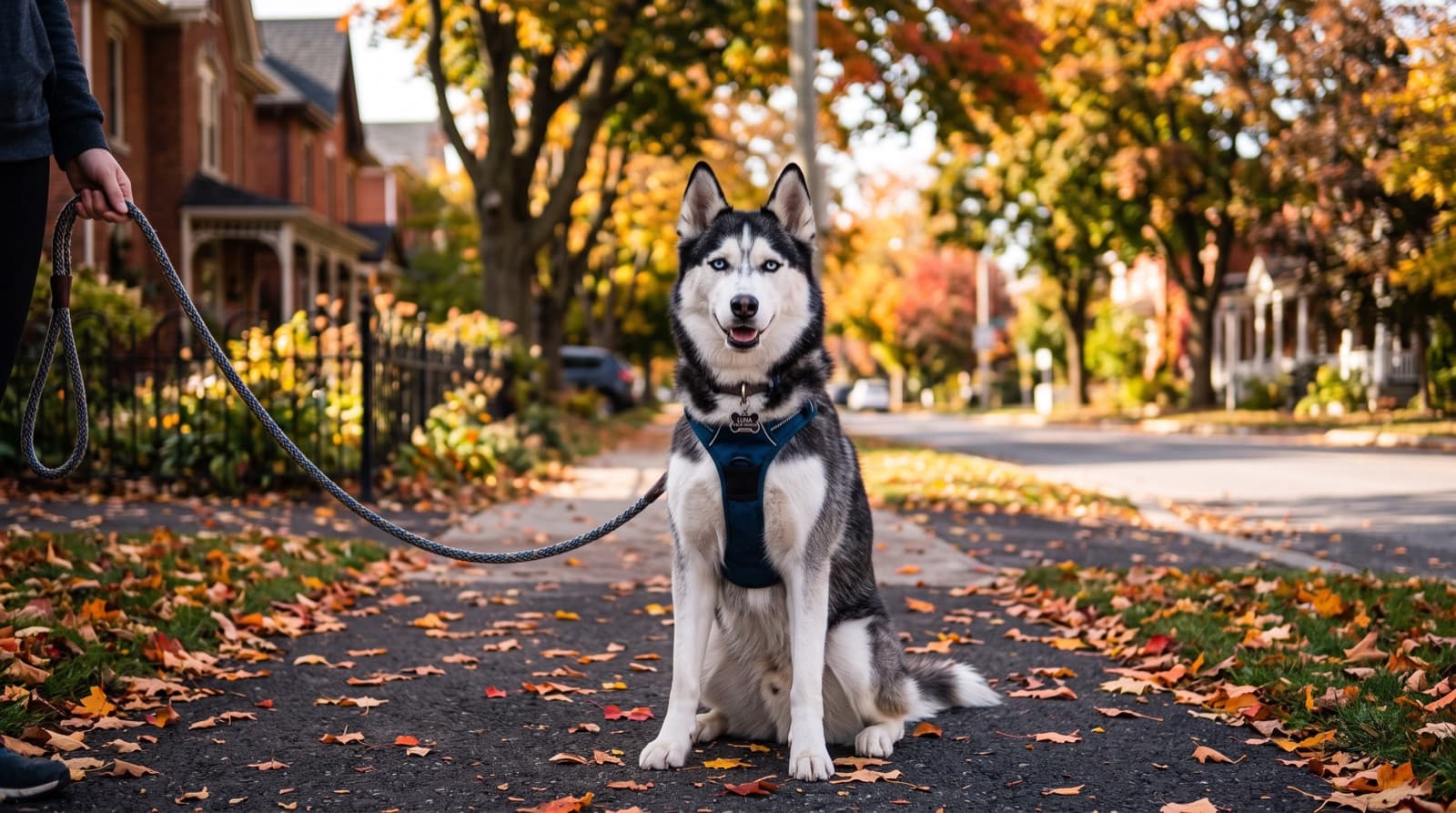
Built for a Winterpeg cold snap
Winnipeg is one of the coldest large cities on earth. Five to six months of sealed-home weather, regular minus 30 nights, and windchill that can hit minus 40, with no chinook relief like Calgary gets. For most breeds this is a season to survive. For a Husky, it is the environment the whole dog was built for.
The Husky double coat is a dense, insulating undercoat under a weather-resistant outer coat, developed over centuries as a sled dog in the Arctic. A healthy, well-conditioned adult Husky is comfortable running and playing in Winnipeg cold that would put a short-coat dog at real risk of frostbite and hypothermia. This is a genuine gift for a Manitoba owner: you have one of the few dogs that can happily be active outdoors through the depths of a prairie winter, and activities like skijoring exist precisely because Huskies love to pull and run in the cold.
That said, cold tolerance is not unlimited. Even a Husky feels the difference in an extreme cold warning, and frostbite can still touch the thinly-furred ear tips, nose, and paw pads no matter how thick the body coat is. Puppies, seniors, thin dogs, and a Husky newly arrived from a warmer foster all have lower limits than a conditioned adult. Watch the individual dog and use windchill, not the thermometer, as your guide.
Why escape, not cold, is the winter danger
Here is the part that catches new Husky owners off guard. You spend the fall worrying about whether your dog will be warm enough, and then the actual winter emergency is a gate left ajar. Huskies were bred to run long distances and carry a strong drive to roam, and they are expert escape artists: they dig under fences, climb over them, and bolt through an opening gate.
A loose Husky does not stay near home. It travels, and in a Winnipeg winter that means crossing roads in the low visibility of blowing snow and early darkness, running onto uncertain river ice, and encountering the coyotes that frequent the Assiniboine and Red River corridors, more active and food-stressed in winter. The cold rarely harms a Husky. Getting hit, getting lost in a storm, or getting into trouble while roaming is the real risk, and it is entirely preventable with containment.
This is why we tell every Manitoba Husky adopter the same thing: the most important purchase is not a coat, it is a fence the dog cannot beat, backed by a firm rule that the dog is leashed or long-lined any time it is in an unfenced space.
Building a fence a Husky cannot beat
A standard residential fence on a St. Vital, Transcona, or Charleswood yard is not a Husky-proof fence, and field fencing on a Headingley, Oak Bluff, or Selkirk acreage is even easier to defeat. To actually contain a Husky:
- Go solid and tall. Aim for a six-foot solid fence. A Husky climbs chain-link like a ladder.
- Address the bottom. Huskies dig out as readily as they climb over. Bury the base, add a concrete or paver footing, or install an L-shaped wire skirt that turns inward underground.
- Secure the gate. A Husky learns to nose or push a latch. Use a secure, self-latching gate, and consider a spring or double latch.
- Consider the top. An inward-angled top or a coyote-roller bar stops a determined climber.
- Supervise anyway. A Husky is a problem-solver. Good fencing plus supervision beats fencing alone.
If secure fencing is not possible where you live, the honest answer is that the dog stays leashed or long-lined outdoors, full stop. That is the real cost of Husky ownership, and it is worth knowing before you adopt rather than after the first escape.
Browse adoptable Huskies in Winnipeg
A foster home can tell you how strong a specific Husky's escape drive and recall are before you commit. See which Winnipeg Huskies are available now.
See Available Huskies →Recall, coyotes, and the rivers
Huskies have unreliable recall by nature. A Husky that catches a scent or spots something to chase will run, and it will not hear you. Winter makes this worse: ice underfoot means a dog cannot stop or turn, early darkness cuts visibility, and the coyotes along the river corridors are at their most active. An off-leash Husky on an open trail in a Winnipeg winter is a lost-dog story in the making.
The safe way to give a Husky a real run is a securely fenced off-leash area, or a long-line on a maintained path where the dog has freedom without the ability to bolt. Never trust a Husky off-leash near the Assiniboine or Red River in any season. A Husky may chase or follow a coyote, and that rarely ends well. Our Winnipeg off-leash parks guide notes which areas are fenced and which are open.
The American Kennel Club is blunt about the breed's need for secure containment, and it is one of the most consistent pieces of advice you will hear from anyone who has lived with a Husky.
Paw care and winter exercise
Cold tolerance does not exempt a Husky from paw care. Winnipeg salts and sands heavily, and salt cracks pads, stings, and irritates when licked off, while ice balls form in the hair between the toes. Apply a paw balm or musher's wax before walks, consider booties, and rinse and dry the paws afterward. Trim the hair between the pads before winter so ice cannot ball up and cut the skin.
On exercise, use the season to your advantage. On a normal winter day, a Husky can get a real, hard run in cold that sidelines other dogs, and a tired Husky is a less destructive, less escape-prone Husky. During an extreme cold warning, even a Husky's outings shorten, and indoor enrichment (scent games, puzzle feeders, training, a frozen Kong) does the work. For the full cold-weather playbook that applies to every Winnipeg dog, see our Winnipeg winter dog care guide, and the American Veterinary Medical Association has solid cold-weather safety guidance.
Frequently asked questions
Can Huskies stay outside in Winnipeg winter?
For extended play and exercise, yes, more than almost any other breed, but "can tolerate the cold" is not the same as "should live outdoors." The Husky double coat is genuinely built for deep cold, and a healthy adult Husky is comfortable running and playing in Winnipeg temperatures that would be dangerous for a short-coat dog. That is a real gift for exercise. But Huskies are social dogs that need to be part of the family, and even a cold-hardy dog needs a warm, dry, wind-sheltered place, unlimited access indoors on the worst nights, fresh unfrozen water, and monitoring. An extreme cold warning still shortens outings even for a Husky, and puppies, seniors, or a thin dog off a transport need more protection than a conditioned adult. Cold tolerance is not permission to leave a dog outside unattended in a prairie deep freeze.
What temperature is too cold for a Husky?
Higher than most people assume, but there is still a limit. A healthy, well-conditioned adult Husky handles typical Winnipeg winter temperatures, including the minus 20s and colder, better than nearly any breed, and often genuinely enjoys them. Where even a Husky needs shortened outings is in an extreme cold warning, when windchill drives into the minus 30s and minus 40s, because frostbite on the thinly-furred extremities (ear tips, nose, paw pads) does not care how thick the body coat is. Watch the individual dog: if a Husky starts lifting paws, whining, or wanting to head in, listen. Puppies, seniors, thin dogs, and dogs newly arrived from a milder foster all have lower limits than a conditioned adult. Use windchill, not air temperature, as your guide.
Do Huskies need a coat in Winnipeg?
A healthy adult Husky generally does not, and this is one of the few breeds that truly does not need one at normal winter temperatures, because the double coat is doing the job a coat would do for another dog. Forcing a coat onto a well-coated adult Husky can even cause overheating during active exercise. The exceptions matter, though: a Husky puppy, a senior, a thin or underweight dog, or a dog just arrived from a warmer foster with no winter conditioning may benefit from a coat in the deep freeze, and the rescue can advise. And regardless of coat, every Husky needs paw protection from road salt and ice, and shelter from wind on the coldest days. When in doubt about a specific dog, ask your vet.
Why is escaping the real Husky winter danger?
Because a Husky that gets loose in a Winnipeg winter combines the breed's biggest flaw with the harshest conditions. Huskies were bred to run long distances and have a strong drive to roam, and they dig under, climb over, and bolt through fences and gates. A loose Husky does not circle the block, it travels, and in winter that means crossing roads in low visibility, encountering coyotes along the Assiniboine and Red River corridors, and being far from home fast. The cold itself is not what usually harms a Husky. Getting hit, getting lost, or getting into trouble while roaming is. That is why the single most important thing for a Winnipeg Husky owner is not a coat, it is a fence the dog cannot beat and a firm rule that the dog stays leashed or long-lined in any unfenced space.
How do I build a Husky-proof fence?
Plan for a dog that digs, climbs, and jumps, because a standard residential fence stops none of those. Aim for a solid six-foot fence, and address the bottom, because Huskies dig out as readily as they climb over: bury the base or add a concrete or paver footing or an L-shaped wire skirt that turns inward underground so the dog cannot tunnel under. Watch the gate, since a Husky learns to nose or push a latch, so use a secure, self-latching gate and consider a spring or double latch. Some owners add a coyote-roller or an inward-angled top to stop climbing. Even with good fencing, supervise, because a determined Husky is a problem-solver. If secure fencing is not possible where you live, the honest answer is that the dog stays leashed or long-lined outdoors, full stop. This is the real cost of Husky ownership, not the adoption fee.
Can I let my Husky off-leash in winter?
Only in a securely fenced space, and off-leash on an open trail is a genuine risk with this breed year-round, worse in winter. Huskies have unreliable recall by nature, and a Husky that catches a scent or spots something to chase will run, ignoring your call. Add winter ice, which means a dog cannot stop or turn, plus early darkness and coyote presence along the rivers, and an open-trail off-leash Husky in a Winnipeg winter is a lost-dog story waiting to happen. The safe way to give a Husky a real run is a securely fenced off-leash area or a long-line on a maintained path. Our Winnipeg off-leash parks guide covers which spaces are fenced and which are open. Never trust a Husky off-leash near the Assiniboine or Red River, in any season.
Are coyotes a real risk to Huskies in Winnipeg?
Yes, particularly in winter and particularly along the river corridors. The Assiniboine and Red River paths, and the green spaces near them, carry a real coyote presence, and coyotes are more active and more food-stressed in winter when prey is thin. A loose or off-leash Husky near either river is exactly the scenario to avoid: a Husky may chase or confront a coyote, or be drawn into following one, and either can end badly. Keep your Husky leashed near the rivers and in coyote-frequented green space, do not let it roam at dawn or dusk when coyotes are most active, and never leave food or attractants that draw wildlife into your yard. This is one more reason the leash-or-secure-fence rule is not negotiable for this breed in Winnipeg.
How do I protect my Husky's paws in winter?
Even a cold-hardy Husky has vulnerable paw pads. Road salt and ice-melt crack the pads and sting, and ice balls form in the hair between the toes. Three defences handle most of it: apply a paw balm or musher's wax before walks to create a barrier, consider booties (which solve the salt problem completely, though many dogs need time to accept them), and rinse the paws with lukewarm water after a walk, drying between the toes. Trim the long hair between the pads before winter so ice balls cannot form and cut the skin. Check the paws after every walk for cracks or redness. This is the same paw care every Winnipeg dog needs, and it applies to Huskies too despite their cold tolerance.
Does a Husky still need exercise in a Winnipeg cold snap?
Yes, and this is actually where a Husky has an advantage: on a normal winter day a Husky can get real outdoor exercise in cold that would be too much for other breeds. That is a gift, because a tired Husky is a less destructive, less escape-prone Husky. During an extreme cold warning, though, even a Husky's outings get shortened, and that is where indoor enrichment carries the load: scent games, puzzle feeders, training sessions, and a frozen stuffed Kong all tire a Husky's mind. A Husky that is under-exercised through a long cold snap will channel that energy into digging out, chewing, and howling. So use the good winter days for real running in a fenced space, and lean on indoor work during the deep-freeze stretches. Our winter dog care guide has the full indoor-exercise playbook.
Is a Husky a good choice for a Winnipeg winter specifically?
For the winter, a Husky is arguably the best-suited breed there is, and if cold-weather compatibility were the only factor, it would be an easy yes. The double coat means you have a dog that genuinely thrives in the season that keeps most breeds indoors, and a Husky owner can enjoy long winter runs and activities like skijoring that few other dogs handle. But winter fitness is only one piece. The escape drive, unreliable recall, high exercise needs, prey drive, and vocalisation do not disappear because the dog handles cold well, and those are what put Huskies in rescue. So a Husky is a wonderful winter dog for the owner who can also meet the fencing, exercise, and management the breed demands year-round. Read our full Husky adoption guide before deciding, so the winter appeal does not talk you past the rest of the reality.
Related Winnipeg guides
Husky Adoption Winnipeg
Rescues, real costs, escape risk, and the full breed reality.
Husky Health Issues: Eyes, Skin, Thyroid
Siberian Husky health issues to plan for: juvenile cataracts, corneal dystrophy and PRA, zinc-responsive skin disease, hypothyroidism, epilepsy and degenerative myelopathy.
Winnipeg Winter Dog Care
Windchill thresholds, frostbite, paw care, and indoor exercise.
Adoptable Winnipeg Huskies
Every available Husky and Husky cross across Manitoba rescues.
New dog? Start with these care guides
Everything a new adopter needs to set up a safe, happy home.